"Wet again"
Benachbarte Sets (30)Alle Zusammenhänge anzeigen
Diese Sets wurden den gleichen Sets hinzugefügt wie das ausgewählte Set.
30 Inhalte
- Seite 1 von 3
TOWER POWER
Name that can easily go onto 2 lines
Author that can easily go onto 2 lines as well
- Titel
- TOWER POWER
- Autor/in
- Beschreibung (de)
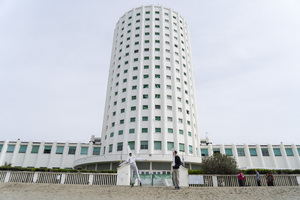
- TOWER POWER ist ein szenischer Kurzessay zur architektonischen Formensprache und Symbolik des Torre Fiat in Marina di Massa, Italien - einem Turm aus der Zeit des italienischen Faschismus und Ausstellungsort des POST-COLONIA Festivals of Architecture and Imaginaries in Transition, für das die Arbeit entwickelt wurde.
Als in Architektur materialisierte Ideologie steht der Turm scheinbar unausweichlich für eine lineare, gewaltvolle Erzählung von Geschichte. Mithilfe von Ursula K. Le Guins „Carrier Bag Theory of Fiction“ (1986) befragt TOWER POWER die dem Turm eingeschriebenen Narrative und den Umgang mit einem derart aufgeladenen baulichen Erbe:
"Are we in an airplane? A column? A ‚fascio littorio‘? What would each scenario mean? […] It’s just a building, right?" (deutsche Übersetzung: "Sitzen wir in einem Flugzeug? Einer Säule? Einem „Fascio Littorio“? Was würde das jeweils bedeuten? […] Es ist doch nur ein Gebäude, oder?")
- TOWER POWER ist ein szenischer Kurzessay zur architektonischen Formensprache und Symbolik des Torre Fiat in Marina di Massa, Italien - einem Turm aus der Zeit des italienischen Faschismus und Ausstellungsort des POST-COLONIA Festivals of Architecture and Imaginaries in Transition, für das die Arbeit entwickelt wurde.
- Beschreibung (en)
- TOWER POWER is a short performative essay, investigating the formal language and architectural symbolism of the Torre Fiat in Marina di Massa, Italy - a tower built during the Italian Fascist era, and the venue of POST-COLONIA Festival of Architecture and Imaginaries in Transition we had been invited to explore and exhibit in.
Steeped in ideology, the tower’s architecture inescapably seems to stand for a linear, violent historiography. TOWER POWER investigates the narratives inscribed into the tower through the lens of Ursula K. Le Guin’s Carrier Bag Theory of Fiction and poses questions on how to deal with such a charged architectural legacy:
"Are we in an airplane? A column? A ‚fascio littorio‘? What would each scenario mean? […] It’s just a building, right?"
- TOWER POWER is a short performative essay, investigating the formal language and architectural symbolism of the Torre Fiat in Marina di Massa, Italy - a tower built during the Italian Fascist era, and the venue of POST-COLONIA Festival of Architecture and Imaginaries in Transition we had been invited to explore and exhibit in.
- Kategorie
- Typ des Projekts/Werks
- Schlagworte
- Datierung
- 2025
- Mitwirkende
- Dank an
- Sprache
- Titel
- TOWER POWER
- Projektleiter/in
- Semester
- Studiengang
- Importiert am
- 27.06.2025
- Übergeordnete Sets
- 0
- Set enthält
- 0 7
Vakna
Name that can easily go onto 2 lines
Author that can easily go onto 2 lines as well
- Titel
- Vakna
- Titel (en)
- Vakna
- Untertitel
- Der menschliche Körper. Das Wiederentdecken. Das Akzeptieren. Das Erwachen
- Autor/in
- Beschreibung (de)
- Der menschliche Körper.
Das Wiederentdecken.
Das Akzeptieren.
Das Erwachen.
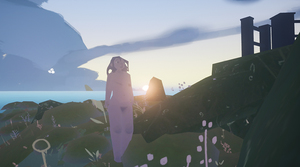
Diese Gedanken sind der Beginn des Spiels Vakna, einer Gedankenwelt, die sich mit der Wahrnehmung und der Akzeptanz des unbekleideten menschlichen Körpers befasst und dadurch gesellschaftliche Einflüsse hinterfragt.
In dieser Gedankenwelt ist es dem/der Spieler/in möglich durch auffindbare Fragen und Aussagen mehr über sich selbst, die eigene Wahrnehmung, das eigene Verhalten, die eigene Moral und die eigenen rituellen Gedankengänge den menschlichen Körper betreffend herauszufinden.
Die Gedankenwelt Vakna erwacht gemeinsam mit der spielenden Person, welche vielleicht beginnt die eigene Wahrnehmung, das eigene Verhalten, die eigene Moral und die eigenen rituellen Gedankengänge den menschlichen Körper betreffend zu hinterfragen, für sich selbst und gegenüber anderen Menschen neu zu ordnen oder zu verändern.
Am Ende dieses Spiels hat jede Person für sich selbst zu entscheiden, ob das Wiedererwachen des Körpers und damit verbundene „Neu-Erleben“ der Welt ausprobiert oder gelebt werden möchte.
Auch sind die Fragen zu beantworten, wie mit der neugewonnen Akzeptanz und Wiederentdeckung umzugehen ist. Doch hat die spielende Person bei dieser Entscheidung sich nicht dem Spiel gegenüber zu verantworten, sondern sich selbst und den Mitmenschen der Gesellschaft.
Bei diesem Computerspiel handelt es sich um einen Single-Player im Bereich der Serious- und Educational-Games, das mit Tastatur und Maus gespielt werden kann.
- Der menschliche Körper.
- Beschreibung (en)
- The human Body.
The Rediscovery.
The Accepting.
The Awakening.
These thoughts are the beginning of the game Vakna, a world of thoughts that deals with the perception and acceptance of the human body without clothes, thereby questioning social influences.
In this world of thoughts it is possible for the player to find out more about himself, his own perception, his own behavior, his own morality and his own ritual thoughts concerning the human body through discoverable questions and statements.
Vakna awakens together with the player. The player begins to question the own perception, the own behavior, the own morality and the own ritual thought processes concerning the human body and perhaps to rearrange or change them for themselves and for other people.
At the end of this game, each person has to decide for himself whether the body's reawakening and the „re-experiencing“ of the world would be tried out or lived.
Also, the questions to be answered are how to deal with the newly gained acceptance and rediscovery. But in this decision, the player does not have to answer to the game, but to himself and the fellow human beings of society.
This computer game is a single player in the field of serious and educational games that can be played with a keyboard and a mouse.
- The human Body.
- Typ des Projekts/Werks
- Schlagworte
- Datierung
- 21.11.2018
- Mitwirkende
- Sprache
- Material
- Technik/Verfahren/Formate
- Computerspiel für Windows
- Abmessungen
- 3D
- Ort
- Hochschule für Gestaltung Karlsruhe
- Stadt
- Land
- Internetlinks
- Titel
- Vakna
- Importiert am
- 16.11.2018
- Übergeordnete Sets
- 1
- Set enthält
- 1 21
Wavebreaker
Name that can easily go onto 2 lines
Author that can easily go onto 2 lines as well
- Titel
- Wavebreaker
- Titel (en)
- Wavebreaker
- Untertitel
- Schallabsorbierende Fliesen
- Untertitel des Projekts/Werks (en)
- Sound absorbing tiles
- Autor/in
- Beschreibung (de)
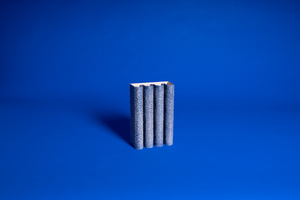
- Wavebreaker ist ein modulares Fliesensystem, das entwickelt wurde, um Lärm in U-Bahn-Stationen wirksam zu reduzieren und die Aufenthaltsqualität spürbar zu verbessern. Die aus robuster Keramik gefertigten Fliesen werden im 3D-Druckverfahren hergestellt und lassen sich dadurch flexibel an verschiedene räumliche Situationen anpassen. Ihre Form orientiert sich an Schallwellen, wodurch sie nicht nur akustisch, sondern auch visuell zur Beruhigung des Raumes beitragen. Unterstützt wird dieser Effekt durch eine blaue Glasur, welche die ruhige Wirkung zusätzlich verstärkt.
Die schallabsorbierende Wirkung entsteht durch integrierte Helmholtz-Resonatoren und Schalldiffusoren, welche gezielt bestimmte Frequenzen aufnehmen, ohne dass poröse Materialien notwendig sind. Dies geschieht, indem der Schall in kleine Schlitze der Fliese eindringt und im Inneren in Hohlkammern resoniert und somit gedämpft wird. So wird der Umgebungslärm effektiv verringert, was zu einer entspannteren Atmosphäre im oft hektischen U-Bahn-Alltag führt. Dank ihres modularen und anpassungsfähigen Aufbaus eignen sich die Fliesen sowohl für Neubauten als auch für die Nachrüstung bestehender Stationen.
- Wavebreaker ist ein modulares Fliesensystem, das entwickelt wurde, um Lärm in U-Bahn-Stationen wirksam zu reduzieren und die Aufenthaltsqualität spürbar zu verbessern. Die aus robuster Keramik gefertigten Fliesen werden im 3D-Druckverfahren hergestellt und lassen sich dadurch flexibel an verschiedene räumliche Situationen anpassen. Ihre Form orientiert sich an Schallwellen, wodurch sie nicht nur akustisch, sondern auch visuell zur Beruhigung des Raumes beitragen. Unterstützt wird dieser Effekt durch eine blaue Glasur, welche die ruhige Wirkung zusätzlich verstärkt.
- Beschreibung (en)
- Wavebreaker is a modular tile system designed to effectively reduce noise in subway stations and noticeably improve the quality of stay. The tiles are made of durable ceramic and produced using 3D printing, which allows them to be flexibly adapted to different spatial conditions. Their shape is inspired by sound waves, helping to calm the environment not only acoustically but also visually. This effect is further supported by a blue glaze, which enhances the overall sense of calm.
The sound-absorbing effect is achieved through integrated Helmholtz resonators and sound diffusers, which target and absorb specific frequencies without the need for porous materials. This happens as sound enters small slits in the tile and resonates within internal cavities, where it is effectively dampened. As a result, ambient noise is significantly reduced, leading to a more relaxed atmosphere in the often hectic environment of subway stations. Thanks to their modular structure, the tiles are suitable for both new constructions and the retrofitting of existing stations.
- Wavebreaker is a modular tile system designed to effectively reduce noise in subway stations and noticeably improve the quality of stay. The tiles are made of durable ceramic and produced using 3D printing, which allows them to be flexibly adapted to different spatial conditions. Their shape is inspired by sound waves, helping to calm the environment not only acoustically but also visually. This effect is further supported by a blue glaze, which enhances the overall sense of calm.
- Kategorie
- Typ des Projekts/Werks
- Schlagworte
- Datierung
- 2024
- Dank an
- Material
- Technik/Verfahren/Formate
- Keramik 3D-Druck
- Abmessungen
- 15cm x 25cm x 5cm
- Ort: Institution
- Stadt
- Land
- Titel
- Wavebreaker
- Projektleiter/in
- Semester
- Studiengang
- Importiert am
- 26.06.2025
- Übergeordnete Sets
- 1
- Set enthält
- 0 16
Well, don't you do wellness?
- Titel
- Well, don't you do wellness?
- Titel (en)
- Well, don't you do wellness?
- Autor/in
- Beschreibung (de)
- Das Projekt "Well, don’t you do Wellness?" untersucht Wellness als Spannungsfeld zwischen Selbstoptimierung und Widerstand. Es fragt, was Wohlbefinden bedeutet, wenn Erholung zur gesellschaftlichen Pflicht geworden ist, und wie Körper und Stimme zu Werkzeugen der Selbstermächtigung werden können.
"Well, don’t you do Wellness?" versteht Wohlbefinden als politische, kollektive Praxis und skizziert Möglichkeiten, Körper, Stimme und Sorgearbeit jenseits von Optimierung zu denken.
Ausgangspunkt der Arbeit ist die Beschäftigung mit Badekultur, feministischen Handarbeitstechniken und historischen Formen der kollektiven Selbstfürsorge. Dabei greift das Projekt auf textile und therapeutische Methoden zurück, wie sie in Gesundheitsbewegungen, psychiatrischen Einrichtungen sowie in feministischen Kontexten entstanden sind – als Ausdruck kollektiver Fürsorge und Widerständigkeit.
- Das Projekt "Well, don’t you do Wellness?" untersucht Wellness als Spannungsfeld zwischen Selbstoptimierung und Widerstand. Es fragt, was Wohlbefinden bedeutet, wenn Erholung zur gesellschaftlichen Pflicht geworden ist, und wie Körper und Stimme zu Werkzeugen der Selbstermächtigung werden können.
- Beschreibung (en)
- The project 'Well, don't you do wellness?' considers wellness as an area of tension between self-optimisation and resistance. Considering what well-being means when wellness has become a social obligation, it explores how the body and voice can be used as tools of agency.
The project understands well-being as a political, collective practice and outlines possibilities for rethinking the body beyond optimisation.
The research begins with an examination of bathing culture, feminist craft techniques, and historical forms of (collective) self-care. Drawing on textile and therapeutic methods that emerged in health movements, psychiatric institutions and feminist contexts, the project presents these as expressions of care and resistance.
- The project 'Well, don't you do wellness?' considers wellness as an area of tension between self-optimisation and resistance. Considering what well-being means when wellness has become a social obligation, it explores how the body and voice can be used as tools of agency.
- Kategorie
- Typ des Projekts/Werks
- Schlagworte
- Datierung
- 2025
- Mitwirkende
- Dank an
- Material
- Ort: Institution
- Stadt
- Titel
- Well, don't you do wellness?
- Projektleiter/in
- Studiengang
- Typ der Abschlussarbeit
- Importiert am
- 14.09.2025
- Übergeordnete Sets
- 0
- Set enthält
- 0 0
WHERE LEGENDS ARE MADE AND LIES ARE TOLD
Name that can easily go onto 2 lines
Author that can easily go onto 2 lines as well
- Titel
- WHERE LEGENDS ARE MADE AND LIES ARE TOLD
- Autor/in
- Beschreibung (de)
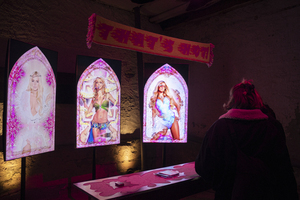
- WHERE LEGENDS ARE MADE AND LIES ARE TOLD (graduation project). Originated by this divine union of @parishilton @britneyspears @lindsaylohan (aka the Holy Trinity <3) the night of the infamous Bimbo Summit, WLAMALAT is the visual and critical translation of my obsession for the #y2k it-girls and #popculture in general. Mixing a religious with a highly commercial aesthetic, the project questions several topics such as women representation in the mass media, visual/celebrity culture consumption and new belief systems.
- WHERE LEGENDS ARE MADE AND LIES ARE TOLD (graduation project). Originated by this divine union of @parishilton @britneyspears @lindsaylohan (aka the Holy Trinity <3) the night of the infamous Bimbo Summit, WLAMALAT is the visual and critical translation of my obsession for the #y2k it-girls and #popculture in general. Mixing a religious with a highly commercial aesthetic, the project questions several topics such as women representation in the mass media, visual/celebrity culture consumption and new belief systems.
- Beschreibung (en)
- WHERE LEGENDS ARE MADE AND LIES ARE TOLD (graduation project). Originated by this divine union of @parishilton @britneyspears @lindsaylohan (aka the Holy Trinity <3) the night of the infamous Bimbo Summit, WLAMALAT is the visual and critical translation of my obsession for the #y2k it-girls and #popculture in general. Mixing a religious with a highly commercial aesthetic, the project questions several topics such as women representation in the mass media, visual/celebrity culture consumption and new belief systems.
- WHERE LEGENDS ARE MADE AND LIES ARE TOLD (graduation project). Originated by this divine union of @parishilton @britneyspears @lindsaylohan (aka the Holy Trinity <3) the night of the infamous Bimbo Summit, WLAMALAT is the visual and critical translation of my obsession for the #y2k it-girls and #popculture in general. Mixing a religious with a highly commercial aesthetic, the project questions several topics such as women representation in the mass media, visual/celebrity culture consumption and new belief systems.
- Kategorie
- Typ des Projekts/Werks
- Datierung
- 06.12.23
- Dank an
- Ort
- Rudolf 5
- Titel
- WHERE LEGENDS ARE MADE AND LIES ARE TOLD
- Projektleiter/in
- Semester
- Studiengang
- Typ der Abschlussarbeit
- Importiert am
- 05.11.2024
- Übergeordnete Sets
- 1
- Set enthält
- 3 8
Wrapping Waste
Name that can easily go onto 2 lines
Author that can easily go onto 2 lines as well
- Titel
- Wrapping Waste
- Titel (en)
- Wrapping Waste
- Untertitel
- Generative Design-Tools für die Verwertung von Lederverschnitt
- Untertitel des Projekts/Werks (en)
- Generative design tools for the reuse of leather waste
- Autor/in
- Beschreibung (de)
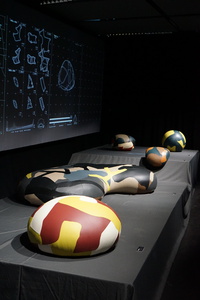
- Fast eine halbe Milliarde m² Leder weltweit endet jedes Jahr als Verschnitt in der Polsterproduktion.
Viel zu lange mussten sich natürliche Materialien starren Vorlagen unterordnen: Wir schneiden zu, wir kürzen, wir verwerfen – wir erzeugen Verschnitt durch Design.
Was wäre, wenn sich Technologie endlich der Natur anpassen könnte – und nicht umgekehrt?
Algorithmen können unreguläre Materialien und den Verschnitt als eine neue Ressource verwenden. Es geht dabei nicht nur um Effizienz; es geht darum, die Produkt-Ästhetik neu zu definieren – Schönheit in der natürlichen Variation und den natürlichen Fehlern zu sehen und zu erkennen, dass ein gutes Produkt am besten attraktiv, nachhaltig aber vor allem auch skalierbar ist.
Ich habe Algorithmen entwickelt, die Polsterobjekte aus digitalisiertem Lederabfall generieren. Dieses Programm kann gewünschte Objekte direkt anhand verschiedener Designrichtlinien und Parameter erstellen und nutzt dabei jedes Lederstück zu fast 90% im Durchschnitt aus. Es entsteht ein auf das Material zugeschnittenes Design.
Danach habe ich es selbst ausprobiert und eine Serie von wassertropfenförmigen Polstermöbeln hergestellt. Das Material wurde von der Möbelfirma MOROSO und einer deutschen Polsterfirma gesponsort.
- Fast eine halbe Milliarde m² Leder weltweit endet jedes Jahr als Verschnitt in der Polsterproduktion.
- Beschreibung (en)
- Nearly half a billion square meters of global leather ends up as offcuts on upholstery production every year.
For so long, natural materials have been forced to conform to rigid templates: We trim, we crop, we discard - we create waste by design.
What if technology could finally adapt to nature and not the other way around?
Using algorithms to find hidden potential in imperfect materials. This is more than efficiency; it's about redefining the product aesthetic, to see beauty in variation and to recognize that the most attractive design is one that is both: sustainable and scalable.
I have created such algorithms that generate upholstery objects from leather waste, which has been digitalized. This program can directly create desired objects based on a variety of design guidelines, parameters and constraints. It utilizes each leather piece up to 90% in average. The outcome is a design that is 100% based on the material's shape.
Afterwards I have tried it myself and made a series of upholstered furniture from leather waste. The leather was sponsored by MOROSO, the filling by a german upholstery company.
- Nearly half a billion square meters of global leather ends up as offcuts on upholstery production every year.
- Kategorie
- Schlagworte
- Datierung
- 09.07.2025
- Dank an
- Sprache
- Technik/Verfahren/Formate
- Digitale Arbeit, Pythoncode, Grasshopper, Nähen, Polstern
- Abmessungen
- 205cm x 130cm x 42cm / 50cm x 50cm x 32cm / 78cm x 78cm x 40cm und kleinere.
- Ort: Institution
- Ort
- Glaskubus, 2. OG, Raum 208
- Stadt
- Land
- Titel
- Wrapping Waste
- Projektleiter/in
- Semester
- Studiengang
- Typ der Abschlussarbeit
- Importiert am
- 30.06.2025
- Übergeordnete Sets
- 2
- Set enthält
- 0 19