The Plenum – A Scripted Play
Benachbarte Sets (32)Alle Zusammenhänge anzeigen
Diese Sets wurden den gleichen Sets hinzugefügt wie das ausgewählte Set.
32 Inhalte
- Seite 1 von 3
Die Methode Duchamp – Magritte
Name that can easily go onto 2 lines
Author that can easily go onto 2 lines as well
- Titel
- Die Methode Duchamp – Magritte
- Untertitel
- Das „Musée d’Art Moderne. Département des Aigles” von Marcel Broodthaers unter dem Aspekt der strategischen Aneignung
- Autor/in
- Beschreibung (de)
- „Der Fall Marcel Broodthaers lädt den Rezipienten dazu ein, sich mit dessen Vorläufern auseinanderzusetzen. Nicht etwa, weil dort Geheimnisse aufzudecken wären – im Gegenteil, die broodthaers’schen Galionsfiguren sind in seinem Werk alle namentlich präsentiert –, sondern eher auf Grund der Tatsache, da er es wie kaum ein anderer verstanden hat, sich bestimmter Vorbilder zu bedienen, sprich, sich Teilaspekte aus deren Werken anzueignen und die darin enthaltenen Kerngedanken eigens fortzuschreiben. Dies geschieht auf eine Art und Weise, die es vermag, Hommage und Kritik zu vereinen.”
„Über zwei Doppelseiten hinweg breitet sich im Ausstellungskatalog zur Section des Figures [...] das graphisch aus, was Broodthaers als seine METHODE tituliert. Diese Blätter folgen in direktem Anschluß an das Vorwort, sie markieren den Anfang zu jenem Katalogteil, der sowohl inhaltlich, als auch formal maßgeblich vom Künstler gestaltet worden ist. Bereits die Typographie des Titelworts strahlt – in Majuskel gesetzt – eine hohe Wichtigkeit aus. Wer allerdings ausführliche Erläuterung erwartet hat, wird enttäuscht, es handelt sich vielmehr um eine anspielungsreiche Illustration als um eine schriftliche Erklärung, doch gleichwohl trägt diese Ausführung den Charakter des Manifests.”
- „Der Fall Marcel Broodthaers lädt den Rezipienten dazu ein, sich mit dessen Vorläufern auseinanderzusetzen. Nicht etwa, weil dort Geheimnisse aufzudecken wären – im Gegenteil, die broodthaers’schen Galionsfiguren sind in seinem Werk alle namentlich präsentiert –, sondern eher auf Grund der Tatsache, da er es wie kaum ein anderer verstanden hat, sich bestimmter Vorbilder zu bedienen, sprich, sich Teilaspekte aus deren Werken anzueignen und die darin enthaltenen Kerngedanken eigens fortzuschreiben. Dies geschieht auf eine Art und Weise, die es vermag, Hommage und Kritik zu vereinen.”
- Beschreibung (en)
- "The case of Marcel Broodthaers invites the recipient to engage with his precursors. Not because there are secrets to be uncovered there - on the contrary, Broodthaers' figureheads are all presented by name in his work - but rather due to the fact that he understood better than almost anyone else how to make use of certain role models, i.e. to appropriate partial aspects from their works and to continue the core ideas contained therein in his own way. This is done in a way that manages to combine homage and criticism."
"Over two double-page spreads in the exhibition catalogue for Section des Figures [...] Broodthaers' METHOD is presented graphically. These pages follow directly after the preface and mark the beginning of the section of the catalogue that was designed by the artist both in terms of content and form. Even the typography of the title word - set in majuscule - radiates great importance. However, anyone expecting a detailed explanation will be disappointed; it is more of an allusive illustration than a written explanation, but this version nevertheless has the character of a manifesto."
- "The case of Marcel Broodthaers invites the recipient to engage with his precursors. Not because there are secrets to be uncovered there - on the contrary, Broodthaers' figureheads are all presented by name in his work - but rather due to the fact that he understood better than almost anyone else how to make use of certain role models, i.e. to appropriate partial aspects from their works and to continue the core ideas contained therein in his own way. This is done in a way that manages to combine homage and criticism."
- Kategorie
- Schlagworte
- Datierung
- November 2010
- Sprache
- Ort: Institution
- Titel
- Die Methode Duchamp – Magritte
- Untertitel
- Das „Musée d’Art Moderne. Département des Aigles” von Marcel Broodthaers unter dem Aspekt der strategischen Aneignung
- Semester
- Archiv-Signatur
- HfG HS 2010 09
- Externes Archiv
- Importiert am
- 10.01.2025
- Übergeordnete Sets
- 2
- Set enthält
- 0 2
Testzentrum für chronischen Automobilismus
- Titel
- Testzentrum für chronischen Automobilismus
- Autor/in
- Beschreibung (de)
- Radweg Ende, kein Zebrastreifen, Parkplatz voll, Bahn verpasst and stop and go, jemand hupt alle schauen, rote Ampel niemand da, falsch abgebogen, Licht vergessen, vollgas Lichthupe, Überholmaneuver trotz Geschwindigkeitsbegrenzung, ups! Personenschaden, Spiegel abgebrochen, Fenster runter „Arschloch!“, selber! Brumm. Kennen Sie das?
Verkehr ist eine höchst emotionale Angelegenheit. Die vielen kleinen Entscheidungen, die wir im automobilen Individualverkehr treffen müssen, sind immer auch mit einem Risiko behaftet. Sehen wir den "Personenschaden" als Katastrophe an, so müssen wir doch zugeben, dass auch die kleinen Fehlentscheidungen für Stress, Frust und Wut sorgen können. Ebendiese Reaktionen möchten wir im Kontext der sogenannten Mobilitätswende anerkennen, attestieren und aus ihnen Forderungen ableiten, die wir gerne für unsere Besucher*innen an die lokalen Behörden weiterleiten.
Auto, Fahrrad, Zufuß? Egal! Unsere 20-minütige Erstuntersuchung richtet sich an alle Verkehrsteilnehmer*innen. Erfahren Sie fachkundige Beratung und die Anwendung neuester Technologie. Tipp: Buchen Sie schon jetzt einen Termin und vermeiden Sie Wartezeiten. Wir freuen uns auf ihren Besuch!
- Radweg Ende, kein Zebrastreifen, Parkplatz voll, Bahn verpasst and stop and go, jemand hupt alle schauen, rote Ampel niemand da, falsch abgebogen, Licht vergessen, vollgas Lichthupe, Überholmaneuver trotz Geschwindigkeitsbegrenzung, ups! Personenschaden, Spiegel abgebrochen, Fenster runter „Arschloch!“, selber! Brumm. Kennen Sie das?
- Kategorie
- Typ des Projekts/Werks
- Schlagworte
- Datierung
- 25.03.2024 - 28.03.2024
- Mitwirkende
- Sprache
- Material
- Technik/Verfahren/Formate
- GameMaker Studio 2 (Game)
- Abmessungen
- 5 x 7,5 m
- Dauer
- 25 Minuten (Erstuntersuchung)
- Ort: Institution
- Stadt
- Land
- Internetlinks
- Bemerkungen
- Dank an: Alexander Knoppik, Alexander Thelen, Anna Haas (Badisches Staatstheater), Astrid Lindner-Maier, Barbara Kuon, Charlotte Singer, Christian Platz, Cornelia Herzog, Daniel Heiss (ZKM), Dario Schmid, Emelie Schreiner, Felix Fisgus, Franzi Wentz, Isabelle Schneider, Julian Kuf, Laura Richter, Leonie Mühlen, Martin Mangold (ZKM), Marvin Uhde (cant-deci.de), Max Bernhard, Miri, Omni-Mobil GmbH, Paula Schacke (die Anstoss e.V.), Pavel Polenz, Ralph Saam (Scheck-In Center Durlach), Richard Brunner, Sebastian Schäfer, Sebastian Schillbach, Sebastian Schönfeld, Silke Roth (die Anstoss e.V.), Susanne Henneberger (WERKRAUM: Karlsruhe e.V.), Susanne Schmitt, Sven Krahl, Timothée Charon, Tobias Keilbach, Tjark Schönfeld, Ute Wienberg (Badisches Staatstheater), Vlado Petrovic, Waldemar Schwab, Yun-Wen Liu
- Dank an: Alexander Knoppik, Alexander Thelen, Anna Haas (Badisches Staatstheater), Astrid Lindner-Maier, Barbara Kuon, Charlotte Singer, Christian Platz, Cornelia Herzog, Daniel Heiss (ZKM), Dario Schmid, Emelie Schreiner, Felix Fisgus, Franzi Wentz, Isabelle Schneider, Julian Kuf, Laura Richter, Leonie Mühlen, Martin Mangold (ZKM), Marvin Uhde (cant-deci.de), Max Bernhard, Miri, Omni-Mobil GmbH, Paula Schacke (die Anstoss e.V.), Pavel Polenz, Ralph Saam (Scheck-In Center Durlach), Richard Brunner, Sebastian Schäfer, Sebastian Schillbach, Sebastian Schönfeld, Silke Roth (die Anstoss e.V.), Susanne Henneberger (WERKRAUM: Karlsruhe e.V.), Susanne Schmitt, Sven Krahl, Timothée Charon, Tobias Keilbach, Tjark Schönfeld, Ute Wienberg (Badisches Staatstheater), Vlado Petrovic, Waldemar Schwab, Yun-Wen Liu
- Titel
- Testzentrum für chronischen Automobilismus
- Projektleiter/in
- Semester
- Studiengang
- Typ der Abschlussarbeit
- Importiert am
- 31.05.2024
- Übergeordnete Sets
- 2
- Set enthält
- 0 0
“I see” “with my voice”
Name that can easily go onto 2 lines
Author that can easily go onto 2 lines as well
- Titel
- “I see” “with my voice”
- Autor/in
- Beschreibung (de)
- „I see“ „with my voice“ beschäftigt sich mit Themen wie Transformation, Gestaltwandel und Materialität durch ein Zusammenspiel von literarischen Fragmenten und entliehenen Stimmen. Das Ergebnis ist eine nicht-lineare, fluide Erzählung, die die flüchtige Natur von Visionen, Träumen und Metamorphosen einfängt.
- Beschreibung (en)
- “I see” “with my voice” engages with themes of transformation,
shapeshifting, and materiality through an interplay of literary
fragments and borrowed voices, resulting in a non-linear, fluid
narrative that encapsulates the ephemeral nature of visions,
dreams, and metamorphoses.
This project draws substantial inspiration from Alice Notley's
The Descent of Alette, a transformative odyssey that employs
rhythmic spoken language to explore continuous change.
Alongside Notley’s influence, the works of Hildegard von Bingen,
a 12th-century mystic, and the visionary narratives from the
biblical book of Ezekiel, serve as foundational texts that inform
the thematic and structural framework of this piece.
The text is presented as an audio recording, whispered as a 20 minute loop.
Visitors can listen to the piece when pressing their ear against the tents walls.
My objects are performers, maybe even imposters: frozen in a state of change or mimicry. My objects are performers, maybe even imposters: frozen in a state of change or mimicry.
They are skillfull imitators, but you can tell something is off.
Moving along this crack between the believable and the not quite right, I like to engage
with different realities and states of being. The artificial, almost real-life fakeness of their with different realities and states of being. The artificial, almost real-life fakeness of their
surfaces set the stage for my narrative of transformation, imitation and shapeshifting.
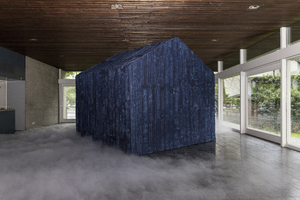
1. A wooden house crafted from smooth denim. Made by sanding the grain of wood
onto the denim fabric
2. Heavy fog covering the floor that could be perceived as dew, mixed with a light subtle
smoke of Incense burning.
The fragrance envokes sacred, holy feelings with its warm, resinous smell with peppery The fragrance envokes sacred, holy feelings with its warm, resinous smell with peppery
undertones.
3. 100 cherries made from a thick mixture of honey and almonds. The heavy sweetness
of the stoneless candy-imposter meant to linger in the visitors mouth as it is tasted. of the stoneless candy-imposter meant to linger in the visitors mouth as it is tasted.
A thin gelatine film – imitating the coolnes of cherry skin as it touches the lips A thin gelatine film – imitating the coolnes of cherry skin as it touches the lips
The installation is accompanied by a small reader containing the three part text to be taken The installation is accompanied by a small reader containing the three part text to be taken
home and serve as a keep sake or document of the fleeting spoken text.
The reader is bound with one simple staple. It does not have a beginning or end, but The reader is bound with one simple staple. It does not have a beginning or end, but
rather works like a gif. No cover or back. Just like wheels turning endlessly in a nonlinear rather works like a gif. No cover or back. Just like wheels turning endlessly in a nonlinear
storytelling.
- “I see” “with my voice” engages with themes of transformation,
- Kategorie
- Typ des Projekts/Werks
- Schlagworte
- Datierung
- 18.04.2024
- Sprache
- Ort: Institution
- Ort
- “I see” “with my voice” at ZKM Pavillon, Karlsruhe
- Stadt
- Land
- Titel
- “I see” “with my voice”
- Projektleiter/in
- Semester
- Studiengang
- Typ der Abschlussarbeit
- Importiert am
- 19.09.2024
- Übergeordnete Sets
- 0
- Set enthält
- 0 2
Cooking Care
- Titel
- Cooking Care
- Autor/in
- Beschreibung (de)
- Welche Art von unbezahlter Sorgearbeit leistest du?
Fühlst du dich dafür wertgeschätzt?
Würdest du dir mehr Hilfe von Familienmitgliedern oder Freund*innen wünschen?
Die szenische Installation „Cooking Care“ zeigt eine pflanzen gefärbte Patchwork-Tischdecke, die die Geschichten von Valeria, Susanne, Anna, Heike und Anne und deren unbezahlten Sorgearbeit über eine Woche hinweg in sich aufgesogen hat. Sie möchte die unsichtbare Arbeit sichtbar machen, investierte Zeit würdigen und sie feiern. Sie bietet eine Bühne, um ihre Stimmen zu hören, Verbindungen zu knüpfen und sich gegenseitig zu unterstützen.
Ausgangspunkt dieses Projekts war ein Abendessen mit fünf Frauen, die in verschiedenen Bereichen der unbezahlten Sorgearbeit tätig sind. An diesem Abend war das Kochen eine gemeinsame Aufgabe, die es allen ermöglichte, nicht nur den Prozess und das gemeinsame Essen zu genießen, sondern auch sich umeinder zu sorgen. Es wurde eine Reihe von vorbereiteten Fragen gestellt, um einen Raum für den Austausch von Geschichten, Zweifeln und Erfahrungen zu schaffen.
Darüber hinaus wurden die Teilnehmer ermutigt, die Stunden unbezahlter Sorgearbeit, die sie in den nächsten sieben Tagen leisteten, zu dokumentieren; sie sollten konkrete Zahlen auf Papier bringen, um die Stunden sowohl für sich selbst als auch für andere sichtbar zu machen. Sie wurden auch gebeten, die psychische Belastung zu dokumentieren, die sie in dieser Zeit erfahren haben. Anschließend wurden die dokumentierten Stunden unterschiedlicher Sorgearbeit und die entsprechende psychische Belastung in eine abstrakte Infografik – in Form einer Tischdecke – übersetzt.
Die Tischdecke besteht aus mehreren gleich großen Quadraten, die jeweils eine Stunde unbezahlter Pflegearbeit repräsentieren, die von diesen fünf Frauen im Laufe der sieben Tagen dokumentiert wurde. Die einzelnen Stoffstücke wurden mit essbaren, saisonalen und lokal beschafften Pflanzen gefärbt, von denen viele selbst gesammelt wurden. Sie wurden vorbehandelt und 24 bis 48 Stunden lang im Färbebad gekocht. Da es sich bei den Stoffen um gebrauchte Haushaltstextilien handelt, hat jedes Stück seine eigene Geschichte und variiert in seiner Fähigkeit, Farbe zu absorbieren. Daher war der Färbeprozess experimentell und variierte, was jedes Mal zu einem einzigartigen Ergebnis führte. Außerdem trug der unterschiedliche Wuchs der zum Färben verwendeten Pflanzen zur Vielfalt der Ergebnisse bei.
Jede gefärbte Farbnuance steht für eine andere Art von Pflegearbeit. Bei hoher psychischer Belastung wurden die Quadrate mit zusätzlichem Stoff durch die Quilting Technik verdickt. Die so entstandene Tischdecke dient somit als künstlerische Abstraktion der unbezahlten Sorgearbeit, die ihre Sichtbarkeit erhöhen soll.
- Welche Art von unbezahlter Sorgearbeit leistest du?
- Beschreibung (en)
- What kind of unpaid care work are you doing?
Do you feel appreciated for it?
Would you like to have more help from family members or friends?
The spatial installation 'Cooking Care' shows a plant-dyed patchwork tablecloth soaked in the stories of Valeria, Susanne, Anna, Heike und Anne and their unpaid care-workload of one week. It aims to reach visibility, to celebrate, and appreciate the time and effort put into that work, and to give their voices a stage to be heard, connected and empowered.
The starting point of this project was a dinner with five women who engage in different fields of unpaid care work. That evening, cooking was a shared task, allowing everyone to not only enjoy the process and feasting together but also to care for each other. A set of premeditated question was asked to create a space to share stories, doubts, and experiences.
Furthermore, the participants were encouraged to document the hours of unpaid care work they performed over the next seven days; to provide actual numbers on paper, making it visible both to themselves and to others. They were also asked to document the mental load they experienced during this time. Then, the documented hours of different care work and the according mental load were translated into an abstract infographic in the form of a tablecloth.
The tablecloth consists of multiple squares of identical size each representing one hour of unpaid care work as documented by these five women over the course of seven days. The individual fabric pieces have been dyed using edible, seasonal, and locally-sourced plants, many of which were self-collected. They were pre-treated and cooked in the dye bath for 24 to 48 hours. Since the fabric consists of second hand household textiles, each piece carries its own history and varies in its ability to absorb dye. Thus, the dyeing process was experimental and varied with each batch, resulting in a unique outcome every time. The different growth of the plants used for dyeing added to the variety.
Each dyed color shade stands for a different type of care work. When there was a high mental load reported, squares were also thickened with additional fabric by the quilting technique. The resulting tablecloth thus serves as an artistic abstraction of the unpaid care work that aims to increase its visibility.
- What kind of unpaid care work are you doing?
- Kategorie
- Typ des Projekts/Werks
- Schlagworte
- Datierung
- 14.01.2025 - 21.01.2025
- Mitwirkende
- Dank an
- Eike Buff
- Jaya Demmer
- Lina Determann
- Nele Faust
- Miki Feller
- Ricarda Fischer
- Severin Geißler
- Laura Haak
- Laurine Haller
- Noa Haller
- Line-Gry Hørup
- Anne Duk Hee Jordan
- Leonie Junker
- Florian Knöbl
- Hanne König
- Susanne Kriemann
- Jannik Lang
- James Langdon
- Helene Lauppe
- Yun-Wen Liu
- Nini Lue
- Mona Mayer
- Leonie Mühlen
- Kamilla Murtazina
- Kathrin Rüll
- Tereza Ruller
- Henriette Schwabe (Jette Schwabe)
- Isabel Seiffert
- Merve Şimşek
- Leia Morgana Walz
- Judith Wolff
- Feminist Hiking Collective
- Sprache
- Abmessungen
- 180cm x 66cm x 400cm
- Dauer
- 23:18
- Ort: Institution
- Ort
- Im Innenhof und Garten der Schützenstraße 37, zwischen tv-Hifi, Ateliergemeinschaft und Wohnungen
- Stadt
- Land
- Titel
- Cooking Care
- Importiert am
- 14.11.2024
- Übergeordnete Sets
- 1
- Set enthält
- 0 0
'all the good girls go to hell' – Zur Widerständigkeit in der Figur der Hexe
- Titel
- 'all the good girls go to hell' – Zur Widerständigkeit in der Figur der Hexe
- Autor/in
- Beschreibung (de)
- In der Magisterarbeit „all the good girls go to hell – Zur Widerständigkeit in der Figur der Hexe“ untersucht Louisa Raspé den Begriff der Hexe und die in der Figur existierende Ambivalenz. Ausgehend von der Unterscheidung von der „Hexe“ als negative Fremdbezeichnung und der »Hexe« als positive Selbstbezeichnung, sowie der damit zusammenhängenden Machtaspekte, beschäftigt sich diese Arbeit mit der Frage nach Subjektkonstruktionen und den Subjekten der Geschichtsschreibung im Gegensatz zu Erzählungen. Es geht um die Hexe als Figur der Übergänge und Grenzüberschreitungen, sowie ihren Beitrag zu gesellschaftlichen, kulturellen und politischen Umbrüchen im westeuropäischen Kontext. In dieser Arbeit geht es darum eine kritische Perspektive auf die Konstruktion von Subjekt, Geschlecht und Macht einzunehmen und stellt zugleich die Frage, wie sich Widerständigkeit im Spannungsfeld zwischen Stigma und Empowerment ausdrücken lässt.
- Kategorie
- Schlagworte
- Dank an
- Sprache
- Ort: Institution
- Titel
- 'all the good girls go to hell' – Zur Widerständigkeit in der Figur der Hexe
- Projektleiter/in
- Semester
- Studiengang
- Typ der Abschlussarbeit
- Importiert am
- 06.12.2024
- Übergeordnete Sets
- 0
- Set enthält
- 0 0
Das ist ein Kinderspiel, not an Apple, 也就⼋年
Name that can easily go onto 2 lines
Author that can easily go onto 2 lines as well
- Titel
- Das ist ein Kinderspiel, not an Apple, 也就⼋年
- Autor/in
- Beschreibung (de)
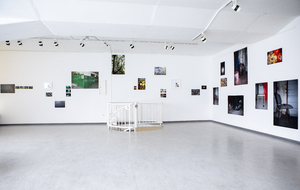
- Das ist ein Kinderspiel, not an Apple, 也就八年 ist meine erste Einzelausstellung, sowie mein Abschlussprojekt. Es ist eine tief persönliche Reflexion über meine Erfahrungen in Deutschland, die meinen künstlerischen Ansatz und mein konzeptionelles Denken maßgeblich geprägt haben. Mein Fokus auf sprachlichen Herausforderungen, kulturelle Kollisionen und die Gegenüberstellung verschiedener Welten ist in meiner Arbeit deutlich erkennbar.
Indem ich Fotografie als meine primäre Sprache nutze, konzentriere ich mich auf das alltägliche Leben, das in den Ecken der Städte verborgen ist – gesehen, aber vergessen, wie die Stuttgarter Straße in Karlsruhe. Dieses Thema wurde besonders deutlich, als ich nach der Pandemie in meine Heimatstadt zurückkehrte. Ich beobachte aufmerksam die marginalisierten Bereiche meiner Heimatstadt und die oft unsichtbaren Aspekte des täglichen Lebens meiner Familie. Diese sowohl ungewohnte als auch vertraute Perspektive vertieft sich in die Frage, wie das Leben in Deutschland meine Weltanschauung beeinflusst hat. Es betont die Komplexitäten, die aus Konflikten zwischen Sprachen und Kulturen entstehen.
Durch Fotografie, Video, Live-Performance und Publikation webe ich ein Netz aus Zeit, das Individuen, Ereignisse und Objekte aus parallelen Zeitlinien miteinander verknüpft. Jedes Fragment eingefrorener Zeit erzählt seine eigne Geschichte und präsentiert eine einzigartige Erzählung – sei es aus einer einheimischen Perspektive oder durch die Linse einer neuen Beobachtung, die durch eigne Erfahrungen in Deutschland geprägt ist.
Meine acht Jahre Leben in Deutschland scheinen in dieser acht Jahre alten Apfelkerzen eingefroren zu sein, sich entwickelnd und eine neue Form annehmend, während sie brennt und sich die Zeit ändert.
https://hangyanchen.de/
- Das ist ein Kinderspiel, not an Apple, 也就八年 ist meine erste Einzelausstellung, sowie mein Abschlussprojekt. Es ist eine tief persönliche Reflexion über meine Erfahrungen in Deutschland, die meinen künstlerischen Ansatz und mein konzeptionelles Denken maßgeblich geprägt haben. Mein Fokus auf sprachlichen Herausforderungen, kulturelle Kollisionen und die Gegenüberstellung verschiedener Welten ist in meiner Arbeit deutlich erkennbar.
- Beschreibung (en)
- My graduation project is a deeply personal reflection on my experiences living in Germany, which have significantly shaped my artistic approach and conceptual thinking. I focus on language challenges, cultural collisions, and the juxtaposition of different worlds, all of which are evident in my work.
Using photography as my primary language, I focus on the everyday life hidden in the corners of cities – seen but forgotten, such as Stuttgarter Street in Karlsruhe. This theme became particularly pronounced upon my return to my hometown after the pandemic. I keenly observe the marginalized areas of my hometown and the neglected aspects of my family's daily life. This both unfamiliar and familiar perspective delves into how living in Germany has impacted my worldview, emphasizing the complexities arising from conflicts between languages and cultures.
Through photography, video, live performance, and publication, I weave a web of time, intertwining individuals, events, and objects from parallel timelines. Each fragment of frozen time tells its own story, presenting a unique narrative – whether as a native perspective or through the lens of a new observation shaped by my experiences in Germany.
- My graduation project is a deeply personal reflection on my experiences living in Germany, which have significantly shaped my artistic approach and conceptual thinking. I focus on language challenges, cultural collisions, and the juxtaposition of different worlds, all of which are evident in my work.
- Kategorie
- Typ des Projekts/Werks
- Schlagworte
- Datierung
- 19.01.2024 - 25.01.2024
- Mitwirkende
- Ort
- GEDOK, Karlsruhe
- Stadt
- Land
- Titel
- Das ist ein Kinderspiel, not an Apple, 也就⼋年
- Urheberrechtshinweis
- ©Hangyan Chen
- Projektleiter/in
- Semester
- Studiengang
- Typ der Abschlussarbeit
- Importiert am
- 31.05.2024
- Übergeordnete Sets
- 4
- Set enthält
- 0 26
Who cares?
Name that can easily go onto 2 lines
Author that can easily go onto 2 lines as well
- Titel
- Who cares?
- Titel (en)
- Who Cares?
- Untertitel
- Digitale Sozialität, Infrastrukturen der Fürsorge und konviviale Technologien
- Untertitel des Projekts/Werks (en)
- Digital sociality, care infrastructure and convivial technology
- Autor/in
- Beschreibung (de)
- Die Hackerkultur verbindet Theorie und Praxis (nach hand-on Prinzipien) und einen neuen Ansatz für Kulturmaterialien ("information wants to be free"), der nicht nur eine andere Epistemologie, sondern auch einen neuen politischen Diskurs über Digitalität, Geräte und Menschen impliziert. Das Verhältnis zwischen Technik und Politik dieser Gruppe wird im ersten Kapitel analysiert: Zuerst wird die Entstehung proprietärer Software betrachtet, dann die Unterschiede zwischen Open Source und freier Software, und wie im letzten die Privateigentum und die soziale Beziehung zwischen Programmen, Benutzern und Entwicklern radikal in Frage gestellt werden. Später wird diese Beziehung anhand von Hanna Arendts 'Die conditio humana' in Bezug auf Arbeit, Herstellen und Handlen, Notwendigkeit und Freiheit, die die Bedingungen für Politik schaffen, weiter diskutiert. Im zweiten Kapitel wird das Konzept der Konvivialität (Ivan Illich) vorgestellt und diskutiert. Diese Idee wird später in der Wartung als infrastrukturelle Vorsorge weiterentwickelt und als ein zentrales Element digitaler Technologien vorgeschlagen, das weiter diskutiert werden sollte. Diese Konstellation des Denkens und Handelns, des Spielens und Lernens, des Experimentierens und der Übernahme von Verantwortung sowie der Politik und der sozialen Beziehungen sollte in der Technologiedebatte eine wichtige Rolle spielen.
- Beschreibung (en)
- Hacker culture connects theory and praxis (following hand-on principles) and a new approach to culture materials ("information wants to be free"), that implies not only a different epistemology, but also a new political discourse on digitality, devices, and people. The relation between technic and politic of this group is analyzed in the first chapter: first focusing on the emergence of proprietary software; then considering the differences between open source and free software, the last one challenging radically the notion of private property and the social relation among programs, users, and developers. Later on, reading Hanna Arendts 'The Human condition, the relation will be further discussed in terms of labor, work and action, necessity and freedom, which establish the conditions for politics. In the second chapter, the concept of conviviality (Ivan Illich) is introduced and discussed. This idea is later developed in maintenance as infrastructural care and proposed as a central element of digital technologies that should be further discussed. This constellation of thinking and acting, playing and learning, experimenting and taking responsibility, as well as politics and social relations should play a prominent role in the debate about technology.
- Kategorie
- Typ des Projekts/Werks
- Schlagworte
- Datierung
- 30.03.2023
- Sprache
- Titel
- Who cares?
- Untertitel
- Digitale Sozialität, Infrastrukturen der Fürsorge und konviviale Technologien
- Projektleiter/in
- Semester
- Studiengang
- Typ der Abschlussarbeit
- Importiert am
- 30.11.2023
- Übergeordnete Sets
- 3
- Set enthält
- 0 4
WHERE LEGENDS ARE MADE AND LIES ARE TOLD
Name that can easily go onto 2 lines
Author that can easily go onto 2 lines as well
- Titel
- WHERE LEGENDS ARE MADE AND LIES ARE TOLD
- Autor/in
- Beschreibung (de)
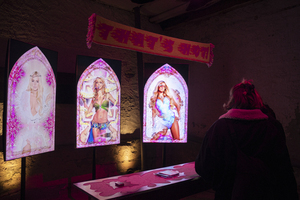
- WHERE LEGENDS ARE MADE AND LIES ARE TOLD (graduation project). Originated by this divine union of @parishilton @britneyspears @lindsaylohan (aka the Holy Trinity <3) the night of the infamous Bimbo Summit, WLAMALAT is the visual and critical translation of my obsession for the #y2k it-girls and #popculture in general. Mixing a religious with a highly commercial aesthetic, the project questions several topics such as women representation in the mass media, visual/celebrity culture consumption and new belief systems.
- WHERE LEGENDS ARE MADE AND LIES ARE TOLD (graduation project). Originated by this divine union of @parishilton @britneyspears @lindsaylohan (aka the Holy Trinity <3) the night of the infamous Bimbo Summit, WLAMALAT is the visual and critical translation of my obsession for the #y2k it-girls and #popculture in general. Mixing a religious with a highly commercial aesthetic, the project questions several topics such as women representation in the mass media, visual/celebrity culture consumption and new belief systems.
- Beschreibung (en)
- WHERE LEGENDS ARE MADE AND LIES ARE TOLD (graduation project). Originated by this divine union of @parishilton @britneyspears @lindsaylohan (aka the Holy Trinity <3) the night of the infamous Bimbo Summit, WLAMALAT is the visual and critical translation of my obsession for the #y2k it-girls and #popculture in general. Mixing a religious with a highly commercial aesthetic, the project questions several topics such as women representation in the mass media, visual/celebrity culture consumption and new belief systems.
- WHERE LEGENDS ARE MADE AND LIES ARE TOLD (graduation project). Originated by this divine union of @parishilton @britneyspears @lindsaylohan (aka the Holy Trinity <3) the night of the infamous Bimbo Summit, WLAMALAT is the visual and critical translation of my obsession for the #y2k it-girls and #popculture in general. Mixing a religious with a highly commercial aesthetic, the project questions several topics such as women representation in the mass media, visual/celebrity culture consumption and new belief systems.
- Kategorie
- Typ des Projekts/Werks
- Datierung
- 06.12.23
- Dank an
- Ort
- Rudolf 5
- Titel
- WHERE LEGENDS ARE MADE AND LIES ARE TOLD
- Projektleiter/in
- Semester
- Studiengang
- Typ der Abschlussarbeit
- Importiert am
- 05.11.2024
- Übergeordnete Sets
- 1
- Set enthält
- 3 8
PERMANENT BROKENNESS
Name that can easily go onto 2 lines
Author that can easily go onto 2 lines as well
- Titel
- PERMANENT BROKENNESS
- Autor/in
- Beschreibung (de)
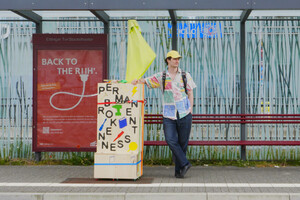
- PERMANENT BROKENNESS ist eine mobile (Infra-)Struktur, die das transformative Potential von öffentlichen Orten aufzeigt, indem sie die Reparatur von Haushalts- und Konsumgeräten verfügbar und sichtbar macht. Angelehnt an das Format des Reparatur-Cafés, werden Benutzer*innen dazu eingeladen eigenständig und gemeinsam Dinge zu reparieren. Hierbei steht nicht nur die Müllvermeidung und Ressourcenschonung im Vordergrund, sondern vor allem der selbstwirksame Zugang zur dinglichen Umwelt. Das Projekt basiert auf einer umfangreichen Recherche zur kulturellen Praxis des Reparierens und formuliert ein Gegennarrativ zu Hegemonien der Produktion, der Innovation und des unreflektierten Massenkonsums.
- Beschreibung (en)
- PERMANENT BROKENNESS is a mobile (infra-)structure that demonstrates the transformative potential of public spaces by making the repair of household and consumer appliances available and visible. Inspired by the repair café format, users are invited to repair things independently and together. The focus here is not only on avoiding waste and conserving resources, but above all on self-effective access to the material environment. The project is based on extensive research into the cultural practice of repairing and formulates a counter-narrative to hegemonies of production, innovation and unreflected mass consumption.
- Kategorie
- Schlagworte
- Datierung
- 26.06.2024
- Mitwirkende
- Dank an
- Titel
- PERMANENT BROKENNESS
- Projektleiter/in
- Semester
- Studiengang
- Typ der Abschlussarbeit
- Importiert am
- 01.11.2024
- Übergeordnete Sets
- 1
- Set enthält
- 0 6
I Cried A Smile
Name that can easily go onto 2 lines
Author that can easily go onto 2 lines as well
- Titel
- I Cried A Smile
- Autor/in
- Beschreibung (de)
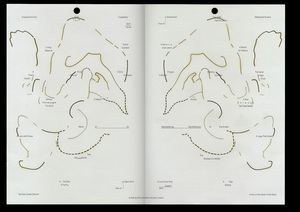
- Mit den Mitteln einer wissenschaftlichen Lecture erzählt „I Cried A Smile“ eine Geschichte über eine Person mit 2 Köpfen, Holz das zu Menschen wird, und die Erinnerung daran als Kind mit Neuropsychologie in Kontakt zu treten. Zwei übereinander hängende Projektionsflächen zeigen Zeichnungen, Animationen und gefundenes Bildmaterial während meine Stimme vom Band läuft und ich an einem Schreibtisch sitzend, mit dem Verfahren „Lip-Sync“ lautlos mitspreche. Das Publikum sitzt wie in einem anatomischen Theater in zwei Halbkreisen um mich herum.
- Beschreibung (en)
- Using the means of a scientific lecture, “I Cried A Smile” tells a story about a person with two heads, wood that becomes human, and the memory of coming into contact with neuropsychology as a child. Two projection screens hanging above me showcasing drawings, animations and found footage while my voice runs from the tape and I, sitting at a desk, speak along inaudibly using the “Lip-Sync” method. The audience sits around me like in an anatomical theater.
- Using the means of a scientific lecture, “I Cried A Smile” tells a story about a person with two heads, wood that becomes human, and the memory of coming into contact with neuropsychology as a child. Two projection screens hanging above me showcasing drawings, animations and found footage while my voice runs from the tape and I, sitting at a desk, speak along inaudibly using the “Lip-Sync” method. The audience sits around me like in an anatomical theater.
- Kategorie
- Typ des Projekts/Werks
- Schlagworte
- Mitwirkende
- Technik/Verfahren/Formate
- 2 Channel Video
- Dauer
- 8 Minuten
- Ort: Institution
- Stadt
- Land
- Titel
- I Cried A Smile
- Importiert am
- 30.09.2024
- Übergeordnete Sets
- 1
- Set enthält
- 0 5
Querschnitte des anthropogenen Lagers
Name that can easily go onto 2 lines
Author that can easily go onto 2 lines as well
- Titel
- Querschnitte des anthropogenen Lagers
- Titel (en)
- Cross-sections of the anthropogenic material stock
- Autor/in
- Beschreibung (de)
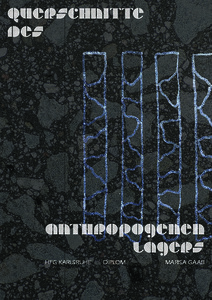
- Die Arbeit "Querschnitte des anthropogenen Lagers" setzt sich konzeptionell und praktisch mit der Wiederverwendung von Bauschutt auseinander.
Ein Großteil des in Deutschland aufkommenden Abfalls entsteht im Bausektor in Form von mineralischem Bauschutt und wird meist nur in abgewerteter Form wieder in den Kreislauf eingebracht.
Durch das Besuchen verschiedener Baustellen und Deponien, das Dokumentieren, Sammeln, Sortieren, und Fotografieren der vorgefundenen Materialien und Formen, wurden die noch vorhandenen formalen und optischen Qualitäten des anfallenden Materials analysiert, ergründet und Konzepte entwickelt, wie diese wieder im gleichen Bereich ihres Ursprungs Verwendung finden können.
Dabei wurden durch Querschnitte durch das Material die schon vorhandenen Qualitäten, wie die zylindrische Form von Bohrkernen oder die Terrazzo-Optik im Inneren von Betonbrocken, zum Vorschein gebracht, betont und in einen nutzbaren Kontext gesetzt. Die entstandenen Materialscheiben können durch verschiedene Verbindungstechniken als architektonische Halbzeuge genutzt und in Wandpaneele, Fliesen oder Fassadenelemente eingebracht werden.
- Die Arbeit "Querschnitte des anthropogenen Lagers" setzt sich konzeptionell und praktisch mit der Wiederverwendung von Bauschutt auseinander.
- Beschreibung (en)
- The work "Cross-sections of the anthropogenic material stock" deals conceptually and practically with the reuse of construction waste.
A large part of the waste generated in Germany is produced in the construction sector in the form of mineral building rubble and is usually only recycled in a downgraded form.
By visiting various construction sites and landfills, documenting, collecting, sorting and photographing the materials and shapes found, the remaining formal and visual qualities of the accumulated material were analysed, explored and concepts were developed on how they could be reused in the same area of their origin.
The existing qualities, such as the cylindrical shape of drill cores or the terrazzo look inside chunks of concrete, were brought to light, emphasised and placed in a usable context by making cross-sections through the material. The resulting material discs can be used as architectural semi-finis.
- The work "Cross-sections of the anthropogenic material stock" deals conceptually and practically with the reuse of construction waste.
- Kategorie
- Typ des Projekts/Werks
- Schlagworte
- Datierung
- 30.10.2023
- Titel
- Querschnitte des anthropogenen Lagers
- Projektleiter/in
- Semester
- Studiengang
- Typ der Abschlussarbeit
- Importiert am
- 27.05.2024
- Übergeordnete Sets
- 4
- Set enthält
- 0 23
Ghost Story
Name that can easily go onto 2 lines
Author that can easily go onto 2 lines as well
- Titel
- Ghost Story
- Autor/in
- Beschreibung (en)
- The project was born in response to the passing of an unaccompanied homeless individual in 2018, a person without known family or friends. Her death was cataloged—reduced to data archived in newsrooms and on digital servers. Yet, if this data remains untouched, and her memory fades into obscurity, does her existence persist? She lingers and remains unseen—a paradoxical state of both presence and absence. Within the digital void, she exists as a spectral trace, haunting the silence, waiting to be rediscovered, forever closed in on herself.
Such is the nature of ghosts—the living create them. We resurrect the departed in our own ways, through rituals, texts, and the intangible recipes of memory. We read, we create, we consume, and through this, we invite the dead to inhabit us once more. This project is an assemblage of fragments—an exploration of the processes through which we become haunted by the past.
- The project was born in response to the passing of an unaccompanied homeless individual in 2018, a person without known family or friends. Her death was cataloged—reduced to data archived in newsrooms and on digital servers. Yet, if this data remains untouched, and her memory fades into obscurity, does her existence persist? She lingers and remains unseen—a paradoxical state of both presence and absence. Within the digital void, she exists as a spectral trace, haunting the silence, waiting to be rediscovered, forever closed in on herself.
- Kategorie
- Typ des Projekts/Werks
- Schlagworte
- Datierung
- 18.04.2024
- Dank an
- Sprache
- Material
- Ort
- Pförtnerhäuser, Alter Schlachthof
- Stadt
- Land
- Titel
- Ghost Story
- Projektleiter/in
- Semester
- Studiengang
- Typ der Abschlussarbeit
- Importiert am
- 25.09.2024
- Übergeordnete Sets
- 0
- Set enthält
- 0 9