„Rudolf Herz hat mit seiner Ausstellung im Fotomuseum im Münchner Stadtmuseum und der gleichnamigen Publikation „Hoffmann und Hitler – Fotografie als Medium des Führer-Mythos“ 1994 einen wichtigen Grundstein für die Forschung um Heinrich Hoffmann, Adolf Hitler und die fotografische Führerpropaganda gelegt. Herz führt in seiner Darlegung in gewisser Weise eine Genealogie des „Hitlerbildes“ aus, das durch die Fotografie Hoffmanns seinen Ausdruck fand: Beginnend mit frühen fotografischen Portraitstudien, die von Heinrich Hoffmann als Postkarten vertrieben wurden, eröffnet der Medienforscher Herz in seinem Buch ein Panorama, das nicht nur die Herausformung der Figur Hitler zeigt, sondern auch die darauf folgenden Bildgattungen, in denen Hitler als Mensch vermarktet wurde.”
„Dieser Band ist nicht der erste Versuch, Adolf Hitler als Bildkonstante in die Gesellschaft einzuführen. Allerdings ist es der erste erfolgreiche Bildband, der es schafft, nicht nur von Hitler zu erzählen, sondern ihn mittels geschickt arrangierter Bildfolge zugleich als Führer und als natürlichen Menschen erscheinen zu lassen. In welchem Zeitraum des Jahres 1932 genau der Bildband „Hitler wie ihn keiner kennt“ erschienen ist, kann mittels der heute noch vorliegenden Bände nicht mehr rekonstruiert werden. Es ist vor allem der Rückgriff auf den Kontext, der in der analytischen Betrachtung und Einordnung des Bandes helfen muss. Das Medium Fotografie wird hier ein zweites Mal wirksam, jedoch nicht immanent (narrativ), sondern aus historischer Perspektive: eine Perspektive, die an dieser Stelle trotz propagandistischer Bildkonzeption auch dokumentarisch Auskunft geben kann.”
‘With his exhibition at the Fotomuseum in Munich's Stadtmuseum and the publication of the same name ‘Hoffmann and Hitler - Photography as a Medium of the Führer Myth’ in 1994, Rudolf Herz laid an important foundation stone for research into Heinrich Hoffmann, Adolf Hitler and photographic Führer propaganda. In his account, Herz sets out a kind of genealogy of the ‘Hitler image’, which found its expression through Hoffmann's photography: Beginning with early photographic portrait studies that were distributed by Heinrich Hoffmann as postcards, media researcher Herz opens up a panorama in his book that shows not only the moulding of the figure of Hitler, but also the subsequent image genres in which Hitler was marketed as a human being.’
‘This volume is not the first attempt to introduce Adolf Hitler into society as an image constant. However, it is the first successful illustrated book that manages not only to tell the story of Hitler, but also to make him appear both as a leader and as a natural human being by means of a skilfully arranged sequence of images. It is no longer possible to reconstruct exactly when the illustrated book ‘Hitler wie ihn keiner kennt’ was published in 1932 using the volumes still available today. It is above all the recourse to the context that must help in the analytical consideration and categorisation of the volume. The medium of photography becomes effective a second time here, but not immanently (narratively), but from a historical perspective: a perspective that can also provide documentary information at this point, despite the propagandistic image concept.’
Über einen Zeitraum von vier Wochen führte Ulf Beck in einer Versuchsanordnung Fotografien aus der Tagespresse einem Kompost mit Kompostwürmern zu. Ausgehend von der Untersuchung, welche Schlagzeilen es auf die erste Seite schaffen sowie deren fotografischer Darstellung, beschäftigte er sich mit dem Nachleben dieser Bilder. Dafür schnitt er jeden Tag die Abbildungen der Titelseite dreier großer Tageszeitungen aus und legte sie in einem Raster auf ein Becken mit Komposterde.
Das fotografische Bild wird als Teil des Medienorganismus durch die Verdauung der Würmer und verschiedener Mikroorganismen innerhalb von ca. 15 Tagen in den Erdorganismus überführt. Der Transformationsprozess ist am Ende nicht mehr sichtbar. Das Bild verliert seine Form und wird zu wertvollem Humus, welcher als Ansammlung von Millionen von Mikrobildern betrachtet werden kann.
Beschreibung (en)
Over a period of four weeks, Ulf Beck experimented with composting, using photographs from the daily press with compost worms. Based on the investigation of which headlines make it to the first page and their photographic representation, he deals with the afterlife of these images. For this, every day he cut out the illustrations of the front page of three large daily newspapers and put them in a grid on a basin with compost soil.
The photographic image is transferred as part of the media organism through the digestion of worms and various microorganisms into the earth organism, in around 15 days. The transformation process is no longer visible at the end. The image loses its form and becomes valuable humus, which can be regarded as an accumulation of millions of micro-images.
Die Arbeit war - in veränderter Form - am 27. & 28.01.2018 im Rahmen von Plat(t)form 2018, dem zwölften kuratierten internationalen Portfolio-Viewing für junge Künstler aus Europa, im renommierten Fotomuseum Winterthur (CH) zu sehen.
In dieser interdisziplinären Arbeit wird der schleichende Prozess der Selbstkontrolle als Reaktion auf äußere Störungen untersucht. Ausgangspunkt ist die Angst, einen Fehler zu begehen, die nicht mit einem sichtbaren Eingriff beginnt, sondern sich langsam in das Bewegungsrepertoire des Körpers einschreibt, bis sie schließlich zum Stillstand führt.
Die Performance wird aus mehreren Perspektiven gefilmt. Diese Aufnahmen aus verschiedenen Blickachsen eines überwachenden Apparats, werden in der Installation projiziert.
Beschreibung (en)
This interdisciplinary work examines the creeping process of self-control as a response to external disturbances. The starting point is the fear of making a mistake, which does not begin with a visible intervention, but slowly inscribes itself into the body's repertoire of movements until it finally leads to a standstill.
The performance is filmed from several perspectives. These recordings from different viewing angles of a surveillance device are projected in the installation.
I CAN BUY MYSELF FLOWERS (OH) ist eine performative Aktion, die am internationalen feministischen Kampftag, dem 8. März 2024, stattfand. Angelehnt an die 5-Finger-Taktik aus der Demonstrationspraxis und die macht- und herrschaftszentrierte Stadtplanung Karlsruhes bewegen sich fünf Performende auf das Karlsruher Schloss zu, um dieses als patriarchales Machtzentrum zu konfrontieren. Unterstützt und begleitet werden sie dabei von jeweils einem "militanten Accessoire". Als Katalysator*in und Vermittler*in ermöglicht das "militante Accessoire" dissidente Handlungsspielräume für die Träger*innen. Es stört, empowert und protestiert.
I CAN BUY MYSELF FLOWERS (OH) ist eine performative Erprobung und geht den zentralen Fragestellungen meiner Magistraarbeit "Performende Körper und ihre militanten Accessoires. Zur Materialisierung von Dissens" nach.
Die performative Aktion wurde mit einer Sony DCR-DVD406E auf Mini-DVD dokumentiert.
Beschreibung (en)
I CAN BUY MYSELF FLOWERS (OH) is a performative action that took place on the International Feminist Day of Struggle, March 8, 2024. Based on the 5-finger tactic of protest practice and Karlsruhe's power-centric and hegemonial urban planning, five performers move towards the Karlsruhe Palace to confront it as a patriarchal center of power. Each performer is supported and accompanied by a "militant accessory". As a catalyst and mediator, the "militant accessory" enables acts of dissent. It disrupts, empowers, and protests.
I CAN BUY MYSELF FLOWERS (OH) is a performative enactment that engages with the key questions of my magistra’s thesis "Performende Körper und ihre militanten Accessoires. Zur Materialisierung von Dissens".
The performative action was documented with a Sony DCR-DVD406E on Mini-DVD.
Ausgehend von der Annahme, dass Protest nicht nur durch Sprache oder Körper, sondern vor allem durch Gegenstände artikuliert wird, richtet die Magistraarbeit den Fokus auf die materiell-symbolischen Politiken feministischer Protestperformances. Dafür schlage ich das Konzept des "militanten Accessoires" als Analysekategorie für feministische Performancepraktiken vor. Das Accessoire, das oft mit weiblich* gelesenen Körpern assoziiert ist, wird als scheinbar harmloses, alltägliches und schmückendes Modeelement in einen handlungsorientierten, widerständigen Gegenstand umgedeutet und neu kontextualisiert. Anhand von zwei aktivistisch-performativen Aktionen der Women’s Social and Political Union (Window Smashing Campaign, 1912 ) und Pussy Riot (Punk Prayer, 2012) werden zwei Gegenstände, ein 19cm großer Toffeehammer sowie eine neonbunte Sturmhaube, als "militante Accessoires" identifiziert. In ihrem wechselwirkenden Verhältnis mit Körpern ermöglicht das "militante Accessoire" diesen, politische und emanzipatorische Potenziale zu entfalten und Orte in Räume des Protests zu transformieren.
Dieser Analyse folgend übertrage ich die Bedingungen des "militanten Accessoires" im letzten Kapitel auf künstlerische Protestperformances. Dabei betrachte ich unter anderem künstlerische Produktionen von Selma Selman (You Have No Idea), Pipilotti Rist (Ever Is Over All) und Milica Tomić (One Day, Instead of One Night, a Burst of Machine-Gun Fire Will Flash, if Light Cannot Come Otherwise) und frage, inwiefern "militante Accessoires" nicht nur in kollektiven Protestperformances, sondern auch für einzelne Körper in feministischen, künstlerischen Performances eine Möglichkeit des Ausdrucks von Protest bieten.
Die Magistraarbeit rückt die kompliz*innenhafte Beziehung zwischen Kunst und Protest in den Fokus und zeigt, dass "militante Accessoires" nicht nur symbolische Bedeutungsträger*innen sind, sondern in ihrer relationalen und körperlich-performativen Dimension als Mittel des Widerstands agieren. Im Zusammenspiel mit den handelnden Körpern treten sie als Katalysator*innen und Vermittler*innen auf und entfalten eine doppelte Rolle als materiell-semiotische Akteur*innen.
Based on the premise that protest is articulated not only through language or the body, but above all through objects, the magistra's thesis focuses on the material-symbolic politics of feminist protest performances.
In this regard, I propose the concept of the "militant accessory" as an analytical category for feminist performance practices. The accessory as an everyday, decorative fashion element, which is often associated with bodies read as female*, is reinterpreted and transformed into an action-oriented, resistant object.
In consideration of two activist-performative actions by the Women's Social and Political Union (Window Smashing Campaign, 1912) and Pussy Riot (Punk Prayer, 2012), two objects, a 19cm toffee hammer and a neon-coloured balaclava, are identified as "militant accessories". In their reciprocal relationship with bodies, "militant accessories" enable them to develop political and emancipatory potential and transform places into spaces of protest. Building on this analysis, I apply the conditions of the "militant accessory" to artistic protest performances. To this end, I focus on artistic productions by artists such as Selma Selman (You Have No Idea), Pipilotti Rist (Ever Is Over All), and Milica Tomić (One Day, Instead of One Night, a Burst of Machine-Gun Fire Will Flash, if Light Cannot Come Otherwise), asking to what extent "militant accessories" act as tools for expressing dissent in collective protest performances and individual bodies within feminist artistic practices.
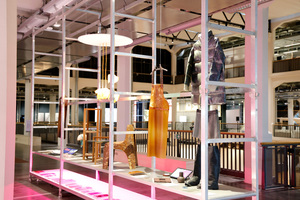
Im Zusammenhang mit Textilien ist ein "skein" eine gewickelte Spule aus Garn oder Faden. In metaphorischem Sinne wird es gebraucht, um ein verworrenes, komplexes Arrangement von Dingen zu beschreiben, wie zb einer Beziehung, einem Satz, kniffligen Problemen oder Situationen, die auf irgendeine Weise festgefahren sind. Die Rauminstallation “skeins” zeigt eine Sammlung von Mythen und Geschichten die sich mit der Symbolik des Knoten auseinandersetzen. Sie umfasst Fundstücke und eigens für die Ausstellung angefertigte Objekte, Bildsammlungen, Rechercheergebnisse einer Forschungsreise, Textilarbeiten, Zeichnungen, Flechtobjekte aus Haar, Videoarbeiten, Gebäck, Briefe und Texte. Um diese Objekte zu kuratieren wurde zum einen mit Schaukästen gearbeitet, zum anderen dienten die natürlichen Beschaffenheiten des Raumes (z.B. Fenster, Türrahmen) als Rahmengeber. Knoten dienen als Stützen gegen die Zeit und das Vergessen. Der “Unendliche Liebesknoten” ist eine symbolische Darstellung einer ewigen Liebe, die so umfassend ist, dass sie weder Anfang noch Ende kennt. Immerwährende Liebe eingeschlossen in der Form eines unveränderbaren Loops. Doch tragen Knoten die Erinnerung an den Prozess ihrer Entstehung in sich. Ein Knoten fügt sein eigenes Entknoten in das Gewebe seines Zweckes ein. Er kann verändert, aktualisiert und angepasst werden. “skeins” reflektiert dieses Phänomen des Festhaltens und wirft unweigerlich Fragen nach den Möglichkeiten die das Entknoten bereit hält, auf. Hierbei werden verschiedene Arten des Verriegelns (Knoten) und Entriegelns (Entknoten) einander gegenübergestellt. Die Intervisualität von den miteinander verflochtenen Bildern lässt eine Erzählung entstehen. Der Raumplan im Ausstellungsführer diente als Wegweiser und lud die Besucher ein, der Narration durch die Ausstellung zu folgen. Ergänzt wurde dies durch kurze Texte zu den Objekten.
Untertitel des Projekts/Werks (en)
There are certain knots that are supposed to store time or hold it back from itself –– The endless knot of love is a fraud ––––– There is more than one way to get through a locked door –––– There are different ways of how to untie a knot
Im Zusammenhang mit Textilien ist ein "skein" eine gewickelte Spule aus Garn oder Faden. In metaphorischem Sinne wird es gebraucht, um ein verworrenes, komplexes Arrangement von Dingen zu beschreiben, wie zb einer Beziehung, einem Satz, kniffligen Problemen oder Situationen, die auf irgendeine Weise festgefahren sind.
Die Rauminstallation “skeins” zeigt eine Sammlung von Mythen und Geschichten die sich mit der Symbolik des Knoten auseinandersetzen. Sie umfasst Fundstücke und eigens für die Ausstellung angefertigte Objekte, Bildsammlungen, Rechercheergebnisse einer Forschungsreise, Textilarbeiten, Zeichnungen, Flechtobjekte aus Haar, Videoarbeiten, Gebäck, Briefe und Texte. Um diese Objekte zu kuratieren wurde zum einen mit Schaukästen gearbeitet, zum anderen dienten die natürlichen Beschaffenheiten des Raumes (z.B. Fenster, Türrahmen) als Rahmengeber.
Knoten dienen als Stützen gegen die Zeit und das Vergessen. Der “Unendliche Liebesknoten” ist eine symbolische Darstellung einer ewigen Liebe, die so umfassend ist, dass sie weder Anfang noch Ende kennt. Immerwährende Liebe eingeschlossen in der Form eines unveränderbaren Loops. Doch tragen Knoten die Erinnerung an den Prozess ihrer Entstehung in sich. Ein Knoten fügt sein eigenes Entknoten in das Gewebe seines Zweckes ein. Er kann verändert, aktualisiert und angepasst werden.
“skeins” reflektiert dieses Phänomen des Festhaltens und wirft unweigerlich Fragen nach den Möglichkeiten die das Entknoten bereit hält, auf.
Hierbei werden verschiedene Arten des Verriegelns (Knoten) und Entriegelns (Entknoten) einander gegenübergestellt. Die Intervisualität von den miteinander verflochtenen Bildern lässt eine Erzählung entstehen. Der Raumplan im Ausstellungsführer diente als Wegweiser und lud die Besucher ein, der Narration durch die Ausstellung zu folgen. Ergänzt wurde dies durch kurze Texte zu den Objekten.
In the context of textiles and crafting, a "skein" is a loosely wound coil of yarn or thread. In a more metaphorical sense, "skeins" can like knots be used to describe
a tangled or complex arrangement of things, such as relationships, a sentence, tricky problems or situations that are stuck in a way.
The installation presented a collection of myths and stories dealing with the symbolism of the knot. It includes found objects and objects made especially for the exhibition, image collections, research results from a research trip, textile works, drawings, braided hair objects, video works, biscuits, letters and texts. To curate these objects, on the one hand showcases were used, on the other the natural features of the room (e.g. windows, door frames) functioned as framing system.
A knot illustrates the recording of a moment in time. There are certain knots that are supposed to store time or hold it back from itself. The ‘Infinite Knot of Love’ is a symbolic representation of an eternal all-encompassing love, that it knows neither beginning nor end. Everlasting love locked into the shape of an unchangeable loop. But knots have a memory of the process of their formation. A knot inserts its own undoing into the very fabric of its purpose. It can be altered, updated and adjusted.
"skeins" reflects on the phenomenon of holding on and inevitably raises questions about the possibilities of unknotting.
Different ways of locking (knotting) and unlocking (unknotting) are opposed to each other. Through the intervisuality of the entwined images a narrative is created. The floor plan in the exhibition guide served as a signpost, inviting visitors to follow the narration through the exhibition. This was complemented by short texts about the objects.
„The Violent Container“ konzentriert sich auf das kulturelle Phänomen des Käfigs und das Einsperren als Praxis, um Objekte oder Körper einzuschließen, zu kategorisieren, einzuschränken und sich anzueignen – sowie als Mittel, um sie zu sammeln, zu schätzen, zu bewahren und zu schützen.
Das Projekt umfasst eine Ausstellung und eine Publikation, die die verschiedenen Eigenschaften und Funktionen der sich wandelnden Formen des Käfigs untersuchen und dabei erforschen, wie Käfige nicht nur die Verwaltung lebender oder toter Körper und Objekte ermöglichen, sondern auch die Art und Weise bestimmen, wie wir sie wahrnehmen.
Beschreibung (en)
"The Violent Container" focuses on the cultural phenomenon of the cage, and caging as a practice to contain, categorise, restrict, and appropriate objects or bodies – as well as a tool to collect, treasure, preserve, and protect them.
The project comprises an exhibition and a publication that examine the various properties and functions of the cage’s shifting forms, exploring how cages not only enable the administration of living or dead bodies and objects, but also govern the ways in which we perceive them.
AMBASSADORS ist eine installative Sammlung, bestehend aus 120 Stofftieren, die das Verhältnis der Konzepte vom Natürlichen und Künstlichen anhand des Eisbären in menschlicher Gefangenschaft beleuchtet. Im Kampf um die Klimakrise ist der Eisbär zum Symbolbild der zu schützenden Natur geworden und hat sich als solches zum Repräsentanten in das kollektive Gedächtnis eingebrannt. KI-generierte Bilder, von denen jeweils 10 eine der 12 Geschichten in der Installation visualisieren, wurden einzeln auf die Rücken der 120 Stofftiere übertragen und gemeinsam in ein immersives Wimmelbild verwoben. So werden die Stofftiere in der Installation zu Botschaftern einer künstlichen Population und verlängern damit, ohne Lebewesen Leid zuzufügen, die Ketten an Abbildungen von Abbildungen von etwas, das mal natürlich war.
Beschreibung (en)
Ambassadors is an installation consisting of 120 stuffed animals that explores the relation between the natural and the artificial through the lens of the polar bear in human captivity. In the fight against the climate crisis, polar bears haves become a symbolic image of nature in need of protection—an image that has etched itself into the collective memory. Each set of ten AI-generated images represents one of the twelve stories depicted in the installation. These images were transferred individually onto the backs of the 120 stuffed animals and collectively woven into an immersive Wimmelbild. In this way, the stuffed animals once again become ambassadors of an artificial population—extending the chain of representations of representations of something that once was natural, without causing harm to living beings.
A score is not just a set of instructions; it creates a collective body that breathes and moves as one. Through embodiment, the score is transformed into a dynamic interplay of movement, sound, and presence, a merging of the physical and the ephemeral.
We become not just individuals but one body. Individuality is blurred, and there is no longer any sense of who is who. Boundaries disappear, and physicality flows freely. Differences are acknowledged, and points of connection.
In this shared experience, the present moment is crucial. We are fully present in the score, not merely seen. Each movement represents the present and captures the essence of the momentary and the eternal.
The collective body expresses the power of unity in diversity. We share an understanding of how creativity emerges from being together.
Embracing the fluidity and immediacy of the present evokes new dimensions of connection and expression. Our scores offer a transformative experience in which everyone becomes part of a collectivity.
The scores from 'Performing Difference’ are not just a guide but a gateway to a deeper understanding of embodiment and presence. We invite everyone to participate in an infinite connection with each other, where the boundaries between self and other blur and become a shared expression.
Seminar
Prof. Filipa César
Helin Hulas
Lucas Gutierrez
Nico Hain
Media Art
Performing Difference
"As you can see, 'difference' is essentially 'division' in the understanding of many. It is no more than a tool of self-defense and conquest."
–Trinh T Minh Ha
Historically and contemporarily, "difference" has been deployed in social politics to produce separation and division between people, groups, and agencies. Although "difference" can be the departing point for connection, exchange, collaboration, affect, and togetherness, its otherwise aspects have been insistingly instrumentalized as political tools towards divide, separation, conflict, privilege, and inequality, which has been informing socialities, inscribing bodies, and affecting and impacting relations. Critical artistic positions in film and performance have been focusing on and reflecting through these social phenomena and performing socialities of togetherness within difference.
Performing Difference is a four-part hands-on block seminar where students will work with performance, moving-image, and display technologies in dialogue with various artistic and theoretical positions. The block-seminar will draw a curve of practical experimentation and production in four phases, with the following learning outcomes:
PERFORMING DIFFERENCE #1: from thought to body
Exercising with body awareness, score, and performance; research artistic positions of historical filmmakers working with performance to engage in body politics, social ethics, and power relations. Inquire about the relationship between women's relations to computation, score, and algorithm, learning about parameters of the body & parameters of the software. Render an idea, a trouble, a cause, a feeling into a performance score;
PERFORMING DIFFERENCE #2: from skin to grain
Experimenting with camera work and performance; revisit concepts of the "model" in Robert Bresson's reflections on cinematography. Produce the shooting of students' scores.
PERFORMING DIFFERENCE #3: from pixel to surface
Experimenting with post-production and interactive displaying formats and studying technologies, aesthetics, and politics of visibility. Knowledge and experience with the most popular cross-platform game engines and multimedia software that supports 2D and 3D graphics, such as Madmapper, Resolume, TouchDesigner, and Unity3d. Learn how to use Mediapipe on pre-recorded footage, apply computer vision for motion tracking using TouchDesigner, and transfer data via OSC to the VJ software.
PERFORMING DIFFERENCE #4: Rundgang presentations
Setting up one collective installation or a series of individual installations for the Rundgang.
Transients is a series of performances that simultaneously work with and against the possibility of a form of media-archaeological listening. They activate a historical object, the Subharchord II synthesiser built by the GDR in East Berlin in 1964. The piece listens to the ways in which its material-technical composition resonates in the present and, more specifically, how its filter design reappears as a constitutive component for the algorithm of the so-called “dialect recognition software,” a proprietary machine learning solution used in Germany since 2017 for cases of undocumented asylum seekers since 2017. Because we cannot listen to how this software listens, engaging with the filter in the Subharchord II allows for sonic and historical juxtapositions at the limits of history, offering a “para-genealogy” of machine listening and its connections with the building of a nation, its people, and, more importantly, its others.