Manchmal ist Schmerz ganz leise
Benachbarte Sets (45)Alle Zusammenhänge anzeigen
Diese Sets wurden den gleichen Sets hinzugefügt wie das ausgewählte Set.
45 Inhalte
- Seite 1 von 4
Erikas Töchter

Name that can easily go onto 2 lines
Author that can easily go onto 2 lines as well
- Titel
- Erikas Töchter
- Autor/in
- Beschreibung (de)
- "Erikas Töchter" untersucht anhand der fiktiven Figur Erika Mustermann Perspektiven auf die weibliche* Identitätsbildung in Deutschland. Seit 1987 existiert Erika als Musteridentität in amtlichen Dokumenten - weiß, blond, blau- oder grünäugig. Als ein lächelnder Anachronismus geistert sie, erschreckend unkommentiert, durch die Bürokratielandschaft Deutschlands. Ihre durchdringende Augen blicken uns alle aufmerksam an, die Mundwinkel deuten ein neutrales Lächeln an. Doch je länger man sie betrachtet, desto schwerer wiegt ihr Blick: normierend, klassifizierend und ausschließend.
Die Arbeit übersetzt diese fiktive Identität in ein irritierendes Szenario, das zwischen Gartenfest, Ausstellung, Performance und Büroalltag changiert. Im Zentrum stehen zwei Ebenen: Zum einen die Präsentation der IDOLLs, einer Serie neuer weiblicher Musteridentitäten, die im Format einer Teleshopping-Show als innovative Lösung zeitgenössischer Identitätsprobleme vermarktet werden. Zum anderen der Blick in Erikas Büroalltag. Umgeben von Plastik-Buchsbaumbüschen, Teppichboden und generischen Büromöbeln ist sie gefangen im Moment des Fotos und der Reproduktion ihres Gesichtes.
- "Erikas Töchter" untersucht anhand der fiktiven Figur Erika Mustermann Perspektiven auf die weibliche* Identitätsbildung in Deutschland. Seit 1987 existiert Erika als Musteridentität in amtlichen Dokumenten - weiß, blond, blau- oder grünäugig. Als ein lächelnder Anachronismus geistert sie, erschreckend unkommentiert, durch die Bürokratielandschaft Deutschlands. Ihre durchdringende Augen blicken uns alle aufmerksam an, die Mundwinkel deuten ein neutrales Lächeln an. Doch je länger man sie betrachtet, desto schwerer wiegt ihr Blick: normierend, klassifizierend und ausschließend.
- Beschreibung (en)
- “Erikas Töchter” explores perspectives on female* identity formation in Germany through the fictional figure of Erika Mustermann. Since 1987, Erika has served as the standard identity in official documents – white, blonde, blue- or green-eyed. As a smiling anachronism, she continues to haunt Germany’s bureaucratic landscape. Erika’s eyes look directly at the viewer, the corners of her mouth suggesting a neutral smile. Yet the longer she gazes at you, the more insistent her expression becomes: classifying and excluding
The work translates this fictional identity into a scenario that shifts between garden party, exhibition, performance, and office routine. At its center are two layers: on the one hand, the presentation of the IDOLLs – a series of new female standard identities, presented in the style of a teleshopping show, offering an innovative approach to contemporary issues of identity; on the other hand, a glimpse into Erika’s everyday office life. Surrounded by plastic boxwood shrubs, carpeting, and generic office furniture, she remains trapped in the moment of the photograph and the endless reproduction of her own face.
- “Erikas Töchter” explores perspectives on female* identity formation in Germany through the fictional figure of Erika Mustermann. Since 1987, Erika has served as the standard identity in official documents – white, blonde, blue- or green-eyed. As a smiling anachronism, she continues to haunt Germany’s bureaucratic landscape. Erika’s eyes look directly at the viewer, the corners of her mouth suggesting a neutral smile. Yet the longer she gazes at you, the more insistent her expression becomes: classifying and excluding
- Kategorie
- Typ des Projekts/Werks
- Schlagworte
- Datierung
- 22.07.2025
- Mitwirkende
- Sprache
- Material
- Abmessungen
- Ein kleines Haus mit Garten
- Dauer
- 4 Stunden
- Ort: Institution
- Stadt
- Land
- Titel
- Erikas Töchter
- Projektleiter/in
- Semester
- Studiengang
- Typ der Abschlussarbeit
- Importiert am
- 29.09.2025
- Übergeordnete Sets
- 3
- Set enthält
- 2 23
Folded Sheets
Name that can easily go onto 2 lines
Author that can easily go onto 2 lines as well
- Titel
- Folded Sheets
- Autor/in
- Beschreibung (de)
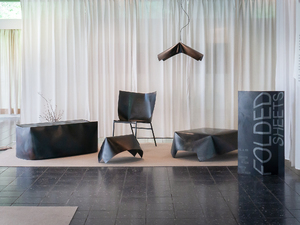
- Folded Sheets untersucht, wie sich Papier-Falttechniken auf Stahlbleche übertragen lassen. Rechteckige Tafeln werden durch gezielte Einschnitte und Faltungen in stabile dreidimensionale Formen gebracht, ohne dass Material verloren geht. Der Prozess des Schwarzbrennens, bei dem Leinöl in die Oberfläche eingebrannt wird, verleiht den Objekten ihre charakteristische schwarze Färbung, schützt sie vor Korrosion und unterstützt die strukturelle Festigkeit.
- Beschreibung (en)
- Folded Sheets explores the possiblities of transferring paper folds into steel sheet furniture. By using cuts and folds on rectangular steel sheets, tensioned rigid shapes without offcuts are created. The objects are further strengthend by blackening the surface with burnt linseed oil.
- Kategorie
- Typ des Projekts/Werks
- Schlagworte
- Datierung
- 2025
- Dank an
- Material
- Technik/Verfahren/Formate
- Falttechnik, Schwarzbrennen mit Leinöl
- Stadt
- Land
- Internetlinks
- Titel
- Folded Sheets
- Projektleiter/in
- Semester
- Studiengang
- Typ der Abschlussarbeit
- Importiert am
- 15.07.2025
- Übergeordnete Sets
- 3
- Set enthält
- 0 18
Ghost Story
Name that can easily go onto 2 lines
Author that can easily go onto 2 lines as well
- Titel
- Ghost Story
- Autor/in
- Beschreibung (en)
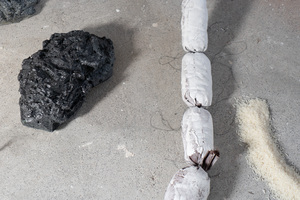
- The project was born in response to the passing of an unaccompanied homeless individual in 2018, a person without known family or friends. Her death was cataloged—reduced to data archived in newsrooms and on digital servers. Yet, if this data remains untouched, and her memory fades into obscurity, does her existence persist? She lingers and remains unseen—a paradoxical state of both presence and absence. Within the digital void, she exists as a spectral trace, haunting the silence, waiting to be rediscovered, forever closed in on herself.
Such is the nature of ghosts—the living create them. We resurrect the departed in our own ways, through rituals, texts, and the intangible recipes of memory. We read, we create, we consume, and through this, we invite the dead to inhabit us once more. This project is an assemblage of fragments—an exploration of the processes through which we become haunted by the past.
- The project was born in response to the passing of an unaccompanied homeless individual in 2018, a person without known family or friends. Her death was cataloged—reduced to data archived in newsrooms and on digital servers. Yet, if this data remains untouched, and her memory fades into obscurity, does her existence persist? She lingers and remains unseen—a paradoxical state of both presence and absence. Within the digital void, she exists as a spectral trace, haunting the silence, waiting to be rediscovered, forever closed in on herself.
- Kategorie
- Typ des Projekts/Werks
- Schlagworte
- Datierung
- 18.04.2024
- Dank an
- Sprache
- Material
- Ort
- Pförtnerhäuser, Alter Schlachthof
- Stadt
- Land
- Titel
- Ghost Story
- Projektleiter/in
- Semester
- Studiengang
- Typ der Abschlussarbeit
- Importiert am
- 25.09.2024
- Übergeordnete Sets
- 0
- Set enthält
- 0 9
G.O.T.T.A.L.I.S.T.E.N.
Name that can easily go onto 2 lines
Author that can easily go onto 2 lines as well
- Titel
- G.O.T.T.A.L.I.S.T.E.N.
- Autor/in
- Beschreibung (de)
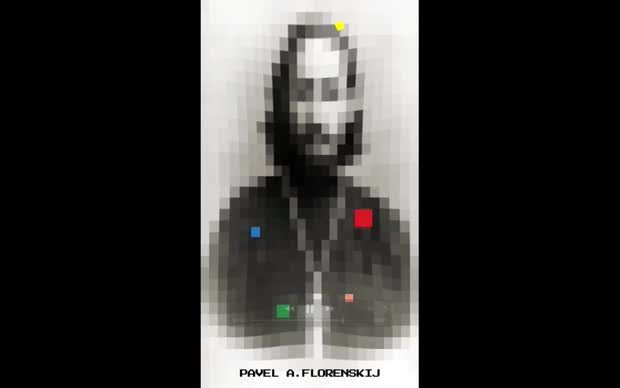
- "GOTTALISTEN", kurz für „Grab One Terrene Thought And Let It Slide To Eternal Nothingness”, beschäftigt sich mit der Zeit der Oktoberrevolution in Russland im Jahr 1917. Die Klebeband-Leinwände nehmen Bezug auf den Künstler Kasimir Malewitsch, der während dieser Epoche in Russland lebte. Zudem setzt Claus sich mit dem russischen Religionsphilosoph, Priester, Mathematiker und Kunstwissenschaftler Pavel Florenskij auseinander.
- Beschreibung (en)
- "GOTTALISTEN", short for "Grab One Terrene Thought And Let It Slide To Eternal Nothingness", deals with the time of the October Revolution in Russia in 1917. The tape canvases refer to the artist Kasimir Malewitsch, who lived in Russia during this era. Claus also deals with the Russian religious philosopher, priest, mathematician and art historian Pavel Florenskij.
- Kategorie
- Schlagworte
- Titel
- G.O.T.T.A.L.I.S.T.E.N.
- Projektleiter/in
- Semester
- Studiengang
- Typ der Abschlussarbeit
- Importiert am
- 08.08.2024
- Übergeordnete Sets
- 0
- Set enthält
- 1 27
.HYP
Name that can easily go onto 2 lines
Author that can easily go onto 2 lines as well
- Titel
- .HYP
- Titel (en)
- .HYP - a digital wildgrowth
- Untertitel
- interactive installation
- Untertitel des Projekts/Werks (en)
- interactive installation
- Autor/in
- Beschreibung (de)
- .HYP ist eine Diplomarbeit der Hochschule für Gestaltung Karlsruhe aus dem Jahr 2024. Es handelt sich um eine multisensorische Installation und Projektionsarbeit einer sich verändernden digitalen Lebensform. Die Arbeit .HYP ist der Versuch die Grenzen zwischen digitalem Leben und der analogen Welt zusammenzubringen. Dafür habe ich das Programm .HYP entwickelt, welches sich in seiner Funktionsweise und Verhalten an der Welt der Pilze orientiert. Die Idee war es, eine Lebensform zu entwickeln, welche sich selbststädnig verbreitet und mit Nährstoffen versorgt. Ähnlich zu einem Computervirus bedient sich das Projekt .HYP an Metaphern zu organischen Strukturen.
Wie das Programm sich auf einem Endgerät ausbreitet ist nur bedingt auf dem Computer ersichtlich. In der Installation sieht man lediglich bunte Muster und Formen, dessen Inhalt auf Datein basiert, welche die Besucher*innen der Installation über einen QR-Code bereitstellen können. Das Erscheinungsbild von .HYP, welches man in einem abgedunkelten Raum betrachten kann, ändert sich über die Zeit und basierend auf dem Material, welches dem Programm von Besucher*innen dargeboten wird.
- .HYP ist eine Diplomarbeit der Hochschule für Gestaltung Karlsruhe aus dem Jahr 2024. Es handelt sich um eine multisensorische Installation und Projektionsarbeit einer sich verändernden digitalen Lebensform. Die Arbeit .HYP ist der Versuch die Grenzen zwischen digitalem Leben und der analogen Welt zusammenzubringen. Dafür habe ich das Programm .HYP entwickelt, welches sich in seiner Funktionsweise und Verhalten an der Welt der Pilze orientiert. Die Idee war es, eine Lebensform zu entwickeln, welche sich selbststädnig verbreitet und mit Nährstoffen versorgt. Ähnlich zu einem Computervirus bedient sich das Projekt .HYP an Metaphern zu organischen Strukturen.
- Beschreibung (en)
- .HYP is a multisensory installation and diploma project from the Karlsruhe University of Arts and Design. It explores the boundaries between digital life and the analog world through a custom developed program that mimics the biological behavior of fungal mycelium.
The digital organism functioning close to a computer virus, the software infiltrates file systems to survive. Named after fungal cells (hyphae), the project consists of specialized sub-programs:
discovery.HYP: Scouts folder structures for expansion.
collector.HYP: Consumes files, extracting saturated pixels from images as "nutrients."
safe.HYP & mainRoot.HYP: Store energy and coordinate the growth of a digital "fruiting body."
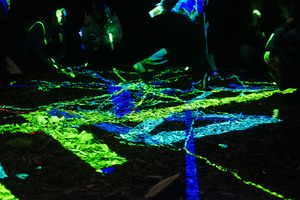
The installation is an immersive experience within a darkened room. The floor is covered in bark mulch and wood, simulating a forest floor complete with the scent of pine and woodland sounds. A powerful top-down projection visualizes the digital fungus. Visitors can interact by uploading their own files via QR code; .HYP "digests" this data, transforming it into ever-evolving, colorful patterns projected onto the organic ground.
- .HYP is a multisensory installation and diploma project from the Karlsruhe University of Arts and Design. It explores the boundaries between digital life and the analog world through a custom developed program that mimics the biological behavior of fungal mycelium.
- Kategorie
- Typ des Projekts/Werks
- Schlagworte
- Sprache
- Material
- Technik/Verfahren/Formate
- coding
- Abmessungen
- 8m x 4,5m
- Dauer
- open end
- Ort: Institution
- Ort
- Großes Studio in der Hochschule für Gestaltung in Karlsruhe
- Stadt
- Land
- Internetlinks
- Titel
- .HYP
- Untertitel
- interactive installation
- Studiengang
- Typ der Abschlussarbeit
- Importiert am
- 05.03.2024
- Übergeordnete Sets
- 1
- Set enthält
- 0 7
I Cried A Smile
Name that can easily go onto 2 lines
Author that can easily go onto 2 lines as well
- Titel
- I Cried A Smile
- Autor/in
- Beschreibung (de)
- Mit den Mitteln einer wissenschaftlichen Lecture erzählt „I Cried A Smile“ eine Geschichte über eine Person mit 2 Köpfen, Holz das zu Menschen wird, und die Erinnerung daran als Kind mit Neuropsychologie in Kontakt zu treten. Zwei übereinander hängende Projektionsflächen zeigen Zeichnungen, Animationen und gefundenes Bildmaterial während meine Stimme vom Band läuft und ich an einem Schreibtisch sitzend, mit dem Verfahren „Lip-Sync“ lautlos mitspreche. Das Publikum sitzt wie in einem anatomischen Theater in zwei Halbkreisen um mich herum.
- Beschreibung (en)
- Using the means of a scientific lecture, “I Cried A Smile” tells a story about a person with two heads, wood that becomes human, and the memory of coming into contact with neuropsychology as a child. Two projection screens hanging above me showcasing drawings, animations and found footage while my voice runs from the tape and I, sitting at a desk, speak along inaudibly using the “Lip-Sync” method. The audience sits around me like in an anatomical theater.
- Using the means of a scientific lecture, “I Cried A Smile” tells a story about a person with two heads, wood that becomes human, and the memory of coming into contact with neuropsychology as a child. Two projection screens hanging above me showcasing drawings, animations and found footage while my voice runs from the tape and I, sitting at a desk, speak along inaudibly using the “Lip-Sync” method. The audience sits around me like in an anatomical theater.
- Kategorie
- Typ des Projekts/Werks
- Schlagworte
- Mitwirkende
- Technik/Verfahren/Formate
- 2 Channel Video
- Dauer
- 8 Minuten
- Ort: Institution
- Stadt
- Land
- Titel
- I Cried A Smile
- Importiert am
- 30.09.2024
- Übergeordnete Sets
- 1
- Set enthält
- 0 5
In Defense of Mis Caprichos
Name that can easily go onto 2 lines
Author that can easily go onto 2 lines as well
- Titel
- In Defense of Mis Caprichos
- Untertitel
- When someone says you canʼt do something. Do it twice, and take pictures.
- Autor/in
- Beschreibung (de)
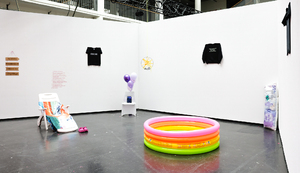
- "In Defense of Mis Caprichos" ist eine multimediale Ausstellung, die auf einem selbst kuratierten Archiv von 140 gefundenen und eigenen Bildern basiert. Sie setzt sich mit der vernakulären Bildsprache Lateinamerikas auseinander – von Memes und persönlichen Fotos bis zu Screenshots. Viele Bilder sind durch digitale Verbreitung nur in niedriger Auflösung erhalten und spiegeln so die visuelle Textur des Internets wider. Sie vermitteln eine Sensibilität, die sich nicht erklären lässt, sondern sich durch Stimmung, Ton und Wiederholung entfaltet. Viele der Bilder stammen aus oder zeigen Kontexte des Globalen Südens und verstehen sich als Hommage an dortige alltägliche, informelle Gesten. Zusammen bilden sie eine visuelle Sprache, die intim, vielschichtig, instabil und oft humorvoll ist.
Das Projekt bezieht sich auf Hal Fosters Aufsatz "An Archival Impulse", der das Archivieren als künstlerische Praxis versteht und Fragmentierung der Kohärenz vorzieht – zentrale Konzepte für dieses sich stetig wandelnde Archiv. Daraus wurden zehn künstlerische Objekte entwickelt, die die Skurrilitäten der Sammlung erfassen: Repliken, Performances oder hybride Assemblagen. Ihre Logik beruht auf Aneignung, Kopie und Transformation – im Sinne Byung-Chul Hans, der Replikation als kreative Strategie für neue Bedeutungen begreift.
Einige Werke greifen konkrete Bilder auf: Eine Performance, bei der ein Plastikpool auf einem Motorrad transportiert wird, bezieht sich auf ein Archivbild. Ein anderes verwandelt einen falsch übersetzten Tweet in ein dekoratives Holzschild. Ein drittes ist ein Traumfänger aus gelber Unterwäsche – inspiriert von einem kolumbianischen Neujahrsbrauch, wonach gelbe Unterwäsche Glück bringen soll.
Ein zentrales Element ist eine Videoarbeit, die das gesamte Archiv in Endlosschleife zeigt, begleitet von Texten aus unterschiedlichen Quellen: akademisch, persönlich oder aus sozialen Medien. Die Anordnung ist nicht erklärend, sondern atmosphärisch. Die Ausstellung schafft einen hierarchiefreien Raum, der Intuition, spielerische Ernsthaftigkeit und visuelle Alltagskulturen in den Mittelpunkt stellt.
- "In Defense of Mis Caprichos" ist eine multimediale Ausstellung, die auf einem selbst kuratierten Archiv von 140 gefundenen und eigenen Bildern basiert. Sie setzt sich mit der vernakulären Bildsprache Lateinamerikas auseinander – von Memes und persönlichen Fotos bis zu Screenshots. Viele Bilder sind durch digitale Verbreitung nur in niedriger Auflösung erhalten und spiegeln so die visuelle Textur des Internets wider. Sie vermitteln eine Sensibilität, die sich nicht erklären lässt, sondern sich durch Stimmung, Ton und Wiederholung entfaltet. Viele der Bilder stammen aus oder zeigen Kontexte des Globalen Südens und verstehen sich als Hommage an dortige alltägliche, informelle Gesten. Zusammen bilden sie eine visuelle Sprache, die intim, vielschichtig, instabil und oft humorvoll ist.
- Beschreibung (en)
- In Defense of Mis Caprichos is a multimedia exhibition based in a self-curated archive of 140 found and self-produced images that reflect the vernacular visual language of Latin America. These images—ranging from memes and personal photographs to screenshots— carry a distinct sensibility: one that resists explanation and instead unfolds through mood, tone, and repetition. Often low in resolution due to constant digital circulation, the images reflect the visual texture of the internet. Many celebrate vernacular and informal gestures, circulating quickly across digital platforms to form a visual language that is intimate, layered, unstable, and often humorous.
The work draws on Hal Foster’s An Archival Impulse, where archiving is seen as an artistic practice and a preference for fragmentation over coherence reflects a deliberate artistic strategy.
From this archive, ten objects were developed, each guided by a specific premise. Some take the form of replicas, others of performances or hybrid assemblages. These objects operate as attempts to “grasp” the underlying sensibility of the archive. Their logic often draws on the aesthetics of appropriation, copying, and transformation—resonating with Byung-Chul Han’s Shanzhai: Deconstruction in Chinese, where copying and sampling are understood as creative strategies capable of generating new meaning.
A second core component of the exhibition is a video slideshow that presents the full image archive in a loop. The video has no beginning and no end, as it is conceived as a work in progress—the archive is constantly evolving. Each image is accompanied by 1–2 lines of text drawn from diverse sources: academic texts, social media posts, and personal writings. The arrangement is not explanatory but atmospheric, evoking how Susan Sontag, in Notes on Camp, approaches a sensibility not through linear explanation but through curation and juxtaposition.
In Defense of Mis Caprichos does not seek resolution or synthesis. Instead, it inhabits a space of connection without hierarchy. It is an argument for intuition, for playful seriousness, and for honoring the seemingly trivial gestures we encounter every day.
- In Defense of Mis Caprichos is a multimedia exhibition based in a self-curated archive of 140 found and self-produced images that reflect the vernacular visual language of Latin America. These images—ranging from memes and personal photographs to screenshots— carry a distinct sensibility: one that resists explanation and instead unfolds through mood, tone, and repetition. Often low in resolution due to constant digital circulation, the images reflect the visual texture of the internet. Many celebrate vernacular and informal gestures, circulating quickly across digital platforms to form a visual language that is intimate, layered, unstable, and often humorous.
- Kategorie
- Typ des Projekts/Werks
- Schlagworte
- Dank an
- Sprache
- Material
- Technik/Verfahren/Formate
- Diashow / Skulptur / Performance
- Ort: Institution
- Ort
- Lichthof 4
- Stadt
- Land
- Titel
- In Defense of Mis Caprichos
- Untertitel
- When someone says you canʼt do something. Do it twice, and take pictures.
- Projektleiter/in
- Semester
- Studiengang
- Typ der Abschlussarbeit
- Importiert am
- 27.06.2025
- Übergeordnete Sets
- 2
- Set enthält
- 4 2
“I see” “with my voice”
Name that can easily go onto 2 lines
Author that can easily go onto 2 lines as well
- Titel
- “I see” “with my voice”
- Autor/in
- Beschreibung (de)
- „I see“ „with my voice“ beschäftigt sich mit Themen wie Transformation, Gestaltwandel und Materialität durch ein Zusammenspiel von literarischen Fragmenten und entliehenen Stimmen. Das Ergebnis ist eine nicht-lineare, fluide Erzählung, die die flüchtige Natur von Visionen, Träumen und Metamorphosen einfängt.
- Beschreibung (en)
- “I see” “with my voice” engages with themes of transformation,
shapeshifting, and materiality through an interplay of literary
fragments and borrowed voices, resulting in a non-linear, fluid
narrative that encapsulates the ephemeral nature of visions,
dreams, and metamorphoses.
This project draws substantial inspiration from Alice Notley's
The Descent of Alette, a transformative odyssey that employs
rhythmic spoken language to explore continuous change.
Alongside Notley’s influence, the works of Hildegard von Bingen,
a 12th-century mystic, and the visionary narratives from the
biblical book of Ezekiel, serve as foundational texts that inform
the thematic and structural framework of this piece.
The text is presented as an audio recording, whispered as a 20 minute loop.
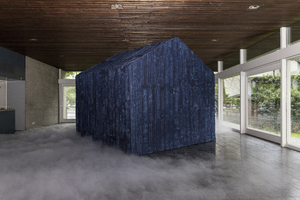
Visitors can listen to the piece when pressing their ear against the tents walls.
My objects are performers, maybe even imposters: frozen in a state of change or mimicry. My objects are performers, maybe even imposters: frozen in a state of change or mimicry.
They are skillfull imitators, but you can tell something is off.
Moving along this crack between the believable and the not quite right, I like to engage
with different realities and states of being. The artificial, almost real-life fakeness of their with different realities and states of being. The artificial, almost real-life fakeness of their
surfaces set the stage for my narrative of transformation, imitation and shapeshifting.
1. A wooden house crafted from smooth denim. Made by sanding the grain of wood
onto the denim fabric
2. Heavy fog covering the floor that could be perceived as dew, mixed with a light subtle
smoke of Incense burning.
The fragrance envokes sacred, holy feelings with its warm, resinous smell with peppery The fragrance envokes sacred, holy feelings with its warm, resinous smell with peppery
undertones.
3. 100 cherries made from a thick mixture of honey and almonds. The heavy sweetness
of the stoneless candy-imposter meant to linger in the visitors mouth as it is tasted. of the stoneless candy-imposter meant to linger in the visitors mouth as it is tasted.
A thin gelatine film – imitating the coolnes of cherry skin as it touches the lips A thin gelatine film – imitating the coolnes of cherry skin as it touches the lips
The installation is accompanied by a small reader containing the three part text to be taken The installation is accompanied by a small reader containing the three part text to be taken
home and serve as a keep sake or document of the fleeting spoken text.
The reader is bound with one simple staple. It does not have a beginning or end, but The reader is bound with one simple staple. It does not have a beginning or end, but
rather works like a gif. No cover or back. Just like wheels turning endlessly in a nonlinear rather works like a gif. No cover or back. Just like wheels turning endlessly in a nonlinear
storytelling.
- “I see” “with my voice” engages with themes of transformation,
- Kategorie
- Typ des Projekts/Werks
- Schlagworte
- Datierung
- 18.04.2024
- Sprache
- Ort: Institution
- Ort
- “I see” “with my voice” at ZKM Pavillon, Karlsruhe
- Stadt
- Land
- Titel
- “I see” “with my voice”
- Projektleiter/in
- Semester
- Studiengang
- Typ der Abschlussarbeit
- Importiert am
- 19.09.2024
- Übergeordnete Sets
- 0
- Set enthält
- 0 2
It's okay now
Name that can easily go onto 2 lines
Author that can easily go onto 2 lines as well
- Titel
- It's okay now
- Titel (en)
- It's okay now
- Autor/in
- Beschreibung (de)
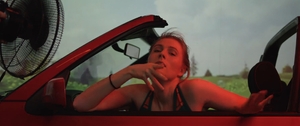
- "It’s okay now" ist ein autobiografisches Werk, das durch die Praxis des Erinnerns die Herkunft und Identität der beiden Protagonistinnen hinterfragt, analysiert und miteinander vergleicht. Das Erinnern dient dabei nicht nur als Mittel der Reflexion, sondern auch als eine Form des Träumens und Verarbeitens von Vergangenem. Fiktionale Szenen und Archivmaterial verweben sich zu einer Erzählung, die persönliche und kollektive Erinnerungen miteinander verschmelzen lässt.
- Beschreibung (en)
- "It’s okay now" is an autobiographical work that, through the practice of remembering, questions, analyzes, and compares the origins and identities of the two protagonists. In this process, remembering serves not only as a tool for reflection but also as a form of dreaming and processing the past. Fictional scenes and archival material intertwine to create a narrative that fuses personal and collective memories.
- Kategorie
- Typ des Projekts/Werks
- Schlagworte
- Datierung
- 01.10.2024 - 04.10.2024
- Mitwirkende
- Dank an
- Sprache
- Untertitel (Film)
- Material
- Technik/Verfahren/Formate
- 3-Kanal-Video-Audio Rauminstallation
- Abmessungen
- Breite: 10m; Tiefe: 10m; Höhe 4,5m
- Dauer
- 45 min
- Ort: Institution
- Ort
- Großes Studio
- Stadt
- Land
- Beteiligte Institution(en)
- Titel
- It's okay now
- Projektleiter/in
- Semester
- Studiengang
- Typ der Abschlussarbeit
- Archiv-Signatur
- its okay now
- Importiert am
- 10.10.2024
- Übergeordnete Sets
- 3
- Set enthält
- 0 11
Known Unknown
Name that can easily go onto 2 lines
Author that can easily go onto 2 lines as well
- Titel
- Known Unknown
- Autor/in
- Beschreibung (de)
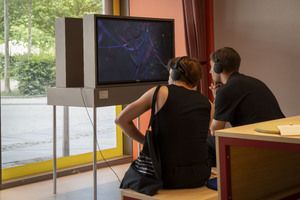
- KNOWN UNKNOWN ist eine politisch-künstlerische Installation über die Kontinuitäten rechter Gewalt in Deutschland und das Versagen staatlicher Institutionen im NSU-Komplex. Das 15-minütige audiovisuelle Werk basiert auf über anderthalb Jahren Recherchearbeit und verbindet dokumentarisches Archivmaterial, narrative Textarbeit und digitale Visualisierung.
Das Hörstück rückt die Perspektiven der Betroffenen in den Mittelpunkt – ebenso wie die Lücken in der Aufarbeitung und die Namen jener, die direkt oder indirekt zur Existenz des NSU beigetragen haben: durch aktives Handeln, Mitwissen oder institutionelles Wegsehen. In seinem dokumentarischen Charakter benennt es Täter, Behördenverantwortliche und politische Akteure, zeigt Archivmaterial und gibt Raum für die Stimmen der Überlebenden und Angehörigen. Die Sprecherin führt durch das dichte Material stets mit dem Anspruch, Zuhörenden Zugang zu einer eigenen Haltung zu lassen.
Parallel dazu entstand eine digitale 3D-Installation – ein abstraktes, mehrdimensionales Netz, das die Komplexität des NSU-Unterstützernetzwerks visualisiert: jenes Geflecht, das im offiziellen Narrativ oft ausgespart bleibt. Die Installation übersetzt die Recherche räumlich und visuell, macht Strukturen erfahrbar, Knotenpunkte sichtbar und zeigt: Der NSU bestand nicht nur aus drei Personen, sondern war eingebettet in ein weit verzweigtes System aus Neonazi-Strukturen, V-Leuten, Behörden und gesellschaftlicher Ignoranz.
Erst im Zusammenwirken von Hörstück und Installation entfaltet sich das Narrativ vollständig: Das Netz beginnt zu sprechen, sobald es eine Stimme erhält – kollektives Zuhören statt Schweigen. KNOWN UNKNOWN richtet sich gegen die Vorstellung eines „Schlussstrichs“ und lädt zur aktiven Auseinandersetzung ein. Im Dialog zwischen Stimme, Stille, Raum und Visualisierung entsteht ein dichtes, forderndes und reflexives Werk.
- KNOWN UNKNOWN ist eine politisch-künstlerische Installation über die Kontinuitäten rechter Gewalt in Deutschland und das Versagen staatlicher Institutionen im NSU-Komplex. Das 15-minütige audiovisuelle Werk basiert auf über anderthalb Jahren Recherchearbeit und verbindet dokumentarisches Archivmaterial, narrative Textarbeit und digitale Visualisierung.
- Kategorie
- Typ des Projekts/Werks
- Mitwirkende
- Sprache
- Material
- Dauer
- 15min
- Ort: Institution
- Stadt
- Land
- Beteiligte Institution(en)
- Titel
- Known Unknown
- Projektleiter/in
- Semester
- Studiengang
- Lehrveranstaltung
- Importiert am
- 18.06.2025
- Übergeordnete Sets
- 1
- Set enthält
- 0 9
Leaving on a High Note
Name that can easily go onto 2 lines
Author that can easily go onto 2 lines as well
- Titel
- Leaving on a High Note
- Autor/in
- Beschreibung (de)
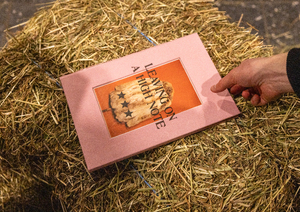
- "Leaving on a High Note" ist eine Reflexion über Schönheit und das Medium Buch. Die Arbeit bringt vielfältiges visuelles Material, von gescannten Fotografien und Kunstwerken über handgezeichnete Textilmuster bis hin zu in Auftrag gegebenen künstlerischen Beiträgen, zusammen. Als eine Art poetisches Moodboard geht das Projekt der Frage nach, wie sich Atmosphäre, Schönheit und visuelle Intuition durch Kuration im Zusammenspiel mit materiellen Entscheidungen formen lassen. Das Papier wurde akribisch gewählt, um die Betrachtung um eine haptische Ebene zu erweitern. Die Bindung durch den Rücken des Hardcovers verweist auf den konzeptuellen, redaktionellen und praktischen Prozess, der zum finalen Objekt geführt hat. Das Buch enthält künstlerische Beiträge von Alva Bücking sowie Zeichnungen von Charlotte Singer.
"Leaving on a High Note" wurde im Rahmen einer Ausstellung gezeigt, die die Stimmung des Buches in den Raum übertrug. Die Soirée fand am 17. Dezember 2025 im ZKM Pavillon in Karlsruhe statt und umfasste eine Installation und eine Chorperformance. Der Chor wurde von Leonie Inga Klopstock geleitet und mit von Anton Schüler designten Krägen ausgestattet.
- "Leaving on a High Note" ist eine Reflexion über Schönheit und das Medium Buch. Die Arbeit bringt vielfältiges visuelles Material, von gescannten Fotografien und Kunstwerken über handgezeichnete Textilmuster bis hin zu in Auftrag gegebenen künstlerischen Beiträgen, zusammen. Als eine Art poetisches Moodboard geht das Projekt der Frage nach, wie sich Atmosphäre, Schönheit und visuelle Intuition durch Kuration im Zusammenspiel mit materiellen Entscheidungen formen lassen. Das Papier wurde akribisch gewählt, um die Betrachtung um eine haptische Ebene zu erweitern. Die Bindung durch den Rücken des Hardcovers verweist auf den konzeptuellen, redaktionellen und praktischen Prozess, der zum finalen Objekt geführt hat. Das Buch enthält künstlerische Beiträge von Alva Bücking sowie Zeichnungen von Charlotte Singer.
- Beschreibung (en)
- "Leaving on a High Note" is a reflection on beauty as well as on bookmaking. It is a collection of diverse visual material ranging from scanned photography and artworks to hand-drawn textile patterns and commissioned artistic contributions. It functions as a poetic moodboard, exploring how atmosphere, beauty and visual intuition can be shaped through curation and material decisions. The paper was chosen meticulously in order to introduce a refined tactile experience to the act of viewing. The work is bound with thread punched through the hardcover spine, referencing the conceptual, editorial and practical process that led to the final object. The book includes commissioned work by Alva Bücking as well as drawings by Charlotte Singer.
"Leaving on a High Note" was shown in an exhibition that translated the book’s mood into the space. The soirée took place at the ZKM Pavillon in Karlsruhe on December 17, 2025 and featured an installation alongside a choir performance. The choir was conducted by Leonie Inga Klopstock and outfitted with collars by Anton Schüler.
- "Leaving on a High Note" is a reflection on beauty as well as on bookmaking. It is a collection of diverse visual material ranging from scanned photography and artworks to hand-drawn textile patterns and commissioned artistic contributions. It functions as a poetic moodboard, exploring how atmosphere, beauty and visual intuition can be shaped through curation and material decisions. The paper was chosen meticulously in order to introduce a refined tactile experience to the act of viewing. The work is bound with thread punched through the hardcover spine, referencing the conceptual, editorial and practical process that led to the final object. The book includes commissioned work by Alva Bücking as well as drawings by Charlotte Singer.
- Kategorie
- Typ des Projekts/Werks
- Schlagworte
- Datierung
- 17.12.2025
- Mitwirkende
- Dank an
- Paul Bailey
- Vincent Carl Becher
- Alva Bücking
- Rahel Diederich
- Till Engelhardt
- Marie Faaß
- Line-Gry Hørup
- Dans Jirgensons
- Tobias Keilbach
- Leonie Inga Klopstock
- Susanne Kriemann
- Ida Kuczewski
- Barbara Kuon
- Isabel Motz
- Tereza Ruller
- Luis Rüttiger
- Jana Schmeckenbecher
- Anton Schüler
- Isabel Seiffert
- Moritz Kamil Simon
- Charlotte Singer
- Lilith Stumpf
- Pierre Zimmer
- Petra Zimmermann
- HfG Chor
- Sprache
- Ort: Institution
- Stadt
- Land
- Titel
- Leaving on a High Note
- Projektleiter/in
- Semester
- Studiengang
- Typ der Abschlussarbeit
- Importiert am
- 05.01.2026
- Übergeordnete Sets
- 0
- Set enthält
- 0 10
LET ME SEE (c) THE SUN
Name that can easily go onto 2 lines
Author that can easily go onto 2 lines as well
- Titel
- LET ME SEE (c) THE SUN
- Autor/in
- Beschreibung (de)
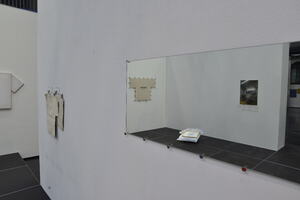
- Die Diplomarbeit „LET ME SEE (c) THE SUN“ setzt sich mit Sprache und Kommunikation auseinander, wobei das Medium Kleidung als Sprachrohr von Geschichten und als Bote von Identitäten analysiert werden soll.
Die ausgestellten Arbeiten greifen visuelle Elemente von Theaterkostümen, Bühnenrequisiten und Umkleidekabinen auf, um Besucher*innen einzuladen, sich selbst als Performer*innen von Sprache und Identität wahrzunehmen. Ein besonderer Schwerpunkt liegt dabei auf grafischen T-Shirts, da diese oft kulturelle Assoziationen oder oberflächliche Identitäten signalisieren (z. B. Bandshirts, Arbeitskleidung). Diese bekannte Struktur wird dekonstruiert und umgebaut, um Betrachter*innen die Bewohnbarkeit von Sprache zu verdeutlichen.
Die begleitende Performance beschäftigt sich mit der Mehrdeutigkeit von Sprache, die stets von persönlicher Interpretation abhängt. Wörter und Texte sind untrennbar mit ihrem Kontext sowie der Art und Weise verbunden, wie und wo sie erscheinen. In den Text-/Textil-Konstruktionen werden Wörter zu Requisiten, die Bedeutungen – sowohl offensichtlich als auch schwer fassbar – tragen und durch das Medium der Requisite von anderen „bewohnt“ werden können.
- Die Diplomarbeit „LET ME SEE (c) THE SUN“ setzt sich mit Sprache und Kommunikation auseinander, wobei das Medium Kleidung als Sprachrohr von Geschichten und als Bote von Identitäten analysiert werden soll.
- Beschreibung (en)
- The diploma project “LET ME SEE (c) THE SUN” deals with language and communication, analyzing the medium of clothing as a mouthpiece for stories and as a messenger of identities.
The exhibited works take up visual elements of theater costumes, stage props and dressing rooms to invite visitors to perceive themselves as performers of language and identity. A particular focus is placed on graphic T-shirts, as these often signal cultural associations or superficial identities (e.g. band shirts, work clothes). This familiar structure is deconstructed and rebuilt to show viewers the habitability of language.
The accompanying performance deals with the ambiguity of language, which always depends on personal interpretation. Words and texts are inextricably linked to their context and how and where they appear. In the text/textile constructions, words become props that carry meanings - both obvious and elusive - and can be “inhabited” by others through the medium of the prop.
- The diploma project “LET ME SEE (c) THE SUN” deals with language and communication, analyzing the medium of clothing as a mouthpiece for stories and as a messenger of identities.
- Kategorie
- Typ des Projekts/Werks
- Schlagworte
- Datierung
- 15.01.2025
- Mitwirkende
- Dank an
- Paul Bailey
- Jonathan Blaschke
- Céline Condorelli
- Amelie Enders
- Till Engelhardt
- Kira Fuchs
- Line-Gry Hørup
- Rafael Jörger
- Chiara Kern
- Simon Knebl
- Florian Knöbl
- Alexander Knoppik
- Barbara Kuon
- James Langdon
- Nina Overkott
- Leo Schick
- Henriette Schwabe (Jette Schwabe)
- Neele Seidel
- Isabel Seiffert
- Moritz Kamil Simon
- Charlotte Singer
- Niklas Weisenbach
- Maximilian Zschiesche
- Sprache
- Material
- Ort: Institution
- Ort
- Lichthof 3
- Stadt
- Land
- Titel
- LET ME SEE (c) THE SUN
- Projektleiter/in
- Semester
- Studiengang
- Typ der Abschlussarbeit
- Importiert am
- 11.02.2025
- Übergeordnete Sets
- 3
- Set enthält
- 0 11