About Fighting the Fear (of the World)
Benachbarte Sets (152)Alle Zusammenhänge anzeigen
Diese Sets wurden den gleichen Sets hinzugefügt wie das ausgewählte Set.
152 Inhalte
- Seite 1 von 13
Ambassadors
Name that can easily go onto 2 lines
Author that can easily go onto 2 lines as well
- Titel
- Ambassadors
- Titel (en)
- Ambassadors
- Untertitel
- 12 stories of artificial survival
- Untertitel des Projekts/Werks (en)
- 12 stories of artificial survival
- Autor/in
- Beschreibung (de)
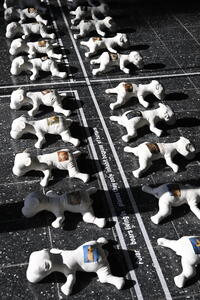
- AMBASSADORS ist eine installative Sammlung, bestehend aus 120 Stofftieren, die das Verhältnis der Konzepte vom Natürlichen und Künstlichen anhand des Eisbären in menschlicher Gefangenschaft beleuchtet. Im Kampf um die Klimakrise ist der Eisbär zum Symbolbild der zu schützenden Natur geworden und hat sich als solches zum Repräsentanten in das kollektive Gedächtnis eingebrannt. KI-generierte Bilder, von denen jeweils 10 eine der 12 Geschichten in der Installation visualisieren, wurden einzeln auf die Rücken der 120 Stofftiere übertragen und gemeinsam in ein immersives Wimmelbild verwoben. So werden die Stofftiere in der Installation zu Botschaftern einer künstlichen Population und verlängern damit, ohne Lebewesen Leid zuzufügen, die Ketten an Abbildungen von Abbildungen von etwas, das mal natürlich war.
- Beschreibung (en)
- Ambassadors is an installation consisting of 120 stuffed animals that explores the relation between the natural and the artificial through the lens of the polar bear in human captivity. In the fight against the climate crisis, polar bears haves become a symbolic image of nature in need of protection—an image that has etched itself into the collective memory. Each set of ten AI-generated images represents one of the twelve stories depicted in the installation. These images were transferred individually onto the backs of the 120 stuffed animals and collectively woven into an immersive Wimmelbild. In this way, the stuffed animals once again become ambassadors of an artificial population—extending the chain of representations of representations of something that once was natural, without causing harm to living beings.
- Kategorie
- Schlagworte
- Mitwirkende
- Material
- Titel
- Ambassadors
- Untertitel
- 12 stories of artificial survival
- Projektleiter/in
- Semester
- Studiengang
- Typ der Abschlussarbeit
- Importiert am
- 29.09.2025
- Übergeordnete Sets
- 3
- Set enthält
- 0 8
A man in the shape of...
Name that can easily go onto 2 lines
Author that can easily go onto 2 lines as well
- Titel
- A man in the shape of...
- Titel (en)
- A man in the shape of...
- Autor/in
- Beschreibung (de)
- „A man in the shape of...“ ist eine von Calvin Kudufia realisierte Ausstellung, die Februar 2024 im Rahmen seines Diploms stattfand. In der Ausstellung beschäftigt sich Kudufia mit der metaphorischen Praxis des Sammelns und Verdichtens: „gathering time and binding it“, wie es die dänische Dichterin Inger Christensen in ihrem Gedicht „Alphabet“ (1981) formuliert hat. Scheinbar unzusammenhängende ‚Dinge‘ werden im Gedicht zusammengetragen und durch die einfache Verwendung eines einzelnen Wortes, des "Existierens" in Zusammenhang gebracht und bedeutsam gemacht. Allein die Geste des Zusammentragen und Benennens verstärkt ihre symbolische Kraft.
Durch einen losen Kontaktpunkt in 2019 begann Kudufias Recherche an der Sepulkralkultur der fantasy coffins, einem traditionellen Kunsthandwerk der Ga-Ethnie in Ghana. Die individuell gestalteten Särge folgen einem mündlich überlieferten Bildindex und sind stellvertretende Gefäße für das ins Jenseits übertretende Leben. Die ‚fantasy coffins‘ verhüllen nicht nur den physischen Körper, ihre Hülle trägt konkrete Spuren der in ihnen gefassten Existenz.
Wie alle Gefäße schirmen die ‚fantasy coffins‘ ihren Inhalt vor den Blicken der Umgebung ab. Im selben Moment dienen sie als repräsentativer Körper des Verstorbenen. Die Suche nach dem richtig geformten Gefäß, sei es ein Weidenkorb für Früchte, ein Buch für Worte oder im Fall der ‚fantasy coffins‘ ein Fischernetz für Fischer, stellt die Suche nach Signifikanz des eigenen Lebens dar: eine treffende Metapher für die Odyssee des Lebens.
In seiner Arbeit „A man in the shape of...“ macht Kudufia sein väterliches Haus in Tema (Ghana) zum physischen Ausgangspunkt seiner Recherche. In Form einer trans-medialen Erzählung wird dessen Essenz eingefangen und greifbar gemacht. Poetische Artefakte und Beobachtungen aus dem Alltag in Ghana werden sorgfältig arrangiert und dienen als Verdinglichung von Zeit. Sie dienen als greifbare Säulen von Kudufias Zeit in Ghana.
„A man in the shape of...“ trägt der angeborenen Sehnsucht nach einer konkreten geografischen Verankerung Rechnung. Kudufia nutzt die gesamte Ausstellung als metaphorischen Fingerzeig auf einen Ort auf der Landkarte.
In Form einer Audioübertragung, einer speziellen Sitzposition auf der Nachbildung eines traditionellen Hockers, referentiellen Bautechniken und einer Dreikanal-Videoinstallation wird diese geografische Verankerung konkret vermittelt. Durch die Untersuchung der Rolle von Ritualen bei der Gestaltung unseres Zugehörigkeitsgefühls, inspiriert durch die philosophischen Überlegungen von Byung Chul Han, bietet die Ausstellung ein Fenster zu einer Kultur, die gleichzeitig vertraut und fremd ist.
Im Mittelpunkt der Ausstellung steht eine Videoinstallation, die in sieben Abschnitte unterteilt ist. Die Aufteilung bezieht sich auf die Tradition der „one-week observation“ und beschreibt jeweils eine Facette von Kudufias persönlicher Reise. Das Video wird begleitet von einem Musikstück der ghanaischen Theatermacherin Edufa T. Sutherland, das mit der Unterstützung des Cellisten Ben Grocock gespielt und aufgenommen wurde. Das Video lässt Kudufias Erinnerungen, Fiktionen und Realitäten verschwimmen und vermischt dabei die Identitäten von Kudufia mit denen seines Vaters und Großvaters und lässt so ein komplexes Netz aus Zugehörigkeiten entstehen.
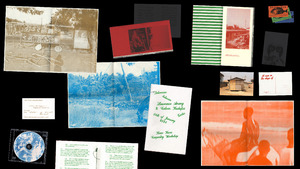
Eine Publikation, die integraler Bestandteil der Ausstellung ist, bedient sich der Form eines Gefäßes. Eine bedruckte Archivbox sammelt Kudufias Spuren auf seiner Suche nach den ‚fantasy coffins‘ und wird durch eine Hand voll ephemeraler Druckprodukte und Publikationen zum Dokumentationsapparat. Im Mittelpunkt der Archivbox steht ein Interview, zwischen Kudufia und dem Sargmacher Lawrence Anang in dessen Werkstatt in Teshie. Die einzige textliche Spur, die eine klare Verbindung zur Geschichte der Särge herstellt.
Das hölzerne Fundament einer nachgebauten Hütte dient als Sammelpunkt der Ausstellung und ermöglicht die Verbindung zwischen Druckerzeugnissen, Audio, Artefakten und den Betrachtenden. Die Kombination aus gesammeltem haptischen Material und audiovisuellen Arbeiten setzt sich zu einer transmedialen Collage zusammen, in der Kudufia die Geschichte seiner Verwurzelung auf intime Weise erzählt.
- „A man in the shape of...“ ist eine von Calvin Kudufia realisierte Ausstellung, die Februar 2024 im Rahmen seines Diploms stattfand. In der Ausstellung beschäftigt sich Kudufia mit der metaphorischen Praxis des Sammelns und Verdichtens: „gathering time and binding it“, wie es die dänische Dichterin Inger Christensen in ihrem Gedicht „Alphabet“ (1981) formuliert hat. Scheinbar unzusammenhängende ‚Dinge‘ werden im Gedicht zusammengetragen und durch die einfache Verwendung eines einzelnen Wortes, des "Existierens" in Zusammenhang gebracht und bedeutsam gemacht. Allein die Geste des Zusammentragen und Benennens verstärkt ihre symbolische Kraft.
- Beschreibung (en)
- "A man in the shape of..." is an exhibition realised by Calvin Kudufia, which took place in February 2024 as part of his diploma. In the exhibition, Kudufia deals with the metaphorical practice of "gathering time and binding it", as formulated by the Danish poet Inger Christensen. Through a trans-medial narration, the exhibition aims to capture the essence of his father's home in Tema (Ghana) and to make it tangible by carefully compiling poetic artefacts from the observed everyday life in Ghana.
Kudufia's research began with the so-called fantasy coffins, a traditional handicraft practiced by the Ga people of Ghana. The individually designed coffins follow an oral figurative index and are emblematic vessels for life passing into the afterlife. Not only do they conceal the physical body, but their shell bears imprints of the existence that preceded death. To give an example, the vessel of a fisherman might take the form of a boat or fishing net.
Similar to all vessels, they shield their content from its surroundings, simultaneously serving as a representation of the deceased to the eyes of the outside world. The search for the right-shaped vessel, be it a wicker basket for fruit or a book for words, mirrors the journey to discover one's own significance, as displayed figuratively by the fantasy coffins - an apt metaphor for the odyssey of life.
"A man in the shape of..." takes into account the innate longing for a concrete geographical rooting and uses the entirety of the exhibition as a metaphorical finger pointing to a place on the map. This geographical pinning is conveyed in the form of an audio transmission, a special seating position on a replica of a traditional stool, referential construction techniques and a three-channel video installation. By examining the role of rituals in shaping our sense of belonging, inspired by the philosophical reflections of Byung Chul Han, the exhibition offers a window into a culture that is both familiar and foreign at the same time.
At the heart of the exhibition is a video installation divided into seven segments referring to the tradition of the one-week observation, each describing a facet of Kudufia's personal journey. The video installation is accompanied by a musical piece composed by Edufa T. Sutherland, played and recorded with the assistance of cellist Ben Grocock. It blurs the boundaries between memory, fiction, and reality, inviting the viewer to reflect on the complexity of cultural identity and belonging.
The publication, an integral part of the exhibition, also takes the form of a vessel. Borrowing the shape of a printed archive box it collects Kudufia's traces on his search for the fantasy coffins and is conveyed through his graphic expression. At its center is an interview he conducted with coffin maker Lawrence Anang in his workshop in Teshie, the sole textual trace of the coffins' history.
In order to bring all of the pieces together, a wooden fundament of a hut serves as the gathering point of the exhibition, enabling the connection between printed matter, audio, artefacts, and the viewers.
The collected haptic material combined with the audiovisual pieces results in a trans-medial collage in which Kudufia intimately tells the story of his rooting.
- "A man in the shape of..." is an exhibition realised by Calvin Kudufia, which took place in February 2024 as part of his diploma. In the exhibition, Kudufia deals with the metaphorical practice of "gathering time and binding it", as formulated by the Danish poet Inger Christensen. Through a trans-medial narration, the exhibition aims to capture the essence of his father's home in Tema (Ghana) and to make it tangible by carefully compiling poetic artefacts from the observed everyday life in Ghana.
- Kategorie
- Typ des Projekts/Werks
- Schlagworte
- Datierung
- 22.02.2024
- Dank an
- Sprache
- Material
- Ort: Institution
- Ort
- Lichthof 04
- Stadt
- Land
- Titel
- A man in the shape of...
- Projektleiter/in
- Semester
- Studiengang
- Typ der Abschlussarbeit
- Importiert am
- 31.05.2024
- Übergeordnete Sets
- 4
- Set enthält
- 0 21
all the things you are.
Name that can easily go onto 2 lines
Author that can easily go onto 2 lines as well
- Titel
- all the things you are.
- Untertitel
- Die Lebenszeichen von Wolfgang Schmidt
- Untertitel des Projekts/Werks (en)
- Signs of life from Wolfgang Schmidt
- Autor/in
- Beschreibung (de)
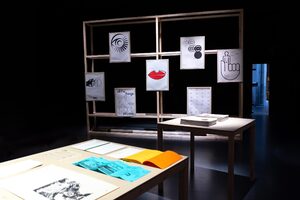
- Der Künstler und Grafiker Wolfgang Schmidt (* 24. Juli 1929; † 8. März 1995) begann 1972 mit der Gestaltung seines individuellen Zeichensystems: Den Lebenszeichen. Bis 1979 waren von den geplanten 893 Zeichen 262 fertiggestellt, in Kombination miteinander ergeben sich aus ihnen über 394 Variationen. [...] Die Ausstellung "all the things you are." geht diesem Katalog nach und zeigt neben originalen Drucken, auch eine Auswahl an Manuskripten und Plänen. [...] Die Exponate in der Ausstellung werden durch neu entstandene Arbeiten ergänzt, welche die durch Schmidts Zeichensystem aufgeworfenen Fragen nach Identität, Emotion und Kommunikation aufgreifen.
- Beschreibung (en)
- The artist and graphic designer Wolfgang Schmidt (* July 24, 1929; † March 8, 1995) began designing his individual sign system in 1972: the signs of life. By 1979, 262 of the planned 893 signs had been completed; in combination with each other, they resulted in over 394 variations. [...] The exhibition "all the things you are." explores this catalog and shows original prints as well as a selection of manuscripts and plans. [...] The exhibits in the exhibition are supplemented by newly created works that address the questions of identity, emotion and communication raised by Schmidt's system of signs.
- Kategorie
- Typ des Projekts/Werks
- Schlagworte
- Mitwirkende
- Ort: Institution
- Ort
- Großes Studio
- Stadt
- Land
- Bemerkungen
- Digitalisierung der Lebenszeichen:
Massimiliano Audretsch, Jona Dienst, Rana Karan & Alper Kazokoglu, Victoria Langmann, Yannick Nuss, Felix Plachtzik, Bernadeta Rimutyte
Gestaltung der Lebenszeichen Hoodies:
Janina Capelle und Hanna Scherwinski
Leihgaben: Anke Schabacker, Inez Franksen, INTeF Darmstadt
Sponsoring und Unterstützung:
Stiftung Landesbank Baden-Württemberg
Kulturbüro Karlsruhe
AStA der Staatlichen Hochschule für Gestaltung Karlsruhe
Badischer Kunstverein
DUSS Maschinenfabrik
Leitner Ausstellungssysteme
- Digitalisierung der Lebenszeichen:
- Titel
- all the things you are.
- Untertitel
- Die Lebenszeichen von Wolfgang Schmidt
- Projektleiter/in
- Semester
- Studiengang
- Typ der Abschlussarbeit
- Importiert am
- 14.06.2024
- Übergeordnete Sets
- 2
- Set enthält
- 0 6
A Factor of Evolution - Triangel Studio
Name that can easily go onto 2 lines
Author that can easily go onto 2 lines as well
- Titel
- A Factor of Evolution - Triangel Studio
- Titel (en)
- A Factor of Evolution - Triangel Studio
- Autor/in
- Beschreibung (en)
- We live in times of high competition. Survival of the fittest is the omnipresent motto in most fields of human action, especially in the western world. This philosophy was only established about 200 years ago and manifested by Charles Darwin and especially the Social Darwinists at the end of the 19th century. They believed that according to a law of nature, only the physically strongest and most aggressive individuals and species would survive in the struggle for life. Many Social Darwinists justified therefore capitalism and racism with devastating consequences in the coming decades until nowadays.
Peter Kropotkin is attempting in his philosophical work Mutual Aid: A Factor of Evolution (1902) to dismantle their arguments and based on numerous observations of zoologists and anthropologists, he proves, that the fittest species are the most sociable ones and that sociability develops intelligence, which is the most powerful arm in the struggle for survival. This includes insects, animals and humans. Higher moral sentiments and compassion is also essential for survival in all societies.
The ritual burning of sage in nature should help to cleanse the negative energy of social darwinism in our world and make room for a more cooperative society, that will secure the well-being of all members, even the most weak ones and furthermore facilitate a more sustainable, safe and content society.
- We live in times of high competition. Survival of the fittest is the omnipresent motto in most fields of human action, especially in the western world. This philosophy was only established about 200 years ago and manifested by Charles Darwin and especially the Social Darwinists at the end of the 19th century. They believed that according to a law of nature, only the physically strongest and most aggressive individuals and species would survive in the struggle for life. Many Social Darwinists justified therefore capitalism and racism with devastating consequences in the coming decades until nowadays.
- Typ des Projekts/Werks
- Schlagworte
- Datierung
- 07.06.2024
- Mitwirkende
- Beteiligte Institution(en)
- Titel
- A Factor of Evolution - Triangel Studio
- Importiert am
- 05.06.2024
- Übergeordnete Sets
- 1
- Set enthält
- 0 14
7QM
Name that can easily go onto 2 lines
Author that can easily go onto 2 lines as well
- Titel
- 7QM
- Titel (en)
- 7sqm - inside views
- Untertitel
- Innen(an)sichten
- Autor/in
- Beschreibung (de)
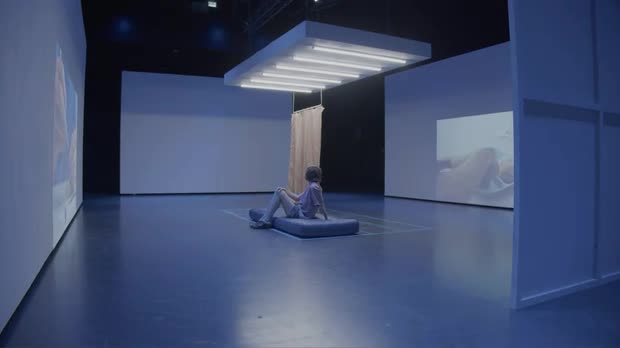
- Was passiert, wenn Individuen in engen, geschlossenen Räumen mit kaum persönlicher, sondern standardisierter, fest verankerter, textilloser Ausstattung leben, in denen sie einer permanenten Überwachung und Kontrolle sowie streng geregelten Tagesabläufen ausgesetzt sind?
Mascha Dilger untersucht die Parameter sanktionierender Räume: Besuche in unterschiedlichen Justizvollzugsanstalten und Interviews mit ehemaligen Inhaftierten werden in der Rauminstallation 7qm - Innen(an)sichten verarbeitet. Realitäten eines vor der Gesellschaft verborgenen und von ihr verdrängten Ortes werden offengelegt.
Die Arbeit beleuchtet, wie aus einem fremdbestimmten, rasterartigen Alltag einer totalen Institution, Versuche der geistigen Flucht und der Selbstbestimmtheit hervorgehen können. Es werden ortsspezifische und subkulturelle Erscheinungsformen betrachtet, die als Überlebensstrategien zu verstehen sind.
- Was passiert, wenn Individuen in engen, geschlossenen Räumen mit kaum persönlicher, sondern standardisierter, fest verankerter, textilloser Ausstattung leben, in denen sie einer permanenten Überwachung und Kontrolle sowie streng geregelten Tagesabläufen ausgesetzt sind?
- Beschreibung (en)
- What happens when individuals live in narrow, confined spaces with hardly any personal but standardized, firmly anchored, textile-less furnishings, in which they are exposed to permanent surveillance and control as well as strictly regulated daily routines?
Mascha Dilger investigates the parameters of sanctioning spaces: visits to various prisons and interviews with former inmates are processed in the spatial installation "7qm - Innen(an)sichten". Realities of a place hidden from society are revealed.
The work illuminates how attempts of mental escape and self-determination can emerge from the grid-like everyday life of a total institution. Site-specific and subcultural manifestations are considered, which are to be understood as survival strategies.
- What happens when individuals live in narrow, confined spaces with hardly any personal but standardized, firmly anchored, textile-less furnishings, in which they are exposed to permanent surveillance and control as well as strictly regulated daily routines?
- Kategorie
- Typ des Projekts/Werks
- Schlagworte
- Datierung
- 11.07.2023 - 12.07.2023
- Mitwirkende
- Dank an
- Zaur Ahlimanov
- Phillip Banian
- Jeremias Beckford
- Sandra Blatterer
- Barbara Bohnen
- Matthias Bruhn
- Richard Brunner
- Céline Condorelli
- Hannah Cooke
- Jaya Demmer
- Lina Determann
- Nicola Dilger
- Alfred Dilger
- Susanne Dilger
- Manfred Döpke
- Nina Eberle
- Kerstin Eisenmenger
- Constanze Fischbeck
- Ebba Fransén Waldhör
- Laura Haak
- Uwe Habel
- Laurine Haller
- Igor Hardt
- Lina Höhne
- Lovis Iglinski
- Martina Kaltenbrunner
- Tobias Keilbach
- Alexander Knoppik
- Katja Koch
- Mikail Kolbasar
- Hanne König
- Susanne Kriemann
- Claudia Kröhl
- Barbara Kuon
- Alexia Metge
- Paulina Mimberg
- Ilja Morgenstern
- Leonie Mühlen
- Minh Anh Nguyen
- Luise Peschko
- Vlado Petrovic
- Milena Petrovic
- Tibor Pilz
- Paul Platz
- Christian Platz
- Waldemar Präg
- Corinne Riepert
- Thomas Rustemeyer
- Sebastian Schäfer
- Max Schäffer
- Philipp Schell
- Susanne Schmitt
- Mischa Schneider
- Waldemar Schwab
- Henriette Schwabe (Jette Schwabe)
- Manuel Sékou
- Alexander Theis
- Alexander Thelen
- Jan Tölle
- Lisa Tölle
- Lioudmila Voropai
- Badaue
- Initiative „Faites Votre Jeu!“
- JVA Mannheim
- JVA Bühl
- Exit - Enter Life e.V.
- AStA
- Sprache
- Material
- Ort: Institution
- Ort
- im großen Studio
- Stadt
- Land
- Beteiligte Institution(en)
- Titel
- 7QM
- Untertitel
- Innen(an)sichten
- Projektleiter/in
- Semester
- Studiengang
- Typ der Abschlussarbeit
- Importiert am
- 26.07.2023
- Übergeordnete Sets
- 3
- Set enthält
- 4 2
25 Grad: Vernissage
Name that can easily go onto 2 lines
Author that can easily go onto 2 lines as well
- Titel
- 25 Grad: Vernissage
- Titel (en)
- 25 Grad: Opening
- Kategorie
- Datierung
- 13.02.2025
- Ort
- Postgalerie Karlsruhe / Kaiserstraße 217 / 76133 Karlsruhe
- Postgalerie Karlsruhe / Kaiserstraße 217 / 76133 Karlsruhe
- Titel
- 25 Grad: Vernissage
- Importiert am
- 24.02.2025
- Übergeordnete Sets
- 1
- Set enthält
- 0 13
25 Grad: Graduierte im Gespräch
- Titel
- 25 Grad: Graduierte im Gespräch
- Beschreibung (de)
- In den zwei Kolloquien tauschen sich Absolvent:innen aus den verschiedenen Disziplinen der HfG über ihre Abschlussarbeiten aus. In offener Runde geben sie einen Einblick in die Entstehung und Entwicklung ihrer Projekte. Das Publikum ist eingeladen, Fragen zu stellen und mit zu diskutieren.
15.02.2025: Julius Bläser, Eike Buff, Lara Landbrecht, Janosch Kratz
22.02.2025: Florian Knöbl, Mona Mayer, Bob Reinert
- In den zwei Kolloquien tauschen sich Absolvent:innen aus den verschiedenen Disziplinen der HfG über ihre Abschlussarbeiten aus. In offener Runde geben sie einen Einblick in die Entstehung und Entwicklung ihrer Projekte. Das Publikum ist eingeladen, Fragen zu stellen und mit zu diskutieren.
- Beschreibung (en)
- In the colloquia, graduates from the various disciplines at the HfG discuss their final projects. In open discussions, they provide an insight into the creation and development of their projects. The audience is invited to ask questions and join in the discussion.
15.02.2025: Julius Bläser, Eike Buff, Lara Landbrecht, Janosch Kratz
22.02.2025: Florian Knöbl, Mona Mayer, Bob Reinert
- In the colloquia, graduates from the various disciplines at the HfG discuss their final projects. In open discussions, they provide an insight into the creation and development of their projects. The audience is invited to ask questions and join in the discussion.
- Typ des Projekts/Werks
- Datierung
- 15.02.2025 und 22.02.2025
- Mitwirkende
- Ort: Institution
- Titel
- 25 Grad: Graduierte im Gespräch
- Importiert am
- 04.03.2025
- Übergeordnete Sets
- 1
- Set enthält
- 0 0