Timothée Charon
| Name | Timothée Charon |
5 Inhalte
- Seite 1 von 1
Umpolen Kollektiv
Name that can easily go onto 2 lines
Author that can easily go onto 2 lines as well
- Titel
- Umpolen Kollektiv
- Titel (en)
- Umpolen Collective
- Autor/in
- Merve Abt
- Klara Beck
- Franka Breunig
- Timothée Charon
- Athina Chrisofakis
- Edona Ibrahimi
- Alexander Johl
- Jule Köpke
- Peter Oellerich
- Anika Osbelt
- Nina Overkott
- Lasse Peters
- Elisabeth Potemkin
- Leo Schick
- Emil Schönert
- Charlot Schümann
- Asimina Sideris
- Estella Staader
- Joscha Thorn
- Laura Waterstradt
- Cédric Weber
- Max Werling
- Camilla Wondrak
- Lando
- Beschreibung (de)
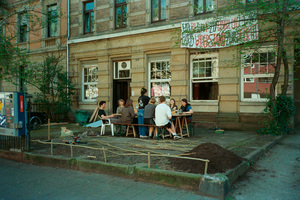
- Umpolen ist ein Kollektiv das leerstehende Räume in Karlsruhe nutzt, um temporäre, nicht-kommerzielle Orte der Begegnung und des Austauschs zu schaffen. Sie dienen als kurzfristige soziokulturelle Veranstaltungs- und Ausstellungsräume, aber auch einfache Treffpunkte. Im Januar 2026 bespielte Umpolen für eine Woche eine ehemalige Wohngemeinschaft in der Karlsruher Südstadt und widmete sich Fragen von Freund*innenschaft und Distanz. Dazu gab es Workshops, “Küche für Alle”, Filmvorführungen, Konzerte und Lesungen.
Seit Mai 2026 baut Umpolen einen temporären Nachbar*innenschaftstreff und Kulturort im ehemaligen Löwenbräukeller in der Karlsruher Weststadt auf. Ausgangspunkt ist jedes Mal der Raum selbst, von dem aus sich das Kollektiv dem Thema Nachbar*innenschaft widmen will. Die Orte stellen eine Brücke zwischen sozialem Raum, Werkstatt, Arbeitsraum, Ausstellungsraum, Garten und versuchen Menschen in Dialoge miteinander zu setzen. Dabei arbeitet Umpolen sowohl mit lokalen Initiativen als auch mit Menschen außerhalb Karlsruhes zusammen und entwickelt Formate, die gegenseitiges Lernen, Gespräche und Beisammensein ermöglichen.
Im ehemaligen Löwenbräukeller wird versucht im Alltag Strukturen zu schaffen in dem die Nachbar*innenschaft nicht nur fremde Gesichter bleiben, sondern Mitmenschen sind, mit denen man solidarisch lebt und in Kontakt tritt.
Der Raum ist zwei mal die Woche geöffnet und bespielt manchmal mit Programm manchmal als reinen Treffpunkt den Ort und beschäftigt sich auch mit den Erinnerungen, die an den Ort geknüpft sind.
Umpolen hat sich als Kollektiv im Sommer 2025 gegründet und besteht aus Studierenden der Studiengänge Ausstellungsdesign und Szenografie, Kunstwissenschaft und Medienphilosophie und Kommunikationsdesign von der HfG, Studierenden der Kunstakademie und Menschen aus Karlsruhe, die zusammengekommen sind um Gemeinschaft und Kulturarbeit in Karlsruhe zugänglich zu machen. Umpolen arbeitet zudem fest mit Radio ShbShb zusammen, die die Veranstaltungen live online übertragen.
- Umpolen ist ein Kollektiv das leerstehende Räume in Karlsruhe nutzt, um temporäre, nicht-kommerzielle Orte der Begegnung und des Austauschs zu schaffen. Sie dienen als kurzfristige soziokulturelle Veranstaltungs- und Ausstellungsräume, aber auch einfache Treffpunkte. Im Januar 2026 bespielte Umpolen für eine Woche eine ehemalige Wohngemeinschaft in der Karlsruher Südstadt und widmete sich Fragen von Freund*innenschaft und Distanz. Dazu gab es Workshops, “Küche für Alle”, Filmvorführungen, Konzerte und Lesungen.
- Beschreibung (en)
- Umpolen is a collective that uses vacant spaces in Karlsruhe to create temporary, non-commercial places for people to meet and exchange ideas. These spaces serve as short-term venues for sociocultural events and exhibitions, as well as simple gathering places. In January 2026, Umpolen took over a former shared apartment in Karlsruhe’s Südstadt neighborhood for a week and explored questions of friendship and distance. The event featured workshops, “Kitchen for All,” film screenings, concerts, and readings.
Since May 2026, the collective has been setting up a temporary neighborhood gathering place and cultural space in the former Löwenbräukeller in Karlsruhe’s Weststadt district. Each time, the starting point is the space itself, from which Umpolen aims to explore the theme of neighborliness. These spaces serve as a bridge between social space, workshop, workspace, exhibition space, and garden, and aim to bring people together in dialogue. In doing so, Umpolen collaborates with both local initiatives and people outside of Karlsruhe, developing formats that facilitate mutual learning, conversation, and socializing.
At the former Löwenbräukeller, Umpolen strives to create structures in our daily lives where neighbors aren’t just strangers, but fellow human beings with whom we live in solidarity and connect.
The space is open twice a week and serves as a venue, sometimes hosting events, sometimes simply as a gathering place, while also engaging with the memories tied to the location.
Umpolen was founded as a collective in the summer of 2025 and consists of students from the HfG and the Art Academy, as well as people from Karlsruhe who have come together to make community and cultural work accessible in Karlsruhe. Umpolen also collaborates closely with Radio ShbShb, which broadcasts the events live online.
- Umpolen is a collective that uses vacant spaces in Karlsruhe to create temporary, non-commercial places for people to meet and exchange ideas. These spaces serve as short-term venues for sociocultural events and exhibitions, as well as simple gathering places. In January 2026, Umpolen took over a former shared apartment in Karlsruhe’s Südstadt neighborhood for a week and explored questions of friendship and distance. The event featured workshops, “Kitchen for All,” film screenings, concerts, and readings.
- Kategorie
- Typ des Projekts/Werks
- Schlagworte
- Datierung
- 01.01.2026 - 01.11.2026
- Mitwirkende
- Sprache
- Ort
- Im Januar 2026 in der Rüppurerstr. 14, 76137 Karlsruhe
von Mai bis Oktober 2026 in der ehemaligen Gaststätte Löwenbräukeller in der Sophienstraße 95, 76135 Karlsruhe
- Im Januar 2026 in der Rüppurerstr. 14, 76137 Karlsruhe
- Stadt
- Land
- Internetlinks
- Titel
- Umpolen Kollektiv
- Importiert am
- 23.06.2026
- Übergeordnete Sets
- 1
- Set enthält
- 0 24
Well, don't you do wellness?
Name that can easily go onto 2 lines
Author that can easily go onto 2 lines as well
- Titel
- Well, don't you do wellness?
- Titel (en)
- Well, don't you do wellness?
- Autor/in
- Beschreibung (de)
- Well, don’t you do Wellness? untersucht Wellness im Spannungsfeld zwischen Wohlbefinden, Selbstoptimierung und Widerstand. Die Arbeit hinterfragt gesellschaftlich erlernte Vorstellungen von Gesundheit und Leistungsfähigkeit aus feministischer Perspektive. Dabei verbinden sich Bezüge zu historischen Badekulturen und Quilting als feministischer Handarbeitstechnik mit Schreien als spekulativer Methode im Kontrast zu gängigen Wellness-Trends. Folgende Formate und Arbeiten sind Teil des Projekts:
○ Public Screaming zur Bundestagswahl am 23.02.2025
öffentliches, kollektives Schreien zur ersten Hochrechnung um 18:00 Uhr auf dem Mount Klotz, Günther Klotz Anlage
○ Scream Your Heart Out, Workshop mit Andrzej Profus, 07.05.2025 ZKM Pavillion
Screaming-Workshop, organisiert in Kooperation mit Betty Potemkin und Edona Ibrahimi.
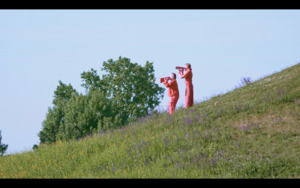
○ auch meine Zunge, die ich rausstrecke, ist rot, videodokumentierte Performance
Während der 60 minütigen Performance sehen wir drei Scream Queens auf der Suche nach der optimalen Auszeit, der maximalen Entladung. Sie weihen als professionelle Schreier*innen einen Berg im Karlsruher Naherholungsgebiet als Mount Scream ein und eröffnen damit eine neue Phase der innerstädtischen Naherholung.
○ morning Session, Lecture Performance, 06.06.2025 Günther Klotz Anlage
Eine Einladung zu einer Lesung über Wellness, Baderituale und quilting auf einem roten Quilt aus ausrangierten, rot gefärbten Handtüchern. Beginn und Ende wird durch den Klang eines keramischen Zungengongs markiert.
○ Scream Queen Couture, Ausstellung, CU Karlsruhe 06.- 08.06.2025
Die dreitägige Ausstellung thematisiert Schreien als Gegenentwurf zu gängigen Wellness-Trends und lädt Besucher*innen dazu ein, sich durch das Ausleihen von Scream Queen Outfits, keramischen Schreirohren und Schreianleitungen selbst in Scream Queens zu verwandeln und Schreien im öffentlichen Raum als mögliche Form von Wellness zu erproben.
- Well, don’t you do Wellness? untersucht Wellness im Spannungsfeld zwischen Wohlbefinden, Selbstoptimierung und Widerstand. Die Arbeit hinterfragt gesellschaftlich erlernte Vorstellungen von Gesundheit und Leistungsfähigkeit aus feministischer Perspektive. Dabei verbinden sich Bezüge zu historischen Badekulturen und Quilting als feministischer Handarbeitstechnik mit Schreien als spekulativer Methode im Kontrast zu gängigen Wellness-Trends. Folgende Formate und Arbeiten sind Teil des Projekts:
- Beschreibung (en)
- 'Well, don't you do wellness?' examines wellness in the context of well-being, self-optimisation, and resistance. Consisting of several parts, the work questions socially learned ideas about health and productivity with a feminist approach. References to historical bathing cultures are combined with quilting as a feminist and activist handcraft technique, while screaming is tested as a speculative wellness method.
○ Public Screaming for the federal election on 23 February 2025
public, collective screaming at the first projection at 6 p.m. on Mount Klotz, Günther Klotz Anlage
○ Scream Your Heart Out, Screaming workshop by Andrzej Profus, 7 May 2025, ZKM Pavilion
organised in cooperation with Betty Potemkin and Edona Ibrahimi.
○ auch meine Zunge, die ich rausstrecke, ist rot video-documented performance
During the 60-minute performance, three scream queens seek the optimal time-out and maximum release. As professional screamers, they inaugurate Mount Scream in Karlsruhe's local recreation area, thus opening a new phase of urban recreation.
○ Scream Queen Couture exhibition, CU Karlsruhe, 6th - 8th May 2025
This three-day exhibition explores screaming as an alternative to current wellness trends. Visitors are invited to become Scream Queens by borrowing outfits, screaming tubes and instructions. They can also experience screaming in public spaces as a potential wellness practice.
- 'Well, don't you do wellness?' examines wellness in the context of well-being, self-optimisation, and resistance. Consisting of several parts, the work questions socially learned ideas about health and productivity with a feminist approach. References to historical bathing cultures are combined with quilting as a feminist and activist handcraft technique, while screaming is tested as a speculative wellness method.
- Kategorie
- Typ des Projekts/Werks
- Schlagworte
- Datierung
- 2025
- Mitwirkende
- Dank an
- Material
- Ort: Institution
- Stadt
- Titel
- Well, don't you do wellness?
- Projektleiter/in
- Semester
- Studiengang
- Typ der Abschlussarbeit
- Importiert am
- 14.09.2025
- Übergeordnete Sets
- 1
- Set enthält
- 0 14
WHERE LEGENDS ARE MADE AND LIES ARE TOLD
Name that can easily go onto 2 lines
Author that can easily go onto 2 lines as well
- Titel
- WHERE LEGENDS ARE MADE AND LIES ARE TOLD
- Autor/in
- Beschreibung (de)
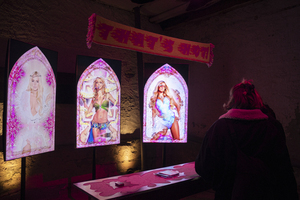
- WHERE LEGENDS ARE MADE AND LIES ARE TOLD (graduation project). Originated by this divine union of @parishilton @britneyspears @lindsaylohan (aka the Holy Trinity <3) the night of the infamous Bimbo Summit, WLAMALAT is the visual and critical translation of my obsession for the #y2k it-girls and #popculture in general. Mixing a religious with a highly commercial aesthetic, the project questions several topics such as women representation in the mass media, visual/celebrity culture consumption and new belief systems.
- WHERE LEGENDS ARE MADE AND LIES ARE TOLD (graduation project). Originated by this divine union of @parishilton @britneyspears @lindsaylohan (aka the Holy Trinity <3) the night of the infamous Bimbo Summit, WLAMALAT is the visual and critical translation of my obsession for the #y2k it-girls and #popculture in general. Mixing a religious with a highly commercial aesthetic, the project questions several topics such as women representation in the mass media, visual/celebrity culture consumption and new belief systems.
- Beschreibung (en)
- WHERE LEGENDS ARE MADE AND LIES ARE TOLD (graduation project). Originated by this divine union of @parishilton @britneyspears @lindsaylohan (aka the Holy Trinity <3) the night of the infamous Bimbo Summit, WLAMALAT is the visual and critical translation of my obsession for the #y2k it-girls and #popculture in general. Mixing a religious with a highly commercial aesthetic, the project questions several topics such as women representation in the mass media, visual/celebrity culture consumption and new belief systems.
- WHERE LEGENDS ARE MADE AND LIES ARE TOLD (graduation project). Originated by this divine union of @parishilton @britneyspears @lindsaylohan (aka the Holy Trinity <3) the night of the infamous Bimbo Summit, WLAMALAT is the visual and critical translation of my obsession for the #y2k it-girls and #popculture in general. Mixing a religious with a highly commercial aesthetic, the project questions several topics such as women representation in the mass media, visual/celebrity culture consumption and new belief systems.
- Kategorie
- Typ des Projekts/Werks
- Datierung
- 06.12.23
- Dank an
- Ort
- Rudolf 5
- Titel
- WHERE LEGENDS ARE MADE AND LIES ARE TOLD
- Projektleiter/in
- Semester
- Studiengang
- Typ der Abschlussarbeit
- Importiert am
- 05.11.2024
- Übergeordnete Sets
- 1
- Set enthält
- 3 8
PERMANENT BROKENNESS
Name that can easily go onto 2 lines
Author that can easily go onto 2 lines as well
- Titel
- PERMANENT BROKENNESS
- Autor/in
- Beschreibung (de)
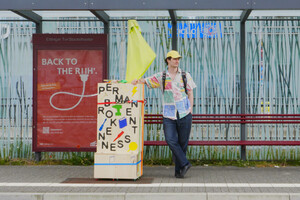
- PERMANENT BROKENNESS ist eine mobile (Infra-)Struktur, die das transformative Potential von öffentlichen Orten aufzeigt, indem sie die Reparatur von Haushalts- und Konsumgeräten verfügbar und sichtbar macht. Angelehnt an das Format des Reparatur-Cafés, werden Benutzer*innen dazu eingeladen eigenständig und gemeinsam Dinge zu reparieren. Hierbei steht nicht nur die Müllvermeidung und Ressourcenschonung im Vordergrund, sondern vor allem der selbstwirksame Zugang zur dinglichen Umwelt. Das Projekt basiert auf einer umfangreichen Recherche zur kulturellen Praxis des Reparierens und formuliert ein Gegennarrativ zu Hegemonien der Produktion, der Innovation und des unreflektierten Massenkonsums.
- Beschreibung (en)
- PERMANENT BROKENNESS is a mobile (infra-)structure that demonstrates the transformative potential of public spaces by making the repair of household and consumer appliances available and visible. Inspired by the repair café format, users are invited to repair things independently and together. The focus here is not only on avoiding waste and conserving resources, but above all on self-effective access to the material environment. The project is based on extensive research into the cultural practice of repairing and formulates a counter-narrative to hegemonies of production, innovation and unreflected mass consumption.
- Kategorie
- Schlagworte
- Datierung
- 26.06.2024
- Mitwirkende
- Dank an
- Titel
- PERMANENT BROKENNESS
- Projektleiter/in
- Semester
- Studiengang
- Typ der Abschlussarbeit
- Importiert am
- 01.11.2024
- Übergeordnete Sets
- 1
- Set enthält
- 0 6
The Plenum – A Scripted Play
Name that can easily go onto 2 lines
Author that can easily go onto 2 lines as well
- Titel
- The Plenum – A Scripted Play
- Autor/in
- Beschreibung (de)
- "The Plenum – A Scripted Play" behandelt das performative, das rituelle und das gemeinschaftsbildende Moment des Plenums als Planungstreffen selbstverwalteter Gruppen im politischen und kulturellen Kontext.
Über den Zeitraum eines Jahres wurden "Plena" in unterschiedlichen Konstellationen durchgeführt, die die gruppeneigene Dynamik untersuchten und auf Basis eines sich verändernden Scripts, einem Theaterdrehbuch oder Code gleichend, in einer kollektiven Performance Ausdruck fanden.
Die dabei von der Gruppe gemachten Erfahrungen dienten nicht nur zur Dokumentation für Gewesenes, sondern wurden als neuer „Input“ sofort in das bestehende Script eingearbeitet. Das sich permanent verändernde Projekt konnte so nach Vorbild eines Computerprogramms transparent gestaltet werden und ermöglichte eine basisdemokratische Beteiligung aller Akteur:innen – unabhängig von präexistentem Wissen oder Erfahrungswerten.
Nach Vorbild von Jo Freemans Essay „The Tyranny Of Structurelessness“ stand das Schaffen offener und klarer Kommunikation bezüglich der eigenen Gruppenstruktur und deren „Balance of Power“ im Mittelpunkt der Treffen.
„The Plenum – A Scripted Play“ ist jedoch nicht nur ein reales Treffen einer politischen Gruppe, sondern schafft seine identitäre Notwendigkeit durch seine Schnittstelle mit der Simulation: Das Finden von Mehrheiten (oder Einstimmigkeiten), die Verteilung von Macht und Autorität innerhalb der eigenen Gruppe sowie der Entscheidungsfindungsprozess wurden in verschiedenen Modellen spielerisch erprobt und in ihren politischen und historischen Kontext eingeordnet. Der fiktive Aspekt der Treffen öffnete Spielräume zur Reflexion über das eigene Verhalten innerhalb von Gruppengefügen. Vielen dieser Simulationen dienten Computercodes, Brettspiele und politische Verfassungen zur Vorlage.
Einem jeden Treffen selbstverwalteter Gruppen wohnt immer – oft unbewusst – etwas Rituelles inne, das zum Schaffen der kollektiven Identität von hoher Bedeutung ist. Das Wiederholen planerischer Abläufe und die kodifizierten, gruppenspezifischen Kommunikationsregeln entscheiden über Zugehörigkeit zur Gruppe und sind identitäts- und sinnstiftend.
Was vom Plenum bleibt, sind Simulationsskizzen, ein (beinahe) gegründeter Verein, eine intensive Auseinandersetzung um Vergütungsmodelle in einer nonmonetären Mikrowirtschaft und das Erarbeiten nachhaltiger Strukturen für die eigene kulturelle und politische Praxis, die sich bis heute fortsetzen. Sichtbar von alledem ist nichts, außer die Spuren, die wir stigmergisch hinterlassen.
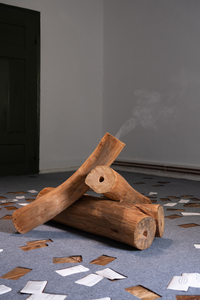
Diese Spuren: Der Raum, in dem wir uns treffen; das Feuer, um das wir uns versammeln; die Karten, aus denen wir ablesen können, was einmal besprochen wurde – und werden wird; und das Script, ein sich permanent veränderndes Programm, das es uns vielleicht einmal ermöglichen wird, eine sozial und ökologisch nachhaltige Existenz in der Kunst- und Kulturszene zu führen.
- "The Plenum – A Scripted Play" behandelt das performative, das rituelle und das gemeinschaftsbildende Moment des Plenums als Planungstreffen selbstverwalteter Gruppen im politischen und kulturellen Kontext.
- Beschreibung (en)
- "The Plenum - A Scripted Play" deals with the performative, ritual and community-building moment of the plenum as a planning meeting of self-organised groups in a political and cultural context.
Over the course of a year, "Plena" were held in different constellations, which examined the group's own dynamics and found expression in a collective performance based on a changing script, similar to a theatre script or code.
The experiences made by the group not only served to document what had already happened, but were also immediately incorporated into the existing script as new "input". The constantly changing project could thus be designed transparently, modelled like a computer program, and enabled the grassroots democratic participation of all actors - regardless of pre-existing knowledge or experience.
Inspired by Jo Freeman's essay "The Tyranny Of Structurelessness", the creation of open and clear communication regarding the group's own structure and its "balance of power" was at the centre of the meetings.
However, "The Plenum – A Scripted Play" is not just a real meeting of a political group, but creates its identitary necessity through its intersection with the simulation: finding majorities (or unanimity), the distribution of power and authority within one's own group and the decision-making process were playfully tested in various models and placed in their political and historical context. The fictitious aspect of the meetings opened up scope for reflection on one's own behaviour within group structures. Many of these simulations were based on computer codes, board games and political constitutions.
There is always – often unconsciously – something of ritual inherent to every meeting of self-governed groups, which is of great importance for creating a collective sense of identity. The repetition of planning processes and the codified, group-specific communication rules determine membership of the group and create identity and purpose.
What remains of the plenum are simulation sketches, an (almost) founded association, an intensive debate about remuneration models in a non-monetary micro-economy and the development of sustainable structures for one's own cultural and political practice, which continue to this day. None of this is visible, except for the traces that we stigmergically leave behind.
These traces: the space in which we meet; the fire around which we gather; the cards from which we can read what has been – and will be – discussed; and the script, a constantly changing programme that will perhaps one day enable us to lead a socially and ecologically sustainable existence in the world of art and culture.
- "The Plenum - A Scripted Play" deals with the performative, ritual and community-building moment of the plenum as a planning meeting of self-organised groups in a political and cultural context.
- Kategorie
- Typ des Projekts/Werks
- Datierung
- 07.03.2023 - 18.04.2024
- Sprache
- Ort
- Plenarwohnung, Atelier von K.-J. Overkott, Günther-Klotz-Anlage, Schlosspark, Stephanienstraße (bei Sven), Sophienstraße (bei Tim), auf dem Dach, ßpace.
- Stadt
- Land
- Titel
- The Plenum – A Scripted Play
- Projektleiter/in
- Studiengang
- Typ der Abschlussarbeit
- Importiert am
- 16.06.2024
- Übergeordnete Sets
- 1
- Set enthält
- 0 6