Sets
444 Inhalte
- Seite 1 von 37
Modern Salon
Name that can easily go onto 2 lines
Author that can easily go onto 2 lines as well
- Titel
- Modern Salon
- Autor/in
- Beschreibung (de)
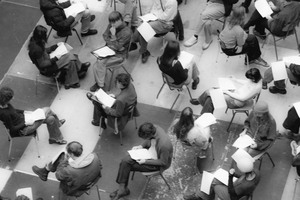
- „Modern Salon“ ist ein räumliches, literarisches und performatives Experiment über das Schreiben, Lesen und Öffentlichwerden von Sprache. Im Zentrum steht ein fortlaufendes, vielstimmiges Manuskript, das weniger als abgeschlossenes Werk denn als „Container“ verstanden wird – als Rahmen, der Sprache hält und zugleich offenbleibt.
Dieses Prinzip überträgt sich auf den Raum: Box, Manuskript und Bühne werden zu unterschiedlichen Maßstäben derselben Bewegung. Während des Readings wird der Text verteilt und gleichzeitig laut vorgelesen. Lesen und Zuhören finden nebeneinander statt, der Text zirkuliert zwischen Stimme, Schrift und Vorstellung.
Das gemeinsame Lesen wird so zu einem „Akt des Publizierens“: Sprache wird in dem Moment öffentlich, in dem sie geteilt wird. Für die Dauer des Readings entsteht eine „imagined community“ – ein temporärer Raum, in dem Bedeutung nicht festgeschrieben, sondern gemeinsam in Bewegung gebracht wird.
- „Modern Salon“ ist ein räumliches, literarisches und performatives Experiment über das Schreiben, Lesen und Öffentlichwerden von Sprache. Im Zentrum steht ein fortlaufendes, vielstimmiges Manuskript, das weniger als abgeschlossenes Werk denn als „Container“ verstanden wird – als Rahmen, der Sprache hält und zugleich offenbleibt.
- Beschreibung (en)
- “Modern Salon” is a spatial, literary, and performative experiment exploring the writing, reading, and public circulation of language. At its center is an ongoing, polyphonic manuscript, understood less as a finished work than as a “container” — a framework that holds language while remaining open.
This principle extends into space: box, manuscript, and stage become different scales of the same movement. During the reading, the text is distributed and read aloud simultaneously. Reading and listening coexist as the text circulates between voice, writing, and imagination.
This shared reading becomes an “act of publishing”: language becomes public in the moment it is shared. For the duration of the reading, an “imagined community” emerges — a temporary space in which meaning is not fixed, but collectively set in motion.
- “Modern Salon” is a spatial, literary, and performative experiment exploring the writing, reading, and public circulation of language. At its center is an ongoing, polyphonic manuscript, understood less as a finished work than as a “container” — a framework that holds language while remaining open.
- Kategorie
- Typ des Projekts/Werks
- Schlagworte
- Datierung
- 17.12.2025
- Mitwirkende
- Sprache
- Dauer
- 20 min
- Ort: Institution
- Ort
- Lichthof
- Internetlinks
- s-i-e-s-o.net
- Titel
- Modern Salon
- Projektleiter/in
- Semester
- Studiengang
- Typ der Abschlussarbeit
- Importiert am
- 01.09.2026
- Übergeordnete Sets
- 1
- Set enthält
- 0 7
Finale Objektserie
Name that can easily go onto 2 lines
Author that can easily go onto 2 lines as well
- Titel
- Finale Objektserie
- Autor/in
- Beschreibung (de)
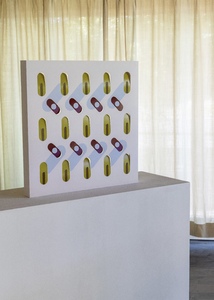
- Eine fotografische Dokumentation der Objektserie "Patterns in Perception" mit den drei Arbeiten "Pattern of Breath", "Weaving Spaces" und "Shifting Shadows". Die Serie zeigt unterschiedliche Wege, wie Muster durch Bewegung, räumliche Struktur und Licht über ihre zweidimensionale Form hinaus erweitert und neu wahrgenommen werden können.
- Beschreibung (en)
- A photographic documentation of the series “Patterns in Perception,” featuring the three works “Pattern of Breath,” “Weaving Spaces,” and “Shifting Shadows.” The series explores different ways in which patterns can be expanded beyond their two-dimensional form and perceived anew through movement, spatial structure, and light.
- Kategorie
- Schlagworte
- Mitwirkende
- Dank an
- Material
- Ort: Institution
- Stadt
- Land
- Titel
- Finale Objektserie
- Projektleiter/in
- Semester
- Studiengang
- Typ der Abschlussarbeit
- Importiert am
- 12.08.2026
- Übergeordnete Sets
- 1
- Set enthält
- 0 20
Form- und Materialstudien
Name that can easily go onto 2 lines
Author that can easily go onto 2 lines as well
- Titel
- Form- und Materialstudien
- Titel (en)
- Studies of Form and Materials
- Autor/in
- Beschreibung (de)
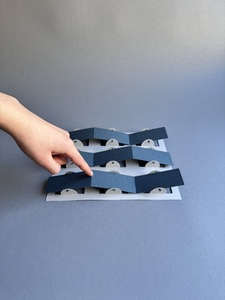
- Eine Auswahl experimenteller Studien, in denen unterschiedliche Techniken, Materialien und Anwendungsmöglichkeiten untersucht wurden. Schritt für Schritt entwickelten sich aus diesen Erkundungen die Ansätze, die später in die finale Objektserie überführt wurden.
- Beschreibung (en)
- A selection of experimental studies in which various techniques, materials, and potential applications were explored. Step by step, these explorations gave rise to the approaches that were later incorporated into the final series of objects.
- Kategorie
- Typ des Projekts/Werks
- Dank an
- Ort: Institution
- Stadt
- Land
- Titel
- Form- und Materialstudien
- Projektleiter/in
- Semester
- Studiengang
- Typ der Abschlussarbeit
- Importiert am
- 12.08.2026
- Übergeordnete Sets
- 1
- Set enthält
- 0 18
Patterns in Perception
Name that can easily go onto 2 lines
Author that can easily go onto 2 lines as well
- Titel
- Patterns in Perception
- Titel (en)
- Patterns in Perception
- Autor/in
- Beschreibung (de)
- "Patterns in Perception" untersucht, wie sich Muster über die Fläche hinaus zu lebendigen räumlichen Strukturen entwickeln können. Ausgangspunkt ist ein offener experimenteller Prozess, der erforscht, wie Material, Bewegung und Licht gemusterte Oberflächen aktivieren und verändern können. Durch Techniken wie Biegen, Falten, Ineinanderstecken und Verschieben entwickeln sich zweidimensionale Muster nach und nach zu räumlichen Formen und eröffnen durch das Experimentieren neue gestalterische Möglichkeiten.
Aus diesen Untersuchungen entstand schließlich eine Serie aus drei Objekten, die jeweils eine andere Entdeckung aus dem experimentellen Prozess aufgreifen. "Pattern of Breath" nutzt Bewegung, um ein Muster in eine responsive Atemerfahrung zu übersetzen. "Weaving Spaces" überträgt den manuellen Prozess des Biegens und Ineinandersteckens in einen architektonischen Maßstab und schafft dadurch neue räumliche Beziehungen. "Shifting Shadows" nutzt die Bewegung einzelner Elemente, um Licht gezielt zu lenken und durch wechselnde Reflexionen und Schatten die Wahrnehmung des umgebenden Raumes kontinuierlich zu verändern.
Gemeinsam zeigen die drei Objekte unterschiedliche Möglichkeiten, Muster über ihre vertraute zweidimensionale Form hinaus zu aktivieren, wahrzunehmen und zu erleben.
- "Patterns in Perception" untersucht, wie sich Muster über die Fläche hinaus zu lebendigen räumlichen Strukturen entwickeln können. Ausgangspunkt ist ein offener experimenteller Prozess, der erforscht, wie Material, Bewegung und Licht gemusterte Oberflächen aktivieren und verändern können. Durch Techniken wie Biegen, Falten, Ineinanderstecken und Verschieben entwickeln sich zweidimensionale Muster nach und nach zu räumlichen Formen und eröffnen durch das Experimentieren neue gestalterische Möglichkeiten.
- Beschreibung (en)
- "Patterns in Perception" explores how patterns can move beyond the surface to become living spatial structures. Beginning with an open process of experimentation, the project investigates how material, movement, and light can activate and transform patterned surfaces. Through techniques such as bending, folding, interlocking, and shifting, two-dimensional patterns gradually evolve into spatial forms, revealing new possibilities through the process of making.
These explorations ultimately unfold into a series of three objects, each translating a different discovery from the experimental process. "Pattern of Breath" uses movement to transform a pattern into a responsive breathing experience. "Weaving Spaces" brings the hands-on process of bending and interlocking into an architectural scale, shaping new spatial relationships. "Shifting Shadows" uses the movement of individual elements to redirect light, creating changing reflections and shadows that continuously reshape the perception of the surrounding space.
Together, the three objects reflect different ways in which patterns can be activated, experienced, and perceived beyond their familiar two-dimensional form.
- "Patterns in Perception" explores how patterns can move beyond the surface to become living spatial structures. Beginning with an open process of experimentation, the project investigates how material, movement, and light can activate and transform patterned surfaces. Through techniques such as bending, folding, interlocking, and shifting, two-dimensional patterns gradually evolve into spatial forms, revealing new possibilities through the process of making.
- Kategorie
- Schlagworte
- Mitwirkende
- Material
- Technik/Verfahren/Formate
- Schneideplotten, Materialexperimente, Arbeiten mit Formgedächtnislegierungen, kinetische und responsive Bewegung, manuelle und sensorbasierte Aktivierung
- Titel
- Patterns in Perception
- Projektleiter/in
- Semester
- Studiengang
- Typ der Abschlussarbeit
- Importiert am
- 12.08.2026
- Übergeordnete Sets
- 2
- Set enthält
- 2 4
Shaping Thought
Name that can easily go onto 2 lines
Author that can easily go onto 2 lines as well
- Titel
- Shaping Thought
- Titel (en)
- Shaping Thought
- Untertitel
- Writing Tools shape how we think & write. Break their rules to change your thinking.
- Untertitel des Projekts/Werks (en)
- Writing Tools shape how we think & write. Break their rules to change your thinking.
- Autor/in
- Beschreibung (de)
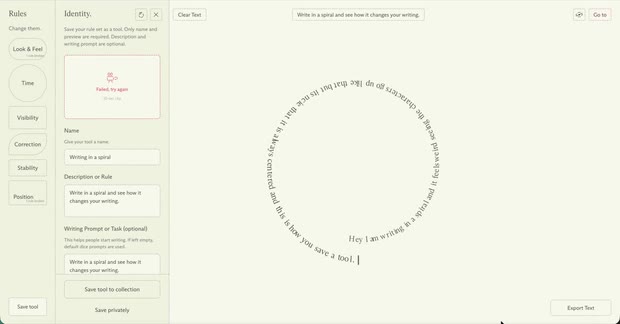
- "Shaping Thought" untersucht, wie digitale Schreibwerkzeuge beeinflussen, wie wir denken und schreiben. Klassische Texteditoren folgen festen Regeln: Der Cursor wartet, Text bleibt sichtbar, Fehler können gelöscht und Gedanken jederzeit neu geordnet werden. Dadurch erscheint Schreiben als linearer und kontrollierter Prozess, obwohl Gedanken häufig sprunghaft, fragmentiert und zeitlich sind.
Meine Arbeit bricht diese vertrauten Regeln auf. In einer Sammlung experimenteller Schreibtools verändern sich Cursor, Text, Raum und Zeit: Wörter verschwinden, Pausen werden sichtbar, Buchstaben bewegen sich oder das Geschriebene lässt sich nicht mehr korrigieren. Jede Regel erzeugt eine andere Form des Schreibens und beeinflusst, wie Gedanken entstehen, festgehalten und wahrgenommen werden.
Das Projekt versteht das Schreibinterface nicht als neutrales Werkzeug, sondern als System, das Denken mitgestaltet. Die Tools laden dazu ein, vertraute Schreibgewohnheiten spielerisch zu hinterfragen und alternative Formen des Denkens und Schreibens zu erproben.
- "Shaping Thought" untersucht, wie digitale Schreibwerkzeuge beeinflussen, wie wir denken und schreiben. Klassische Texteditoren folgen festen Regeln: Der Cursor wartet, Text bleibt sichtbar, Fehler können gelöscht und Gedanken jederzeit neu geordnet werden. Dadurch erscheint Schreiben als linearer und kontrollierter Prozess, obwohl Gedanken häufig sprunghaft, fragmentiert und zeitlich sind.
- Beschreibung (en)
- "Shaping Thought" explores how digital writing tools influence the way we think and write. Traditional text editors follow fixed rules: the cursor waits, text remains visible, mistakes can be deleted, and thoughts can be rearranged at any time. As a result, writing appears to be a linear and controlled process, even though thoughts are often erratic, fragmented, and time-bound.
My work breaks these familiar rules. In a collection of experimental writing tools, the cursor, text, space, and time undergo transformation: words disappear, pauses become visible, letters move, or what has been written can no longer be corrected. Each rule generates a different form of writing and influences how thoughts arise, are captured, and are perceived.
The project views the writing interface not as a neutral tool, but as a system that helps shape thought. The tools invite users to playfully question familiar writing habits and to experiment with alternative forms of thinking and writing.
- "Shaping Thought" explores how digital writing tools influence the way we think and write. Traditional text editors follow fixed rules: the cursor waits, text remains visible, mistakes can be deleted, and thoughts can be rearranged at any time. As a result, writing appears to be a linear and controlled process, even though thoughts are often erratic, fragmented, and time-bound.
- Kategorie
- Schlagworte
- Technik/Verfahren/Formate
- Browserbasierte interaktive Schreibtools, Webanwendung, HTML/CSS/JavaScript
- Titel
- Shaping Thought
- Untertitel
- Writing Tools shape how we think & write. Break their rules to change your thinking.
- Projektleiter/in
- Semester
- Studiengang
- Typ der Abschlussarbeit
- Importiert am
- 24.07.2026
- Übergeordnete Sets
- 2
- Set enthält
- 0 8
Temporary Shapes
Name that can easily go onto 2 lines
Author that can easily go onto 2 lines as well
- Titel
- Temporary Shapes
- Titel (en)
- Temporary Shapes
- Autor/in
- Beschreibung (de)
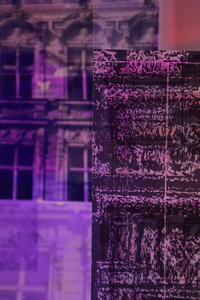
- Die durch einen räumlichen Audiowalk ergänzte Installation untersucht die Beziehung zwischen Menschen und Städten aus der Perspektive der Zeit. Sie erforscht, wie sich beide kontinuierlich verändern und wie sich die Zeitlinien von Individuen und Städten gelegentlich überschneiden, bevor sie sich wieder voneinander entfernen.
Die Ausstellung stellt zwei parallele Erzählungen gegenüber: die Veränderung einer Stadt und die persönlichen Geschichten von Menschen, die sich durch verschiedene Lebensphasen entfalten. Diese beiden Ebenen werden sowohl räumlich als auch klanglich erfahrbar.
Durch Interviews, persönliche Fotografien, Archivfotografien, Tonaufnahmen und transparente räumliche Schichten bewegt sich die Besucherin bzw. der Besucher gleichzeitig durch die Geschichte einer Stadt und den Lebensweg eines Menschen und erlebt dabei, wie Vergangenheit, Gegenwart und Zukunft kontinuierlich ineinander übergehen. Matthias Mansens Holzschnittserie Potsdamer Strasse erscheint als konkretes Beispiel für diese Beziehung: Sie bewahrt einen einzelnen Moment der Begegnung zwischen einem Künstler und einer sich ständig verändernden Stadt.
- Die durch einen räumlichen Audiowalk ergänzte Installation untersucht die Beziehung zwischen Menschen und Städten aus der Perspektive der Zeit. Sie erforscht, wie sich beide kontinuierlich verändern und wie sich die Zeitlinien von Individuen und Städten gelegentlich überschneiden, bevor sie sich wieder voneinander entfernen.
- Beschreibung (en)
- The installation, complemented by a spatial audio walk. Explores the relationship between people and cities from the perspective of time.
It examines how both are constantly changing, and how the timelines of individuals and cities occasionally intersect before moving apart again. The exhibition presents two parallel narratives: the transformation of a city and the personal stories of individuals unfolding through different stages of life. These two dimensions are experienced through both space and sound. Through interviews, personal photographs, archival photographs, sound, and transparent spatial layers, visitors move simultaneously through the history of a city and the trajectory of a human life, experiencing how past, present, and future continuously merge into one another.
Matthias Mansen’s Potsdamer Strasse woodcut series serves as a concrete example of this relationship, preserving a single moment of encounter between an artist and a constantly changing city.
- The installation, complemented by a spatial audio walk. Explores the relationship between people and cities from the perspective of time.
- Kategorie
- Typ des Projekts/Werks
- Schlagworte
- Datierung
- 02.05.2026 - 02.07.2026
- Mitwirkende
- Dank an
- Sprache
- Ort: Institution
- Stadt
- Land
- Beteiligte Institution(en)
- Titel
- Temporary Shapes
- Projektleiter/in
- Semester
- Studiengang
- Typ der Abschlussarbeit
- Importiert am
- 23.07.2026
- Übergeordnete Sets
- 0
- Set enthält
- 0 25
wie (wir) erinnern
Name that can easily go onto 2 lines
Author that can easily go onto 2 lines as well
- Titel
- wie (wir) erinnern
- Titel (en)
- how (we) remember
- Autor/in
- Beschreibung (de)
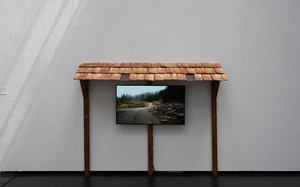
- Ausgehend von einem ehemaligen Militärstützpunkt untersucht die Arbeit „how (we) remember“ die Prozesse, durch die Erinnerungen materielle Gestalt annehmen. Inwieweit verkörpern Artefakte, Denkmäler und andere Objekte Erinnerungen? Was sind die zentralen Bedingungen und Voraussetzungen einer Erinnerung? Welche Rolle spielen dabei Politik, „Zeitgeist“ und die Verantwortung jedes Einzelnen?
Die Ausstellung visualisiert und reflektiert meine persönliche Perspektive auf eine Erinnerung an die militärhistorische Vergangenheit der Hornisgrinde im nördlichen Schwarzwald. Dabei setzt sich die Installation materiell mit der Flüchtigkeit und Aura menschlicher Erinnerungsprozesse auseinander und untersucht die Sichtbarkeit der Vergangenheit im öffentlichen und privaten Raum.
- Ausgehend von einem ehemaligen Militärstützpunkt untersucht die Arbeit „how (we) remember“ die Prozesse, durch die Erinnerungen materielle Gestalt annehmen. Inwieweit verkörpern Artefakte, Denkmäler und andere Objekte Erinnerungen? Was sind die zentralen Bedingungen und Voraussetzungen einer Erinnerung? Welche Rolle spielen dabei Politik, „Zeitgeist“ und die Verantwortung jedes Einzelnen?
- Beschreibung (en)
- Taking a former military base as its starting point, the work “how (we) remember” explores the processes through which memories take material form. To what extent do artifacts, monuments, and other objects embody memories? What are the central conditions and requirements of a memory? What role do politics, “Zeitgeist” and each individual’s responsibility play in this?
The series of artworks visualizes and reflects my personal perspective on a memory of the Hornisgrinde’s military-historical past in the northern Black Forest. In doing so, the installation materially addresses the fleeting and auratic nature of human memory processes and examines the visibility of the past in public and private spaces.
- Taking a former military base as its starting point, the work “how (we) remember” explores the processes through which memories take material form. To what extent do artifacts, monuments, and other objects embody memories? What are the central conditions and requirements of a memory? What role do politics, “Zeitgeist” and each individual’s responsibility play in this?
- Kategorie
- Typ des Projekts/Werks
- Schlagworte
- Dank an
- Material
- Ort: Institution
- Beteiligte Institution(en)
- Titel
- wie (wir) erinnern
- Projektleiter/in
- Semester
- Studiengang
- Typ der Abschlussarbeit
- Importiert am
- 23.07.2026
- Übergeordnete Sets
- 2
- Set enthält
- 0 9
As beginning is to end
Name that can easily go onto 2 lines
Author that can easily go onto 2 lines as well
- Titel
- As beginning is to end
- Autor/in
- Beschreibung (de)
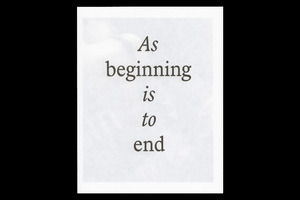
- „As beginning is to end“ beschäftigt sich mit Fotografie, Architektur, Zeitlichkeit und der Neuordnung von vorhandenem Bildmaterial. Das Projekt verbindet eine Publikation mit einer räumlichen Installation. Dafür wurden gescannte Fotografien aus bestehenden Fotobüchern zu einer offenen, filmischen Sequenz neu angeordnet. Die Fotografien werden als Fragmente eines fortlaufenden Geschehens verstanden, dessen Narrativ wiederkehrenden Motiven, Atmosphären und Blickrichtungen folgt.
Die gefundenen Fotografien zeigen ausschließlich Fragmente von privaten Innenräumen und Figuren, die sich durch diese bewegen. Die Innenräume werden dabei zu Spuren von Identitäten, Erinnerungen und Geschichten und eröffnen den intimen Blick in geschlossene Wände.
In der Publikation bestimmen die im Vollformat gedruckten Fotografien und darauf folgende weiße Doppelseiten den Rhythmus des Betrachtens. Die leeren Seiten schaffen kurze Pausen und schlagen Brücken zu dem Unwissenden. Außerdem ist der Publikation ein Text beigefügt, der den Gang durch die Fotografien leitet.
Der selbe Rhythmus wird in den Ausstellungsraum übersetzt. Die ausgewählten Fotografien wurden hier dabei stark vergrößert und immer wieder durch Leerstellen pausiert. Bei der Wahl des Ausstellungsraums war es wichtig, einen Ort zu finden, der durch seine architektonische Beschaffenheit bereits fragmentarisch Spuren und Geschichten in sich trägt. Jedes Element der Architektur ist ein Bestandteil der Übersetzung der fotografischen Szenen und lassen die Betrachtenden in diese räumlich eintreten.
- „As beginning is to end“ beschäftigt sich mit Fotografie, Architektur, Zeitlichkeit und der Neuordnung von vorhandenem Bildmaterial. Das Projekt verbindet eine Publikation mit einer räumlichen Installation. Dafür wurden gescannte Fotografien aus bestehenden Fotobüchern zu einer offenen, filmischen Sequenz neu angeordnet. Die Fotografien werden als Fragmente eines fortlaufenden Geschehens verstanden, dessen Narrativ wiederkehrenden Motiven, Atmosphären und Blickrichtungen folgt.
- Beschreibung (en)
- “As beginning is to end” explores photography, architecture, temporality, and the rearrangement of existing visual material. The project combines a publication with a spatial installation. Scanned photographs from existing photo books were rearranged to form an open, cinematic sequence.
The found photographs depict fragments of private interiors and figures moving through them. The interiors become traces of identities, memories, and stories, offering an intimate glimpse behind closed walls.
In the publication, the printed images and the following white double-page spreads determine the rhythm of viewing. The blank pages create brief pauses and build bridges to the unknown. Additionally, the publication includes a text that guides the viewer through the photographs.
The same rhythm is translated into the exhibition space. The selected photographs are greatly enlarged and repeatedly paused with blank spaces. When selecting the exhibition space, it was important to find a place whose architectural character already contains fragmentary traces and stories. Each architectural element plays a role in interpreting the photographic scenes and allows viewers to enter them spatially.
- “As beginning is to end” explores photography, architecture, temporality, and the rearrangement of existing visual material. The project combines a publication with a spatial installation. Scanned photographs from existing photo books were rearranged to form an open, cinematic sequence.
- Kategorie
- Schlagworte
- Abmessungen
- Publikation: 225mm x 290mm. Reproduktionen in der Ausstellung: ca. 3,5m x 2,5m und ca. 1,5m x 1m
- Dauer
- Dauer der Ausstellung: 3 Tage
- Titel
- As beginning is to end
- Projektleiter/in
- Semester
- Studiengang
- Typ der Abschlussarbeit
- Importiert am
- 21.07.2026
- Übergeordnete Sets
- 2
- Set enthält
- 0 2
Like Sediment in a Slow Current
Name that can easily go onto 2 lines
Author that can easily go onto 2 lines as well
- Titel
- Like Sediment in a Slow Current
- Titel (en)
- Like Sediment in a Slow Current
- Untertitel
- Reconnecting to a paralyzed river
- Untertitel des Projekts/Werks (en)
- Reconnecting to a paralyzed river
- Autor/in
- Beschreibung (de)
- „Wir sind zunehmend wasserundurchlässig geworden: gedanklich abgeschottet von den subtilen und vielfältigen Beziehungen zu Flüssen, auch wenn diese weiterhin unsere Körper, Gedanken, Lieder und Geschichten durchströmen. Flüsse fließen durch die Menschen ebenso sicher wie durch Orte.“
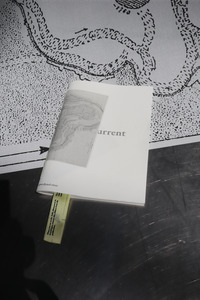
Dieses Zitat stammt aus Robert Macfarlanes Buch "Sind Flüsse Lebewesen?" und bildet den Einstieg in mein Diplomprojekt, „Like Sediment in a Slow Current“. Ausgehend von der Rheinbegradigung am Oberrhein untersuche ich die verzerrte Beziehung zwischen uns Menschen, Wasser und anderen Wasserkörpern. Das Projekt sammelt und kuratiert verschiedene Texte und Bilder aus Bereichen der Kunst, Biologie, Geologie und Philosophie und versucht, sich folgenden Fragen zu nähern:
Wie sind wir mit Flüssen verbunden? Wie sah der Rhein vor der Begradigung aus? Welche Folgen hat eine Begradigung für einen Fluss? Ist es möglich, einen Fluss als juristische Person anzusehen? Wie sind wir mit anderen Wasserkörpern verbunden? Was definiert einen Wasserkörper? Wie kann ich mich kritisch mit einem Ort und seiner Geschichte auseinandersetzen?
- „Wir sind zunehmend wasserundurchlässig geworden: gedanklich abgeschottet von den subtilen und vielfältigen Beziehungen zu Flüssen, auch wenn diese weiterhin unsere Körper, Gedanken, Lieder und Geschichten durchströmen. Flüsse fließen durch die Menschen ebenso sicher wie durch Orte.“
- Beschreibung (en)
- “We have become increasingly waterproofed: conceptually sealed against subtle and various relations with rivers, even as they continue to irrigate our bodies, thoughts, songs and stories. Rivers run through people as surely as they run through places.”
This quote from Robert Macfarlane’s book „Is a River Alive?“ serves as the point of entry to my diploma project, „Like Sediment in a Slow Current“. Taking the straightening of the Upper Rhine as my starting point, I explore the distorted relationship between us humans, water, and other bodies of water. The project collects and curates various texts and images from the fields of art, biology, geology, and philosophy and attempts to address questions like:
How are we connected to rivers? What did the Rhine look like before it was straightened? What are the consequences of straightening a river? Is it possible to view a river as a legal entity? How are we connected to other bodies of water? What defines a body of water? How can I critically engage with a place and its history?
- “We have become increasingly waterproofed: conceptually sealed against subtle and various relations with rivers, even as they continue to irrigate our bodies, thoughts, songs and stories. Rivers run through people as surely as they run through places.”
- Kategorie
- Typ des Projekts/Werks
- Schlagworte
- Datierung
- 24.06.2026
- Dank an
- Sprache
- Material
- Technik/Verfahren/Formate
- Digitaldruck, UV-Lack-Druck
- Abmessungen
- 175mm x 270mm
- Ort: Institution
- Ort
- Rhein
- Stadt
- Land
- Titel
- Like Sediment in a Slow Current
- Untertitel
- Reconnecting to a paralyzed river
- Projektleiter/in
- Semester
- Studiengang
- Typ der Abschlussarbeit
- Importiert am
- 20.07.2026
- Übergeordnete Sets
- 0
- Set enthält
- 0 10
Layered Visions
Name that can easily go onto 2 lines
Author that can easily go onto 2 lines as well
- Titel
- Layered Visions
- Titel (en)
- Layered Visions
- Autor/in
- Beschreibung (de)
- Die Arbeit entstand im Seminar Frameworks of Fiction in Zusammenarbeit mit der Kunsthalle Mannheim. Ausgangspunkt des Seminars war die kritische Auseinandersetzung mit der Sammlung der Kunsthalle Mannheim, insbesondere mit historischen Gemälden und den Bildkonstruktionen, die sie repräsentieren. Die Studierenden konnten frei ein Werk aus der Sammlung als Ausgangspunkt ihrer eigenen künstlerischen Arbeit wählen. Thematisiert wurden unter anderem Die Erschießung Kaiser Maximilians, Der türkische Frauenraub sowie Anselm Feuerbachs Hafis an der Schenke, das den Ausgangspunkt dieser Arbeit bildet.
Ausgehend von Feuerbachs Hafis an der Schenke werden die kolonialen Bildpolitiken und hierarchischen Konstruktionen des Gemäldes dekonstruiert.
Figuren, die im Original gesichtslos bleiben oder lediglich als Staffage erscheinen, erhalten Individualität, ein Gesicht und Handlungsmacht.
Durch ihre neue Anordnung entstehen Beziehungen, die von Empathie, Zärtlichkeit und gegenseitiger Fürsorge geprägt sind. Die zentrale Stellung des persischen Dichters Hafis wird zugunsten eines kollektiven Gefüges aufgelöst.
Gleichzeitig richtet sich die Arbeit gegen die Vorstellung des Künstlers als herausragendes Einzelgenie, das losgelöst von seiner Gemeinschaft schöpft. Dieser Idee wird ein Verständnis künstlerischer Praxis gegenübergestellt, das Gemeinschaft, gegenseitiges Zuhören, Fürsorge und Zusammenarbeit als Grundlage kreativen Handelns begreift. Künstlerisches Schaffen erscheint nicht als isolierter Akt, sondern als Ergebnis sozialer Beziehungen und gemeinschaftlicher Prozesse.
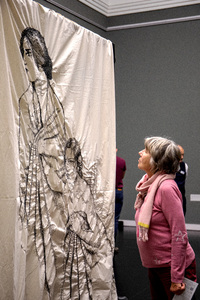
Die Rauminstallation besteht aus acht frei hängenden Leinentüchern, die mit verschiedenen Nähmaschinenstichen bearbeitet wurden. Mehrere Bildfragmente lösen die Figuren aus Feuerbachs ursprünglicher Komposition heraus und setzen sie in neue räumliche Beziehungen zueinander. Die hierarchische Bildordnung des Originals weicht einem offenen Geflecht aus Körpern, Blicken und Begegnungen.
Die Materialität der Installation steht bewusst im Kontrast zur Tradition der Malerei. An die Stelle der fest auf einen rechteckigen Keilrahmen gespannten Leinwand treten frei hängende Stoffbahnen, die durch ihre Beweglichkeit eine skulpturale Qualität entwickeln. Die Naht ersetzt den Pinselstrich. Während die Vorzeichnung in der Malereitradition lediglich als vorbereitender Arbeitsschritt galt, wird die Linie hier selbst zum bildgebenden Element. Als verbindende Spur zwischen den Figuren macht sie Beziehungen sichtbar und tritt an die Stelle der malerischen Geste.
Das Nähen, historisch dem Kunsthandwerk und weiblich konnotierten Tätigkeiten zugeordnet, wird als eigenständiges künstlerisches Medium eingesetzt. Die Naht verbindet nicht nur Stoff, sondern auch Körper, Figuren und Bildräume und führt damit das zentrale Motiv des Verbindens auf materieller Ebene fort.
- Die Arbeit entstand im Seminar Frameworks of Fiction in Zusammenarbeit mit der Kunsthalle Mannheim. Ausgangspunkt des Seminars war die kritische Auseinandersetzung mit der Sammlung der Kunsthalle Mannheim, insbesondere mit historischen Gemälden und den Bildkonstruktionen, die sie repräsentieren. Die Studierenden konnten frei ein Werk aus der Sammlung als Ausgangspunkt ihrer eigenen künstlerischen Arbeit wählen. Thematisiert wurden unter anderem Die Erschießung Kaiser Maximilians, Der türkische Frauenraub sowie Anselm Feuerbachs Hafis an der Schenke, das den Ausgangspunkt dieser Arbeit bildet.
- Beschreibung (en)
- The work was created in the seminar Frameworks of Fiction in collaboration with the Kunsthalle Mannheim. The seminar's starting point was a critical examination of the Kunsthalle Mannheim's collection, particularly its historical paintings and the image constructions they represent. Students were free to choose a work from the collection as the starting point for their own artistic work. Among the works addressed were The Execution of Emperor Maximilian, The Turkish Abduction of Women and Anselm Feuerbach's Hafiz at the Tavern, which forms the starting point of this work.
Taking Feuerbach's Hafiz at the Tavern as its point of departure, the work deconstructs the painting's colonial image politics and hierarchical constructions. Figures who remain faceless in the original or appear merely as staffage are given individuality, a face and agency. Their new arrangement creates relationships marked by empathy, tenderness and mutual care. The central position of the Persian poet Hafiz is dissolved in favor of a collective structure.
At the same time the work pushes back against the idea of the artist as an exceptional individual genius creating in isolation from their community. Against this idea it sets an understanding of artistic practice that grounds creative action in community, mutual listening, care and collaboration. Artistic creation appears not as an isolated act but as the result of social relationships and collective processes.
The spatial installation consists of eight freely hanging linen cloths worked with various sewing machine stitches. Several image fragments extract the figures from Feuerbach's original composition and place them in new spatial relationships to one another. The hierarchical pictorial order of the original gives way to an open web of bodies, gazes and encounters.
The materiality of the installation deliberately contrasts with the tradition of painting. In place of canvas stretched tightly over a rectangular frame are freely hanging lengths of fabric whose mobility gives them a sculptural quality. The seam replaces the brushstroke. While the preliminary sketch was traditionally seen merely as a preparatory step in painting, here the line itself becomes an image making element. As a connecting trace between the figures it makes relationships visible and takes the place of the painterly gesture.
Sewing, historically associated with craft and with work coded as feminine, is employed here as an independent artistic medium. The seam joins not only fabric but also bodies, figures and pictorial spaces, carrying the central motif of connection forward onto the material level.
- The work was created in the seminar Frameworks of Fiction in collaboration with the Kunsthalle Mannheim. The seminar's starting point was a critical examination of the Kunsthalle Mannheim's collection, particularly its historical paintings and the image constructions they represent. Students were free to choose a work from the collection as the starting point for their own artistic work. Among the works addressed were The Execution of Emperor Maximilian, The Turkish Abduction of Women and Anselm Feuerbach's Hafiz at the Tavern, which forms the starting point of this work.
- Kategorie
- Typ des Projekts/Werks
- Schlagworte
- Datierung
- 10.2025
- Dank an
- Material
- Ort: Institution
- Ort
- Alter Bau
- Alter Bau
- Stadt
- Land
- Beteiligte Institution(en)
- Titel
- Layered Visions
- Projektleiter/in
- Semester
- Studiengang
- Lehrveranstaltung
- Importiert am
- 30.06.2026
- Übergeordnete Sets
- 1
- Set enthält
- 0 5
Raumintervention Paradies
- Titel
- Raumintervention Paradies
- Autor/in
- Beschreibung (de)
- Der Hermann-Levi-Platz, „Vorplatz“ des Badischen Staatstheaters Karlsruhe, bleibt zwischen mehreren Großbaustellen voraussichtlich bis 2036 ein Ort des Übergangs. Vor diesem Hintergrund nimmt die temporäre „Raumintervention Paradies“ einen Dialog mit der urbanen Brache auf. Die Umbenennung des Platzes in ein „Paradies“ erprobt das Potenzial dieser Fläche als lebendigen, ökologischen und sozialen Raum, der zur Auseinandersetzung mit Natur, Nachhaltigkeit und Gemeinschaft einlädt. Die Intervention gliedert sich in drei miteinander verbundene Orte des Verweilens, des Lernens und des Aus-Tauschens:
A) Biotopos – Paradies als Lernort
Die Installation inszeniert ein unbemerkt entstandenes Biotop am Rande des Platzes. Im Sinne Gilles Cléments Begriff der „dritten Landschaft“ bricht dieser wilde Ort mit geordneter Landschaftsarchitektur im urbanen Raum. Das großformatige Banner zeigt rund 200 ineinanderfließende Fotografien der Pflanzenvielfalt des Biotops, die als Brücke zwischen Realität und Imagination zu verstehen ist. Integrierte Gucklöcher rufen zur bewussten Betrachtung des Biotops auf. Ein QR-Code, der zu einem botanischen Archiv führt, ergänzt die Interaktion als digitalen Lernort.
B) Ein Steg zum Verweilen führt zu einer Insel: Paradies als Aufenthaltsraum
Inmitten von Beton und Baustellenlärm führt der inklusiv gestaltete Steg zu einer Plattform am Wasserbecken des Vorplatzes. Sitzelemente und schattenspendende Wimpel laden zum Verweilen ein. Der Steg ergründet so den Paradiesbegriff als Sehnsuchtsort, dem man sich zwar annähern kann, aber zu dem man stets auf Distanz bleibt. Die orangefarbene Leuchtschrift „Paradies“ vervollständigt als konkrete und abstrakte Größe das Bild eines sichtbaren, aber unerreichbaren Inselparadieses.
C) Feld und Pflanzentauschbörse am K-Punkt: Paradies als sozialer Raum
Bepflanzte Refarmkästen, bunte Sitzelemente und Schattenwimpel ergänzen die bereits vorhandenen entsiegelten Betonflächen und machen das Paradies als sozialen Raum und Ort der Interaktion erfahrbar. Im Mittelpunkt steht eine Pflanzentauschbörse, die neben dem Tausch auch die Pflege von Kräuterbeeten beinhaltet und die Idee des Paradieses als gemeinschaftlichen Prozess transportiert. Vergleichbar mit einem Ausstellungsraum laden die Sitzgelegenheiten zum Betrachten der Pflanzen ein.
Der szenografischen Intervention ging eine intensive Recherchearbeit voraus – bestehend aus Raumanalysen des Vorplatzes sowie der vorhandenen Vegetation, einer Besichtigung der Theaterbaustelle, Recherche zur Baugeschichte des Ortes und den städtischen Zukunftsplänen. Der Anspruch an eine möglichst nachhaltige Produktion hat den Prozess begleitet. Materialien wie die Wimpel und Elemente wie die Paletten und Sitzgelegenheiten wurden wiederverwendet und umfunktioniert.
Raumintervention Paradies wurde durch Studierende aller Studiengänge der HfG Karlsruhe entworfen und realisiert.
- Der Hermann-Levi-Platz, „Vorplatz“ des Badischen Staatstheaters Karlsruhe, bleibt zwischen mehreren Großbaustellen voraussichtlich bis 2036 ein Ort des Übergangs. Vor diesem Hintergrund nimmt die temporäre „Raumintervention Paradies“ einen Dialog mit der urbanen Brache auf. Die Umbenennung des Platzes in ein „Paradies“ erprobt das Potenzial dieser Fläche als lebendigen, ökologischen und sozialen Raum, der zur Auseinandersetzung mit Natur, Nachhaltigkeit und Gemeinschaft einlädt. Die Intervention gliedert sich in drei miteinander verbundene Orte des Verweilens, des Lernens und des Aus-Tauschens:
- Kategorie
- Typ des Projekts/Werks
- Schlagworte
- Datierung
- 23.05.2026 - 19.07.2026
- Mitwirkende
- Dank an
- Sprache
- Material
- Ort: Institution
- Ort
- Herman-Levi-Platz (Vorplatz des Staatstheaters)
- Stadt
- Beteiligte Institution(en)
- Internetlinks
- Titel
- Raumintervention Paradies
- Projektleiter/in
- Semester
- Studiengang
- Importiert am
- 30.06.2026
- Übergeordnete Sets
- 1
- Set enthält
- 0 0
Schwarm #4
Name that can easily go onto 2 lines
Author that can easily go onto 2 lines as well
- Titel
- Schwarm #4
- Titel (en)
- Schwarm #4
- Untertitel
- Student Journal for Art and Theory
- Untertitel des Projekts/Werks (en)
- Student Journal for Art and Theory
- Autor/in
- Beschreibung (de)
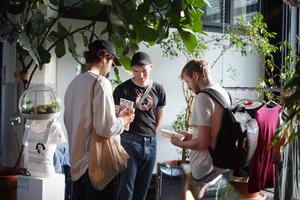
- Schwarm #4 ist eine studentische Publikation mit künstlerischen und wissenschaftlichen Beiträgen aus verschiedenen Fachbereichen der HfG Karlsruhe, die sich mit dem Begriff „Realities“ auseinandersetzen.
- Beschreibung (en)
- Schwarm #4 is a student publication featuring artistic and academic contributions from various departments at the HfG Karlsruhe, which explore the concept of ‘Realities’.
- Kategorie
- Datierung
- 2025
- Sprache
- Abmessungen
- 210x145mm
- Ort: Institution
- Land
- Auftrag durch
- Lorena Karn, Ilayda Kohl, Darius Kühner, Alessia Meyer, Yuliana Mosheeva, Elisabeth Potemkin, Vici Schwab, Yanina Sharipova
- Titel
- Schwarm #4
- Untertitel
- Student Journal for Art and Theory
- Importiert am
- 28.06.2026
- Übergeordnete Sets
- 1
- Set enthält
- 0 14