Sets
444 Inhalte
- Seite 1 von 37
DNS #68
Name that can easily go onto 2 lines
Author that can easily go onto 2 lines as well
- Titel
- DNS #68
- Untertitel
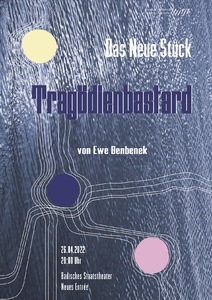
- Tragödienbastard
- Autor/in
- Beschreibung (de)
- Es ist ein Akt der Emanzipation. Das mit dem Mühlheimer Dramatikerpreis gekrönte Stück erzählt in einem rhythmisch tobenden Redestrom davon, wie sich die Tochter polnischer Einwanderer und ihre „chosen sisters“ von der Last des Migrationsnarrativs befreien und zu dem werden, was sie eigentlich immer waren: Göttinnen.
Das Stück “Tragödienbastard” von Ewe Benbenek wurde im Wintersemester 2021/2022 im Rahmen des Seminars ‘Das neue Stück’ von Studierenden technisch und künstlerisch erarbeitet und in eine knapp zweistündige szenische Lesung umgesetzt. Das Projekt wurde von Constanze Fischbeck, Anna Haas und Eivind Haugland betreut sowie von Sandra Blatterer, welche in einem einwöchigen Lichtworkshop spannende Impulse zur Erarbeitung des Licht- und Bühnenkonzepts gab.
Im Anschluss an die szenische Lesung findet ein Nachgespräch mit der Autorin Ewe Benbenek und den Mitwirkenden statt.
- Es ist ein Akt der Emanzipation. Das mit dem Mühlheimer Dramatikerpreis gekrönte Stück erzählt in einem rhythmisch tobenden Redestrom davon, wie sich die Tochter polnischer Einwanderer und ihre „chosen sisters“ von der Last des Migrationsnarrativs befreien und zu dem werden, was sie eigentlich immer waren: Göttinnen.
- Beschreibung (en)
- It is an act of emancipation. The play, which was awarded the Mühlheim Dramatist Prize, tells the story of how the daughter of Polish immigrants and her "chosen sisters" free themselves from the burden of the migration narrative in a rhythmically raging stream of speech and become what they actually always were: Goddesses.
The play "Tragödienbastard" by Ewe Benbenek was technically and artistically developed by students in the winter semester 2021/2022 as part of the seminar 'Das neue Stück' and transformed into a staged reading lasting almost two hours. The project was supervised by Constanze Fischbeck, Anna Haas and Eivind Haugland as well as Sandra Blatterer, who gave exciting impulses for the development of the lighting and stage concept in a one-week lighting workshop.
The staged reading will be followed by a discussion with the author Ewe Benbenek and the participants.
- It is an act of emancipation. The play, which was awarded the Mühlheim Dramatist Prize, tells the story of how the daughter of Polish immigrants and her "chosen sisters" free themselves from the burden of the migration narrative in a rhythmically raging stream of speech and become what they actually always were: Goddesses.
- Typ des Projekts/Werks
- Schlagworte
- Datierung
- 26.04.2022
- Mitwirkende
- Sprache
- Dauer
- 2 Stunden
- Ort: Institution
- Ort
- neues Entrée
- Stadt
- Land
- Beteiligte Institution(en)
- Titel
- DNS #68
- Untertitel
- Tragödienbastard
- Projektleiter/in
- Semester
- Studiengang
- Lehrveranstaltung
- Importiert am
- 20.12.2023
- Übergeordnete Sets
- 1
- Set enthält
- 0 9
DNS #66
Name that can easily go onto 2 lines
Author that can easily go onto 2 lines as well
- Titel
- DNS #66
- Untertitel
- FRAU VERSCHWINDET (VERSIONEN)
- Autor/in
- Beschreibung (de)
- Das neue Stück ist ein Format, in langjähriger Kooperation von Staatstheater Karlsruhe und HfG Karlsruhe, welches Texte zeitgenössischer Autor*innen behandelt. Die Studierenden entwickeln eine szenische Lesung, die normalerweise im Studio des Staatstheaters stattfindet.
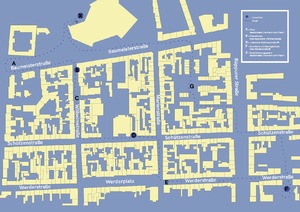
Im Sommersemester 2020, entwickelte die Gruppe einen etwa einstündigen Audiowalk durch die Südstadt, der somit der Zeit - inmitten des Pandemiegeschehens – gerecht werden konnte.
Die Besucher*innen, die sich am Staatstheater sammelten, bekamen eine Karte mit verzeichneten Stationen, Kopfhörer, einen Mp3 Player und eine Sitzgelegenheit für unterwegs. Die von den Schauspielerinnen eingelesen Texte (Marie-Joelle Blazejewski
Lucie Emons), leiteten die Teilnehmer*innen audio-visuell durch die Straßen. Ergänzt wurde der Walk durch unterschiedliche Interventionen: z.B. das Verteilen von Joghurts, Aushänge von Wohnungen im Markler*innen Büro, Ruhestationen und ein Livemoment mit den Schauspiele-rinnen Lodi Doumit und Antonia Mohr in einem leerstehenden Ladenlokal in der Schützenstraße.
Inhalt:
„Frau Verschwindet (Versionen)“ von Julia Haenni ist 2019 im „Verlag der Autoren“ in Frankfurt am Main erschienen.
Eine Frau verschwindet aus ihrer Wohnung. Die Tür steht offen. Ist ihr Verschwinden Zufall, trifft die Frau die Entscheidung ihr Heim zu verlassen selbstbestimmt, ist etwas passiert…?
Die Autorin skizziert unterschiedliche Frauenstimmen, die mal mit sich selbst, mal untereinander in Dialog treten. Die Themen des Verschwindens und die Rolle der Frau in unserer Gesellschaft, sind herbei zentral.
- Das neue Stück ist ein Format, in langjähriger Kooperation von Staatstheater Karlsruhe und HfG Karlsruhe, welches Texte zeitgenössischer Autor*innen behandelt. Die Studierenden entwickeln eine szenische Lesung, die normalerweise im Studio des Staatstheaters stattfindet.
- Beschreibung (en)
- The new play is a format, in a long-standing cooperation between Staatstheater Karlsruhe and HfG Karlsruhe, which deals with texts by contemporary authors. The students develop a staged reading that normally takes place in the Staatstheater's studio.
In the 2020 summer semester, the group developed a one-hour audio walk through the Südstadt, which was thus able to do justice to the time - in the midst of the pandemic.
The visitors, who gathered at the Staatstheater, were given a map with marked stations, headphones, an mp3 player and a place to sit on the go. The texts read by the actresses (Marie-Joelle Blazejewski
Lucie Emons), guided the participants audio-visually through the streets. The walk was supplemented by various interventions: e.g. the distribution of yoghurts, notices of apartments in the Markler*innen office, resting stations and a live moment with the actresses Lodi Doumit and Antonia Mohr in a vacant store in Schützenstraße.
Content:
"Frau Verschwindet (Versionen)" by Julia Haenni was published in 2019 by "Verlag der Autoren" in Frankfurt am Main.
A woman disappears from her apartment. The door is open. Is her disappearance a coincidence, did the woman make the decision to leave her home on her own, did something happen...?
The author sketches different women's voices, who sometimes enter into dialog with themselves, sometimes with each other. The themes of disappearance and the role of women in our society are central.
- The new play is a format, in a long-standing cooperation between Staatstheater Karlsruhe and HfG Karlsruhe, which deals with texts by contemporary authors. The students develop a staged reading that normally takes place in the Staatstheater's studio.
- Typ des Projekts/Werks
- Schlagworte
- Mitwirkende
- Sprache
- Ort: Institution
- Ort
- Südstadt
- Stadt
- Land
- Beteiligte Institution(en)
- Internetlinks
- https://vimeo.com/484387006
Die Videoarbeit war Teil des Audiowalks und war vor dem Staatstheater auf einem alten Röhrenfernseher zu sehen.
- https://vimeo.com/484387006
- Bemerkungen
- Szenische Einrichtung& Ausstattung& Video:
Mascha Dilger
Nina Erika Eberle
Katja Koch
Josephine Leicht
Mariia Merkulova
Videoschnitt: Mariia Merkulova
Fotos: Felix Grünschloß
Grafik Flyer: Mascha Dilger
- Szenische Einrichtung& Ausstattung& Video:
- Titel
- DNS #66
- Untertitel
- FRAU VERSCHWINDET (VERSIONEN)
- Projektleiter/in
- Semester
- Studiengang
- Lehrveranstaltung
- Importiert am
- 19.12.2023
- Übergeordnete Sets
- 1
- Set enthält
- 0 11
DNS #65
Name that can easily go onto 2 lines
Author that can easily go onto 2 lines as well
- Titel
- DNS #65
- Untertitel
- Bookpink
- Autor/in
- Beschreibung (de)
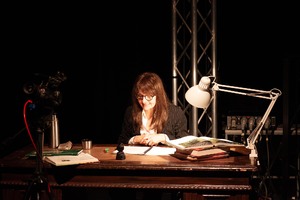
- In sieben komisch-poetischen Miniaturen beschreibt Caren Jeß menschliche Abgründe im Gewand von Federtieren wie dem Dreckspfau, der Sumpfmeise, tanzenden Flamingos oder dem Bussard im Beton der Vernunft. Ein Stück voller Humor, subtilem Wortwitz und draller Situationskomik.
- Beschreibung (en)
- In seven comic-poetic miniatures, Caren Jeß describes human abysses in the guise of feathered creatures such as the peacock, the marsh tit, dancing flamingos or the buzzard in the concrete of reason. A play full of humor, subtle wordplay and gritty situation comedy.
- Typ des Projekts/Werks
- Schlagworte
- Datierung
- 27.02.2020
- Mitwirkende
- Sprache
- Dauer
- 1 Stunde 30 Minuten
- Ort: Institution
- Ort
- Studio
- Stadt
- Land
- Beteiligte Institution(en)
- Bemerkungen
- Szenische Lesung und Autor*innengespräch
Bühne/Kostüm: Paula Klotzki, Jana Trampert, Cara Kollmann, Julia Ihls
Dramaturgie: Nele Lindemann, Anna Haas
Regie: Tobias Döhmer
SchauspielerInnen: Antonia Mohr, Jannek Petri, Alisa Kunina, Pål Fredrik Kvale, Constantin Petry
Plakat: Julia Ihls
- Szenische Lesung und Autor*innengespräch
- Titel
- DNS #65
- Untertitel
- Bookpink
- Projektleiter/in
- Semester
- Studiengang
- Lehrveranstaltung
- Importiert am
- 19.12.2023
- Übergeordnete Sets
- 1
- Set enthält
- 0 4
DNS #64
Name that can easily go onto 2 lines
Author that can easily go onto 2 lines as well
- Titel
- DNS #64
- Untertitel
- Frau Ada denkt Unerhörtes
- Autor/in
- Beschreibung (de)
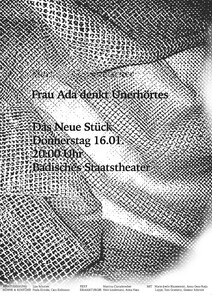
- Das neue Stück „Frau Ada denkt Unerhörtes“ handelt von der ersten Programmiererin der Welt, Ada Lovelace. Es beschreibt Adas Leben in zwei Teilen: Einem biografischen aber stark verfremdeten ersten Teil, der durch seine Dialoge und Besetzung eher Traumhaft wirkt, und einem realistisch anmutenden zweiten Teil, in dem eine Zukunft erdacht wird, in der eine der Maschinen, die Ada einst erfand, die Macht über die Menschheit an sich nimmt.
Unsere Kulisse bestand aus einem leicht durchscheinenden Vorhang, der die Bühne in der Mitte teilt. Im ersten Teil des Stücks saßen die Zuschauer auf der Tribüne, für den zweiten Teil wechselten sie die Seite des Vorhangs und saßen dann auf niedrigen Podesten auf der Rückseite der Bühne.
Um die Traumhaftigkeit des ersten Teils darzustellen, zeigten wir dort nur die Schauspielerin von Ada vor dem Vorhang, die anderen drei Schauspieler, welche die Figuren der Mutter und zweier Puppen darstellten, befanden sich hinter dem Vorhang und waren nur durch Schatten auf diesem zu sehen. Das Stück lässt offen, ob Ada mit echten Personen spricht, ob die Ereignisse wirklich passiert sind, oder ob alles nur in Adas Kopf stattfindet. Dieses Verschwimmen aus Fiebertraum und Wirklichkeit wurde durch die Schatten auf dem Vorhang artikuliert. Um dem Publikum dennoch ein Gefühl für die echte Ada Lovelace zu geben, wurden immer wieder Fakten aus ihrem Leben auf den Vorhang projiziert.
Im zweiten, sehr realistisch anmutenden Teil, bei dem sich die Zuschauer auf der anderen Seite des Vorhangs befinden, stehen die drei Schauspieler nun auf der Publikumsseite des Vorhangs in den Rollen dreier Wissenschaftler. Ada, jetzt als Roboter, steht leicht beleuchtet hinter dem Vorhang und scheint wie eine Traumvorstellung trüb durch den Stoff. In dem Moment, als sie zu eigenständigem Leben erwacht, wechselt sie die Seite des Vorhangs, tritt aus dem Traum und übernimmt die Realität.
Neben dem Verschwimmen von Traum und Realität, ist das Stück ebenfalls geprägt von Machtverhältnissen: Im ersten Teil wird Ada von ihrer Mutter und ihren vielen Krankheiten dominiert und muss viel liegen. Die Schauspielerin sitzt im gesamten ersten Teil auf dem Boden. Der Schatten der Mutter hinter ihr ist groß und bedrohlich. Das Publikum sitzt in einer erhöhten Position auf der Tribüne und schaut auf Ada herab.
Im zweiten Teil übernimmt Ada in Form eines Roboters die Macht, das Publikum wird ihr untergeordnet und sitzt auf niedrigen Podesten fast auf dem Boden. Die Wissenschaftler werden von Ada überwunden und verlassen nach und nach den Lichtkegel der Bühne.
- Das neue Stück „Frau Ada denkt Unerhörtes“ handelt von der ersten Programmiererin der Welt, Ada Lovelace. Es beschreibt Adas Leben in zwei Teilen: Einem biografischen aber stark verfremdeten ersten Teil, der durch seine Dialoge und Besetzung eher Traumhaft wirkt, und einem realistisch anmutenden zweiten Teil, in dem eine Zukunft erdacht wird, in der eine der Maschinen, die Ada einst erfand, die Macht über die Menschheit an sich nimmt.
- Beschreibung (en)
- The new play "Frau Ada denkt Unerhörtes" is about the world's first female programmer, Ada Lovelace. It describes Ada's life in two parts: A biographical but heavily distorted first part, which seems rather dreamlike due to its dialog and cast, and a realistic-seeming second part, in which a future is imagined in which one of the machines Ada once invented takes power over humanity.
Our backdrop consisted of a slightly translucent curtain that divided the stage in the middle. In the first part of the play, the audience sat on the bleachers; for the second part, they changed sides of the curtain and then sat on low platforms at the back of the stage.
In order to portray the dreamlike nature of the first part, we only showed Ada's actress in front of the curtain; the other three actors, who played the characters of the mother and two puppets, were behind the curtain and could only be seen through shadows on it. The play leaves it open as to whether Ada is talking to real people, whether the events really happened or whether everything is just taking place in Ada's head. This blurring of fever dream and reality was articulated by the shadows on the curtain. In order to give the audience a feeling for the real Ada Lovelace, facts from her life were projected onto the curtain again and again.
In the second, very realistic-looking part, in which the audience is on the other side of the curtain, the three actors now stand on the audience side of the curtain in the roles of three scientists. Ada, now as a robot, stands slightly illuminated behind the curtain and seems to be clouding through the fabric like a dream. The moment she awakens to independent life, she changes sides of the curtain, steps out of the dream and takes over reality.
In addition to the blurring of dream and reality, the play is also characterized by power relations: In the first part, Ada is dominated by her mother and her many illnesses and has to lie down a lot. The actress sits on the floor throughout the first part. The shadow of her mother behind her is large and threatening. The audience sits in an elevated position on the stand and looks down on Ada.
In the second part, Ada takes over in the form of a robot, the audience is subordinated to her and sits on low platforms almost on the floor. The scientists are overcome by Ada and gradually leave the light cone of the stage.
- The new play "Frau Ada denkt Unerhörtes" is about the world's first female programmer, Ada Lovelace. It describes Ada's life in two parts: A biographical but heavily distorted first part, which seems rather dreamlike due to its dialog and cast, and a realistic-seeming second part, in which a future is imagined in which one of the machines Ada once invented takes power over humanity.
- Typ des Projekts/Werks
- Schlagworte
- Datierung
- 16.01.2020
- Mitwirkende
- Sprache
- Ort: Institution
- Ort
- Studiobühne
- Stadt
- Land
- Beteiligte Institution(en)
- Bemerkungen
- Szenische Lesung
Bühne & Kostüme: Paula Klotzki, Cara Kollmann
Regie: Liss Scholtes
Dramaturgie: Nele Lindemann, Anna Haas
Mit: Marie-Joelle Blazejewski, Anna Gesa-Raija Lappe, Tom Gramenz, Gunnar Schmidt
- Szenische Lesung
- Titel
- DNS #64
- Untertitel
- Frau Ada denkt Unerhörtes
- Projektleiter/in
- Semester
- Studiengang
- Lehrveranstaltung
- Importiert am
- 19.12.2023
- Übergeordnete Sets
- 1
- Set enthält
- 0 8
DNS #63
Name that can easily go onto 2 lines
Author that can easily go onto 2 lines as well
- Titel
- DNS #63
- Untertitel
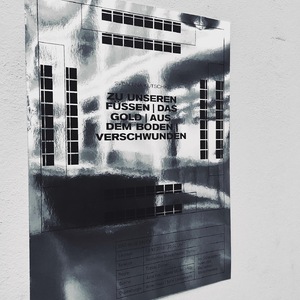
- Zu unseren Füßen, das Gold, aus dem Boden Verschwunden
- Autor/in
- Beschreibung (de)
- Ein Wohnhaus in Berlin: darin ein alter Trinker, ein lesbisches Paar, ein Geflüchteter, eine depressive Frau und ihr Ex-Mann. Im Stück „Zu unseren Füßen, das Gold, aus dem Boden verschwunden“ von Svealena Kutschke entspinnen sich im Alltag jener Figuren Fragen nach unserem Umgang mit dem Fremdem – sei es kultureller oder ideologischer Couleur. Die voyeuristische Situation, in welcher sich jegliche Erkenntnis nur durch die Blicke und Zuschreibungen der Nachbarn vollzieht, wurde hierfür in eine panoptische Szenografie übersetzt. Darin bewohnen die Schauspieler gemeinsam mit den Zuschauern Vorder- und Hinterhaus sowie die Seitenflügel, um so gleichsam eine diskursive wie affizierende Arena aufzuspannen. In der Mitte, ein Spiegel. Jene Leerstelle fungiert zugleich – in Form des Hinterhofs – als Austragungsort der einsamen Monologe wie auch als räumlicher Akteur für den, in der Besetzung nicht vorgesehenen, Flüchtling. Ob und wie jene Figur durch die Spiegelreflexion eine Stimme erlangt oder ob die Anwesenden in der Betrachtung lediglich auf sich selbst zurückgeworfen werden, bleibt bewusst eine offene, ungelöste Frage.
- Beschreibung (en)
- An apartment building in Berlin: an old drunk, a lesbian couple, a refugee, a depressed woman and her ex-husband. In Svealena Kutschke's play "Zu unseren Füßen, das Gold, aus dem Boden verschwunden" (At our feet, the gold that has disappeared from the ground), questions about how we deal with the foreign - be it of a cultural or ideological nature - arise in the everyday lives of these characters. The voyeuristic situation, in which all knowledge is only gained through the gazes and attributions of the neighbors, was translated into a panoptic scenography. In it, the actors inhabit the front and back houses as well as the side wings together with the audience in order to create an arena that is both discursive and affirmative. In the middle, a mirror. This empty space functions simultaneously - in the form of the backyard - as a venue for the solitary monologues and as a spatial actor for the refugee, who is not included in the cast. Whether and how this figure acquires a voice through the mirror reflection or whether those present are merely thrown back on themselves in the reflection deliberately remains an open, unresolved question.
- Typ des Projekts/Werks
- Schlagworte
- Datierung
- 13.12.2019
- Mitwirkende
- Sprache
- Ort: Institution
- Ort
- Studio
- Stadt
- Land
- Beteiligte Institution(en)
- Bemerkungen
- Szenische Lesung
Bühne: Julia Ihls und Gloria Müller, ADSZ Hfg Karslruhe WS 2019/2020
Regie: Tobias Dömer
Dramaturgie: Nele Lindemann, Anna Haas
Mit: Ute Baggeröhr, Marie-Joelle Blazejewski, Antonia Mohr, Sven Daniel Bühler, Timo Tank
- Szenische Lesung
- Titel
- DNS #63
- Untertitel
- Zu unseren Füßen, das Gold, aus dem Boden Verschwunden
- Projektleiter/in
- Semester
- Studiengang
- Lehrveranstaltung
- Importiert am
- 19.12.2023
- Übergeordnete Sets
- 1
- Set enthält
- 0 8
DNS #59
Name that can easily go onto 2 lines
Author that can easily go onto 2 lines as well
- Titel
- DNS #59
- Untertitel
- Worte
- Autor/in
- Beschreibung (de)
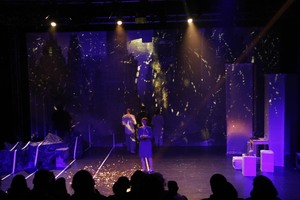
- In einer unbestimmten Zukunft sind nur noch Menschen mit einem besonderen Sprach-Gen privilegiert. Wer dieses Gen nicht aufweist, lebt außerhalb eines urbanen Zentrums, in Ruinen, mit rudimentärer Sprache, auf den evolutionären Grad eines Insekts reduziert. Wurm ist sprachlich begabt und schlüpft täglich durch die Absperrungen, die die Kolonien voneinander trennen, um im Zentrum zu arbeiten. Doch sein Vorgesetzter hat schon Verdacht geschöpft. Wie Sprache, Macht und die Herausbildung totalitärer Systeme zusammenhängen, davon schreibt Maria Milisavljevic in ihrem Stück Worte.
- Beschreibung (en)
- In an indefinite future, only people with a special language gene will be privileged. Those without this gene live outside an urban center, in ruins, with rudimentary language, reduced to the evolutionary level of an insect. Wurm is linguistically gifted and slips through the barriers separating the colonies every day to work in the center. But his superior has already become suspicious. Maria Milisavljevic writes about how language, power and the development of totalitarian systems are connected in her play Worte.
- Typ des Projekts/Werks
- Schlagworte
- Datierung
- 01.05.2019 - 15.05.2019
- Mitwirkende
- Sprache
- Ort: Institution
- Ort
- Studiobühne
- Stadt
- Land
- Beteiligte Institution(en)
- Bemerkungen
- Szenische Lesung und Autor*innengespräch
EINRICHTUNG Tobias Dömer
BÜHNE & KOSTÜME Lena Breitmoser, Carina Fenderich*
DRAMATURGIE Nele Lindemann MIT Emons, Hübschmann – Koch, Schumacher, Wagner
- Szenische Lesung und Autor*innengespräch
- Titel
- DNS #59
- Untertitel
- Worte
- Projektleiter/in
- Semester
- Studiengang
- Lehrveranstaltung
- Importiert am
- 19.12.2023
- Übergeordnete Sets
- 1
- Set enthält
- 0 9
DNS #53
- Titel
- DNS #53
- Untertitel
- Sieben Geister
- Autor/in
- Beschreibung (de)
- Oma ist tot, es lebe Oma?! Anlässlich der Beerdigung der Großmutter brechen zwischen Kinder- und Enkelgeneration Familienkonflikte auf, in deren Nöten und Sehnsüchten sich 70 Jahre deutscher Geschichte spiegeln. Entlang dreier Generationen spannt Sören Hornungs, mit dem Chemnitzer Theaterpreis für junge Dramatik ausgezeichneter wie für den Autorenpreis des Heidelberger Stückemarkt nominierter, Text einen Bogen von 1945 bis heute.
- Beschreibung (en)
- Grandma is dead, long live grandma?! On the occasion of the grandmother's funeral, family conflicts break out between the children and grandchildren's generation, whose needs and longings reflect 70 years of German history. Spanning three generations, Sören Hornung's text, which was awarded the Chemnitz Theater Prize for Young Drama and nominated for the Heidelberg Stückemarkt Author's Prize, spans an arc from 1945 to the present day.
- Typ des Projekts/Werks
- Schlagworte
- Datierung
- 18.05.2018
- Mitwirkende
- Sprache
- Ort: Institution
- Ort
- Studio
- Stadt
- Land
- Beteiligte Institution(en)
- Bemerkungen
- EINRICHTUNG Dominik Jellen
BÜHNE & KOSTÜME Tiffany Erdwein, Yael Kolb
DRAMATURGIE Lena Fritschle MIT Annette Büschelberger, Marthe Lola Deutschmann, Lisa Schlegel – Klaus Cofalka Adami, Jannek Petri
- EINRICHTUNG Dominik Jellen
- Titel
- DNS #53
- Untertitel
- Sieben Geister
- Projektleiter/in
- Semester
- Studiengang
- Lehrveranstaltung
- Importiert am
- 20.12.2023
- Übergeordnete Sets
- 1
- Set enthält
- 0 0
DNS #52
- Titel
- DNS #52
- Untertitel
- Paradies spielen (Abendland. Ein Abgesang)
- Autor/in
- Beschreibung (de)
- Ungebremst rast ein Zug durch Europas Landschaften und Bahnhöfe. Ein chinesisches Paar wandert aus auf der Suche nach dem Paradies Europa, stößt dort aber auf die gleichen ausbeuterischen Arbeitsbedingungen wie in der Heimat. Und am Krankenbett seines Vaters schaut ein junger Mann dem Tod ins Gesicht. In paradies spielen, dem Abschluss seiner Klimatrilogie, erzählt der preisgekrönte Dramatiker Thomas Köck kraftvoll, kühn und mit leisem Humor von den globalen Erschütterungen des 21. Jahrhunderts. Im Rahmen seines Stipendiums der Akademie Schloss Solitude schreibt er für das STAATSTHEATER KARLSRUHE und das Theater Rampe mit Abfall der Welt außerdem mit Abfall der Welt außerdem einen vielstimmigen Monolog für fünf Spieler und zwei Tänzer, den Sie ab dem 22.2. im STUDIO erleben können.
- Beschreibung (en)
- A train races unchecked through Europe's landscapes and train stations. A Chinese couple emigrate in search of paradise in Europe, but encounter the same exploitative working conditions there as at home. And a young man looks death in the face at his father's sickbed. In paradies spielen, the conclusion of his climate trilogy, award-winning playwright Thomas Köck tells of the global upheavals of the 21st century with power, boldness and gentle humor. As part of his fellowship at Akademie Schloss Solitude, he is also writing a polyphonic monologue for five players and two dancers for STAATSTHEATER KARLSRUHE and Theater Rampe with Abfall der Welt, which you can experience from 22.2. at STUDIO.
- Typ des Projekts/Werks
- Schlagworte
- Datierung
- 16.02.2018
- Mitwirkende
- Sprache
- Ort: Institution
- Ort
- Studio
- Stadt
- Land
- Beteiligte Institution(en)
- Bemerkungen
- REGIE Jenny Regnet
BÜHNE & KOSTÜME Luisa Hentsch, Emily Ortlepp, Lisa Schächner, Victor van Wetten
DRAMATURGIE Judith Heese MIT Susanne Buchenberger, Lydia Fuchs, Florian Mania, Mona Müller, Luis Quintana
FOTOS: Isabelle Kaczmarek und Luisa Hentsch
- REGIE Jenny Regnet
- Titel
- DNS #52
- Untertitel
- Paradies spielen (Abendland. Ein Abgesang)
- Projektleiter/in
- Semester
- Studiengang
- Lehrveranstaltung
- Importiert am
- 20.12.2023
- Übergeordnete Sets
- 1
- Set enthält
- 0 0
DNS #51
- Titel
- DNS #51
- Untertitel
- Das Knurren der Milchstraße
- Autor/in
- Beschreibung (de)
- Ein Raumschiff landet und es entsteigen: ein abgewählter Donald Trump, ein pazifistischer Kim Jong-Un, eine verfettete Heidi Klum und viele mehr. Der Text des deutsch-koreanischen Dramatikers Bonn Park erzählt mit viel Witz von einer ebenso nahen wie unwahrscheinlichen Zukunft.
Das Stück gewann den 1. Preis des Stückemarktes beim Berliner Theatertreffen 2017 und Bonn Park damit einen Werkauftrag am STAATSTHEATER für die Spielzeit 2018/19.
- Ein Raumschiff landet und es entsteigen: ein abgewählter Donald Trump, ein pazifistischer Kim Jong-Un, eine verfettete Heidi Klum und viele mehr. Der Text des deutsch-koreanischen Dramatikers Bonn Park erzählt mit viel Witz von einer ebenso nahen wie unwahrscheinlichen Zukunft.
- Beschreibung (en)
- A spaceship lands and the following emerge: an ousted Donald Trump, a pacifist Kim Jong-Un, a fatty Heidi Klum and many more. The text by German-Korean playwright Bonn Park wittily tells of a future that is as near as it is improbable.
The play won first prize in the Stückemarkt at the 2017 Berlin Theatertreffen and Bonn Park was thus commissioned to write a work for the STAATSTHEATER for the 2018/19 season.
- A spaceship lands and the following emerge: an ousted Donald Trump, a pacifist Kim Jong-Un, a fatty Heidi Klum and many more. The text by German-Korean playwright Bonn Park wittily tells of a future that is as near as it is improbable.
- Typ des Projekts/Werks
- Schlagworte
- Datierung
- 09.01.2018
- Mitwirkende
- Sprache
- Ort: Institution
- Ort
- Studio
- Stadt
- Land
- Beteiligte Institution(en)
- Bemerkungen
- EINRICHTUNG Sarah Steinfelder
AUSSTATTUNG Maria Merkulova, Jonas Rehren
DRAMATURGIE Roland Marzinowski MIT Marthe Lola Deutschmann, Sithembile Menck, Sven Daniel Bühler, Meik van Severen
- EINRICHTUNG Sarah Steinfelder
- Titel
- DNS #51
- Untertitel
- Das Knurren der Milchstraße
- Projektleiter/in
- Semester
- Studiengang
- Lehrveranstaltung
- Importiert am
- 20.12.2023
- Übergeordnete Sets
- 1
- Set enthält
- 0 0
DNS #50
- Titel
- DNS #50
- Untertitel
- Die Hockenden
- Autor/in
- Beschreibung (de)
- Eine Dorfgemeinschaft, eine Schicksalsgemeinschaft? Sie hocken in Pfützen und Mulden und erzählen von brennenden Kneipen und immer gleichen Heilsbringern. Eine Gruppe Alteingesessener, die darauf hofft, dass endlich etwas passiert. Miroslava Svolikovas preisgekröntes Stück ist eine vielstimmige Partitur, die mit Witz und Poesie von der Radikalisierung einer Gesellschaft erzählt. 2016 wurde das Stück am Burgtheater Wien uraufgeführt.
- Beschreibung (en)
- A village community, a community of destiny? They squat in puddles and hollows and talk about burning pubs and the same old saviors. A group of long-established people hoping that something will finally happen. Miroslava Svolikova's award-winning play is a polyphonic score that tells of the radicalization of a society with wit and poetry. The play premiered at the Burgtheater Vienna in 2016.
- Typ des Projekts/Werks
- Schlagworte
- Mitwirkende
- Sprache
- Ort: Institution
- Ort
- Studio
- Stadt
- Land
- Beteiligte Institution(en)
- Internetlinks
- Bemerkungen
- EINRICHTUNG Jenny Regnet
BÜHNE & KOSTÜME Janina Capelle, Katharina Küster, Hanna Scherwinski
DRAMATURGIE Jakob Schumann
MIT Sithembile Menck, Jannek Petri, Jens Koch, Louis Quintana
Fotos: Cécile Kobel
- EINRICHTUNG Jenny Regnet
- Titel
- DNS #50
- Untertitel
- Die Hockenden
- Projektleiter/in
- Semester
- Studiengang
- Lehrveranstaltung
- Importiert am
- 20.12.2023
- Übergeordnete Sets
- 1
- Set enthält
- 0 0
DNS #48
- Titel
- DNS #48
- Untertitel
- Ausfallgesellschaft
- Autor/in
- Beschreibung (de)
- Fußballsommer 2016: Auf einem Brüsseler Polizeirevier warten die Beamten gespannt auf das EM-Viertelfinale, doch ein als Terrorverdächtiger festgenommener Afrikaner muss ins Kreuzverhör genommen werden. Auch der vor Kurzem in Europa Angekommene ist ein begeisterter Fußballfan und verwickelt die zunehmend entnervten Polizisten in immer neue Gespräche über seine Perspektive auf unsere scheinbar krisengeschüttelten Verhältnisse.
Mit den Alltagserfahrungen aus einem Bürgerkriegsland und trotzdem ungewöhnlicher Leichtigkeit wirft der junge kongolesische Autor David-Minor Ilunga einen neuen Blick auf unseren Umgang mit Racial Profiling und die paranoiden Auswüchse unserer Terrorbekämpfung.
- Fußballsommer 2016: Auf einem Brüsseler Polizeirevier warten die Beamten gespannt auf das EM-Viertelfinale, doch ein als Terrorverdächtiger festgenommener Afrikaner muss ins Kreuzverhör genommen werden. Auch der vor Kurzem in Europa Angekommene ist ein begeisterter Fußballfan und verwickelt die zunehmend entnervten Polizisten in immer neue Gespräche über seine Perspektive auf unsere scheinbar krisengeschüttelten Verhältnisse.
- Beschreibung (en)
- Soccer summer 2016: the officers at a Brussels police station are eagerly awaiting the European Championship quarter-finals, but an African arrested as a terror suspect has to be cross-examined. The recent arrival in Europe is also an enthusiastic soccer fan and involves the increasingly unnerved police officers in ever new conversations about his perspective on our seemingly crisis-ridden circumstances.
With everyday experiences from a country in civil war and yet with an unusual lightness of touch, the young Congolese author David-Minor Ilunga takes a new look at how we deal with racial profiling and the paranoid excesses of our fight against terror.
- Soccer summer 2016: the officers at a Brussels police station are eagerly awaiting the European Championship quarter-finals, but an African arrested as a terror suspect has to be cross-examined. The recent arrival in Europe is also an enthusiastic soccer fan and involves the increasingly unnerved police officers in ever new conversations about his perspective on our seemingly crisis-ridden circumstances.
- Typ des Projekts/Werks
- Schlagworte
- Datierung
- 21.06.2017
- Mitwirkende
- Sprache
- Ort: Institution
- Ort
- Studio
- Stadt
- Land
- Beteiligte Institution(en)
- Bemerkungen
- EINRICHTUNG Sarah Steinfelder
BÜHNE & KOSTÜME Till Gombert, Felix Plachtzik
ÜBERSETZUNG & DRAMATURGIE Jakob Schumann
- EINRICHTUNG Sarah Steinfelder
- Titel
- DNS #48
- Untertitel
- Ausfallgesellschaft
- Projektleiter/in
- Semester
- Studiengang
- Lehrveranstaltung
- Importiert am
- 20.12.2023
- Übergeordnete Sets
- 1
- Set enthält
- 0 0
DNS
Name that can easily go onto 2 lines
Author that can easily go onto 2 lines as well
- Titel
- DNS
- Typ des Projekts/Werks
- Schlagworte
- Sprache
- Stadt
- Land
- Titel
- DNS
- Studiengang
- Importiert am
- 19.12.2023
- Übergeordnete Sets
- 0
- Set enthält
- 12 0