Sets
444 Inhalte
- Seite 1 von 37
Rundgang 2026
Name that can easily go onto 2 lines
Author that can easily go onto 2 lines as well
- Titel
- Rundgang 2026
- Autor/in
- Beschreibung (de)
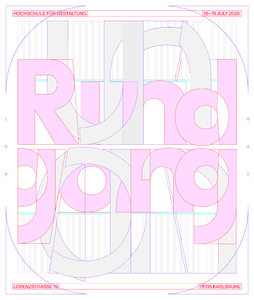
- Traditionell zum Ende des Sommersemesters öffnet die Staatliche Hochschule für Gestaltung Karlsruhe ihre Türen zum Rundgang und lädt Besucher:innen dazu ein, die Hochschule über mehrere Tage hinweg als Ausstellungs- und Begegnungsort zu erleben. Vom 16. bis 19. Juli 2026 verwandeln sich die Lichthöfe, Werkstätten, Ateliers und Seminarräume der HfG Karlsruhe erneut in ein weitläufiges Forum für aktuelle studentische Arbeiten und Projekte.
- Traditionell zum Ende des Sommersemesters öffnet die Staatliche Hochschule für Gestaltung Karlsruhe ihre Türen zum Rundgang und lädt Besucher:innen dazu ein, die Hochschule über mehrere Tage hinweg als Ausstellungs- und Begegnungsort zu erleben. Vom 16. bis 19. Juli 2026 verwandeln sich die Lichthöfe, Werkstätten, Ateliers und Seminarräume der HfG Karlsruhe erneut in ein weitläufiges Forum für aktuelle studentische Arbeiten und Projekte.
- Beschreibung (en)
- As is tradition at the end of the summer semester, the Karlsruhe University of Arts and Design opens its doors for a campus tour and invites visitors to experience the university as a venue for exhibitions and encounters over the course of several days. From July 16 to 19, 2026, the atriums, workshops, studios, and seminar rooms of the HfG Karlsruhe will once again be transformed into a spacious forum for current student work and projects.
- As is tradition at the end of the summer semester, the Karlsruhe University of Arts and Design opens its doors for a campus tour and invites visitors to experience the university as a venue for exhibitions and encounters over the course of several days. From July 16 to 19, 2026, the atriums, workshops, studios, and seminar rooms of the HfG Karlsruhe will once again be transformed into a spacious forum for current student work and projects.
- Datierung
- 16.07.2026 - 19.07.2026
- Ort: Institution
- Titel
- Rundgang 2026
- Importiert am
- 01.06.2026
- Übergeordnete Sets
- 1
- Set enthält
- 1 1
Rundgang 2025

Name that can easily go onto 2 lines
Author that can easily go onto 2 lines as well
- Titel
- Rundgang 2025
- Untertitel
- Jahresausstellung der HfG Karlsruhe
- Beschreibung (de)
- Traditionell zum Ende des Sommersemesters lädt die Staatliche Hochschule für Gestaltung Karlsruhe zum alljährlichen Rundgang durch die Lichthöfe ein und gewährt für ein verlängertes Wochenende einen Blick hinter die Kulissen der Hochschule. Zum Rundgang 2025 unter dem Motto KIOSK, vom 24. bis 27. Juli, werden die Werkstätten, Lichthöfe und Räume der HfG Karlsruhe wieder zur Ausstellungsfläche.
Die große Jahresausstellung zeigt aktuelle Projekte aus allen Studiengängen und Fachgruppen – Kommunikationsdesign, Produktdesign, Medienkunst, Ausstellungsdesign & Szenografie sowie Kunstwissenschaft & Medienphilosophie. In den Lichthöfen der HfG und an weiteren Präsentationsorten in der Hochschule erhalten Besucher:innen Einblicke in rund 100 studentische Arbeiten. Darunter finden sich beispielsweise Performances, Installationen, Videos, Objekte und Texte. Ein begleitendes Veranstaltungsprogramm mit öffentlichen Führungen, Filmvorführungen, Gesprächen und weiteren Formaten, mitgestaltet vom Allgemeinen Studierendenausschuss der Hochschule, bietet über vier Tage hinweg Gelegenheiten zum Austausch mit Studierenden und Lehrenden.
Die HfG zeigt sich beim Rundgang als lebendiger Ort, an dem Kunst, Theorie und Gestaltung in interdisziplinären Projekten zusammenkommen. So entwerfen mit „THE NEST“ beispielsweise drei Studierende aus dem Fachbereich Produktdesign einen lebensgroßen, nestartigen Pavillon aus regionalen, bio-basierten Materialien wie Hanf, Holz und invasiven Pflanzen. Die Installation reflektiert ökologische Wertschöpfungsketten und entsteht in Kooperation mit dem Bio Design Lab, das sich an der HfG auf regenerative Materialien und nachhaltige Gestaltungsansätze spezialisiert.
Studierende aus dem Fachbereich Ausstellungsdesign und Szenografie wiederum präsentieren beispielsweise ein mobiles Bühnenbild, das ein spekulatives Zukunftsszenario für das Jahr 2034 entwirft – mit Blick auf ökologische Kipppunkte, globale Gerechtigkeit und politische Handlungsfähigkeit. Die Arbeit basiert auf dem Roman „Das Ministerium für die Zukunft“ von Kim Stanley Robinson und entsteht in Kooperation mit dem Theater Neumarkt sowie dem Collegium Helveticum Zürich.
Am Eröffnungsabend des Rundgangs, am 24.7.25 ab 19 Uhr, vergibt die Fördergesellschaft ZKM/HfG Preise für herausragende Abschluss- und Semesterarbeiten, die von Professor:innen aus allen Fachbereichen im Vorfeld der Ausstellung nominiert wurden.
Unter den diesjährigen Nominierten findet sich beispielsweise das Projekt der beiden Studierenden Sophie Reißfelder und Luise Peschko, mit dem Titel „Manchmal ist Schmerz ganz leise“: eine immersive, autobiographische Hörstück-Installation, die den stillen und oft unsichtbaren Kampf mit einer schweren, namenlosen Krankheit thematisiert. Eine Fachjury aus Wissenschaft, Kunst und Kultur wählt die Preisträger:innen aus den nominierten Arbeiten aus. Die Auszeichnungen ehren besondere Leistungen und unterstützen die Weiterentwicklung von Projekten.
- Traditionell zum Ende des Sommersemesters lädt die Staatliche Hochschule für Gestaltung Karlsruhe zum alljährlichen Rundgang durch die Lichthöfe ein und gewährt für ein verlängertes Wochenende einen Blick hinter die Kulissen der Hochschule. Zum Rundgang 2025 unter dem Motto KIOSK, vom 24. bis 27. Juli, werden die Werkstätten, Lichthöfe und Räume der HfG Karlsruhe wieder zur Ausstellungsfläche.
- Beschreibung (en)
- Traditionally, at the end of the summer semester, the Karlsruhe University of Arts and Design invites visitors to its annual tour of the atriums and offers a look behind the scenes of the university for a long weekend. The workshops, atriums and rooms of the HfG Karlsruhe will once again become an exhibition space for the 2025 tour under the motto KIOSK, from July 24 to 27.
The large annual exhibition will showcase current projects from all degree programs and subject groups - Communication Design, Product Design, Media Art, Exhibition Design & Scenography and Art Research & Media Philosophy. In the atriums of the HfG and at other presentation locations throughout the university, visitors can gain an insight into around 100 student works. These include performances, installations, videos, objects and texts. An accompanying program of events with public tours, film screenings, talks and other formats, co-organized by the university's General Student Committee, offers opportunities for exchange with students and teachers over four days.
During the tour, the HfG presents itself as a lively place where art, theory and design come together in interdisciplinary projects. With “THE NEST”, for example, three students from the Product Design department are designing a life-size, nest-like pavilion made from regional, bio-based materials such as hemp, wood and invasive plants. The installation reflects ecological value chains and was created in cooperation with the Bio Design Lab, which specializes in regenerative materials and sustainable design approaches at the HfG. Students from the Department of Exhibition Design and Scenography, on the other hand, are presenting a mobile stage set that creates a speculative future scenario for the year 2034 - with a view to ecological tipping points, global justice and political agency. The work is based on the novel “The Ministry for the Future” by Kim Stanley Robinson and is being created in cooperation with Theater Neumarkt and Collegium Helveticum Zurich.
On the opening evening of the Rundgang, on July 24 from 7 p.m., the ZKM/HfG Sponsorship Society will award prizes for outstanding final and semester projects nominated by professors from all departments in the run-up to the exhibition. This year's nominees include, for example, the project by the two students Sophie Reißfelder and Luise Peschko, entitled “Sometimes pain is very quiet”: an immersive, autobiographical audio piece installation that addresses the silent and often invisible struggle with a serious, nameless illness. A jury of experts from the fields of science, art and culture selects the winners from the nominated works. The awards honor special achievements and support the further development of projects.
- Traditionally, at the end of the summer semester, the Karlsruhe University of Arts and Design invites visitors to its annual tour of the atriums and offers a look behind the scenes of the university for a long weekend. The workshops, atriums and rooms of the HfG Karlsruhe will once again become an exhibition space for the 2025 tour under the motto KIOSK, from July 24 to 27.
- Datierung
- 24.07.2025 - 27.07.2025
- Titel
- Rundgang 2025
- Untertitel
- Jahresausstellung der HfG Karlsruhe
- Importiert am
- 13.05.2025
- Übergeordnete Sets
- 1
- Set enthält
- 0 1
Rundgang 2024 - Projekte
Name that can easily go onto 2 lines
Author that can easily go onto 2 lines as well
- Titel
- Rundgang 2024 - Projekte
- Titel
- Rundgang 2024 - Projekte
- Importiert am
- 15.01.2025
- Übergeordnete Sets
- 1
- Set enthält
- 14 0
Rundgang 2024 - Preisverleihung
Name that can easily go onto 2 lines
Author that can easily go onto 2 lines as well
- Titel
- Rundgang 2024 - Preisverleihung
- Beschreibung (de)
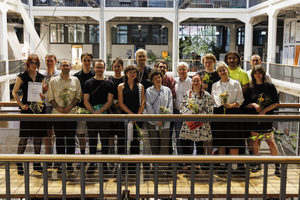
- Am Eröffnungsabend des Rundgangs wurden studentische Arbeiten unterschiedlicher Fachbereiche ausgezeichnet - dank großer Unterstützung der Fördergesellschaft ZKM / HfG, der Gunther-Schroff-Stiftung, der Heinrich-Hertz-Gesellschaft, der Badischen Beamtenbank, der Riemschneider Stiftung und auch privaten Preisgebern. Sie ermöglichen es durch ihre Finanzierungen den Studierenden neben der Anerkennung ihrer Leistungen, ihre Projekte weiterzuführen und neu anzustoßen.
Die HfG Karlsruhe bedankt sich herzlich bei allen Förderern und Stiftern und gratuliert an dieser Stelle noch einmal ausdrücklich allen Nominierten dieses Jahres sowie den Gewinner:innen:
Gunther-Schroff-Preis mit 5.000 €: Henriette Schwabe, Jaya Demmer - JJxH54D – Spring Collection
Preis I der Fördergesellschaft mit 4.000 €: BookBoi
Preis II der Fördergesellschaft mit 2.500 €: Rita Andrulyte - Path Tiles – Knitting Coordinates into Patterns
Preis der BBBank mit 1.500 €: Calvin Kudufia - A man in the shape of…
Preis III der Fördergesellschaft mit 1.000 € : Alicia Luna Ripp- Spellbound
Preis IV der Fördergesellschaft mit 1.000 €: Amelie Enders – ZWISCHEN-RÄUME_N
Achim & Melanie Krämer-Preis mit 1.000 €: Víctor Fancelli Capdevila - Who cares? - Digitale Sozialität, Infrastrukturen der Fürsorge und konviviale Technologien
Preis der Heinrich-Hertz-Gesellschaft mit 2.000 €: Schwarm Publication Issue 2 Delusions
Preis der Riemschneider Stiftung: Kevin Beckmann, Alexander Thelen, Masterclass mit Ida Bregninge unter der Leitung von Marine Hugonnier
- Am Eröffnungsabend des Rundgangs wurden studentische Arbeiten unterschiedlicher Fachbereiche ausgezeichnet - dank großer Unterstützung der Fördergesellschaft ZKM / HfG, der Gunther-Schroff-Stiftung, der Heinrich-Hertz-Gesellschaft, der Badischen Beamtenbank, der Riemschneider Stiftung und auch privaten Preisgebern. Sie ermöglichen es durch ihre Finanzierungen den Studierenden neben der Anerkennung ihrer Leistungen, ihre Projekte weiterzuführen und neu anzustoßen.
- Datierung
- 18.07.2024 - 21.07.2024
- Mitwirkende
- Ort: Institution
- Ort
- Lichtbrücke, Bühne
- Stadt
- Beteiligte Institution(en)
- Titel
- Rundgang 2024 - Preisverleihung
- Semester
- Importiert am
- 29.07.2024
- Übergeordnete Sets
- 1
- Set enthält
- 0 4
Rundgang 2024 - Poster
Name that can easily go onto 2 lines
Author that can easily go onto 2 lines as well
- Titel
- Rundgang 2024 - Poster
- Titel (en)
- Rundgang 2024 - Poster
- Autor/in
- Kategorie
- Typ des Projekts/Werks
- Schlagworte
- Mitwirkende
- Dank an
- Sprache
- Stadt
- Land
- Auftrag durch
- Staatliche Hochschule für Gestaltung Karlsruhe
- Titel
- Rundgang 2024 - Poster
- Projektleiter/in
- Semester
- Studiengang
- Importiert am
- 21.10.2024
- Übergeordnete Sets
- 1
- Set enthält
- 0 2
Rundgang 2024 - Fotos
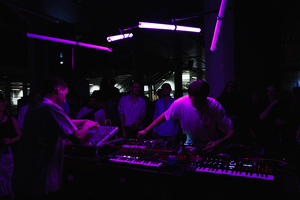
Name that can easily go onto 2 lines
Author that can easily go onto 2 lines as well
- Titel
- Rundgang 2024 - Fotos
- Titel
- Rundgang 2024 - Fotos
- Importiert am
- 20.01.2025
- Übergeordnete Sets
- 1
- Set enthält
- 4 2
Rundgang 2024 - Eröffnung
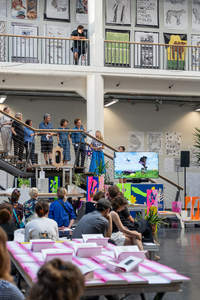
Name that can easily go onto 2 lines
Author that can easily go onto 2 lines as well
- Titel
- Rundgang 2024 - Eröffnung
- Titel
- Rundgang 2024 - Eröffnung
- Importiert am
- 20.01.2025
- Übergeordnete Sets
- 1
- Set enthält
- 0 13
Rundgang 2024
Name that can easily go onto 2 lines
Author that can easily go onto 2 lines as well
- Titel
- Rundgang 2024
- Untertitel
- Ausstellung und Performances mit Führungen zu rund 100 studentischen Arbeiten
- Beschreibung (de)
- Vom 18. bis 21. Juli 2024 öffnet die Staatliche Hochschule für Gestaltung (HfG) Karlsruhe wieder ihre Türen für ihre große Jahresausstellung mit Arbeiten aller Fachgruppen und aus allen Studienjahren. Der Rundgang durch die Lichthöfe zeigt zum Ende des Sommersemesters rund 100 studentische Arbeiten und Performances aus den Studiengängen Ausstellungsdesign & Szenografie, Kommunikationsdesign, Kunstwissenschaft & Medienphilosophie, Medienkunst sowie Produktdesign.
Der viertägige Rundgang ist ab der Eröffnung am 18.07.2024 mit täglich wechselnden Programmpunkten aus Führungen, Lesungen, Performances, Filmvorführungen, Workshops und Events bis zum 21. Juli 2024 zu erleben. Das Begleitprogramm und zwei weitere Ausstellungen in Kooperation der HfG mit den Hallenbaunachbarn ZKM und Städtische Galerie zeigen Ihnen die Vielseitigkeit des Studiums und den gestalterischen Anspruch der HfG auf internationalem Niveau.
Das diesjährige Ausstellungsdesign wurde von Studierenden der HfG unter Leitung von Gastprofessorin Doris Dziersk erarbeitet.
Der Rundgang wird am 18. Juli um 18.00 Uhr feierlich eröffnet durch eine Begrüßung und Empfang mit Constanze Fischbeck (HfG), Helga Huskamp (ZKM), Stefanie Patruno (Städtische Galerie), Henning Rickmann (Fördergesellschaft) und den Ausstellungsteams des Rundgangs.
PROGRAMM ZUM RUNDGANG 2024
Donnerstag, 18.07.
16:00 Uhr Soft Opening der gemeinsamen Ausstellung von HfG und ZKM „Antennae: Frequenzen aus dem Archiv“ im ZKM
16:00 Uhr Soft Opening der an der HfG erarbeiteten Studio-Ausstellung Hydromedia in der Städtischen Galerie
18:00 Uhr Eröffnung und Begrüßung im Lichthof
19:00 Uhr Einführung in die Ausstellung Hydromedia von Vanessa Bosch in der Städtischen Galerie
19:30 Uhr Preisverleihung der Fördergesellschaft ZKM / HfG e.V., der Heinrich-Hertz-Gesellschaft und der Riemschneider-Stiftung
20:30 Uhr Live Musik: Enna Erben
21:30 Uhr Live Musik und Bar: Koda
Freitag 19.07.
10:00 Uhr Hydromedia Workshops in der Städtischen Galerie
11:00 Uhr Antennae Kurator:innen Tour im ZKM
12:00 Uhr Schwarmpräsentation mit Lesung in Lichthof 3
geführte Touren durch die Ausstellung: 12:00, 13:00, 16:00, 17:00 Uhr, Treffpunkt vor dem Bauwagen bei der Palme
Auf dem HfG-Vorplatz
11:00-14:00 Uhr Asta Siebdruck Workshop & Open Decks
11:00-16:00 Uhr Asta Bar
"Talking Sphere" in Raum 112 (1. OG)
13:00-13:30 Uhr Karlsruhe's Race Against Time: Designing the Library of the Future
14:00-16:00 Uhr Antisemitische Ikonographie
Kino im Blauen Salon
14:00 - 15.30 Uhr Filmvorführung HfG-Kurzfilme: Rokas Wille, Quirin Thalhammer, Alexander Thelen & Isabel Winter, Niklas Weisenbach
18:00 - 19.30 Uhr Filmvorführung HfG-Kurzfilme: Jakob Suranovsky, Knut Kuhles, Isabel Konrad, Zulfikar Filandra
21:30 Uhr Kino im Blauen Salon “Ferris macht Blau"
Samstag, 20.07.
Auf dem HfG-Vorplatz
11:00-16:00 Uhr Asta Flohmarkt & Decks + Bar (Sommer, Sonne, Sonnenschein)
ab 12:00 Uhr Tattoos (Rebecca Zink und Cela)
"Talking Sphere" in Raum 112 (1. OG)
14:00-16:00 Uhr Silencing the Past - a conversation with Prof. Dan Hicks
"Plato's Rave" in Grüne Ecke (1. OG)
12:00 Uhr Hinges on our Stillness: MuMa and Isabella Panigada
15:00 Uhr Die Spieluhrprinzessin: Luise Peschko
15:30 Uhr Fuck Art — Marry Lover — Kill Ernest: Isabella Panigada
17:30 Uhr Haeßlig: Lennart Wandsleb
geführte Touren durch die Ausstellung: 12:00, 13:00, 16:00, 17:00 Uhr, Treffpunkt vor dem Bauwagen bei der Palme
Kino im Blauen Salon
14:00 - 15.30 Uhr Filmvorführung HfG-Kurzfilme: Jakob Suranovsky, Knut Kuhles, Isabel Konrad, Zulfikar Filandra
18:00 - 19.30 Uhr Filmvorführung HfG-Kurzfilme: Rokas Wille, Quirin Thalhammer, Alexander Thelen & Isabel Winter, Niklas Weisenbach
22:00 Uhr “HfG Party 1996”
Kinemathek in der Kaiserpassage 6
19:00 Uhr 20-rOundabOut-24: Rundgangskonzert von Studierenden, Alumni und Freunden der HfG Karlsruhe mit Live-Elektronik, Fixed Media, Audiovisuellen Projektionen und Live Performances
Sonntag, 21.07.
Kino im blauen Salon
14:00 - 15.30 Uhr Filmvorführung HfG-Kurzfilme: Rokas Wille, Quirin Thalhammer, Alexander Thelen & Isabel Winter, Niklas Weisenbach
15:30 - 17.00 Uhr Filmvorführung HfG-Kurzfilme : Jakob Suranovsky, Knut Kuhles, Isabel Konrad, Zulfikar Filandra
geführte Touren durch die Ausstellung: 12:00, 13:00, 15:00, 16:00 Uhr, Treffpunkt vor dem Bauwagen bei der Palme
17 Uhr Ende des Rundgangs 2024
- Vom 18. bis 21. Juli 2024 öffnet die Staatliche Hochschule für Gestaltung (HfG) Karlsruhe wieder ihre Türen für ihre große Jahresausstellung mit Arbeiten aller Fachgruppen und aus allen Studienjahren. Der Rundgang durch die Lichthöfe zeigt zum Ende des Sommersemesters rund 100 studentische Arbeiten und Performances aus den Studiengängen Ausstellungsdesign & Szenografie, Kommunikationsdesign, Kunstwissenschaft & Medienphilosophie, Medienkunst sowie Produktdesign.
- Kategorie
- Datierung
- 18.07.2024 - 21.07.2024
- Ort: Institution
- Titel
- Rundgang 2024
- Untertitel
- Ausstellung und Performances mit Führungen zu rund 100 studentischen Arbeiten
- Importiert am
- 21.05.2024
- Übergeordnete Sets
- 1
- Set enthält
- 3 1
Rundgang
Name that can easily go onto 2 lines
Author that can easily go onto 2 lines as well
- Titel
- Rundgang
- Titel
- Rundgang
- Importiert am
- 13.04.2018
- Übergeordnete Sets
- 1
- Set enthält
- 3 0
rOundabOut
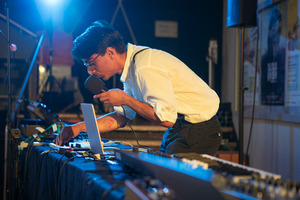
Name that can easily go onto 2 lines
Author that can easily go onto 2 lines as well
- Titel
- rOundabOut
- Kategorie
- Titel
- rOundabOut
- Importiert am
- 15.01.2025
- Übergeordnete Sets
- 1
- Set enthält
- 1 0
Rote Saat
Name that can easily go onto 2 lines
Author that can easily go onto 2 lines as well
- Titel
- Rote Saat
- Autor/in
- Beschreibung (de)
- „Rote Saat“ ist eine installative Arbeit, die sich mit dem Verschwinden traditioneller Nutzpflanzen in Deutschland und der Bedeutung von Saatgutbanken als lebendige Archive auseinandersetzt. Ausgangspunkt ist die Beobachtung eines drastischen Rückgangs der Sortenvielfalt seit dem 20. Jahrhundert, bedingt durch industrielle Landwirtschaft, gesetzliche Regulierungen und die Konzentration auf wenige Hochleistungssorten. Viele regional angepasste Landsorten erfüllen heutige Zulassungskriterien nicht mehr und sind dadurch aus dem Anbau verschwunden. Die Arbeit nimmt diese Entwicklung zum Anlass, um Prozesse der Erhaltung und Weitergabe von Saatgut sichtbar und erfahrbar zu machen.
Sie entstand im Kontext einer künstlerischen Recherche zu agrarökologischen Praktiken, Saatgutpolitik und kollektiven Formen der Wissensweitergabe. Ausgangspunkt war die Zusammenarbeit mit lokalen Initiativen in Karlsruhe, insbesondere der Solidarischen Landwirtschaft KArotte, dem Sozialen Garten (afka) sowie der Genbank für Wildpflanzen für Ernährung und Landwirtschaft (WEL).
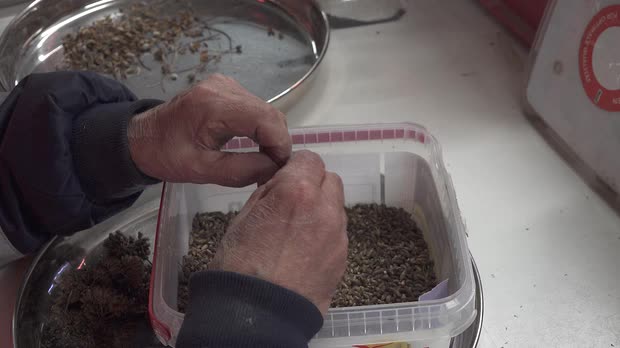
Im Mittelpunkt steht eine 8-Kanal-Soundinstallation, die den Übergang vom Winter zum Frühling auf den Feldern der Solidarischen Landwirtschaft dokumentiert. Die Komposition verbindet Umgebungsgeräusche der Jahreszeiten mit Arbeitsgeräuschen auf dem Feld und der Saatgutaufbereitung: das Umgraben der Erde, das Sieben und Reinigen der Samen, das Abdecken der Beete. Die Konzentration auf kleinste Handgriffe lenkt die Aufmerksamkeit auf die oft unsichtbaren Praktiken, die für den Erhalt von Saatgut notwendig sind.
Ergänzt wird die Soundinstallation durch eine Reihe räumlicher Elemente, die unterschiedliche Formen des Umgangs mit Saatgut aufgreifen. Fünf gefährdete Nutzpflanzensorten aus Baden-Württemberg, die in der Roten Liste geführt werden, sind offen ausgestellt. Sie können berührt, mitgenommen und wieder ausgesät werden.
Auf einem 25 Meter langen Landwirtschaftsnetz werden dokumentarische Videoaufnahmen gezeigt, die die Arbeit von Saatgutbanken und lokalen Initiativen in Karlsruhe in ihren wiederkehrenden Abläufen sichtbar machen.
Ein weiteres Element ist eine Pflanzentransportkiste, die sich formal an den historischen Ward’schen Kasten anlehnt. Dieses im 19. Jahrhundert entwickelte Transportmittel ermöglichte den globalen Austausch von Pflanzen unter kontrollierten Bedingungen und war eng mit kolonialen Handelsstrukturen verknüpft. In der Installation dient der Kasten als Display für die Geschichte der Alb-Linse, einer regionalen Sorte von der Schwäbischen Alb, die lange als verschollen galt und erst durch eine Saatgutbank in Sankt Petersburg wiederentdeckt wurde. Die Arbeit stellt damit lokale landwirtschaftliche Praktiken in einen größeren politischen Zusammenhang und zeigt, dass pflanzliche Vielfalt nur durch gemeinsames Handeln erhalten bleibt.
- „Rote Saat“ ist eine installative Arbeit, die sich mit dem Verschwinden traditioneller Nutzpflanzen in Deutschland und der Bedeutung von Saatgutbanken als lebendige Archive auseinandersetzt. Ausgangspunkt ist die Beobachtung eines drastischen Rückgangs der Sortenvielfalt seit dem 20. Jahrhundert, bedingt durch industrielle Landwirtschaft, gesetzliche Regulierungen und die Konzentration auf wenige Hochleistungssorten. Viele regional angepasste Landsorten erfüllen heutige Zulassungskriterien nicht mehr und sind dadurch aus dem Anbau verschwunden. Die Arbeit nimmt diese Entwicklung zum Anlass, um Prozesse der Erhaltung und Weitergabe von Saatgut sichtbar und erfahrbar zu machen.
- Kategorie
- Schlagworte
- Mitwirkende
- Dank an
- Material
- Titel
- Rote Saat
- Projektleiter/in
- Semester
- Studiengang
- Typ der Abschlussarbeit
- Importiert am
- 20.06.2026
- Übergeordnete Sets
- 1
- Set enthält
- 0 16
Rot
Name that can easily go onto 2 lines
Author that can easily go onto 2 lines as well
- Titel
- Rot
- Titel
- Rot
- Importiert am
- 13.11.2025
- Übergeordnete Sets
- 1
- Set enthält
- 0 7