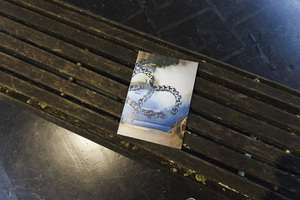
Die Arbeit Prolog 1 (Pavillon) begann mit einem künstlerischen Interesse an den raumvermessenden, kartographierenden Aspekten des Putzens – als Prinzip der Aneignung – sowie seiner skulpturalen Qualität.
Die Arbeit, die am 23. Oktober 2018 von 17-20 Uhr in einem rundumverglasten Pavillon der 1960er Jahre Moderne, an der Brauer-, Ecke Gartenstraße in Karlsruhe stattfand, bestand auf Handlungsebene aus dem Putzen des Inneren des Pavillons. Über vier an den Ecken des Pavillons angebrachte Lautsprecher hörten die sich im umliegenden Park befindenden Besucher*innen Textfragmente über den Pavillon: seine räumliche Verortung, seine (Un)-Zugänglichkeit auf institutioneller und baulicher Ebene sowie seine Architektur – Akten, Erzählungen, Spekulationen. Über drei Stunden Laufzeit verdichteten sich diese immer auch durch die Folie des Putzaktes ausgesuchten, verfassten und montierten Textfragmente zu einer offenen Erzählung.
Aus einer ursprünglich intuitiven Affinität zu diesem Ort sollte die Arbeit über das Putzen in genau diesem Pavillon stattfinden – Architektur der Nachkriegsmoderne, ein Kantinengebäude, angeblich von Egon Eiermann erbaut. Ein Gebäude, das der vielbefahrenen Straßenkreuzung den Rücken zudreht, eigentlich prominent platziert ist, aber von den meisten Passierenden unentdeckt bleibt – ein Ort, der auf vielen Ebenen changiert zwischen Sichtbarkeit, Unzugänglichkeit, Intransparenz und Mysterium.
Erst durch den langen Prozess, überhaupt Zugang zu dem ungenutzten Hochparterre des Gebäudes zu erhalten, und die damit einhergehenden intensiven Nachforschungen, verschob sich der Fokus der Arbeit hin zum Gebäude selbst und seiner schwer zu durchdringenden, sich nie ganz ergründenden Geschichte. Der Versuch, das Gebäude als Ausstellungsort zu nutzen, wurde in diesem Prozess Teil der Arbeit selbst.
So fanden diese unterschiedlichen Formen der Aneignung, das Putzen und die Recherche, letztlich wieder zusammen, am 23. Oktober 2018: einen Tag im Leben des Pavillons markierend, an dem alle Anwesenden zu Zeitzeug*innen seiner Existenz wurden. Die Besucher*innen befanden sich – die Textfragmente hörend – draußen im Park, während Judith Milz sich zeitgleich – als einzige Person – im Inneren des Pavillons befand, ihn drei Stunden lang putzte, während es draußen erst dämmerte und dann dunkel wurde, bis schließlich, Lichter aus, Tür zu, der Pavillon geputzt, der Abend vorbei war.
Prolog 1 (Pavilion) began with an artistic interest in the spatial and cartographic aspects of cleaning—as a principle of appropriation—as well as its sculptural quality.
The work, which took place on October 23, 2018, from 5 to 8 p.m., in a glass-walled pavilion from the modernist 1960s located at the corner of Brauerstraße and Gartenstraße in Karlsruhe, consisted, on the level of action, of cleaning the interior of the pavilion. Through four speakers mounted at the corners of the structure, visitors in the surrounding park could hear fragments of text about the pavilion: its spatial positioning, its (in)accessibility on both institutional and architectural levels, and its architecture—documents, narratives, speculations. Over the course of three hours, these curated, composed, and edited text fragments—always filtered through the act of cleaning—accumulated into an open-ended narrative.
The initial impulse to realize this work in exactly this pavilion arose from an intuitive affinity with the site—post-war modernist architecture, a former cafeteria building, allegedly designed by Egon Eiermann. A structure that turns its back on a busy intersection, prominently situated yet largely unnoticed by passersby—a place that wavers on many levels between visibility, inaccessibility, opacity, and mystery.
Only through the prolonged process of gaining access to the building’s unused raised ground floor—and the intensive research that this required—did the focus of the work begin to shift toward the building itself and its elusive, never fully graspable history. The attempt to use the building as an exhibition site ultimately became part of the work itself.
Thus, these different forms of appropriation—cleaning and research—converged once more on October 23, 2018: marking a day in the life of the pavilion on which all those present became witnesses to its existence. While the audience stood outside in the park listening to the audio fragments, Judith Milz—alone inside the pavilion—cleaned the space for three hours, as dusk settled and darkness fell, until finally, with the lights turned off and the door closed, the pavilion was cleaned, and the evening was over.
In den Archivierungsdokumenten finden Sie einen Text über die Entstehung der Arbeit. In der Online Fassung des PDFs sind zwei Informationen geschwärzt, die aber in der Hochschule für Gestaltung Karlsruhe vor Ort – bei Interesse – eingesehen werden können. Wenden Sie sich hierzu bitte an das Archiv der HfG Karlsruhe. Außerdem können Sie versuchen mich unter folgender Emailadresse zu erreichen: judith.friederike.milz@gmail.com
„Present Tense” beschäftigt sich mit unserer unmittelbaren Gegenwart: Wir leben in einer komplexen, krisenhaften Zeit, in der die Überlagerung von Klima- und Energiekrise, Postpandemie, Prekarität und Konkurrenz, gesellschaftlicher Radikalisierung bis hin zu näher rückenden Kriegen bereits jetzt gravierende Auswirkungen auf unser Leben und Arbeiten hat. Die Anspannung steigt, wir stehen vor dringlichen gesamtgesellschaftlichen Aufgaben und bewegen uns zugleich in Richtung eines Zustands chronischer Erschöpfung. Das etablierte Kunstfeld und die künstlerische und kulturelle Produktion sind davon nicht ausgenommen. Mit Künstler:innen, Kurator:innen und anderen Expert:innen des kulturellen Feldes möchten wir den Blick auf die aktuelle künstlerische Produktion und Ausstellungspraxis richten und die Frage nach möglichen (Zukunfts-)perspektiven für das Kunstfeld diskutieren:
Welche gesellschaftliche Rolle können und müssen Kunst und ihre Produzent:innen in einer sich radikal verändernden Welt einnehmen? Wie können Kunst- und Kulturinstitutionen zu Orten aktiver gesellschaftlicher Transformation werden? Was bedeutet es, eine (ökologisch wie sozial) nachhaltige künstlerische und institutionelle Praxis in der digitalen Gegenwart zu entwickeln? Welche neuen Gemeinschaften brauchen wir, gerade im Hinblick auf die zunehmende gesellschaftliche Spaltung und Radikalisierung? Offensichtlich führt die krisenhafte Gegenwart u. a. dazu, dass sich Menschen nach autoritären Figuren und Programmen sehen – eine Aufgabe von Kunst und Kultur könnte es sein, andere, freiere Konzepte von Zukunft zu entwerfen.
Auch das Konzept der Fürsorge in der künstlerischen und kuratorischen Praxis wird Thema der Veranstaltung sein. Teil des Symposiums sind neben Vorträgen künstlerische Workshops, Interventionen und Performances, die wir als gleichwertige Formen der Wissensproduktion und -vermittlung begreifen.
Mit Beiträgen von Gin Bahc, Sascia Bailer, Constanze Fischbeck, Sina Hensel, Alistair Hudson, Anne Duk Hee Jordan, Valentina Karga, Matriarchale Volksküche, Jacob Ott und Dorothee Richter.
„Present Tense” concerns itself with our immediate present: We live in a complex, crisis-filled age in which the overlapping of climate and energy crisis, post-pandemic times, precarity, social radicalisation and even impending wars already govern our lives and work. Tension is rising, we are faced with imperative responsibilities for society as a whole and are, at the same time, moving towards a state of chronic exhaustion. There is no exception for the field of arts and artistic and cultural production.
Together with artists, curators and other experts from the cultural field, we would like to examine current artistic productions and exhibition practices and discuss possibilities for the (future) perspectives of the arts. Which roles within society can and must art and its producers embrace in a radically changing world? How can art and cultural institutions become venues of active social transformation? What does it mean to develop an (ecologically as well as socially) sustainable artistic and institutional practice in the digital present? The concept of care within artistic and curatorial practices will be a topic of the event as well.
What new relationships do we need, especially in view of intensifying social division and radicalisation? Obviously, the crisis-filled present among other things leads to people looking to authoritarian figures and programmes – one of the tasks for art and culture could be to design other, more independent and free concepts of the future.
In addition to lectures and panels, the symposium will include artistic workshops, interventions and performances, which are also forms of knowledge production and dissemination that we feel to be of equal importance.
With contributions from Gin Bahc, Sascia Bailer, Constanze Fischbeck, Sina Hensel, Alistair Hudson, Anne Duk Hee Jordan, Valentina Karga, Matriarchale Volksküche, Jacob Ott and Dorothee Richter
Plastic Fugue ist eine interaktive Klanginstallation, die mit einer Kindheitserinnerung an die Konzertflöte beginnt, ein Instrument, das ich aufgrund finanzieller Schwierigkeiten nie erlernen konnte und das für mich zum Symbol des Klassismus wurde. Finanzielle Einschränkung ist nicht nur unangenehm, sondern lässt Kinder sich als ungeeignet empfinden, überhaupt etwas zu versuchen, und normalisiert dadurch Klassismus, selbst in der Kunst.
Es passierte mir erneut, als ich Malerei studierte. Die Materialien, Leinwand, Holz, Stoff, Papier, Farbe, Öl, ja sogar ein Bleistift, werden mit einer gewissen Aura vermarktet. Unsere Kunst ist längst zu sehr mit der neoliberalen Wirtschaft verstrickt, ironischerweise im Widerspruch zu ihrem eigentlichen Ziel, Freiheit. Die Qualität von Kunst über den Preis der Materialien zu definieren, ist eine Wiederholung alter Muster, so wie Blau und Grün einst als Zeichen des Reichtums galten und dem Adel vorbehalten waren.
Diese Struktur führte dazu, dass ich klassische Musik als die einzig wahre Musik betrachtete und die Leinwandmalerei, die im späten 15. Jahrhundert in Italien entstand, als den allein gültigen Standard in der bildenden Kunst. Jahrzehnte später erkannte ich, dass es jenseits dessen, was ich damals als Kunst verstand, auch Formen gab, die aus verschiedenen kulturellen Kontexten stammen und nicht als Teil dieses Standards wahrgenommen wurden. Dann versuchte ich, all diese ironischen Elemente in die verschiedenen Medien einzubringen, mit denen ich bisher gearbeitet hatte.
Plastic Fugue is an interactive sound installation project that begins with a childhood memory of the concert flute, which I couldn't learn due to financial hardship, and which came to symbolize classism to me. Being financially debilitated is not only a discomfort, but also makes children feel unqualified to even try, thereby normalizing this classism even in art.
It happened to me again when I studied painting. The materials are marketed with an aura, including canvas, wood, fabric, paper, paint, oil, and even a pencil. Our art already conspires too much with the neoliberal economy, ironically, against its supposed goal: liberty. Classifying the quality of art based on the price of materials is repetitive, much like how blue and green, once symbols of wealth, were valued and reserved for royalty in history.
This structure led me to view classical music as the only true form of music, and canvas painting, which originated in Italy in the late 15th century, as the sole standard in visual art. Decades later, I realized there was more art behind the things I once believed to be art alone. Then I attempted to gather all these ironical elements into diverse mediums I had experienced so far.
Vivian Reuter explores in her project the perhaps uncomfortable reality that we, primarily in the global north, are burning trash as a form of energy.
Known as “waste-to-energy”, the process of burning municipal waste to generate energy has grown rapidly across Europe as a solution to our waste problem. The incineration of trash in countries like the Netherlands, Denmark, and Germany is often portrayed through technological lenses as the exact opposite of its chaotic waste input: orderly, efficient, and clean. Incineration plants designed by prestigious names like Bjarke Ingels paint the image that this energy source is rightfully part of our new energy transition.
Perhaps unusually, waste incineration is largely considered a form of renewable energy, helping nations achieve climate targets. This should raise some eyebrows given that within the incinerated trash are large amounts of petroleum based products, such as plastics. Notably, about 1.1 tonnes of CO2 is emitted per tonne of trash; this is nearly 70M tonnes of CO2 emitted in the EU per year.
Reuter chooses to draw attention to this contentious space through the exploration of the iconic plastic outdoor chair.
By the mutilation of the iconic, playful plastic forms using fire, Reuter creates pieces that are at once attractive and repulsive— the smell and look of burnt plastic inherently makes us think of pollution and even the developing world where images of burning trash abound, such as Ghana’s Agbogbloshie dump. Reuters works seems to challenge waste incineration as having an element of absurdity by transforming the chairs into altogether different objects such as candles, and through the use of a domestic object, reminds us of the cost of our daily activities that are saturated in systems of consumption.
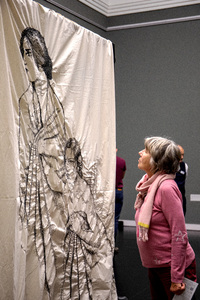
Pink Elephant ist eine textile Skulptur, die im Rahmen der Sprint Residency im Studio Hö der Hoepfner Stiftung entstanden ist. Das Werk übersetzt das Sprichwort „Seeing Pink Elephants“ in den Raum – eine Redewendung für Halluzinationen, die normalerweise durch schweren Alkoholentzug oder alkoholische Halluzinose verursacht werden und einen Zustand des Deliriums darstellen, in dem der Geist bizarre Bilder wie leuchtend rosa Elefanten erzeugt. Damit spielt die Arbeit auf den Kontext an, in dem sie präsentiert wird, nämlich die Kunststiftung einer Brauerei.
Beschreibung (en)
Pink Elephant is a textile sculpture created as part of the Sprint Residency at Studio Hö of the Hoepfner Foundation. The work translates the saying “seeing pink elephants” into space, an idiom for hallucinations, usually caused by severe alcohol withdrawal or alcoholic hallucinosis, representing a state of delirium where the mind fabricates bizarre sights like bright pink elephants. The work thus alludes to the context for which it was originally made and presented, the art foundation of a brewery.
Photosymbiosen – On Co-Developing with Plant Accomplices
Name that can easily go onto 2 lines
Author that can easily go onto 2 lines as well
Titel
Photosymbiosen – On Co-Developing with Plant Accomplices
Titel (en)
Photosymbiosen – On Co-Developing with Plant Accomplices
Untertitel
Sustainable Photography
Beschreibung (de)
Wie können wir fotografische Verfahren entwickeln, die nicht auf einem Ausbeutungsverhältnis der Umwelt beruhen, sondern vielmehr mit nicht-menschlichen Akteuren in Kollaboration treten? Wenn auch ein solches Unterfangen aufgrund der anthropozentrischen Perspektive zu kurz kommen muss, so eröffnet jenes unmögliche Driften hin zum pflanzlicheren Denken ein Spannungsfeld der künstlerischen Auseinandersetzung. Vom Flanieren in den Wäldern, dem Sammeln von Kräutern bis hin zur Ambivalenz zwischen städtischem Raum, pflanzlicher Peripherie und Ruderaler Vegetation – all jene dynamischen Wechselverhältnisse eines geteilten Habitats stellen den gedanklichen Ausgangspunkt der Arbeiten von “Photosymbiosen – On Co-Developing with Plant Accomplices” dar. Neben dem Bemühen um einen Fotografischen Blick, der sich ins mutuale Beziehungsgeflecht jener Co-Existenzen einfügt, steht das Bildgebungsverfahren analoger, nachhaltiger Fotografie im Fokus der Recherche. Denn jene alte Technik, die in Zeiten digitaler Bilderflut zunehmend ein Comeback erfährt, stellt vor einige Herausforderungen:
So basiert jenes Verfahren der Bilderzeugung auf der Lichtempfindlichkeit von Silberhalogenidkristallen, die in einer Gelatineemulsion auf einem Filmträger (zur Herstellung des Negativs) und auf Papier (zur Herstellung des Fotos) aufgebracht sind. Um die Kristalle in metallisches Silber umzuwandeln und so ein (negatives) Bild auf Film zu erhalten, beziehungsweise es dann auf Papier zu verarbeiten und zu vergrößern (positives fotografisches Bild), ist es notwendig, verschiedene, hochgiftige chemische Lösungen zu verwenden. Diese Produkte sind nicht nur gesundheitsgefährdend für diejenigen, die mit ihnen umgehen, sondern stellen auch eine große Quelle für die Verschmutzung von Gewässern, Pipelines und ganz allgemein der Umwelt dar – und müssen daher in besonderer Weise entsorgt und behandelt werden. Darüber hinaus ist nicht nur die Giftigkeit dieser Bildentwicklungsmethode problematisch, sondern auch ihr Medium. Die auf Film und Papier aufgebrachte Gelatine ist tierischen Ursprungs – in der Regel eine Rindergelatine – und wird damit Teil der vielfältigen Probleme der Fleischindustrie. Letztlich macht die Industrialisierung der analogen Fotografie, von ihren chemischen Komponenten bis hin zur Entwicklung der Fotos in Labors, ihre Anwender abhängig von vorgefertigten, in der Regel teuren Produkten.
Getragen von dem Wunsch, neue experimentelle Formen der Kreation zu erforschen und die Umweltbelastung durch jene fotografische Technik zu reflektieren, wurden so verschiedene alternative Verfahren zur Reduktion von Chemikalieneinsatz entwickelt. Dabei gaben verschiedene internationale Initiativen aus dem Bereich der nachhaltigen Fotografie Inspirationen zur Herstellung eigener Schwarz-Weiß-Entwickler, die auf regionalen und saisonalen Pflanzen der städtischen Umgebung Karlsruhes basieren (Kräuter, Blätter, Blumen, Baumrinde, Moos, Gemüse, etc.). Die ausgestellten Werke geben Einblicke in die experimentelle Forschung, eine ergänzende Website gibt weitere Informationen zu Dokumentationen wie auch Herstellungsverfahren und Recherchen.
How can we develop photographic processes that are not based on a relationship of exploitation of the environment, but rather enter into collaboration with non-human actors? Even if such an endeavour must fall short due to the anthropocentric perspective, that impossible drift towards more plant-based thinking opens up a field of tension for artistic exploration. From strolling in the woods, collecting herbs to the ambivalence between urban space, plant periphery and ruderal vegetation – all those dynamic interrelationships of a shared habitat represent the intellectual starting point of the works of "Photosymbioses – On Co-Developing with Plant Accomplices". In addition to the effort to create a photographic gaze that fits into the mutual network of relationships of these co-existences, the research focuses on the imaging process of analogue, sustainable photography. This old technique, which is increasingly making a comeback in times of a flood of digital images, poses a number of challenges:
For example, this method of image creation is based on the light sensitivity of silver halide crystals, which are deposited in a gelatine emulsion on a film carrier (to produce the negative) and on paper (to produce the photograph). In order to convert the crystals into metallic silver and thus obtain a (negative) image on film, or then process and enlarge it on paper (positive photographic image), it is necessary to use various highly toxic chemical solutions. These products are not only hazardous to the health of those who handle them, but are also a major source of pollution of water, pipelines and the environment in general - and must therefore be disposed of and treated in a special way. Furthermore, it is not only the toxicity of this image development method that is problematic, but also its medium. The gelatine applied to film and paper is of animal origin - usually a bovine gelatine - and thus becomes part of the manifold problems of the meat industry. Ultimately, the industrialisation of analogue photography, from its chemical components to the development of the photos in laboratories, makes its users dependent on prefabricated, usually expensive products.
Driven by the desire to explore new experimental forms of creation and to reflect on the environmental impact of that photographic technique, various alternative methods for reducing chemical use were thus developed. In the process, various international initiatives from the field of sustainable photography provided inspiration for the production of own black-and-white developers based on regional and seasonal plants from Karlsruhe's urban environment (herbs, leaves, flowers, tree bark, moss, vegetables, etc.). The exhibited works provide insights into the experimental research, a complementary website gives further information on documentation as well as production processes and research.