Sets
439 Inhalte
- Seite 1 von 37
Objekte
Name that can easily go onto 2 lines
Author that can easily go onto 2 lines as well
- Titel
- Objekte
- Autor/in
- Titel
- Objekte
- Studiengang
- Importiert am
- 08.07.2025
- Übergeordnete Sets
- 1
- Set enthält
- 0 10
Videoarbeit – In no particular order
Name that can easily go onto 2 lines
Author that can easily go onto 2 lines as well
- Titel
- Videoarbeit – In no particular order
- Autor/in
- Titel
- Videoarbeit – In no particular order
- Studiengang
- Importiert am
- 08.07.2025
- Übergeordnete Sets
- 1
- Set enthält
- 0 3
Performances im öffentlichen Raum
Name that can easily go onto 2 lines
Author that can easily go onto 2 lines as well
- Titel
- Performances im öffentlichen Raum
- Autor/in
- Titel
- Performances im öffentlichen Raum
- Studiengang
- Importiert am
- 08.07.2025
- Übergeordnete Sets
- 1
- Set enthält
- 0 3
Midnight Zone
Name that can easily go onto 2 lines
Author that can easily go onto 2 lines as well
- Titel
- Midnight Zone
- Titel (en)
- Midnight Zone
- Autor/in
- Beschreibung (de)
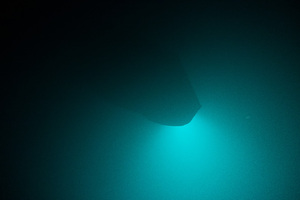
- Midnight Zone ist eine Performance über die Tiefsee, jenen Raum, in den kein Sonnenlicht mehr dringt. In dieser absolut dunklen und hohem Druck ausgesetzten Umgebung verschieben sich unsere Wahrnehmungen von Zeit, Körper und Orientierung.
In einem Raum, der das eigene Körpergefühl verschwimmen lässt, durchziehen Fischlaute, Maschinengeräusche und ferne Erdbeben die verschiedenen atmosphärischen Bedingungen des größten Lebensraums der Erde. Performerinnen bewegen sich wie fremde Wesen, zugleich Teil der Natur und Spiegel menschlicher Eingriffe. Mit jeder Bewegung beeinflussen die Besucher*innen das Netz aus Klang, Schatten und Choreografie und werden selbst Teil des Ökosystems, das sie beobachten.
Midnight Zone macht das fragile System der Tiefsee sinnlich erfahrbar: Dort, wo das Leben möglicherweise begann, wo Zeit anders fließt und Prozesse Jahrhunderte dauern können, ist der menschliche Einfluss zunehmend spürbar. Die Arbeit lässt Traum und Realität, Mensch und Natur, Oberfläche und Tiefe ineinander übergehen. Sie lädt dazu ein, lineare Zeitvorstellungen hinter sich zu lassen und alternative Rhythmen zu erspüren. Rhythmen, die im Einklang mit planetarischen Zyklen stehen und dem beschleunigten Takt des Anthropozäns etwas entgegensetzen.
- Midnight Zone ist eine Performance über die Tiefsee, jenen Raum, in den kein Sonnenlicht mehr dringt. In dieser absolut dunklen und hohem Druck ausgesetzten Umgebung verschieben sich unsere Wahrnehmungen von Zeit, Körper und Orientierung.
- Beschreibung (en)
- Midnight Zone is a performance about the deep sea, that realm into which no sunlight can penetrate. In this environment of absolute darkness and immense pressure, our perceptions of time, body, and orientation begin to shift.
In a space where one’s sense of the body starts to blur, fish sounds, mechanical noises, and distant earthquakes move through the atmospheric layers of the largest habitat on Earth. The performers move like unfamiliar beings, at once part of nature and a reflection of human impact. With every movement, the visitors influence the network of sound, shadow, and choreography, becoming part of the very ecosystem they are observing.
Midnight Zone makes the fragile system of the deep sea sensually perceptible: a place where life may have begun, where time flows differently and processes can take centuries, and where human presence is increasingly noticeable. The work allows dream and reality, human and nature, surface and depth to merge. It invites the audience to let go of linear notions of time and attune themselves to alternative rhythms, rhythms aligned with planetary cycles, offering a counterpoint to the accelerated tempo of the Anthropocene.
- Midnight Zone is a performance about the deep sea, that realm into which no sunlight can penetrate. In this environment of absolute darkness and immense pressure, our perceptions of time, body, and orientation begin to shift.
- Kategorie
- Typ des Projekts/Werks
- Schlagworte
- Datierung
- 30.10.25 und 31.10.25
- Mitwirkende
- Dank an
- Dauer
- 1 Stunde
- Ort: Institution
- Ort
- Großes Studio
- Stadt
- Land
- Beteiligte Institution(en)
- Titel
- Midnight Zone
- Projektleiter/in
- Semester
- Studiengang
- Typ der Abschlussarbeit
- Importiert am
- 03.12.2025
- Übergeordnete Sets
- 3
- Set enthält
- 0 13
Fake it till you make it
Name that can easily go onto 2 lines
Author that can easily go onto 2 lines as well
- Titel
- Fake it till you make it
- Titel (en)
- Fake it till you make it
- Autor/in
- Beschreibung (de)
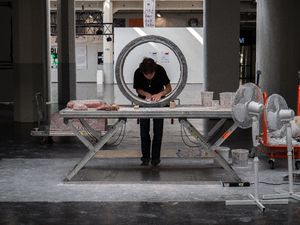
- Stuckmarmor ist eine historische Stucktechnik des 16. und 17. Jahrhunderts aus Italien, die für ihre Marmorimitation bekannt ist. Dabei wurden Gips, Wasser, Pigmente und tierischer Leim gemischt, um marmorähnliche Oberflächen zu schaffen.
"Fake it till you make it" ist eine Erkundung dieses traditionellen Handwerks. Ziel ist es, die alte Kunst der Marmorimitation wiederzubeleben und ihre ästhetischen Werte in der heutigen Welt zu präsentieren. Darüber hinaus befasst sich das Projekt mit der Frage, was "echt" und was "unecht" ist, und untersucht die Rolle der Inszenierung. Inspiriert von den drei Teilen einer Säule (Basis, Schaft, Kapitell) habe ich drei Objekte entwickelt, die als Einzelstücke im Raum zu finden sind. Alle drei Objekte sind aus Holz gefertigt, zwei davon durch ein Stahlgerüst stabilisiert. Die Unterkonstruktion wurde dann mit Streckmetall verkleidet, verputzt und diente schließlich als Untergrund für den Stuckmarmor. Ein Making-of-Video zeigt die Herstellung des Stuckmarmors. Jedes der Objekte ist auf eine andere Art und Weise verkleidet, um die Konstruktion nicht immer zu verbergen, sondern sie vielmehr zu enthüllen, ganz nach dem Motto "fake it till you make it".
- Stuckmarmor ist eine historische Stucktechnik des 16. und 17. Jahrhunderts aus Italien, die für ihre Marmorimitation bekannt ist. Dabei wurden Gips, Wasser, Pigmente und tierischer Leim gemischt, um marmorähnliche Oberflächen zu schaffen.
- Beschreibung (en)
- Stucco marble is a historic plasterwork technique originating from 16th and 17th-century Italy, celebrated for its imitation of marble. This involved blending gypsum plaster, water, pigments, and animal glue to create marble-like surfaces.
„fake it till you make it“ is an exploration of this traditional craft of stucco marble. The aim is to revive the ancient art of imitating marble and to present its aesthetic values in today‘s world. In addition, the project will address the question of what is „real“ and what is „fake“ and examine the role of staging. Inspired by the three parts of a column (base, shaft, capital) I have developed three objects that can be found as individual pieces in the room. All three objects are made of wood, two of them stabilized by a steel framework. Ribbed expanded metal lath was then stapled onto the wood and plastered, serving as the base for the stucco marble. A making of video shows the production of the stucco marble. Each of the objects is covered in a different way, intended not to always conceal the construction but rather to reveal it, embodying the spirit of „fake it till you make it.“
- Stucco marble is a historic plasterwork technique originating from 16th and 17th-century Italy, celebrated for its imitation of marble. This involved blending gypsum plaster, water, pigments, and animal glue to create marble-like surfaces.
- Kategorie
- Typ des Projekts/Werks
- Schlagworte
- Datierung
- 25.06.2024
- Dank an
- Material
- Ort: Institution
- Ort
- Unter der Lichtbrücke
- Stadt
- Land
- Titel
- Fake it till you make it
- Projektleiter/in
- Semester
- Studiengang
- Typ der Abschlussarbeit
- Importiert am
- 20.12.2025
- Übergeordnete Sets
- 1
- Set enthält
- 0 16
Folded Sheets
Name that can easily go onto 2 lines
Author that can easily go onto 2 lines as well
- Titel
- Folded Sheets
- Autor/in
- Beschreibung (de)
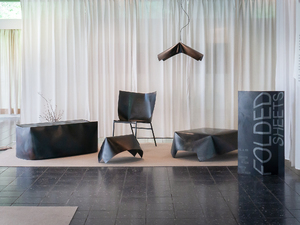
- Folded Sheets untersucht, wie sich Papier-Falttechniken auf Stahlbleche übertragen lassen. Rechteckige Tafeln werden durch gezielte Einschnitte und Faltungen in stabile dreidimensionale Formen gebracht, ohne dass Material verloren geht. Der Prozess des Schwarzbrennens, bei dem Leinöl in die Oberfläche eingebrannt wird, verleiht den Objekten ihre charakteristische schwarze Färbung, schützt sie vor Korrosion und unterstützt die strukturelle Festigkeit.
- Beschreibung (en)
- Folded Sheets explores the possiblities of transferring paper folds into steel sheet furniture. By using cuts and folds on rectangular steel sheets, tensioned rigid shapes without offcuts are created. The objects are further strengthend by blackening the surface with burnt linseed oil.
- Kategorie
- Typ des Projekts/Werks
- Schlagworte
- Datierung
- 2025
- Dank an
- Material
- Technik/Verfahren/Formate
- Falttechnik, Schwarzbrennen mit Leinöl
- Stadt
- Land
- Internetlinks
- Titel
- Folded Sheets
- Projektleiter/in
- Semester
- Studiengang
- Typ der Abschlussarbeit
- Importiert am
- 15.07.2025
- Übergeordnete Sets
- 3
- Set enthält
- 0 18
Shifting Paradigms Symposium I Panel 2
- Titel
- Shifting Paradigms Symposium I Panel 2
- Beschreibung (de)
- Panel 2 (Donnerstag) Fragen der Forschung
Das Panel zielt darauf ab, Forschungsmethoden in den Geistes- und Kunstwissenschaften zu diskutieren, indem es verschiedene Ansätze zur Materialität von Medien und zur Materie in ihrer radikalen Existenz an der Schwelle zum Sichtbaren vorstellt. Darüber hinaus werden die Referenten untersuchen, wie zeitgenössische wissenschaftliche, industrielle und soziale Kulturen Materie verarbeiten, und gleichzeitig ein umfassenderes Verständnis von Materialitäten vermitteln, wobei sie häufig optische Instrumente, Codes und Labore einsetzen, um unser Weltverständnis zu erweitern.
In ihrem Vortrag wird die Wissenschaftsphilosophin Bernadette Bensaude-Vincent ihre Arbeit an einer neuen Philosophie der Chemie kommentieren. Es folgen Forschungsberichte der Künstler Susanne Kriemann und Armin Linke sowie von Tina Lorenz, Leiterin des ZKM/Hertzlab.
- Panel 2 (Donnerstag) Fragen der Forschung
- Beschreibung (en)
- Panel 2 (Thursday) Research Matters
The panel aims to discuss research methodologies in the arts and humanities by presenting multiple approaches to the materiality of media and to matter in its radical existence at the threshold of the visible. Further, the speakers will explore the ways in which contemporary scientific, industrial and social cultures process matter while simultaneously offering broader understandings of materialities, often using ocular instruments, code and laboratories to enhance our sense of the world.
In her lecture, the philosopher of science Bernadette Bensaude-Vincent will comment on her work towards a new philosophy of chemistry. Research reports by artists Susanne Kriemann and Armin Linke as well as by Tina Lorenz, Head of ZKM/ Hertzlab follow.
- Panel 2 (Thursday) Research Matters
- Typ des Projekts/Werks
- Schlagworte
- Datierung
- 05.12.2024
- Ort
- Lichthof 3, HfG
- Beteiligte Institution(en)
- Titel
- Shifting Paradigms Symposium I Panel 2
- Importiert am
- 05.01.2026
- Übergeordnete Sets
- 1
- Set enthält
- 0 0
Shifting Paradigms Symposium I Panel 1
- Titel
- Shifting Paradigms Symposium I Panel 1
- Beschreibung (de)
- Panel 1 (Donnerstag) Polykrise
Als Einführung in das Konzept des Paradigmenwechsels befasst sich das Panel mit den zahlreichen Krisen, denen wir in der Wissenschaft und darüber hinaus gegenüberstehen und die eine kritische Reflexion und Überprüfung unserer Forschungsmethoden erfordern. Angesichts dieser Polykrisen (Umweltkatastrophen, bröckelnde Infrastrukturen, soziale Ungleichheiten, politische Depression und die Unsicherheit des Wissens) werden wir stattdessen Konzepte der Instabilität postulieren, und Monica Narula wird in ihrem Vortrag von den Begriffen „Twilight Language” und „Cavalcade” ausgehen, gefolgt von Antworten von Alistair Hudson, Simon Sheikh und Nina Zschocke.
- Panel 1 (Donnerstag) Polykrise
- Beschreibung (en)
- Panel 1 (Thursday) Polycrisis
As an introduction to the idea of shifting paradigms, the panel will look at the many crises that we are facing, in academia and beyond, and which requires a critical reflection and revisitation of the modes of inquiry we are using. In the face of this polycrisis (environmental disaster, crumbling infrastructures, socil inequalities, political depression, and the uncertainty of knowledge), we will instead posit concepts of instability, and in her lecture performance Monica Narula will depart from notions of twilight language and cavalcade, followed by responses from Alistair Hudson, Simon Sheikh and Nina Zschocke.
- Panel 1 (Thursday) Polycrisis
- Typ des Projekts/Werks
- Schlagworte
- Datierung
- 05.12.2024
- Ort
- Useum, ZKM
- Beteiligte Institution(en)
- Titel
- Shifting Paradigms Symposium I Panel 1
- Importiert am
- 05.01.2026
- Übergeordnete Sets
- 1
- Set enthält
- 0 0
Shifting Paradigms Symposium I Dinner Intervention
- Titel
- Shifting Paradigms Symposium I Dinner Intervention
- Beschreibung (de)
- Dinner Intervention (Donnerstag)
Im Rahmen des Symposiums „Shifting Paradigms“ an der HfG Karlsruhe präsentieren die Künstlerinnen und Designerinnen Marie Faass und Mona Mayer eine gemeinsame Intervention. Darin wird der Austausch theoretischer Diskurse um eine sinnlich erfahrbare Dimension erweitert. Die beiden Künstlerinnen nutzen den Akt des Essens und den Moment des gemeinsamen Erlebens und Teilens als performatives Medium.
Inwieweit beinhaltet ein möglicher Paradigmenwechsel Wechselbeziehungen zwischen intellektuellem Verständnis und körperlich-sinnlichem Lernen? Die Einladung zur Teilnahme und Interaktion eröffnet allen Symposiumsteilnehmer*innen den Raum für eine kollektive, poetische und somatische Erfahrung.
- Dinner Intervention (Donnerstag)
- Beschreibung (en)
- Dinner Intervention (Thursday)
As part of the ‘Shifting Paradigms’ symposium at the HfG Karlsruhe, artists and designers Marie Faass and Mona Mayer are presenting a joint intervention. In it, the sharing of theoretical discourses is expanded to include a dimension that can be experienced through the senses. The two artists utilise the act of eating and the moment of shared experience and sharing as a performative medium.
To what extent does a possible paradigm shift involve interrelationships between intellectual comprehension and physical-sensual learning? The invitation to participate and interact opens up the space for a collective, poetic and somatic experience for all symposium participants.
- Dinner Intervention (Thursday)
- Typ des Projekts/Werks
- Schlagworte
- Datierung
- 05.12.2024
- Dank an
- Ort: Institution
- Ort
- Lichthof 3
- Titel
- Shifting Paradigms Symposium I Dinner Intervention
- Importiert am
- 05.01.2026
- Übergeordnete Sets
- 1
- Set enthält
- 0 0
Shifting Paradigms Symposium I Panel 4
- Titel
- Shifting Paradigms Symposium I Panel 4
- Beschreibung (de)
- Panel 4 (Freitag): Die Kunst der Forschung
Künstlerische Forschung kann in Bezug auf soziale und ökologische Veränderungen westliche epistemologische Perspektiven in Frage stellen. Welche Paradigmenwechsel können zu einer künstlerischen Forschungspraxis beitragen, die den Forderungen nach planetarischer Gerechtigkeit gerecht wird? Welche Forschungsumgebung können das ZKM und die HfG als Institutionen für Medienkunst und Design bieten, um diesen Veränderungen Rechnung zu tragen und künstlerische Laborprozesse und daraus resultierende Diskurse zu beherbergen?
- Panel 4 (Freitag): Die Kunst der Forschung
- Beschreibung (en)
- Panel 4 (Friday): The Art of Research
Artistic research, in relation to social and environmental changes, can challenge Western ontoepistemological perspectives. Which paradigm shifts can contribute to an artistic research practice to respond to demands for planetary justice? What kind of research environment can ZKM and HfG offer, as institutions for media art and design, to attend to these transformations and host artistic laboratory processes and resulting discourses?
- Panel 4 (Friday): The Art of Research
- Typ des Projekts/Werks
- Schlagworte
- Datierung
- 06.12.2024
- Ort
- Lichthof 3, HfG
- Beteiligte Institution(en)
- Titel
- Shifting Paradigms Symposium I Panel 4
- Importiert am
- 05.01.2026
- Übergeordnete Sets
- 1
- Set enthält
- 0 0
Shifting Paradigms Symposium I Panel 3
- Titel
- Shifting Paradigms Symposium I Panel 3
- Beschreibung (de)
- Panel 3 (Freitag) Kill the Dr. phil? Textbasierte Praxis und (künstlerische) Forschung
Muss eine geisteswissenschaftliche Dissertation 400 Seiten lang sein? Rechtfertigt ein bestimmter Entwurf in Design oder Architektur eine Promotion? Und wenn nicht, was sagt diese Beurteilung über die Qualifikationskriterien einer schriftlichen Abschlussarbeit aus? Das Panel diskutiert die Frage, inwieweit die akademische Promotion vom Vergleich mit anderen Promotionsmodellen (insbesondere künstlerischen und praxisorientierten Promotionsmodellen) profitieren und so ihr eigenes Profil schärfen kann.
- Panel 3 (Freitag) Kill the Dr. phil? Textbasierte Praxis und (künstlerische) Forschung
- Beschreibung (en)
- Panel 3 (Friday) Kill the Dr. phil? Text-based practice and (artistic) research
Does a humanities dissertation have to be 400 pages long? Does a particular design or architectural draft justify a doctorate? And if not, what does this judgement say about the qualification criteria of a written thesis? The panel will discuss the question of the extent to which the academic doctorate can benefit from comparison with other PhD models (especially artistic and practice-based PhD models) and thus sharpen its own profile.
- Panel 3 (Friday) Kill the Dr. phil? Text-based practice and (artistic) research
- Typ des Projekts/Werks
- Schlagworte
- Datierung
- 06.12.2024
- Ort
- Lichthof 3, HfG
- Beteiligte Institution(en)
- Titel
- Shifting Paradigms Symposium I Panel 3
- Importiert am
- 05.01.2026
- Übergeordnete Sets
- 1
- Set enthält
- 0 0
Shifting Paradigms Symposium I Konferenzarchitektur und Visuelle Erscheinung
- Titel
- Shifting Paradigms Symposium I Konferenzarchitektur und Visuelle Erscheinung
- Titel (en)
- Shifting Paradigms Symposium I Conference Architecture and Visual Appearance
- Beschreibung (de)
- Ziel des Shifting Paradigms Symposiums (5.-6.12.2024, HfG Karlsruhe und ZKM) war es, gemeinsam Räume und Ideen für eine sich transformierende Forschungspraxis zu entwerfen und aufzuspannen. Wiederspiegeln sollte sich dieser Anliegen bereits im Veranstaltungskonzept.
Die Inhalte des Symposiums sollten nicht in klassischen Vorträgen vermittelt werden, sondern über experimentelle Formate und Präsentationen mit Dialogprinzip ein gemeinsames Nachdenken und Austauschen fördern. Wissenschaft und Kunst, Theorie und Praxis, Akteure jeglichen Alters, Gesinnung und Herkunft sollten auf diese Weise möglichst gleichberechtigt und wertungsfrei Raum erhalten und in Beziehung treten können.
Besonderes Anliegen war es, der jungen Generation eine Stimme durch und genügend Raum für einen hochwertigen Beitrag geben. So haben Studierende der Studiengänge Kommunikationsdesign sowie Ausstellungsdesign und Szenografie den visuellen Auftritt und eine dynamische Konferenzarchitektur entwickelt, um mit ihrer Hilfe den kommunikativen Aspekt der Veranstaltung und ihre Inhalte stärken zu können.
- Ziel des Shifting Paradigms Symposiums (5.-6.12.2024, HfG Karlsruhe und ZKM) war es, gemeinsam Räume und Ideen für eine sich transformierende Forschungspraxis zu entwerfen und aufzuspannen. Wiederspiegeln sollte sich dieser Anliegen bereits im Veranstaltungskonzept.
- Beschreibung (en)
- The aim of the Shifting Paradigms Symposium (December 5–6, 2024, HfG Karlsruhe and ZKM) was to design and develop spaces and ideas for a transforming research practice. This concern was to be reflected in the event concept itself.
The content of the symposium was not to be conveyed in traditional lectures, but rather through experimental formats and presentations based on dialogue, promoting joint reflection and exchange. Science and art, theory and practice, actors of all ages, beliefs, and backgrounds were to be given equal and non-judgmental space to interact.
A particular concern was to give the younger generation a voice and sufficient space for a high-quality contribution. Students of communication design and exhibition design and scenography developed the visual appearance and a dynamic conference architecture to help strengthen the communicative aspect of the event and its content.
- The aim of the Shifting Paradigms Symposium (December 5–6, 2024, HfG Karlsruhe and ZKM) was to design and develop spaces and ideas for a transforming research practice. This concern was to be reflected in the event concept itself.
- Typ des Projekts/Werks
- Schlagworte
- Beteiligte Institution(en)
- Titel
- Shifting Paradigms Symposium I Konferenzarchitektur und Visuelle Erscheinung
- Importiert am
- 05.01.2026
- Übergeordnete Sets
- 1
- Set enthält
- 0 0