Schaufenster Live

Schaufenster Live
| Titel |
|
| Titel (en) |
|
| Beschreibung |
|
126 Inhalte
- Seite 1 von 11
In Defense of Mis Caprichos
Name that can easily go onto 2 lines
Author that can easily go onto 2 lines as well
- Titel
- In Defense of Mis Caprichos
- Untertitel
- When someone says you canʼt do something. Do it twice, and take pictures.
- Autor/in
- Beschreibung (de)
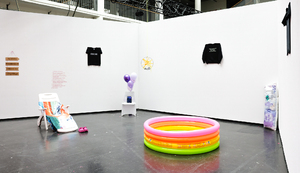
- "In Defense of Mis Caprichos" ist eine multimediale Ausstellung, die auf einem selbst kuratierten Archiv von 140 gefundenen und eigenen Bildern basiert. Sie setzt sich mit der vernakulären Bildsprache Lateinamerikas auseinander – von Memes und persönlichen Fotos bis zu Screenshots. Viele Bilder sind durch digitale Verbreitung nur in niedriger Auflösung erhalten und spiegeln so die visuelle Textur des Internets wider. Sie vermitteln eine Sensibilität, die sich nicht erklären lässt, sondern sich durch Stimmung, Ton und Wiederholung entfaltet. Viele der Bilder stammen aus oder zeigen Kontexte des Globalen Südens und verstehen sich als Hommage an dortige alltägliche, informelle Gesten. Zusammen bilden sie eine visuelle Sprache, die intim, vielschichtig, instabil und oft humorvoll ist.
Das Projekt bezieht sich auf Hal Fosters Aufsatz "An Archival Impulse", der das Archivieren als künstlerische Praxis versteht und Fragmentierung der Kohärenz vorzieht – zentrale Konzepte für dieses sich stetig wandelnde Archiv. Daraus wurden zehn künstlerische Objekte entwickelt, die die Skurrilitäten der Sammlung erfassen: Repliken, Performances oder hybride Assemblagen. Ihre Logik beruht auf Aneignung, Kopie und Transformation – im Sinne Byung-Chul Hans, der Replikation als kreative Strategie für neue Bedeutungen begreift.
Einige Werke greifen konkrete Bilder auf: Eine Performance, bei der ein Plastikpool auf einem Motorrad transportiert wird, bezieht sich auf ein Archivbild. Ein anderes verwandelt einen falsch übersetzten Tweet in ein dekoratives Holzschild. Ein drittes ist ein Traumfänger aus gelber Unterwäsche – inspiriert von einem kolumbianischen Neujahrsbrauch, wonach gelbe Unterwäsche Glück bringen soll.
Ein zentrales Element ist eine Videoarbeit, die das gesamte Archiv in Endlosschleife zeigt, begleitet von Texten aus unterschiedlichen Quellen: akademisch, persönlich oder aus sozialen Medien. Die Anordnung ist nicht erklärend, sondern atmosphärisch. Die Ausstellung schafft einen hierarchiefreien Raum, der Intuition, spielerische Ernsthaftigkeit und visuelle Alltagskulturen in den Mittelpunkt stellt.
- "In Defense of Mis Caprichos" ist eine multimediale Ausstellung, die auf einem selbst kuratierten Archiv von 140 gefundenen und eigenen Bildern basiert. Sie setzt sich mit der vernakulären Bildsprache Lateinamerikas auseinander – von Memes und persönlichen Fotos bis zu Screenshots. Viele Bilder sind durch digitale Verbreitung nur in niedriger Auflösung erhalten und spiegeln so die visuelle Textur des Internets wider. Sie vermitteln eine Sensibilität, die sich nicht erklären lässt, sondern sich durch Stimmung, Ton und Wiederholung entfaltet. Viele der Bilder stammen aus oder zeigen Kontexte des Globalen Südens und verstehen sich als Hommage an dortige alltägliche, informelle Gesten. Zusammen bilden sie eine visuelle Sprache, die intim, vielschichtig, instabil und oft humorvoll ist.
- Beschreibung (en)
- In Defense of Mis Caprichos is a multimedia exhibition based in a self-curated archive of 140 found and self-produced images that reflect the vernacular visual language of Latin America. These images—ranging from memes and personal photographs to screenshots— carry a distinct sensibility: one that resists explanation and instead unfolds through mood, tone, and repetition. Often low in resolution due to constant digital circulation, the images reflect the visual texture of the internet. Many celebrate vernacular and informal gestures, circulating quickly across digital platforms to form a visual language that is intimate, layered, unstable, and often humorous.
The work draws on Hal Foster’s An Archival Impulse, where archiving is seen as an artistic practice and a preference for fragmentation over coherence reflects a deliberate artistic strategy.
From this archive, ten objects were developed, each guided by a specific premise. Some take the form of replicas, others of performances or hybrid assemblages. These objects operate as attempts to “grasp” the underlying sensibility of the archive. Their logic often draws on the aesthetics of appropriation, copying, and transformation—resonating with Byung-Chul Han’s Shanzhai: Deconstruction in Chinese, where copying and sampling are understood as creative strategies capable of generating new meaning.
A second core component of the exhibition is a video slideshow that presents the full image archive in a loop. The video has no beginning and no end, as it is conceived as a work in progress—the archive is constantly evolving. Each image is accompanied by 1–2 lines of text drawn from diverse sources: academic texts, social media posts, and personal writings. The arrangement is not explanatory but atmospheric, evoking how Susan Sontag, in Notes on Camp, approaches a sensibility not through linear explanation but through curation and juxtaposition.
In Defense of Mis Caprichos does not seek resolution or synthesis. Instead, it inhabits a space of connection without hierarchy. It is an argument for intuition, for playful seriousness, and for honoring the seemingly trivial gestures we encounter every day.
- In Defense of Mis Caprichos is a multimedia exhibition based in a self-curated archive of 140 found and self-produced images that reflect the vernacular visual language of Latin America. These images—ranging from memes and personal photographs to screenshots— carry a distinct sensibility: one that resists explanation and instead unfolds through mood, tone, and repetition. Often low in resolution due to constant digital circulation, the images reflect the visual texture of the internet. Many celebrate vernacular and informal gestures, circulating quickly across digital platforms to form a visual language that is intimate, layered, unstable, and often humorous.
- Kategorie
- Typ des Projekts/Werks
- Schlagworte
- Dank an
- Sprache
- Material
- Technik/Verfahren/Formate
- Diashow / Skulptur / Performance
- Ort: Institution
- Ort
- Lichthof 4
- Stadt
- Land
- Titel
- In Defense of Mis Caprichos
- Untertitel
- When someone says you canʼt do something. Do it twice, and take pictures.
- Projektleiter/in
- Semester
- Studiengang
- Typ der Abschlussarbeit
- Importiert am
- 27.06.2025
- Übergeordnete Sets
- 2
- Set enthält
- 4 2
all the things you are.
Name that can easily go onto 2 lines
Author that can easily go onto 2 lines as well
- Titel
- all the things you are.
- Untertitel
- Die Lebenszeichen von Wolfgang Schmidt
- Untertitel des Projekts/Werks (en)
- Signs of life from Wolfgang Schmidt
- Autor/in
- Beschreibung (de)
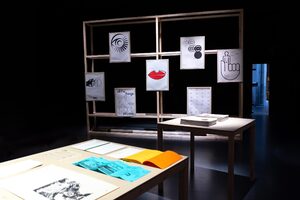
- Der Künstler und Grafiker Wolfgang Schmidt (* 24. Juli 1929; † 8. März 1995) begann 1972 mit der Gestaltung seines individuellen Zeichensystems: Den Lebenszeichen. Bis 1979 waren von den geplanten 893 Zeichen 262 fertiggestellt, in Kombination miteinander ergeben sich aus ihnen über 394 Variationen. [...] Die Ausstellung "all the things you are." geht diesem Katalog nach und zeigt neben originalen Drucken, auch eine Auswahl an Manuskripten und Plänen. [...] Die Exponate in der Ausstellung werden durch neu entstandene Arbeiten ergänzt, welche die durch Schmidts Zeichensystem aufgeworfenen Fragen nach Identität, Emotion und Kommunikation aufgreifen.
- Beschreibung (en)
- The artist and graphic designer Wolfgang Schmidt (* July 24, 1929; † March 8, 1995) began designing his individual sign system in 1972: the signs of life. By 1979, 262 of the planned 893 signs had been completed; in combination with each other, they resulted in over 394 variations. [...] The exhibition "all the things you are." explores this catalog and shows original prints as well as a selection of manuscripts and plans. [...] The exhibits in the exhibition are supplemented by newly created works that address the questions of identity, emotion and communication raised by Schmidt's system of signs.
- Kategorie
- Typ des Projekts/Werks
- Schlagworte
- Mitwirkende
- Ort: Institution
- Ort
- Großes Studio
- Stadt
- Land
- Bemerkungen
- Digitalisierung der Lebenszeichen:
Massimiliano Audretsch, Jona Dienst, Rana Karan & Alper Kazokoglu, Victoria Langmann, Yannick Nuss, Felix Plachtzik, Bernadeta Rimutyte
Gestaltung der Lebenszeichen Hoodies:
Janina Capelle und Hanna Scherwinski
Leihgaben: Anke Schabacker, Inez Franksen, INTeF Darmstadt
Sponsoring und Unterstützung:
Stiftung Landesbank Baden-Württemberg
Kulturbüro Karlsruhe
AStA der Staatlichen Hochschule für Gestaltung Karlsruhe
Badischer Kunstverein
DUSS Maschinenfabrik
Leitner Ausstellungssysteme
- Digitalisierung der Lebenszeichen:
- Titel
- all the things you are.
- Untertitel
- Die Lebenszeichen von Wolfgang Schmidt
- Projektleiter/in
- Semester
- Studiengang
- Typ der Abschlussarbeit
- Importiert am
- 14.06.2024
- Übergeordnete Sets
- 2
- Set enthält
- 0 6
Folded Sheets
Name that can easily go onto 2 lines
Author that can easily go onto 2 lines as well
- Titel
- Folded Sheets
- Autor/in
- Beschreibung (de)
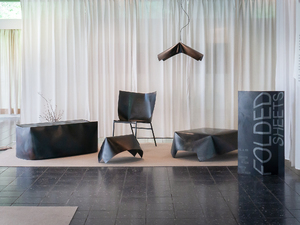
- Folded Sheets untersucht, wie sich Papier-Falttechniken auf Stahlbleche übertragen lassen. Rechteckige Tafeln werden durch gezielte Einschnitte und Faltungen in stabile dreidimensionale Formen gebracht, ohne dass Material verloren geht. Der Prozess des Schwarzbrennens, bei dem Leinöl in die Oberfläche eingebrannt wird, verleiht den Objekten ihre charakteristische schwarze Färbung, schützt sie vor Korrosion und unterstützt die strukturelle Festigkeit.
- Beschreibung (en)
- Folded Sheets explores the possiblities of transferring paper folds into steel sheet furniture. By using cuts and folds on rectangular steel sheets, tensioned rigid shapes without offcuts are created. The objects are further strengthend by blackening the surface with burnt linseed oil.
- Kategorie
- Typ des Projekts/Werks
- Schlagworte
- Datierung
- 2025
- Dank an
- Material
- Technik/Verfahren/Formate
- Falttechnik, Schwarzbrennen mit Leinöl
- Stadt
- Land
- Internetlinks
- Titel
- Folded Sheets
- Projektleiter/in
- Semester
- Studiengang
- Typ der Abschlussarbeit
- Importiert am
- 15.07.2025
- Übergeordnete Sets
- 3
- Set enthält
- 0 18
Kunst in der Praxis
Name that can easily go onto 2 lines
Author that can easily go onto 2 lines as well
- Titel
- Kunst in der Praxis
- Untertitel
- Methoden des Ausstellens im Vergleich zwischen ärztlicher Praxis und Kunstmuseum
- Autor/in
- Beschreibung (de)
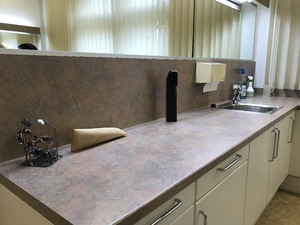
- In ärztlichen Praxen sind häufig künstlerische Objekte ausgestellt. Anders als im Museum ist die Begegnung mit diesen Objekten jedoch eher selten der Anlass für den Besuch der medizinischen Einrichtung. Die beiläufige Betrachtung der Kunstwerke ist vielmehr ein ästhetisches Nebenprodukt des eigentlichen Anliegens der Besucher*innen. Wie und warum werden überhaupt Kunstobjekte in ärztlichen Einrichtungen präsentiert? Lässt sich diese Präsentation mit musealen Ausstellungen vergleichen? Diesen Fragen wird in dieser Magisterarbeit nachgegangen und mittels Feldforschung und museumskritischer Einordnung begegnet.
- Kategorie
- Typ des Projekts/Werks
- Schlagworte
- Datierung
- 21.10.2021
- Dank an
- Sprache
- Abmessungen
- 123 Seiten (85 Seiten Text)
- Stadt
- Land
- Titel
- Kunst in der Praxis
- Untertitel
- Methoden des Ausstellens im Vergleich zwischen ärztlicher Praxis und Kunstmuseum
- Projektleiter/in
- Semester
- Studiengang
- Typ der Abschlussarbeit
- Importiert am
- 13.10.2025
- Übergeordnete Sets
- 2
- Set enthält
- 0 6
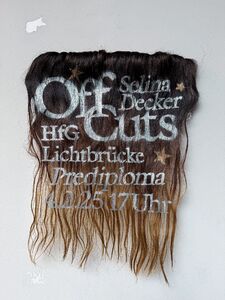
OffCuts
Name that can easily go onto 2 lines
Author that can easily go onto 2 lines as well
- Titel
- OffCuts
- Autor/in
- Beschreibung (de)
- Ich habe menschliches Haar als Material und Textil erforscht. Haare sind etwas zutiefst Persönliches, aber auch eine weithin verfügbare und oft weggeworfene Ressource. Im Rahmen meiner Recherchen habe ich das Material aus verschiedenen Blickwinkeln - wissenschaftlich, kulturell und künstlerisch - untersucht und gleichzeitig mit ihm gearbeitet, um Textilien und Teppiche mit verschiedenen Techniken herzustellen.
- Beschreibung (en)
- I explored human hair as a material and textile. Hair is something deeply personal, yet it is also a widely available and often discarded resource. Through my research, I examined the material from different perspectives - scientific, cultural, and artistic, while also working hands-on with it to create textiles and carpets using various techniques.
- Kategorie
- Typ des Projekts/Werks
- Schlagworte
- Datierung
- 04.02.2025
- Mitwirkende
- Material
- Ort: Institution
- Titel
- OffCuts
- Projektleiter/in
- Semester
- Studiengang
- Typ der Abschlussarbeit
- Importiert am
- 21.07.2025
- Übergeordnete Sets
- 1
- Set enthält
- 0 7
DORMIVEGLIA
Name that can easily go onto 2 lines
Author that can easily go onto 2 lines as well
- Titel
- DORMIVEGLIA
- Titel (en)
- DORMIVEGLIA
- Autor/in
- Beschreibung (de)
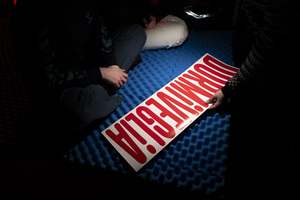
- „DORMIVEGLIA“ ist ein fortlaufendes Archiv zum Thema Schlaf, Ruhe und Regeneration, das Stimmen, Praktiken und künstlerische Beiträge sammelt. Für den Diplomtag wurde daraus eine immersive Traumlandschaft entwickelt: ein Raum mit Liegeflächen aus Audio-Schaumstoff, olfaktorischen Duftkomponenten, amber-rötlichem Licht sowie einer Soundarbeit in Kooperation mit der sri-lankischen Musiker:innengruppe Bilala. Die Arbeit versteht Schlaf als kollektive, politische Praxis und eröffnet einen Ort des Innehaltens, der gemeinsamen Erschöpfung und des Dazwischen-Seins.
- Beschreibung (en)
- “DORMIVEGLIA” is an ongoing archive dedicated to sleep, rest, and regeneration, gathering voices, practices, and artistic contributions. For the diploma presentation, it was transformed into an immersive dreamscape: a space with reclining surfaces made of acoustic foam, olfactory scent components, amber-red light, and a sound piece created in collaboration with the Sri Lankan music collective Bilala. The work understands sleep as a collective and political practice, offering a space for pause, shared exhaustion, and states of in-between.
- Kategorie
- Typ des Projekts/Werks
- Schlagworte
- Datierung
- 2025
- Mitwirkende
- Dank an
- Sprache
- Material
- Dauer
- 45 min
- Ort: Institution
- Ort
- Großes Studio
- Stadt
- Land
- Beteiligte Institution(en)
- Internetlinks
- Titel
- DORMIVEGLIA
- Projektleiter/in
- Semester
- Studiengang
- Typ der Abschlussarbeit
- Importiert am
- 13.10.2025
- Übergeordnete Sets
- 2
- Set enthält
- 0 9
HOCHHAUS Audiowalk
Name that can easily go onto 2 lines
Author that can easily go onto 2 lines as well
- Titel
- HOCHHAUS Audiowalk
- Autor/in
- Beschreibung (de)
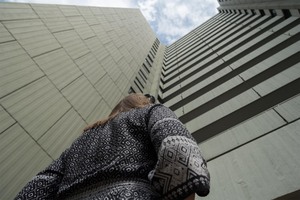
- Der HOCHHAUS Audiowalk führt die Teilnehmer*innen an spezifische Orte des Hochhauses der Kaiserallee 15 in Karlsruhe und lässt das Gebäude zum Hauptakteur werden. In neun Audiotracks werden collageartig Texte aus verschiedenen Perspektiven verarbeitet.
- Beschreibung (en)
- The HOCHHAUS audio walk takes participants to specific locations in the high-rise building at Kaiserallee 15 in Karlsruhe, making the building the main protagonist. In nine audio tracks, texts from different perspectives are collaged together.
- Kategorie
- Typ des Projekts/Werks
- Schlagworte
- Datierung
- 20.07.2019
- Mitwirkende
- Dauer
- 55 min
- Ort
- Hochhaus Kaiserallee 15
- Stadt
- Land
- Bemerkungen
- Referenzen:
J.G. Ballard: Hochhaus
EWG Wohnzentrum Kaiserallee Informationsprospekt von 1968
Interviews mit Bewohner*innen der Kaiserallee 15
Interview mit Hausmeister der Kaiserallee 15
George Perec: Träume von Räumen
Unter der Verwendung von:
Magix Music Maker
Mit Sounds und Musik von:
white bicycle
Title: April Sun Playalong
Link: https://www.audiyou.de/beitrag/april-sun-playalong…
(Veränderungen wurden vorgenommen)
Starscade
Title: sfx-radio-static.flac
Link: https://freesound.org/people/Starscade/sounds/3973…
(Veränderungen wurden vorgenommen)
Satuniman
Title: Gramophone
Link: https://freesound.org/people/Setuniman/sounds/1785…
(Veränderungen wurden vorgenommen)
- Referenzen:
- Titel
- HOCHHAUS Audiowalk
- Projektleiter/in
- Semester
- Studiengang
- Typ der Abschlussarbeit
- Importiert am
- 14.06.2024
- Übergeordnete Sets
- 2
- Set enthält
- 0 15
Sekret
Name that can easily go onto 2 lines
Author that can easily go onto 2 lines as well
- Titel
- Sekret
- Untertitel
- Eine Tränen-Bar Performance
- Autor/in
- Beschreibung (de)
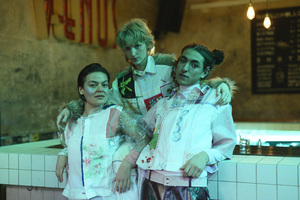
- In einer Bar, in der Innenstadt von Karlsruhe, trifft das Publikum auf ein tourendes Trio mit einer sonderbaren Geschichte: Es war einmal ein Nachtfalter, der lebte im Dschungel des brasilianischen Amazonas. Dieser Falter trug den Namen Gorgone macarea und hatte eine Angewohnheit, die für ein Lebewesen auf der Erde recht eigensinnig erschien. Gorgone macarea trank die Tränen schlafender Vögel. Für ihn: eine sichere Nahrungsquelle in unsicheren Zeiten. Da also Gorgone macareas Lebensraum sich immer mehr veränderte und auch die Vögel nach und nach wegzogen, machte der Falter sich auf, um andere Tränen zu suchen. Dabei kam ihm zu Ohren, dass der Mensch ganz besondere Tränen vergießt, wie kein anderes Lebewesen auf der Erde: Emotionale Tränen.
Und so entschloss sich der Nachtfalter, die Menschen einzuladen, um ihre Tränen mit ihm zu teilen.
Seither touren der Nachtfalter und seine zwei Kompliz*innen Sadgirl und Fluss von Bar zu Bar und lassen für einen Abend das Publikum Teil ihres Universums werden. Ein Universum – in dem Tränen die Hauptzutat des Abends sind und in jedem Cocktail serviert werden.
- In einer Bar, in der Innenstadt von Karlsruhe, trifft das Publikum auf ein tourendes Trio mit einer sonderbaren Geschichte: Es war einmal ein Nachtfalter, der lebte im Dschungel des brasilianischen Amazonas. Dieser Falter trug den Namen Gorgone macarea und hatte eine Angewohnheit, die für ein Lebewesen auf der Erde recht eigensinnig erschien. Gorgone macarea trank die Tränen schlafender Vögel. Für ihn: eine sichere Nahrungsquelle in unsicheren Zeiten. Da also Gorgone macareas Lebensraum sich immer mehr veränderte und auch die Vögel nach und nach wegzogen, machte der Falter sich auf, um andere Tränen zu suchen. Dabei kam ihm zu Ohren, dass der Mensch ganz besondere Tränen vergießt, wie kein anderes Lebewesen auf der Erde: Emotionale Tränen.
- Beschreibung (en)
- In a bar in downtown Karlsruhe, the audience encounters a touring trio with a peculiar story: Once upon a time, there was a moth living in the jungles of the Brazilian Amazon. This moth was called Gorgone macarea and had a habit that seemed rather unusual for a creature on Earth. Gorgone macarea drank the tears of sleeping birds. For the moth, it was a reliable source of nourishment in uncertain times. After all, even back then, the Amazon rainforest was considered a so-called tipping element, capable of disrupting the global climate balance. As Gorgone macarea’s habitat changed more and more, and the birds gradually disappeared, the moth set out in search of other tears. Along the way, it heard that humans shed a kind of tear unlike any other creature on Earth: emotional tears.
And so, the moth decided to invite humans to share their tears with it.
Since then, the moth and its two companions, Sadgirl and Fluss, have been touring from bar to bar, drawing the audience into their universe for one night. A universe where tears are the main ingredient of the evening—served in every cocktail.
- In a bar in downtown Karlsruhe, the audience encounters a touring trio with a peculiar story: Once upon a time, there was a moth living in the jungles of the Brazilian Amazon. This moth was called Gorgone macarea and had a habit that seemed rather unusual for a creature on Earth. Gorgone macarea drank the tears of sleeping birds. For the moth, it was a reliable source of nourishment in uncertain times. After all, even back then, the Amazon rainforest was considered a so-called tipping element, capable of disrupting the global climate balance. As Gorgone macarea’s habitat changed more and more, and the birds gradually disappeared, the moth set out in search of other tears. Along the way, it heard that humans shed a kind of tear unlike any other creature on Earth: emotional tears.
- Kategorie
- Typ des Projekts/Werks
- Schlagworte
- Datierung
- 20.12.2024
- Mitwirkende
- Dank an
- Dauer
- 40 Minuten
- Ort
- Venus Bar, Kaiserpassage
- Stadt
- Land
- Titel
- Sekret
- Untertitel
- Eine Tränen-Bar Performance
- Projektleiter/in
- Semester
- Studiengang
- Typ der Abschlussarbeit
- Importiert am
- 26.02.2025
- Übergeordnete Sets
- 3
- Set enthält
- 0 15
It's okay now
Name that can easily go onto 2 lines
Author that can easily go onto 2 lines as well
- Titel
- It's okay now
- Titel (en)
- It's okay now
- Autor/in
- Beschreibung (de)
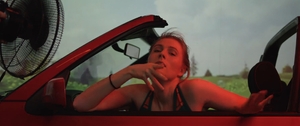
- "It’s okay now" ist ein autobiografisches Werk, das durch die Praxis des Erinnerns die Herkunft und Identität der beiden Protagonistinnen hinterfragt, analysiert und miteinander vergleicht. Das Erinnern dient dabei nicht nur als Mittel der Reflexion, sondern auch als eine Form des Träumens und Verarbeitens von Vergangenem. Fiktionale Szenen und Archivmaterial verweben sich zu einer Erzählung, die persönliche und kollektive Erinnerungen miteinander verschmelzen lässt.
- Beschreibung (en)
- "It’s okay now" is an autobiographical work that, through the practice of remembering, questions, analyzes, and compares the origins and identities of the two protagonists. In this process, remembering serves not only as a tool for reflection but also as a form of dreaming and processing the past. Fictional scenes and archival material intertwine to create a narrative that fuses personal and collective memories.
- Kategorie
- Typ des Projekts/Werks
- Schlagworte
- Datierung
- 01.10.2024 - 04.10.2024
- Mitwirkende
- Dank an
- Sprache
- Untertitel (Film)
- Material
- Technik/Verfahren/Formate
- 3-Kanal-Video-Audio Rauminstallation
- Abmessungen
- Breite: 10m; Tiefe: 10m; Höhe 4,5m
- Dauer
- 45 min
- Ort: Institution
- Ort
- Großes Studio
- Stadt
- Land
- Beteiligte Institution(en)
- Titel
- It's okay now
- Projektleiter/in
- Semester
- Studiengang
- Typ der Abschlussarbeit
- Archiv-Signatur
- its okay now
- Importiert am
- 10.10.2024
- Übergeordnete Sets
- 3
- Set enthält
- 0 11
Wrapping Waste
Name that can easily go onto 2 lines
Author that can easily go onto 2 lines as well
- Titel
- Wrapping Waste
- Titel (en)
- Wrapping Waste
- Untertitel
- Generative Design-Tools für die Verwertung von Lederverschnitt
- Untertitel des Projekts/Werks (en)
- Generative design tools for the reuse of leather waste
- Autor/in
- Beschreibung (de)
- Fast eine halbe Milliarde m² Leder weltweit endet jedes Jahr als Verschnitt in der Polsterproduktion.
Viel zu lange mussten sich natürliche Materialien starren Vorlagen unterordnen: Wir schneiden zu, wir kürzen, wir verwerfen – wir erzeugen Verschnitt durch Design.
Was wäre, wenn sich Technologie endlich der Natur anpassen könnte – und nicht umgekehrt?
Algorithmen können unreguläre Materialien und den Verschnitt als eine neue Ressource verwenden. Es geht dabei nicht nur um Effizienz; es geht darum, die Produkt-Ästhetik neu zu definieren – Schönheit in der natürlichen Variation und den natürlichen Fehlern zu sehen und zu erkennen, dass ein gutes Produkt am besten attraktiv, nachhaltig aber vor allem auch skalierbar ist.
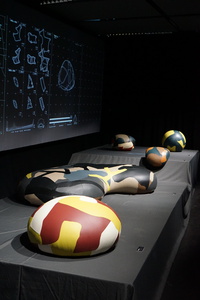
Ich habe Algorithmen entwickelt, die Polsterobjekte aus digitalisiertem Lederabfall generieren. Dieses Programm kann gewünschte Objekte direkt anhand verschiedener Designrichtlinien und Parameter erstellen und nutzt dabei jedes Lederstück zu fast 90% im Durchschnitt aus. Es entsteht ein auf das Material zugeschnittenes Design.
Danach habe ich es selbst ausprobiert und eine Serie von wassertropfenförmigen Polstermöbeln hergestellt. Das Material wurde von der Möbelfirma MOROSO und einer deutschen Polsterfirma gesponsort.
- Fast eine halbe Milliarde m² Leder weltweit endet jedes Jahr als Verschnitt in der Polsterproduktion.
- Beschreibung (en)
- Nearly half a billion square meters of global leather ends up as offcuts on upholstery production every year.
For so long, natural materials have been forced to conform to rigid templates: We trim, we crop, we discard - we create waste by design.
What if technology could finally adapt to nature and not the other way around?
Using algorithms to find hidden potential in imperfect materials. This is more than efficiency; it's about redefining the product aesthetic, to see beauty in variation and to recognize that the most attractive design is one that is both: sustainable and scalable.
I have created such algorithms that generate upholstery objects from leather waste, which has been digitalized. This program can directly create desired objects based on a variety of design guidelines, parameters and constraints. It utilizes each leather piece up to 90% in average. The outcome is a design that is 100% based on the material's shape.
Afterwards I have tried it myself and made a series of upholstered furniture from leather waste. The leather was sponsored by MOROSO, the filling by a german upholstery company.
- Nearly half a billion square meters of global leather ends up as offcuts on upholstery production every year.
- Kategorie
- Schlagworte
- Datierung
- 09.07.2025
- Dank an
- Sprache
- Technik/Verfahren/Formate
- Digitale Arbeit, Pythoncode, Grasshopper, Nähen, Polstern
- Abmessungen
- 205cm x 130cm x 42cm / 50cm x 50cm x 32cm / 78cm x 78cm x 40cm und kleinere.
- Ort: Institution
- Ort
- Glaskubus, 2. OG, Raum 208
- Stadt
- Land
- Titel
- Wrapping Waste
- Untertitel
- Generative Design-Tools für die Verwertung von Lederverschnitt
- Projektleiter/in
- Semester
- Studiengang
- Typ der Abschlussarbeit
- Importiert am
- 30.06.2025
- Übergeordnete Sets
- 2
- Set enthält
- 0 19
A man in the shape of...
Name that can easily go onto 2 lines
Author that can easily go onto 2 lines as well
- Titel
- A man in the shape of...
- Titel (en)
- A man in the shape of...
- Autor/in
- Beschreibung (de)
- „A man in the shape of...“ ist eine von Calvin Kudufia realisierte Ausstellung, die Februar 2024 im Rahmen seines Diploms stattfand. In der Ausstellung beschäftigt sich Kudufia mit der metaphorischen Praxis des Sammelns und Verdichtens: „gathering time and binding it“, wie es die dänische Dichterin Inger Christensen in ihrem Gedicht „Alphabet“ (1981) formuliert hat. Scheinbar unzusammenhängende ‚Dinge‘ werden im Gedicht zusammengetragen und durch die einfache Verwendung eines einzelnen Wortes, des "Existierens" in Zusammenhang gebracht und bedeutsam gemacht. Allein die Geste des Zusammentragen und Benennens verstärkt ihre symbolische Kraft.
Durch einen losen Kontaktpunkt in 2019 begann Kudufias Recherche an der Sepulkralkultur der fantasy coffins, einem traditionellen Kunsthandwerk der Ga-Ethnie in Ghana. Die individuell gestalteten Särge folgen einem mündlich überlieferten Bildindex und sind stellvertretende Gefäße für das ins Jenseits übertretende Leben. Die ‚fantasy coffins‘ verhüllen nicht nur den physischen Körper, ihre Hülle trägt konkrete Spuren der in ihnen gefassten Existenz.
Wie alle Gefäße schirmen die ‚fantasy coffins‘ ihren Inhalt vor den Blicken der Umgebung ab. Im selben Moment dienen sie als repräsentativer Körper des Verstorbenen. Die Suche nach dem richtig geformten Gefäß, sei es ein Weidenkorb für Früchte, ein Buch für Worte oder im Fall der ‚fantasy coffins‘ ein Fischernetz für Fischer, stellt die Suche nach Signifikanz des eigenen Lebens dar: eine treffende Metapher für die Odyssee des Lebens.
In seiner Arbeit „A man in the shape of...“ macht Kudufia sein väterliches Haus in Tema (Ghana) zum physischen Ausgangspunkt seiner Recherche. In Form einer trans-medialen Erzählung wird dessen Essenz eingefangen und greifbar gemacht. Poetische Artefakte und Beobachtungen aus dem Alltag in Ghana werden sorgfältig arrangiert und dienen als Verdinglichung von Zeit. Sie dienen als greifbare Säulen von Kudufias Zeit in Ghana.
„A man in the shape of...“ trägt der angeborenen Sehnsucht nach einer konkreten geografischen Verankerung Rechnung. Kudufia nutzt die gesamte Ausstellung als metaphorischen Fingerzeig auf einen Ort auf der Landkarte.
In Form einer Audioübertragung, einer speziellen Sitzposition auf der Nachbildung eines traditionellen Hockers, referentiellen Bautechniken und einer Dreikanal-Videoinstallation wird diese geografische Verankerung konkret vermittelt. Durch die Untersuchung der Rolle von Ritualen bei der Gestaltung unseres Zugehörigkeitsgefühls, inspiriert durch die philosophischen Überlegungen von Byung Chul Han, bietet die Ausstellung ein Fenster zu einer Kultur, die gleichzeitig vertraut und fremd ist.
Im Mittelpunkt der Ausstellung steht eine Videoinstallation, die in sieben Abschnitte unterteilt ist. Die Aufteilung bezieht sich auf die Tradition der „one-week observation“ und beschreibt jeweils eine Facette von Kudufias persönlicher Reise. Das Video wird begleitet von einem Musikstück der ghanaischen Theatermacherin Edufa T. Sutherland, das mit der Unterstützung des Cellisten Ben Grocock gespielt und aufgenommen wurde. Das Video lässt Kudufias Erinnerungen, Fiktionen und Realitäten verschwimmen und vermischt dabei die Identitäten von Kudufia mit denen seines Vaters und Großvaters und lässt so ein komplexes Netz aus Zugehörigkeiten entstehen.
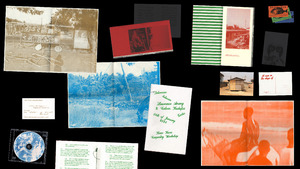
Eine Publikation, die integraler Bestandteil der Ausstellung ist, bedient sich der Form eines Gefäßes. Eine bedruckte Archivbox sammelt Kudufias Spuren auf seiner Suche nach den ‚fantasy coffins‘ und wird durch eine Hand voll ephemeraler Druckprodukte und Publikationen zum Dokumentationsapparat. Im Mittelpunkt der Archivbox steht ein Interview, zwischen Kudufia und dem Sargmacher Lawrence Anang in dessen Werkstatt in Teshie. Die einzige textliche Spur, die eine klare Verbindung zur Geschichte der Särge herstellt.
Das hölzerne Fundament einer nachgebauten Hütte dient als Sammelpunkt der Ausstellung und ermöglicht die Verbindung zwischen Druckerzeugnissen, Audio, Artefakten und den Betrachtenden. Die Kombination aus gesammeltem haptischen Material und audiovisuellen Arbeiten setzt sich zu einer transmedialen Collage zusammen, in der Kudufia die Geschichte seiner Verwurzelung auf intime Weise erzählt.
- „A man in the shape of...“ ist eine von Calvin Kudufia realisierte Ausstellung, die Februar 2024 im Rahmen seines Diploms stattfand. In der Ausstellung beschäftigt sich Kudufia mit der metaphorischen Praxis des Sammelns und Verdichtens: „gathering time and binding it“, wie es die dänische Dichterin Inger Christensen in ihrem Gedicht „Alphabet“ (1981) formuliert hat. Scheinbar unzusammenhängende ‚Dinge‘ werden im Gedicht zusammengetragen und durch die einfache Verwendung eines einzelnen Wortes, des "Existierens" in Zusammenhang gebracht und bedeutsam gemacht. Allein die Geste des Zusammentragen und Benennens verstärkt ihre symbolische Kraft.
- Beschreibung (en)
- "A man in the shape of..." is an exhibition realised by Calvin Kudufia, which took place in February 2024 as part of his diploma. In the exhibition, Kudufia deals with the metaphorical practice of "gathering time and binding it", as formulated by the Danish poet Inger Christensen. Through a trans-medial narration, the exhibition aims to capture the essence of his father's home in Tema (Ghana) and to make it tangible by carefully compiling poetic artefacts from the observed everyday life in Ghana.
Kudufia's research began with the so-called fantasy coffins, a traditional handicraft practiced by the Ga people of Ghana. The individually designed coffins follow an oral figurative index and are emblematic vessels for life passing into the afterlife. Not only do they conceal the physical body, but their shell bears imprints of the existence that preceded death. To give an example, the vessel of a fisherman might take the form of a boat or fishing net.
Similar to all vessels, they shield their content from its surroundings, simultaneously serving as a representation of the deceased to the eyes of the outside world. The search for the right-shaped vessel, be it a wicker basket for fruit or a book for words, mirrors the journey to discover one's own significance, as displayed figuratively by the fantasy coffins - an apt metaphor for the odyssey of life.
"A man in the shape of..." takes into account the innate longing for a concrete geographical rooting and uses the entirety of the exhibition as a metaphorical finger pointing to a place on the map. This geographical pinning is conveyed in the form of an audio transmission, a special seating position on a replica of a traditional stool, referential construction techniques and a three-channel video installation. By examining the role of rituals in shaping our sense of belonging, inspired by the philosophical reflections of Byung Chul Han, the exhibition offers a window into a culture that is both familiar and foreign at the same time.
At the heart of the exhibition is a video installation divided into seven segments referring to the tradition of the one-week observation, each describing a facet of Kudufia's personal journey. The video installation is accompanied by a musical piece composed by Edufa T. Sutherland, played and recorded with the assistance of cellist Ben Grocock. It blurs the boundaries between memory, fiction, and reality, inviting the viewer to reflect on the complexity of cultural identity and belonging.
The publication, an integral part of the exhibition, also takes the form of a vessel. Borrowing the shape of a printed archive box it collects Kudufia's traces on his search for the fantasy coffins and is conveyed through his graphic expression. At its center is an interview he conducted with coffin maker Lawrence Anang in his workshop in Teshie, the sole textual trace of the coffins' history.
In order to bring all of the pieces together, a wooden fundament of a hut serves as the gathering point of the exhibition, enabling the connection between printed matter, audio, artefacts, and the viewers.
The collected haptic material combined with the audiovisual pieces results in a trans-medial collage in which Kudufia intimately tells the story of his rooting.
- "A man in the shape of..." is an exhibition realised by Calvin Kudufia, which took place in February 2024 as part of his diploma. In the exhibition, Kudufia deals with the metaphorical practice of "gathering time and binding it", as formulated by the Danish poet Inger Christensen. Through a trans-medial narration, the exhibition aims to capture the essence of his father's home in Tema (Ghana) and to make it tangible by carefully compiling poetic artefacts from the observed everyday life in Ghana.
- Kategorie
- Typ des Projekts/Werks
- Schlagworte
- Datierung
- 22.02.2024
- Dank an
- Sprache
- Material
- Ort: Institution
- Ort
- Lichthof 04
- Stadt
- Land
- Titel
- A man in the shape of...
- Projektleiter/in
- Semester
- Studiengang
- Typ der Abschlussarbeit
- Importiert am
- 31.05.2024
- Übergeordnete Sets
- 4
- Set enthält
- 0 21
existence.exe
Name that can easily go onto 2 lines
Author that can easily go onto 2 lines as well
- Titel
- existence.exe
- Titel (en)
- existence.exe
- Autor/in
- Beschreibung (de)
- Das Konzept der „Selbstoptimierung“ hat eine zunehmende gesellschaftliche Relevanz erreicht, dementsprechend haben zahlreiche Apps, die sich auf den Körper, die Emotionen und das Selbstmanagement konzentrieren, nach und nach mein Leben durchdrungen.
Ich scheine gleichzeitig in zwei Formen zu existieren: einerseits als organisches Wesen, das aus Wahrnehmung, Widersprüchen und zufälligen Erfahrungen besteht; andererseits als digitales Modell, das von verschiedenen Anwendungen konstruiert wurde.
Allmählich gewöhnte ich mich daran, mich selbst über Zahlen zu messen und zu analysieren – von der Kalorienaufnahme über Schlafzyklen bis hin zu feinen Schwankungen der Herzfrequenz – doch dabei verlor ich zunehmend das Vertrauen in die natürliche Wahrnehmung meines Körpers.
Diese Programme geben vor, „personalisierte Dienste“ zu sein, verwandeln uns letztlich aber in ein einheitliches Datenformat, das sich bequem kategorisieren, vergleichen und extrahieren lässt.
Je mehr Daten es über mich gibt, desto weniger scheine ich mich selbst zu spüren.
- Das Konzept der „Selbstoptimierung“ hat eine zunehmende gesellschaftliche Relevanz erreicht, dementsprechend haben zahlreiche Apps, die sich auf den Körper, die Emotionen und das Selbstmanagement konzentrieren, nach und nach mein Leben durchdrungen.
- Beschreibung (en)
- As “self-optimization” has become a widely accepted life concept, a large number of apps focusing on the body, emotions, and self-management have gradually infiltrated my life.
I seem to exist in two forms at the same time: one, an organic being composed of perception, contradictions, and incidental experiences; the other, a digital model constructed by various applications.
I gradually got used to measuring and examining myself through numbers—from calorie intake to sleep cycles and subtle fluctuations in heart rate—but in doing so, I slowly lost trust in my body’s natural perception.
These programs present themselves as “personalized services,” yet ultimately convert us into a single data format, convenient for categorization, comparison, and extraction.
The more data there is about me, the less I seem to feel myself.
- As “self-optimization” has become a widely accepted life concept, a large number of apps focusing on the body, emotions, and self-management have gradually infiltrated my life.
- Kategorie
- Typ des Projekts/Werks
- Schlagworte
- Datierung
- 14.05.2025
- Mitwirkende
- Dank an
- Dauer
- 2 Tage
- Ort: Institution
- Ort
- Lichthof 4
- Stadt
- Land
- Titel
- existence.exe
- Projektleiter/in
- Semester
- Studiengang
- Typ der Abschlussarbeit
- Importiert am
- 19.05.2025
- Übergeordnete Sets
- 2
- Set enthält
- 0 26