"Wet again"
Benachbarte Sets (30)Alle Zusammenhänge anzeigen
Diese Sets wurden den gleichen Sets hinzugefügt wie das ausgewählte Set.
30 Inhalte
- Seite 1 von 3
Ministry for the Future
Name that can easily go onto 2 lines
Author that can easily go onto 2 lines as well
- Titel
- Ministry for the Future
- Titel (en)
- Ministry for the Future
- Autor/in
- Beschreibung (de)
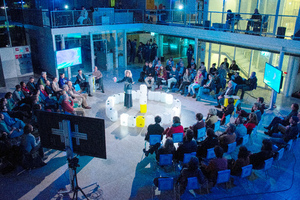
- Ministry for the Future ist eine transdisziplinäre Produktion über mögliche Zukünfte im Angesicht der Klimakrise – und darüber, wie wir sie verhandeln, bevor sie eintreten. Inspiriert vom gleichnamigen Roman von Kim Stanley Robinson entwickelte sich ein groß angelegtes Kooperationsprojekt zwischen dem Theater Neumarkt, dem Collegium Helveticum Zürich und der Hochschule für Gestaltung Karlsruhe.
Ausgangspunkt ist ein spekulatives Szenario im Jahr 2034: Die Erde hat Kipppunkte erreicht, Regierungen reagieren, eine neue Institution wird gegründet – das Ministerium für die Zukunft. Innerhalb dieser Fiktion operiert die Produktion als diskursives Format, das sich fortlaufend mit der zentralen Frage auseinandersetzt: Welche Handlungsspielräume bleiben uns?
Das Projekt kombiniert künstlerische, wissenschaftliche und gestalterische Perspektiven zu einem Format zwischen Preenactment und realer Wissenschaftskommunikation. Herzstück ist ein mobiles Bühnenbild, das drängende forschungsbasierte Diskurse in eine begehbare, funktionale Infrastruktur übersetzt. Die Szenografie wurde konsequent durch Re- und Upcycling-Prozesse entwickelt. Sie folgt einer Haltung, die den Anforderungen ökologischer Krisen standhalten will – indem sie aus dem Material jener Krisen selbst hervorgeht. In vier thematisch fokussierten Episoden an vier verschiedenen Orten in Zürich wird der Raum selbst zum Instrument: eine spekulative Versammlung, eine temporäre Institution, ein Möglichkeitslabor.
Die Inszenierung bringt reale Wissenschaftler:innen, Performer:innen und Bürger:innen im Modus eines fiktionalen Ministeriums in Austausch – und mit ihnen die Fragen: Wie lässt sich Zukunft verhandeln, wenn sie längst begonnen hat? Was bedeutet Teilhabe, wenn die Katastrophe strukturell geworden ist? Und wie kann Raum für solche Aushandlungen heute aussehen?
- Ministry for the Future ist eine transdisziplinäre Produktion über mögliche Zukünfte im Angesicht der Klimakrise – und darüber, wie wir sie verhandeln, bevor sie eintreten. Inspiriert vom gleichnamigen Roman von Kim Stanley Robinson entwickelte sich ein groß angelegtes Kooperationsprojekt zwischen dem Theater Neumarkt, dem Collegium Helveticum Zürich und der Hochschule für Gestaltung Karlsruhe.
- Beschreibung (en)
- Ministry for the Future is a transdisciplinary production about possible futures in the face of the climate crisis—and about how we negotiate them before they arrive. Inspired by the novel of the same name by Kim Stanley Robinson, the project evolved into a large-scale collaboration between Theater Neumarkt, the Collegium Helveticum Zurich, and the Karlsruhe University of Arts and Design (HfG).
Its starting point is a speculative scenario set in the year 2034: the Earth has reached tipping points, governments are reacting, and a new institution is established—the Ministry for the Future. Within this fiction, the production functions as a discursive format that continuously engages with the central question: What room for action remains?
The project combines artistic, scientific, and design perspectives into a hybrid format somewhere between preenactment and real science communication. At its core is a mobile stage design that translates urgent, research-based discourses into an immersive, functional infrastructure. The scenography was developed entirely through re- and upcycling processes, guided by an attitude that seeks to meet the demands of ecological crises—by emerging from their very material. Across four thematically focused episodes in four different locations in Zurich, the space itself becomes an instrument: a speculative assembly, a temporary institution, a lab of possibilities.
The performance brings together real scientists, performers, and citizens within the framework of a fictional ministry—and with them, the questions: How can we negotiate the future when it has already begun? What does participation mean when catastrophe has become structural? And what kind of space is needed for such negotiations today?
- Ministry for the Future is a transdisciplinary production about possible futures in the face of the climate crisis—and about how we negotiate them before they arrive. Inspired by the novel of the same name by Kim Stanley Robinson, the project evolved into a large-scale collaboration between Theater Neumarkt, the Collegium Helveticum Zurich, and the Karlsruhe University of Arts and Design (HfG).
- Kategorie
- Typ des Projekts/Werks
- Schlagworte
- Sprache
- Dauer
- 4 Episoden, jeweils 2 Stunden
- Ort: Institution
- Ort
- Episode 1: ETH Zürich
Episode 2: Naturhistorisches Museum Zürich
Episode 3: Wasserkirche Zürich
Episode 4: Semper Sternwarte / Collegium Helveticum Zürich
- Episode 1: ETH Zürich
- Land
- Beteiligte Institution(en)
- Titel
- Ministry for the Future
- Projektleiter/in
- Semester
- Studiengang
- Importiert am
- 29.06.2025
- Übergeordnete Sets
- 0
- Set enthält
- 0 39
Plastic Fugue
Name that can easily go onto 2 lines
Author that can easily go onto 2 lines as well
- Titel
- Plastic Fugue
- Titel (en)
- Plastic Fugue
- Autor/in
- Beschreibung (de)
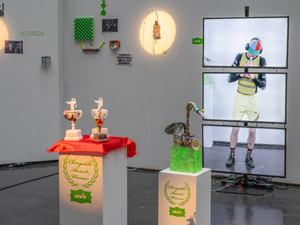
- Plastic Fugue ist eine interaktive Klanginstallation, die mit einer Kindheitserinnerung an die Konzertflöte beginnt, ein Instrument, das ich aufgrund finanzieller Schwierigkeiten nie erlernen konnte und das für mich zum Symbol des Klassismus wurde. Finanzielle Einschränkung ist nicht nur unangenehm, sondern lässt Kinder sich als ungeeignet empfinden, überhaupt etwas zu versuchen, und normalisiert dadurch Klassismus, selbst in der Kunst.
Es passierte mir erneut, als ich Malerei studierte. Die Materialien, Leinwand, Holz, Stoff, Papier, Farbe, Öl, ja sogar ein Bleistift, werden mit einer gewissen Aura vermarktet. Unsere Kunst ist längst zu sehr mit der neoliberalen Wirtschaft verstrickt, ironischerweise im Widerspruch zu ihrem eigentlichen Ziel, Freiheit. Die Qualität von Kunst über den Preis der Materialien zu definieren, ist eine Wiederholung alter Muster, so wie Blau und Grün einst als Zeichen des Reichtums galten und dem Adel vorbehalten waren.
Diese Struktur führte dazu, dass ich klassische Musik als die einzig wahre Musik betrachtete und die Leinwandmalerei, die im späten 15. Jahrhundert in Italien entstand, als den allein gültigen Standard in der bildenden Kunst. Jahrzehnte später erkannte ich, dass es jenseits dessen, was ich damals als Kunst verstand, auch Formen gab, die aus verschiedenen kulturellen Kontexten stammen und nicht als Teil dieses Standards wahrgenommen wurden. Dann versuchte ich, all diese ironischen Elemente in die verschiedenen Medien einzubringen, mit denen ich bisher gearbeitet hatte.
- Plastic Fugue ist eine interaktive Klanginstallation, die mit einer Kindheitserinnerung an die Konzertflöte beginnt, ein Instrument, das ich aufgrund finanzieller Schwierigkeiten nie erlernen konnte und das für mich zum Symbol des Klassismus wurde. Finanzielle Einschränkung ist nicht nur unangenehm, sondern lässt Kinder sich als ungeeignet empfinden, überhaupt etwas zu versuchen, und normalisiert dadurch Klassismus, selbst in der Kunst.
- Beschreibung (en)
- Plastic Fugue is an interactive sound installation project that begins with a childhood memory of the concert flute, which I couldn't learn due to financial hardship, and which came to symbolize classism to me. Being financially debilitated is not only a discomfort, but also makes children feel unqualified to even try, thereby normalizing this classism even in art.
It happened to me again when I studied painting. The materials are marketed with an aura, including canvas, wood, fabric, paper, paint, oil, and even a pencil. Our art already conspires too much with the neoliberal economy, ironically, against its supposed goal: liberty. Classifying the quality of art based on the price of materials is repetitive, much like how blue and green, once symbols of wealth, were valued and reserved for royalty in history.
This structure led me to view classical music as the only true form of music, and canvas painting, which originated in Italy in the late 15th century, as the sole standard in visual art. Decades later, I realized there was more art behind the things I once believed to be art alone. Then I attempted to gather all these ironical elements into diverse mediums I had experienced so far.
- Plastic Fugue is an interactive sound installation project that begins with a childhood memory of the concert flute, which I couldn't learn due to financial hardship, and which came to symbolize classism to me. Being financially debilitated is not only a discomfort, but also makes children feel unqualified to even try, thereby normalizing this classism even in art.
- Kategorie
- Typ des Projekts/Werks
- Schlagworte
- Datierung
- 09.07.2025 - 13.07.2025
- Mitwirkende
- Dank an
- Material
- Abmessungen
- Variable Maße
- Dauer
- Introducing air&dust: 9' 11" / Sax Recital: 16' 37"
- Ort: Institution
- Ort
- Lichthof
- Stadt
- Land
- Internetlinks
- Titel
- Plastic Fugue
- Projektleiter/in
- Semester
- Studiengang
- Typ der Abschlussarbeit
- Importiert am
- 29.06.2025
- Übergeordnete Sets
- 2
- Set enthält
- 4 1
Wrapping Waste
Name that can easily go onto 2 lines
Author that can easily go onto 2 lines as well
- Titel
- Wrapping Waste
- Titel (en)
- Wrapping Waste
- Untertitel
- Generative Design-Tools für die Verwertung von Lederverschnitt
- Untertitel des Projekts/Werks (en)
- Generative design tools for the reuse of leather waste
- Autor/in
- Beschreibung (de)
- Fast eine halbe Milliarde m² Leder weltweit endet jedes Jahr als Verschnitt in der Polsterproduktion.
Viel zu lange mussten sich natürliche Materialien starren Vorlagen unterordnen: Wir schneiden zu, wir kürzen, wir verwerfen – wir erzeugen Verschnitt durch Design.
Was wäre, wenn sich Technologie endlich der Natur anpassen könnte – und nicht umgekehrt?
Algorithmen können unreguläre Materialien und den Verschnitt als eine neue Ressource verwenden. Es geht dabei nicht nur um Effizienz; es geht darum, die Produkt-Ästhetik neu zu definieren – Schönheit in der natürlichen Variation und den natürlichen Fehlern zu sehen und zu erkennen, dass ein gutes Produkt am besten attraktiv, nachhaltig aber vor allem auch skalierbar ist.
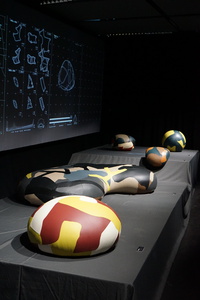
Ich habe Algorithmen entwickelt, die Polsterobjekte aus digitalisiertem Lederabfall generieren. Dieses Programm kann gewünschte Objekte direkt anhand verschiedener Designrichtlinien und Parameter erstellen und nutzt dabei jedes Lederstück zu fast 90% im Durchschnitt aus. Es entsteht ein auf das Material zugeschnittenes Design.
Danach habe ich es selbst ausprobiert und eine Serie von wassertropfenförmigen Polstermöbeln hergestellt. Das Material wurde von der Möbelfirma MOROSO und einer deutschen Polsterfirma gesponsort.
- Fast eine halbe Milliarde m² Leder weltweit endet jedes Jahr als Verschnitt in der Polsterproduktion.
- Beschreibung (en)
- Nearly half a billion square meters of global leather ends up as offcuts on upholstery production every year.
For so long, natural materials have been forced to conform to rigid templates: We trim, we crop, we discard - we create waste by design.
What if technology could finally adapt to nature and not the other way around?
Using algorithms to find hidden potential in imperfect materials. This is more than efficiency; it's about redefining the product aesthetic, to see beauty in variation and to recognize that the most attractive design is one that is both: sustainable and scalable.
I have created such algorithms that generate upholstery objects from leather waste, which has been digitalized. This program can directly create desired objects based on a variety of design guidelines, parameters and constraints. It utilizes each leather piece up to 90% in average. The outcome is a design that is 100% based on the material's shape.
Afterwards I have tried it myself and made a series of upholstered furniture from leather waste. The leather was sponsored by MOROSO, the filling by a german upholstery company.
- Nearly half a billion square meters of global leather ends up as offcuts on upholstery production every year.
- Kategorie
- Schlagworte
- Datierung
- 09.07.2025
- Dank an
- Sprache
- Technik/Verfahren/Formate
- Digitale Arbeit, Pythoncode, Grasshopper, Nähen, Polstern
- Abmessungen
- 205cm x 130cm x 42cm / 50cm x 50cm x 32cm / 78cm x 78cm x 40cm und kleinere.
- Ort: Institution
- Ort
- Glaskubus, 2. OG, Raum 208
- Stadt
- Land
- Titel
- Wrapping Waste
- Projektleiter/in
- Semester
- Studiengang
- Typ der Abschlussarbeit
- Importiert am
- 30.06.2025
- Übergeordnete Sets
- 2
- Set enthält
- 0 19
Well, don't you do wellness?
- Titel
- Well, don't you do wellness?
- Titel (en)
- Well, don't you do wellness?
- Autor/in
- Beschreibung (de)
- Das Projekt "Well, don’t you do Wellness?" untersucht Wellness als Spannungsfeld zwischen Selbstoptimierung und Widerstand. Es fragt, was Wohlbefinden bedeutet, wenn Erholung zur gesellschaftlichen Pflicht geworden ist, und wie Körper und Stimme zu Werkzeugen der Selbstermächtigung werden können.
"Well, don’t you do Wellness?" versteht Wohlbefinden als politische, kollektive Praxis und skizziert Möglichkeiten, Körper, Stimme und Sorgearbeit jenseits von Optimierung zu denken.
Ausgangspunkt der Arbeit ist die Beschäftigung mit Badekultur, feministischen Handarbeitstechniken und historischen Formen der kollektiven Selbstfürsorge. Dabei greift das Projekt auf textile und therapeutische Methoden zurück, wie sie in Gesundheitsbewegungen, psychiatrischen Einrichtungen sowie in feministischen Kontexten entstanden sind – als Ausdruck kollektiver Fürsorge und Widerständigkeit.
- Das Projekt "Well, don’t you do Wellness?" untersucht Wellness als Spannungsfeld zwischen Selbstoptimierung und Widerstand. Es fragt, was Wohlbefinden bedeutet, wenn Erholung zur gesellschaftlichen Pflicht geworden ist, und wie Körper und Stimme zu Werkzeugen der Selbstermächtigung werden können.
- Beschreibung (en)
- The project 'Well, don't you do wellness?' considers wellness as an area of tension between self-optimisation and resistance. Considering what well-being means when wellness has become a social obligation, it explores how the body and voice can be used as tools of agency.
The project understands well-being as a political, collective practice and outlines possibilities for rethinking the body beyond optimisation.
The research begins with an examination of bathing culture, feminist craft techniques, and historical forms of (collective) self-care. Drawing on textile and therapeutic methods that emerged in health movements, psychiatric institutions and feminist contexts, the project presents these as expressions of care and resistance.
- The project 'Well, don't you do wellness?' considers wellness as an area of tension between self-optimisation and resistance. Considering what well-being means when wellness has become a social obligation, it explores how the body and voice can be used as tools of agency.
- Kategorie
- Typ des Projekts/Werks
- Schlagworte
- Datierung
- 2025
- Mitwirkende
- Dank an
- Material
- Ort: Institution
- Stadt
- Titel
- Well, don't you do wellness?
- Projektleiter/in
- Studiengang
- Typ der Abschlussarbeit
- Importiert am
- 14.09.2025
- Übergeordnete Sets
- 0
- Set enthält
- 0 0
Erikas Töchter
Name that can easily go onto 2 lines
Author that can easily go onto 2 lines as well
- Titel
- Erikas Töchter
- Autor/in
- Beschreibung (de)
- "Erikas Töchter" untersucht anhand der fiktiven Figur Erika Mustermann Perspektiven auf die weibliche* Identitätsbildung in Deutschland. Seit 1987 existiert Erika als Musteridentität in amtlichen Dokumenten – weiß, blond, blau- oder grünäugig. Als ein lächelnder Anachronismus geistert sie, erschreckend unkommentiert, durch die Bürokratielandschaft Deutschlands.
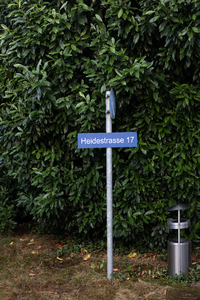
Die Arbeit übersetzt diese fiktive Identität in ein irritierendes Szenario, das zwischen Gartenfest, Ausstellung, Performance und Büroalltag changiert. Im Zentrum stehen zwei Ebenen: Zum einen die Präsentation der IDOLLs, einer Serie neuer weiblicher Musteridentitäten, die im Format einer Teleshopping-Show als innovative Lösung zeitgenössischer Identitätsprobleme vermarktet werden. Zum anderen der Blick in Erikas Büroalltag. Umgeben von Plastik-Buchsbaumbüschen, Teppichboden und generischen Büromöbeln ist sie gefangen im Moment des Fotos und der Reproduktion ihres Gesichtes.
Erikas durchdringende Augen blicken uns alle aufmerksam an, die Mundwinkel deuten ein neutrales Lächeln an. Doch je länger man sie betrachtet, desto schwerer wiegt ihr Blick: normierend, klassifizierend und ausschließend. Ihre Stimme, körperlos und fragmentarisch, erzählt aus dem Inneren dieses leeren Gesichtes und stellt die Frage, welche Gesichter und Narrative durch sie aus dem kollektiven Bild verschwinden.
- "Erikas Töchter" untersucht anhand der fiktiven Figur Erika Mustermann Perspektiven auf die weibliche* Identitätsbildung in Deutschland. Seit 1987 existiert Erika als Musteridentität in amtlichen Dokumenten – weiß, blond, blau- oder grünäugig. Als ein lächelnder Anachronismus geistert sie, erschreckend unkommentiert, durch die Bürokratielandschaft Deutschlands.
- Beschreibung (en)
- “Erikas Töchter” explores perspectives on female* identity formation in Germany through the fictional figure of Erika Mustermann. Since 1987, Erika has served as the standard identity in official documents – white, blonde, blue- or green-eyed. As a smiling anachronism, she continues to haunt Germany’s bureaucratic landscape.
The work translates this fictional identity into a scenario that shifts between garden party, exhibition, performance, and office routine. At its center are two layers: on the one hand, the presentation of the IDOLLs – a series of new female standard identities, presented in the style of a teleshopping show, offering an innovative approach to contemporary issues of identity; on the other hand, a glimpse into Erika’s everyday office life. Surrounded by plastic boxwood shrubs, carpeting, and generic office furniture, she remains trapped in the moment of the photograph and the endless reproduction of her own face.
Erika’s eyes look directly at the viewer, the corners of her mouth suggesting a neutral smile. Yet the longer she gazes at you, the more insistent her expression becomes: classifying and excluding. A bodiless, fragmentary voice accompanies the scene, offering insights from within this empty face and raising the question of which faces and narratives disappear from the collective image through her.
- “Erikas Töchter” explores perspectives on female* identity formation in Germany through the fictional figure of Erika Mustermann. Since 1987, Erika has served as the standard identity in official documents – white, blonde, blue- or green-eyed. As a smiling anachronism, she continues to haunt Germany’s bureaucratic landscape.
- Kategorie
- Typ des Projekts/Werks
- Schlagworte
- Datierung
- 22.07.2025
- Mitwirkende
- Sprache
- Material
- Abmessungen
- Ein kleines Haus mit Garten
- Dauer
- 4 Stunden
- Ort: Institution
- Stadt
- Land
- Titel
- Erikas Töchter
- Projektleiter/in
- Semester
- Studiengang
- Typ der Abschlussarbeit
- Importiert am
- 29.09.2025
- Übergeordnete Sets
- 0
- Set enthält
- 2 23
sampling for relations in the light of a satellite
Name that can easily go onto 2 lines
Author that can easily go onto 2 lines as well
- Titel
- sampling for relations in the light of a satellite
- Titel (en)
- sampling for relations in the light of a satellite
- Autor/in
- Beschreibung (de)
- In dem Format einer sampling session wird eine akustische Struktur erprobt, die das Reisen zum Mond beschwört und sich mit Raumwahrnehmungen, Imagination und kollektiven Vorstellungen auseinandersetzt. Anders als in dieser Performance ist für das menschliche Ohr eine wesentliche Präsenz im Weltraum das Geräuschlose.
- Beschreibung (en)
- In the format of a sampling session, an acoustic structure is tested that conjures a journey to the Moon, engaging with perceptions of space, imagination and collective ideas.
- Kategorie
- Typ des Projekts/Werks
- Schlagworte
- Datierung
- 04.02.2025
- Mitwirkende
- Dank an
- Anja Casser
- Filipa Cesar
- Jaya Demmer
- Hubert Distel
- Till Engelhardt
- Yvonne Fomferra
- Hanna Franke
- Heidi Herzig
- Tobias Keilbach
- Eisenhart Keimeyer
- Susanne Kriemann
- Rebekka Ladewig
- Isabel Motz
- Leonie Mühlen
- Elisabeth Potemkin
- Josefine Scheu
- Lorenz Schwarz
- Leia Morgana Walz
- Niklas Weisenbach
- Maximilian Zschiesche
- Badischer Kunstverein
- Sprache
- Material
- Ort: Institution
- Stadt
- Land
- Beteiligte Institution(en)
- Titel
- sampling for relations in the light of a satellite
- Projektleiter/in
- Semester
- Studiengang
- Typ der Abschlussarbeit
- Importiert am
- 01.10.2025
- Übergeordnete Sets
- 0
- Set enthält
- 0 5