Sora Kim
| Name | Sora Kim |
3 Inhalte
- Seite 1 von 1
Abschlussarbeit
Name that can easily go onto 2 lines
Author that can easily go onto 2 lines as well
- Titel
- Abschlussarbeit
- Titel (en)
- Luv What You Luv
- Untertitel
- Otaku and Community
- Autor/in
- Beschreibung (de)
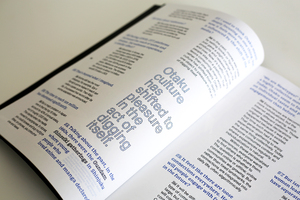
- Der Begriff Otaku bezeichnet eine Person, die eine tiefe, spezialisierte und anhaltende Begeisterung für ein bestimmtes Thema besitzt, die sich häufig durch umfangreiches Wissen, emotionale Bindung und aktive Beschäftigung damit auszeichnet.
In der heutigen Gesellschaft wird es zunehmend schwieriger, unsere reine Begeisterung mit anderen zu teilen. Menschen neigen dazu, soziale Gruppen auf der Grundlage kultureller Geschmäcker zu bilden, und dieses Phänomen hat sich im Zeitalter von Web 2.0 durch Mechanismen wie Filterblasen weiter verstärkt.
Durch das Projekt „Luv What You Luv“ möchte ich zeigen, was ich liebe, und gleichzeitig hören, was andere lieben. Das Projekt besteht hauptsächlich aus einem Magazin, das zwei Ausgaben in einem Band vereint. Die erste Ausgabe, [Girls], zeigt, was ich persönlich liebe. Die zweite Ausgabe, [Otaku], untersucht die Otaku-Fankultur genauer und enthält drei Interviews sowie sechs Gastbeiträge, die hervorheben, wofür andere Menschen eine besondere Leidenschaft haben.
Darüber hinaus umfasst das Projekt einen Fragebogen, der untersucht, was Leser:innen und Besucher:innen der Ausstellung lieben, sowie ein Otaku Presentation Video, in dem Teilnehmende ihre eigenen Leidenschaften und Interessen vorstellen.
Durch dieses Magazin und die dazugehörigen Inhalte hoffe ich, dass Menschen die Freude daran erleben können, das zu teilen, was sie lieben, und durch diese gemeinsamen Ausdrucksformen von Begeisterung lose soziale Verbindungen entstehen.
- Der Begriff Otaku bezeichnet eine Person, die eine tiefe, spezialisierte und anhaltende Begeisterung für ein bestimmtes Thema besitzt, die sich häufig durch umfangreiches Wissen, emotionale Bindung und aktive Beschäftigung damit auszeichnet.
- Beschreibung (en)
- The term otaku refers to a person who has deep, specialized, and sustained enthusiasm for a particular subject, often characterized by extensive knowledge, emotional attachment, and active engagement.
In contemporary society, it is becoming increasingly difficult to share our pure enthusiasm with others. People tend to form social groups based on cultural taste, and this phenomenon has intensified in the Web 2.0 era through mechanisms such as filter bubbles.
Through the “Luv What You Luv” project, I aim to present what I love while also listening to what others love. The project mainly consists of a magazine composed of two issues in a single book. The first issue, [Girls], presents what I personally love. The second issue, [Otaku], explores otaku fandom culture in depth, featuring three interviews and six contributed essays that highlight what others are passionately devoted to.
In addition, the project includes a questionnaire that explores what readers and exhibition visitors love, as well as an Otaku Presentation Video, in which participants present their own passions and interests.
Through this magazine and its accompanying contents, I hope that people can experience the joy of sharing what they love and form weak social bonds through these shared expressions of enthusiasm.
- The term otaku refers to a person who has deep, specialized, and sustained enthusiasm for a particular subject, often characterized by extensive knowledge, emotional attachment, and active engagement.
- Kategorie
- Typ des Projekts/Werks
- Schlagworte
- Datierung
- 11.02.2026
- Mitwirkende
- Dank an
- Sprache
- Untertitel (Film)
- Material
- Abmessungen
- 210*297 mm
- Dauer
- 40:49
- Ort: Institution
- Ort
- Seminar room 202
- Stadt
- Land
- Bemerkungen
- KD(Kommunikationsdesign) Diplomarbeit, 9th Semester, with guide of Tereza Ruller and Paul Bailey
- Titel
- Abschlussarbeit
- Untertitel
- Otaku and Community
- Projektleiter/in
- Semester
- Studiengang
- Typ der Abschlussarbeit
- Importiert am
- 05.03.2026
- Übergeordnete Sets
- 0
- Set enthält
- 0 18
RE: Home
Name that can easily go onto 2 lines
Author that can easily go onto 2 lines as well
- Titel
- RE: Home
- Titel (en)
- RE: Home
- Autor/in
- Beschreibung (de)
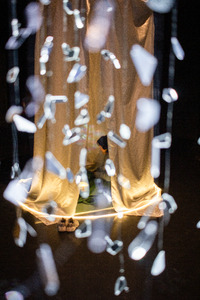
- Wir alle verlassen irgendwann unser erstes Zuhause (das Zuhause unserer Kindheit), entweder freiwillig oder unfreiwillig. Dieser Abschied ist mehr als nur ein physischer Umzug; er markiert den Beginn einer Reise, auf der wir uns ein neues Zuhause schaffen und gleichzeitig die Sehnsucht nach dem Zuhause der Vergangenheit zurücklassen.
Aber Zuhause ist nicht nur der Ort, an dem wir geboren und aufgewachsen sind; es ist auch der Ort (oder Zustand), an dem wir unsere Identität formen, und der psychologische Raum, in dem wir unsere Erinnerungen und Emotionen speichern. Bevor wir weggehen, erinnern wir uns an Zuhause als einen physischen Ort, der uns vertraut und beruhigend ist, aber nachdem wir weggegangen sind, wird es allmählich weniger zu einem konkreten Bild und mehr zu einem fließenden, psychologischen Konzept. Es ist nicht nur ein Verlust, sondern ein Prozess des Findens und Schaffens eines neuen Zuhauses.
In der modernen Welt, in der sich so vieles so schnell verändert, erfinden wir uns ständig neu und das Zuhause ist kein festes Konzept, sondern wird durch die Orte, Erfahrungen und Beziehungen, die wir bewohnen, neu definiert. Heimat ist unser Ausgangspunkt und bleibt nicht unbedingt an einem Ort; vielmehr bewegen und verändern wir uns und entdecken und schaffen auf diesem Weg neue Formen von Heimat.
Was bedeutet also Zuhause für uns und wie schaffen wir es?
- Wir alle verlassen irgendwann unser erstes Zuhause (das Zuhause unserer Kindheit), entweder freiwillig oder unfreiwillig. Dieser Abschied ist mehr als nur ein physischer Umzug; er markiert den Beginn einer Reise, auf der wir uns ein neues Zuhause schaffen und gleichzeitig die Sehnsucht nach dem Zuhause der Vergangenheit zurücklassen.
- Beschreibung (en)
- We all leave our first home (our childhood home) at some point, either willingly or unwillingly. This departure is more than just a physical move; it marks the beginning of a journey where we create a new home, while at the same time leaving behind a sense of nostalgia for the home of our past.
But home isn't just the place where we were born and raised; it's also the place where we form our identity, and the psychological space where we store our memories and emotions. Before we leave, home is remembered as a physical place that is familiar and comforting, but after we leave, it gradually becomes less of a concrete image and more of a fluid, psychological concept. It's not just a loss, but a process of finding and creating a new home.
In the modern world, where so much is changing so quickly, we are constantly re-creating ourselves, and home is not a fixed concept, but is redefined by the places, experiences, and relationships we inhabit. Home functions as our base point, and it doesn't necessarily stay in one place; rather, we move and change, discovering and creating new forms of home along the way.
So, what does home mean to us, and how do we create it?
- We all leave our first home (our childhood home) at some point, either willingly or unwillingly. This departure is more than just a physical move; it marks the beginning of a journey where we create a new home, while at the same time leaving behind a sense of nostalgia for the home of our past.
- Kategorie
- Typ des Projekts/Werks
- Schlagworte
- Mitwirkende
- Material
- Technik/Verfahren/Formate
- Ausstellung
- Abmessungen
- Main : 1 m x 2 m x 2 m (H x B x D), Sub ø 180 cm, H: 2.5 m
- Dauer
- The imaginative narrations take about 10 minutes. / 12.03.2025 - 14.03.2025
- Ort: Institution
- Ort
- Großes Studio
- Stadt
- Land
- Titel
- RE: Home
- Projektleiter/in
- Semester
- Studiengang
- Typ der Abschlussarbeit
- Importiert am
- 10.02.2025
- Übergeordnete Sets
- 2
- Set enthält
- 0 16
Ghost Story
Name that can easily go onto 2 lines
Author that can easily go onto 2 lines as well
- Titel
- Ghost Story
- Autor/in
- Beschreibung (en)
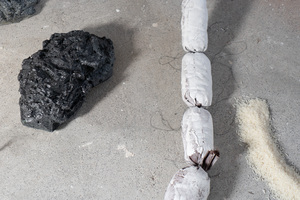
- The project was born in response to the passing of an unaccompanied homeless individual in 2018, a person without known family or friends. Her death was cataloged—reduced to data archived in newsrooms and on digital servers. Yet, if this data remains untouched, and her memory fades into obscurity, does her existence persist? She lingers and remains unseen—a paradoxical state of both presence and absence. Within the digital void, she exists as a spectral trace, haunting the silence, waiting to be rediscovered, forever closed in on herself.
Such is the nature of ghosts—the living create them. We resurrect the departed in our own ways, through rituals, texts, and the intangible recipes of memory. We read, we create, we consume, and through this, we invite the dead to inhabit us once more. This project is an assemblage of fragments—an exploration of the processes through which we become haunted by the past.
- The project was born in response to the passing of an unaccompanied homeless individual in 2018, a person without known family or friends. Her death was cataloged—reduced to data archived in newsrooms and on digital servers. Yet, if this data remains untouched, and her memory fades into obscurity, does her existence persist? She lingers and remains unseen—a paradoxical state of both presence and absence. Within the digital void, she exists as a spectral trace, haunting the silence, waiting to be rediscovered, forever closed in on herself.
- Kategorie
- Typ des Projekts/Werks
- Schlagworte
- Datierung
- 18.04.2024
- Dank an
- Sprache
- Material
- Ort
- Pförtnerhäuser, Alter Schlachthof
- Stadt
- Land
- Titel
- Ghost Story
- Projektleiter/in
- Semester
- Studiengang
- Typ der Abschlussarbeit
- Importiert am
- 25.09.2024
- Übergeordnete Sets
- 0
- Set enthält
- 0 9