Valentina Karga
| Name | Valentina Karga |
3 Inhalte
- Seite 1 von 1
PLAY DATE
Name that can easily go onto 2 lines
Author that can easily go onto 2 lines as well
- Titel
- PLAY DATE
- Untertitel
- PLAY DATE OBJECTS
- Autor/in
- Beschreibung (de)
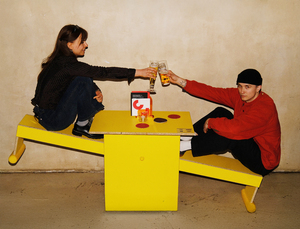
- Ausgehend von der Idee des freien Spielens in der Kindheit entfaltet sich PLAY DATE als Studienreihe, die die Entdeckung des zwecklosen Spielens im Erwachsenenalter erforscht. Oft von gesellschaftlichen Normen und sozialen Hemmungen überdeckt, bleibt der Spieltrieb doch bestehen, sobald man ihm wieder Raum gibt.
Ausgangspunkt war die Beobachtung, dass traditionelle Spielplätze fast ausschließlich Kindern vorbehalten sind, während erwachsene Personen kaum Raum finden, einfach verspielt zu sein.
In PLAY DATE 1, dem ersten experimentellen Spielplatz, wurde untersucht, welche nicht-kompetitiven Spielarten Erwachsene ansprechen. Die Ergebnisse zeigten, dass freies Spiel für Erwachsene angenommen würde, wenn der soziale Rahmen als akzeptierend wahrgenommen wird.
Darauf aufbauend fand PLAY DATE 2 in einer Bar statt, wo spielerische Bewegungsformen situativ in den Kontext des sozialen Zusammenkommens und geselligen Beisammenseins integriert wurden. Spielerische Gesten konnten so nahtlos in gewohnte Beschäftigungen eingeschrieben werden.
Mit PLAY DATE 3 wurde die Erkundung im Alltag erweitert: temporäre Spielobjekte wurden in die Stadtlandschaft gebracht, um zu beobachten, wie Passant:innen auf unerwartete Momente des Spiels reagieren, die den Alltag durchbrechen.
PLAY DATE OBJECTS zeigen, wie freies Spiel für jedes Alter wieder zugänglich gemacht werden kann und neue soziale, kulturelle und räumliche Kontexte eröffnet.
- Ausgehend von der Idee des freien Spielens in der Kindheit entfaltet sich PLAY DATE als Studienreihe, die die Entdeckung des zwecklosen Spielens im Erwachsenenalter erforscht. Oft von gesellschaftlichen Normen und sozialen Hemmungen überdeckt, bleibt der Spieltrieb doch bestehen, sobald man ihm wieder Raum gibt.
- Beschreibung (en)
- Starting from the idea of uninhibited play in childhood, PLAY DATE unfolds as a series of studies exploring the rediscovery of purposeless play in adulthood. Although often obscured by social norms and inhibitions, the impulse to play persists, emerging again once it is given space.
The project originated from the observation that traditional playgrounds are almost exclusively designed for children, while adults rarely find spaces where they can simply be playful.
PLAY DATE 1, the first experimental playground, investigated which forms of non-competitive play appeal to adults. The results suggested that adults readily embrace free play when the social environment is perceived as accepting and non-judgmental.
Building on these findings, PLAY DATE 2 took place in a bar, where playful modes of movement were introduced into the social setting of gathering and spending time together. Playful gestures became seamlessly integrated into familiar social activities.
With PLAY DATE 3, the investigation expanded into everyday urban life. Temporary play objects were placed throughout the city to observe how passersby respond to unexpected moments of play that interrupt the routines of daily life.
PLAY DATE OBJECTS demonstrate how free play can be made accessible again for people of all ages, opening up new social, cultural, and spatial contexts.
- Starting from the idea of uninhibited play in childhood, PLAY DATE unfolds as a series of studies exploring the rediscovery of purposeless play in adulthood. Although often obscured by social norms and inhibitions, the impulse to play persists, emerging again once it is given space.
- Kategorie
- Schlagworte
- Material
- Titel
- PLAY DATE
- Untertitel
- PLAY DATE OBJECTS
- Projektleiter/in
- Semester
- Studiengang
- Importiert am
- 12.06.2026
- Übergeordnete Sets
- 1
- Set enthält
- 0 25
entre-temps
Name that can easily go onto 2 lines
Author that can easily go onto 2 lines as well
- Titel
- entre-temps
- Autor/in
- Beschreibung (de)
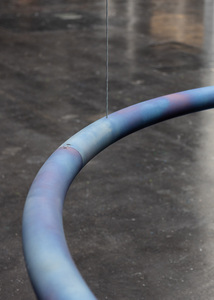
- Unter dem Einfluss von Hitze offenbart Stahl eine unbekannte Seite. Wolkenartige Farbmuster entstehen auf seiner Oberfläche und widersetzen sich materialgebundenen Definitionen. Die Arbeit untersucht die Beziehung zwischen Schwerem und Leichtem sowie Fragen der Komplexität.
- Beschreibung (en)
- Under the influence of heat, steel reveals an unknown side. Cloudlike patterns of color emerge on its surface, resisting materialbound definitions. The work explores the relationship between the heavy and the light, as well as questions of complexity.
- Kategorie
- Typ des Projekts/Werks
- Schlagworte
- Datierung
- 2025
- Dank an
- Kevin Beckmann
- Adrien Benoit
- Matthias Bruhn
- Lukas Clark
- Finn De Bruyn
- Kira Fuchs
- Josephine Gerhardt
- Josef Grair
- Dorothea Griep
- Cansu Gündoğdu
- Jule Heinzelmann
- Hannah Hugger
- Tina Jander
- Chris Kabel
- Valentina Karga
- Florian Knöbl
- Alexander Knoppik
- Philipp Kriebel
- Julian Kuf
- Barbara Kuon
- Florian Lips
- Nini Lue
- Tim Miler
- Sebastian Schäfer
- Sebastian Schilbach
- Susanne Schmitt
- Jules Scoubart
- Manèkè Som
- Pei Zhou
- Material
- Technik/Verfahren/Formate
- Heat Coloring
- Abmessungen
- Ring: 4x4m, Spiegel: 80x4cm
- Ort: Institution
- Stadt
- Land
- Beteiligte Institution(en)
- Internetlinks
- Titel
- entre-temps
- Projektleiter/in
- Semester
- Studiengang
- Typ der Abschlussarbeit
- Importiert am
- 24.02.2026
- Übergeordnete Sets
- 3
- Set enthält
- 0 21
PRESENT TENSE Working in Critical Times
Name that can easily go onto 2 lines
Author that can easily go onto 2 lines as well
- Titel
- PRESENT TENSE Working in Critical Times
- Titel (en)
- PRESENT TENSE Working in Critical Times
- Untertitel
- Symposium des Kunstbüros der Kunststiftung Baden-Württemberg
- Autor/in
- Beschreibung (de)
- „Present Tense” beschäftigt sich mit unserer unmittelbaren Gegenwart: Wir leben in einer komplexen, krisenhaften Zeit, in der die Überlagerung von Klima- und Energiekrise, Postpandemie, Prekarität und Konkurrenz, gesellschaftlicher Radikalisierung bis hin zu näher rückenden Kriegen bereits jetzt gravierende Auswirkungen auf unser Leben und Arbeiten hat. Die Anspannung steigt, wir stehen vor dringlichen gesamtgesellschaftlichen Aufgaben und bewegen uns zugleich in Richtung eines Zustands chronischer Erschöpfung. Das etablierte Kunstfeld und die künstlerische und kulturelle Produktion sind davon nicht ausgenommen. Mit Künstler:innen, Kurator:innen und anderen Expert:innen des kulturellen Feldes möchten wir den Blick auf die aktuelle künstlerische Produktion und Ausstellungspraxis richten und die Frage nach möglichen (Zukunfts-)perspektiven für das Kunstfeld diskutieren:
Welche gesellschaftliche Rolle können und müssen Kunst und ihre Produzent:innen in einer sich radikal verändernden Welt einnehmen? Wie können Kunst- und Kulturinstitutionen zu Orten aktiver gesellschaftlicher Transformation werden? Was bedeutet es, eine (ökologisch wie sozial) nachhaltige künstlerische und institutionelle Praxis in der digitalen Gegenwart zu entwickeln? Welche neuen Gemeinschaften brauchen wir, gerade im Hinblick auf die zunehmende gesellschaftliche Spaltung und Radikalisierung? Offensichtlich führt die krisenhafte Gegenwart u. a. dazu, dass sich Menschen nach autoritären Figuren und Programmen sehen – eine Aufgabe von Kunst und Kultur könnte es sein, andere, freiere Konzepte von Zukunft zu entwerfen.
Auch das Konzept der Fürsorge in der künstlerischen und kuratorischen Praxis wird Thema der Veranstaltung sein. Teil des Symposiums sind neben Vorträgen künstlerische Workshops, Interventionen und Performances, die wir als gleichwertige Formen der Wissensproduktion und -vermittlung begreifen.
Mit Beiträgen von Gin Bahc, Sascia Bailer, Constanze Fischbeck, Sina Hensel, Alistair Hudson, Anne Duk Hee Jordan, Valentina Karga, Matriarchale Volksküche, Jacob Ott und Dorothee Richter.
- „Present Tense” beschäftigt sich mit unserer unmittelbaren Gegenwart: Wir leben in einer komplexen, krisenhaften Zeit, in der die Überlagerung von Klima- und Energiekrise, Postpandemie, Prekarität und Konkurrenz, gesellschaftlicher Radikalisierung bis hin zu näher rückenden Kriegen bereits jetzt gravierende Auswirkungen auf unser Leben und Arbeiten hat. Die Anspannung steigt, wir stehen vor dringlichen gesamtgesellschaftlichen Aufgaben und bewegen uns zugleich in Richtung eines Zustands chronischer Erschöpfung. Das etablierte Kunstfeld und die künstlerische und kulturelle Produktion sind davon nicht ausgenommen. Mit Künstler:innen, Kurator:innen und anderen Expert:innen des kulturellen Feldes möchten wir den Blick auf die aktuelle künstlerische Produktion und Ausstellungspraxis richten und die Frage nach möglichen (Zukunfts-)perspektiven für das Kunstfeld diskutieren:
- Beschreibung (en)
- „Present Tense” concerns itself with our immediate present: We live in a complex, crisis-filled age in which the overlapping of climate and energy crisis, post-pandemic times, precarity, social radicalisation and even impending wars already govern our lives and work. Tension is rising, we are faced with imperative responsibilities for society as a whole and are, at the same time, moving towards a state of chronic exhaustion. There is no exception for the field of arts and artistic and cultural production.
Together with artists, curators and other experts from the cultural field, we would like to examine current artistic productions and exhibition practices and discuss possibilities for the (future) perspectives of the arts. Which roles within society can and must art and its producers embrace in a radically changing world? How can art and cultural institutions become venues of active social transformation? What does it mean to develop an (ecologically as well as socially) sustainable artistic and institutional practice in the digital present? The concept of care within artistic and curatorial practices will be a topic of the event as well.
What new relationships do we need, especially in view of intensifying social division and radicalisation? Obviously, the crisis-filled present among other things leads to people looking to authoritarian figures and programmes – one of the tasks for art and culture could be to design other, more independent and free concepts of the future.
In addition to lectures and panels, the symposium will include artistic workshops, interventions and performances, which are also forms of knowledge production and dissemination that we feel to be of equal importance.
With contributions from Gin Bahc, Sascia Bailer, Constanze Fischbeck, Sina Hensel, Alistair Hudson, Anne Duk Hee Jordan, Valentina Karga, Matriarchale Volksküche, Jacob Ott and Dorothee Richter
- „Present Tense” concerns itself with our immediate present: We live in a complex, crisis-filled age in which the overlapping of climate and energy crisis, post-pandemic times, precarity, social radicalisation and even impending wars already govern our lives and work. Tension is rising, we are faced with imperative responsibilities for society as a whole and are, at the same time, moving towards a state of chronic exhaustion. There is no exception for the field of arts and artistic and cultural production.
- Typ des Projekts/Werks
- Schlagworte
- Datierung
- 26.10.2023 - 28.10.2023
- Mitwirkende
- Sprache
- Ort: Institution
- Ort
- Lichthof, R.112
- Stadt
- Land
- Beteiligte Institution(en)
- Internetlinks
- Titel
- PRESENT TENSE Working in Critical Times
- Untertitel
- Symposium des Kunstbüros der Kunststiftung Baden-Württemberg
- Semester
- Importiert am
- 06.11.2023
- Übergeordnete Sets
- 1
- Set enthält
- 0 146