Known Unknown
Benachbarte Sets (130)Alle Zusammenhänge anzeigen
Diese Sets wurden den gleichen Sets hinzugefügt wie das ausgewählte Set.
130 Inhalte
- Seite 1 von 11
LET ME SEE (c) THE SUN
Name that can easily go onto 2 lines
Author that can easily go onto 2 lines as well
- Titel
- LET ME SEE (c) THE SUN
- Autor/in
- Beschreibung (de)
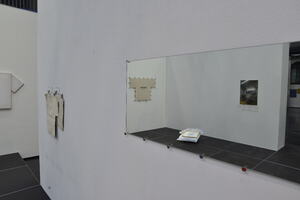
- Die Diplomarbeit „LET ME SEE (c) THE SUN“ setzt sich mit Sprache und Kommunikation auseinander, wobei das Medium Kleidung als Sprachrohr von Geschichten und als Bote von Identitäten analysiert werden soll.
Die ausgestellten Arbeiten greifen visuelle Elemente von Theaterkostümen, Bühnenrequisiten und Umkleidekabinen auf, um Besucher*innen einzuladen, sich selbst als Performer*innen von Sprache und Identität wahrzunehmen. Ein besonderer Schwerpunkt liegt dabei auf grafischen T-Shirts, da diese oft kulturelle Assoziationen oder oberflächliche Identitäten signalisieren (z. B. Bandshirts, Arbeitskleidung). Diese bekannte Struktur wird dekonstruiert und umgebaut, um Betrachter*innen die Bewohnbarkeit von Sprache zu verdeutlichen.
Die begleitende Performance beschäftigt sich mit der Mehrdeutigkeit von Sprache, die stets von persönlicher Interpretation abhängt. Wörter und Texte sind untrennbar mit ihrem Kontext sowie der Art und Weise verbunden, wie und wo sie erscheinen. In den Text-/Textil-Konstruktionen werden Wörter zu Requisiten, die Bedeutungen – sowohl offensichtlich als auch schwer fassbar – tragen und durch das Medium der Requisite von anderen „bewohnt“ werden können.
- Die Diplomarbeit „LET ME SEE (c) THE SUN“ setzt sich mit Sprache und Kommunikation auseinander, wobei das Medium Kleidung als Sprachrohr von Geschichten und als Bote von Identitäten analysiert werden soll.
- Beschreibung (en)
- The diploma project “LET ME SEE (c) THE SUN” deals with language and communication, analyzing the medium of clothing as a mouthpiece for stories and as a messenger of identities.
The exhibited works take up visual elements of theater costumes, stage props and dressing rooms to invite visitors to perceive themselves as performers of language and identity. A particular focus is placed on graphic T-shirts, as these often signal cultural associations or superficial identities (e.g. band shirts, work clothes). This familiar structure is deconstructed and rebuilt to show viewers the habitability of language.
The accompanying performance deals with the ambiguity of language, which always depends on personal interpretation. Words and texts are inextricably linked to their context and how and where they appear. In the text/textile constructions, words become props that carry meanings - both obvious and elusive - and can be “inhabited” by others through the medium of the prop.
- The diploma project “LET ME SEE (c) THE SUN” deals with language and communication, analyzing the medium of clothing as a mouthpiece for stories and as a messenger of identities.
- Kategorie
- Typ des Projekts/Werks
- Schlagworte
- Datierung
- 15.01.2025
- Mitwirkende
- Dank an
- Paul Bailey
- Jonathan Blaschke
- Céline Condorelli
- Amelie Enders
- Till Engelhardt
- Kira Fuchs
- Line-Gry Hørup
- Rafael Jörger
- Chiara Kern
- Simon Knebl
- Florian Knöbl
- Alexander Knoppik
- Barbara Kuon
- James Langdon
- Nina Overkott
- Leo Schick
- Henriette Schwabe (Jette Schwabe)
- Neele Seidel
- Isabel Seiffert
- Moritz Kamil Simon
- Charlotte Singer
- Niklas Weisenbach
- Maximilian Zschiesche
- Sprache
- Material
- Ort: Institution
- Ort
- Lichthof 3
- Stadt
- Land
- Titel
- LET ME SEE (c) THE SUN
- Projektleiter/in
- Semester
- Studiengang
- Typ der Abschlussarbeit
- Importiert am
- 11.02.2025
- Übergeordnete Sets
- 3
- Set enthält
- 0 11
Letters of Dissent
Name that can easily go onto 2 lines
Author that can easily go onto 2 lines as well
- Titel
- Letters of Dissent
- Titel (en)
- Letters of Dissent
- Autor/in
- Beschreibung (de)
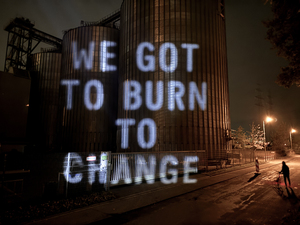
- Mein Diplomprojekt mit dem Titel „LETTERS OF DISSENT“ hatte zum Ziel, praktische und zugängliche Mittel des nächtlichen Protests zu erforschen. Dieses Projekt, das sich mit der Wechselbeziehung von Geschichtenerzählen und Punk-Einflüssen befasst, soll durch künstlerische Intervention ein Schlaglicht auf soziale und politische Themen werfen. Es handelt sich um selbst geschriebene Erzählungen, die in einer auf optimale Lesbarkeit ausgelegten Schriftart verfasst sind. Die Einfachheit der verwendeten Technik sorgt für Tragbarkeit und Zugänglichkeit. Das Engagement der Gemeinschaft ist integraler Bestandteil des Werks, das sowohl als Lasercut- als auch als 3D-Druckversion vorliegt und als Open-Source-Initiative zur Verfügung gestellt wird. Die Gesamtästhetik ist von auffallender Helligkeit geprägt und schafft eine visuell beeindruckende und deutlich wahrnehmbare Präsenz. Neben der Hauptdiplomarbeit ist es erforderlich, neuere Arbeiten in einer Ausstellung zu präsentieren, in der sorgfältig ausgewählte Projekte vorgestellt werden. In dem Bemühen, das Ausstellungsdesign auf das übergreifende Thema des Diplomprojekts abzustimmen, zielte der Designansatz darauf ab, wesentliche Prinzipien wie Zugänglichkeit, Abfallminimierung und eine ephemere Pop-up-Sensibilität zu verkörpern.
- Beschreibung (en)
- My diploma project titled "LETTERS OF DISSENT," aimed to explore practical and approachable means of protesting during the nighttime. Delving into the interrelation of storytelling and punk influence, this project seeks to cast a spotlight on social and political subjects through artistic intervention. It involves self-written narratives, utilising a font designed for optimal readability. The simplicity of the technique employed ensures portability and accessibility. Community engagement is integral, using both a lasercut and 3D-print version of the work, which is made available as an open-source initiative. The overall aesthetic is marked by striking brightness, creating a visually impactful and overtly noticeable presence. In addition to the primary diploma project, it is required to showcase recent works in an exhibition, featuring carefully chosen projects. In an effort to align the exhibition design with the overarching theme of the diploma project, the design approach aimed to encapsulate essential principles such as accessibility, waste minimisation, and an ephemeral, pop-up sensibility.
- Kategorie
- Schlagworte
- Datierung
- 03.11.2023
- Titel
- Letters of Dissent
- Projektleiter/in
- Semester
- Studiengang
- Typ der Abschlussarbeit
- Importiert am
- 30.10.2024
- Übergeordnete Sets
- 3
- Set enthält
- 1 11
Living Library (2024-2026)
Name that can easily go onto 2 lines
Author that can easily go onto 2 lines as well
- Titel
- Living Library (2024-2026)
- Autor/in
- Beschreibung (de)
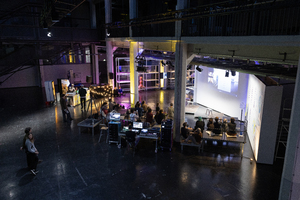
- Die Living Library ist ein transdisziplinäres Projekt, das am Bio Design Lab der Staatlichen Hochschule für Gestaltung Karlsruhe entwickelt wurde. Im Laufe von zwei Jahren förderte es praxisorientiertes Lernen mit Schwerpunkt auf lokal gewonnenen Rohstoffen aus einem Umkreis von 50 Kilometern um die Hochschule, experimentellem Arbeiten und regenerativen Produktionsweisen.
Das Projekt ist ein hybrides und sich ständig weiterentwickelndes Ökosystem. Es vereint ein physisches Archiv mit Materialproben, Werkzeugen, Prozessen und Workshop-Artefakten sowie ein digitales Archiv mit interaktiven Karten, Forschungsergebnissen und Materialdokumentationen. Geleitet von den Prinzipien der Kompostierbarkeit, Lokalität und Nachhaltigkeit folgt das Projekt den ökologischen Zyklen der Aussaat, des Wachstums, der Ernte und des Verfalls. Studierende, Forschende und lokale Praktiker:innen arbeiteten zusammen, um regionale Ressourcen zu lokalisieren, biobasierte Materialien zu ernten und zu verarbeiten sowie deren Lebenszyklen von der Entstehung bis zur Zersetzung zu untersuchen.
Eine Open-Access-Publikation die physische und digitale Living Library und vereint eine Reihe von Essays, die Themen wie die archivarischen Qualitäten der Erde oder die gartenähnliche Kultivierung digitaler Plattformen untersuchen. Diese Essays laden die Leser:innen dazu ein, zu überdenken, wie Wissen angebaut, geteilt und schließlich wieder in den Boden zurückgeführt werden kann, aus dem es entstanden ist.
- Die Living Library ist ein transdisziplinäres Projekt, das am Bio Design Lab der Staatlichen Hochschule für Gestaltung Karlsruhe entwickelt wurde. Im Laufe von zwei Jahren förderte es praxisorientiertes Lernen mit Schwerpunkt auf lokal gewonnenen Rohstoffen aus einem Umkreis von 50 Kilometern um die Hochschule, experimentellem Arbeiten und regenerativen Produktionsweisen.
- Beschreibung (en)
- The Living Library is a transdisciplinary project developed at the Bio Design Lab of the Karlsruhe University of Arts and Design. Over the course of two years, it fostered practice-based learning focused on locally sourced raw materials within a 50-kilometre radius around the academy, experimental making, and regenerative modes of production.
The project is a hybrid and continually evolving ecosystem. It brings together a physical archive showing material samples, tools, processes, and workshop artefacts, and a digital archive featuring interactive maps, research, and material documentation. Guided by the principles of compostability, locality, and sustainability, the project follows ecological rhythms of seeding, growing, harvesting, and decay. Students, researchers, and local practitioners collaborated to map regional resources, harvest and transform bio-based materials, and investigate their lifecycles from origin to decomposition.
An open access publication documents the physical and digital Living Library and brings together a series of essays that explore themes such as the archival qualities of soil or the garden-like cultivation of digital platforms. These essays invite readers to reconsider how knowledge can be grown, shared, and ultimately returned to the ground from which it emerged.
- The Living Library is a transdisciplinary project developed at the Bio Design Lab of the Karlsruhe University of Arts and Design. Over the course of two years, it fostered practice-based learning focused on locally sourced raw materials within a 50-kilometre radius around the academy, experimental making, and regenerative modes of production.
- Kategorie
- Typ des Projekts/Werks
- Datierung
- 31.03.2024 - 31.03.2026
- Mitwirkende
- Dank an
- Sprache
- Internetlinks
- Bemerkungen
- Funded by the Stiftung Innovation in der Hochschullehre
- Titel
- Living Library (2024-2026)
- Semester
- Importiert am
- 08.10.2024
- Übergeordnete Sets
- 1
- Set enthält
- 9 0
Love over Taste II
Name that can easily go onto 2 lines
Author that can easily go onto 2 lines as well
- Titel
- Love over Taste II
- Untertitel
- Piggy's World
- Autor/in
- Beschreibung (de)
- Meine künstlerische Arbeit beschäftigt sich mit Tierschutz, Veganismus und der Frage, warum wir bestimmte Tiere lieben und andere essen. Es ist ein Thema, das mich sowohl auf persönlicher als auch auf künstlerischer Ebene tief bewegt. Vor rund vier Jahren habe ich mich dazu entschieden, mich vegetarisch zu ernähren – und bin bald darauf vegan geworden. Mein jüngeres Ich, das meine Mutter liebevoll „kleine Fleischfresserin“ nannte, hätte sich das kaum vorstellen können. Und doch war der Impuls schon früh da. Ich erinnere mich an meinen achten Geburtstag auf den Philippinen: Meine Familie bereitete ein Fest vor, das Schwein im Garten meiner Tante wurde ausgewählt, geschlachtet, aufgespießt. Erst beim Anblick des toten Körpers auf dem Buffet wurde mir klar, was passiert war – und dass es wegen mir geschah. Das mulmige Gefühl, das ich damals im Bauch hatte, begleitet mich bis heute.
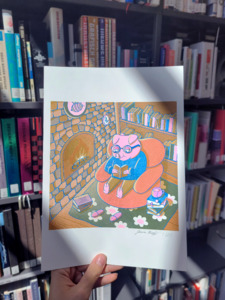
Inspiriert von Melanie Joys Buch Why We Love Dogs, Eat Pigs, and Wear Cows hinterfrage ich in meinem Projekt Love over Taste die gesellschaftlich akzeptierte Trennung zwischen „Nutztieren“ und „Haustieren“, zwischen Leben und Produkt. Im Mittelpunkt steht Piggy – ein liebevoll gestalteter, anthropomorpher Schweine-Charakter, der eine Stimme bekommt, wo Tiere in der Realität keine haben. Basierend auf Recherchen, Dokumentationen wie Dominion oder Mission Erde, erzählt Piggy seine Geschichte als Mastschwein – und findet zugleich in meinen Illustrationen eine Welt jenseits von Leid und Ausbeutung.
Piggy lebt in Szenen weiter, die eine Art Gegenrealität entwerfen: whimsical, freundlich, voller Leichtigkeit. In diesen Bildern ist Piggy allein oder mit seinen Tierfreund*innen zu sehen – in Momenten von Freiheit, Genuss, Selbstbestimmung. Durch die Vermenschlichung möchte ich Empathie wecken: Auch ein Schwein hat ein Recht auf ein leidfreies, selbstbestimmtes Leben.
Zum Projekt gehören neben den Illustrationen auch die Love over Taste Sticker, die Tiere zeigen, die häufig in der Massentierhaltung konsumiert werden – dargestellt mit einem liebevollen, persönlichen Blick.
Mit diesen kleinen, aber sprechenden Arbeiten möchte ich einen Raum öffnen für Gespräche über Mitgefühl, Carnismus und unsere alltäglichen Entscheidungen. Love over Taste ist eine Einladung, die Welt mit anderen Augen zu sehen – mit Piggy’s Augen.
- Meine künstlerische Arbeit beschäftigt sich mit Tierschutz, Veganismus und der Frage, warum wir bestimmte Tiere lieben und andere essen. Es ist ein Thema, das mich sowohl auf persönlicher als auch auf künstlerischer Ebene tief bewegt. Vor rund vier Jahren habe ich mich dazu entschieden, mich vegetarisch zu ernähren – und bin bald darauf vegan geworden. Mein jüngeres Ich, das meine Mutter liebevoll „kleine Fleischfresserin“ nannte, hätte sich das kaum vorstellen können. Und doch war der Impuls schon früh da. Ich erinnere mich an meinen achten Geburtstag auf den Philippinen: Meine Familie bereitete ein Fest vor, das Schwein im Garten meiner Tante wurde ausgewählt, geschlachtet, aufgespießt. Erst beim Anblick des toten Körpers auf dem Buffet wurde mir klar, was passiert war – und dass es wegen mir geschah. Das mulmige Gefühl, das ich damals im Bauch hatte, begleitet mich bis heute.
- Beschreibung (en)
- My artistic work deals with animal welfare, veganism and the question of why we love certain animals and eat others. It's a topic that moves me deeply on both a personal and artistic level. About four years ago, I decided to go vegetarian - and soon after became vegan. My younger self, whom my mother affectionately called ‘little carnivore’, could hardly have imagined it. And yet the impulse was there early on. I remember my eighth birthday in the Philippines: my family was preparing a feast, the pig in my aunt's garden was selected, slaughtered and speared. It was only when I saw the dead body on the buffet that I realised what had happened - and that it was because of me. The queasy feeling I had in my stomach back then is still with me today.
Inspired by Melanie Joy's book Why We Love Dogs, Eat Pigs, and Wear Cows, my project Love over Taste questions the socially accepted separation between ‘farm animals’ and ‘pets’, between life and product. At the centre is Piggy - a lovingly designed, anthropomorphic pig character who is given a voice where animals have none in reality. Based on research and documentaries such as Dominion or Mission Earth, Piggy tells his story as a fattening pig - and at the same time finds a world beyond suffering and exploitation in my illustrations.
Piggy lives on in scenes that create a kind of counter-reality: whimsical, friendly, full of lightness. In these images, Piggy can be seen alone or with her animal friends - in moments of freedom, pleasure and self-determination. By humanising them, I want to awaken empathy: A pig also has a right to a life free of suffering and self-determination.
In addition to the illustrations, the project also includes the Love over Taste stickers, which show animals that are often consumed in factory farming - depicted with a loving, personal view.
With these small but eloquent works, I want to open up a space for conversations about compassion, carnism and our everyday choices. Love over Taste is an invitation to see the world through different eyes - Piggy's eyes.
- My artistic work deals with animal welfare, veganism and the question of why we love certain animals and eat others. It's a topic that moves me deeply on both a personal and artistic level. About four years ago, I decided to go vegetarian - and soon after became vegan. My younger self, whom my mother affectionately called ‘little carnivore’, could hardly have imagined it. And yet the impulse was there early on. I remember my eighth birthday in the Philippines: my family was preparing a feast, the pig in my aunt's garden was selected, slaughtered and speared. It was only when I saw the dead body on the buffet that I realised what had happened - and that it was because of me. The queasy feeling I had in my stomach back then is still with me today.
- Kategorie
- Typ des Projekts/Werks
- Schlagworte
- Datierung
- 2024–ongoing
- Dank an
- Sprache
- Material
- Technik/Verfahren/Formate
- Risografie, Animation mit Hilfe von Cartoon Animator, Illustrationen in den Formaten A5 bis A3
- Abmessungen
- A5 bis A3
- Dauer
- ca. 12 Minuten Animation
- Ort: Institution
- Stadt
- Land
- Beteiligte Institution(en)
- Auftrag durch
- Tereza Ruller's Seminar All About Love
- Internetlinks
- Titel
- Love over Taste II
- Untertitel
- Piggy's World
- Projektleiter/in
- Semester
- Studiengang
- Lehrveranstaltung
- Archiv-Signatur
- Importiert am
- 06.07.2025
- Übergeordnete Sets
- 1
- Set enthält
- 0 18
Manchmal ist Schmerz ganz leise
Name that can easily go onto 2 lines
Author that can easily go onto 2 lines as well
- Titel
- Manchmal ist Schmerz ganz leise
- Titel (en)
- Sometimes pain is very quiet
- Autor/in
- Beschreibung (de)
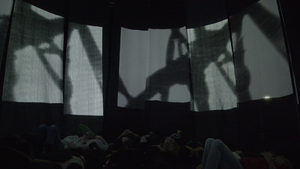
- „Manchmal ist Schmerz ganz leise“ ist eine immersive, autobiographische Hörstück-Installation, die den stillen und oft unsichtbaren Kampf mit einer schweren, namenlosen Krankheit in den Mittelpunkt stellt. Das Werk hinterfragt, was es bedeutet, in einer leistungsorientierten Gesellschaft plötzlich nicht mehr zu "funktionieren". Es geht den Ängsten, der Scham und dem tief empfundenen Gefühl des Versagens nach, das oft mit chronischer Krankheit einhergeht – Gefühle, die Betroffene selten teilen. Das Hörspiel verleiht einer Stimme Ausdruck, die für viele spricht und Einblicke in eine Realität gibt, die oft im Verborgenen bleibt.
- Beschreibung (en)
- ‘Sometimes pain is very quiet’ is an immersive, autobiographical audio play installation that focuses on the silent and often invisible battle with a serious, nameless illness. The work questions what it means to suddenly no longer ‘function’ in a performance-orientated society. It explores the fears, the shame and the deeply felt sense of failure that often accompanies chronic illness – feelings that are rarely shared by those affected. The radio play gives expression to a voice that speaks for many and provides insights into a reality that often remains hidden.
- Kategorie
- Typ des Projekts/Werks
- Schlagworte
- Datierung
- 30.10.2024
- Mitwirkende
- Dank an
- Finn Baygan
- Daniel Berwanger
- Pauline Cemeris
- Filipa Cesar
- Mark Patrick Damian
- Charlotte Eifler
- Flora Güldenpfennig
- Tobias Keilbach
- Eisenhart Keimeyer
- Alexander Knoppik
- Yael Kolb
- Isabelle Konrad
- Julian Kuf
- Barbara Kuon
- Josephine Leicht
- Laura Morcillo
- Ilja Morgenstern
- Sebastian Schäfer
- Sebastian Schönfeld
- Lorenz Schwarz
- Quirin Thalhammer
- Alexander Thelen
- Riemschneider Stiftung
- Zeitbild Lab
- Sprache
- Material
- Technik/Verfahren/Formate
- 4-Kanal-Audio/360° Projection Mapping
- Abmessungen
- Länge: 8m, Breite: 8m, Höhe: 6,50m
- Dauer
- 30min
- Ort: Institution
- Ort
- Großes Studio
- Stadt
- Land
- Titel
- Manchmal ist Schmerz ganz leise
- Projektleiter/in
- Semester
- Studiengang
- Typ der Abschlussarbeit
- Importiert am
- 17.04.2025
- Übergeordnete Sets
- 1
- Set enthält
- 1 5
„Meine Zuständigkeit hört auf, da wo der Strom kommt“
Name that can easily go onto 2 lines
Author that can easily go onto 2 lines as well
- Titel
- „Meine Zuständigkeit hört auf, da wo der Strom kommt“
- Autor/in
- Beschreibung (de)
- „Meine Zuständigkeit hört auf, da wo der Strom kommt“ ist eine Installation über Straßenbahnoberleitungen. Sie setzt sich mit Infrastrukturen im öffentlichen Raum auseinander, die für uns im Alltag essenziell sind, die wir aber gelernt haben auszublenden. Sie soll diesen scheinbar banalen, anonymen Zweckbauten einen Wert verleihen und auf sie aufmerksam machen.
Oberleitungen sind in einer Stadt mit vielen Straßenbahnen, wie Karlsruhe, wenn man sich auf der Straße bewegt, immer da. Alles, was man im öffentlichen Raum sieht, sieht man durch das Netz der Oberleitungen. Sie sind allgegenwärtig und ein wichtiger Bestandteil der täglichen Fortbewegung, doch die meisten Leute blenden das im alltäglichen Leben aus. Und das ist kein Zufall: die Stadt schreibt vor, Oberleitungen so zu planen, dass sie möglichst unauffällig sind und in ihrer Umgebung untergehen. Es gibt keine Wertschätzung dafür, wie viel Technik und Material dahinter steckt, dass man sich mit der Straßenbahn durch die Stadt bewegen kann.
Auf diese Themen soll die Installation aufmerksam machen. Ich habe durch diese Arbeit einen intensiven Blick auf Oberleitungen bekommen und wollte diesen durch meine Installation teilen.
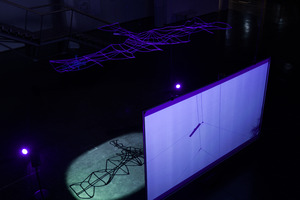
In der Installation „Meine Zuständigkeit hört auf, da wo der Strom kommt“ steht man, unter dem im Maßstab 1:26, aus blauen Seilen nachgebildeten, freischwebenden Muster, einer großen Kreuzung in Karlsruhe. Auf der Leinwand läuft ein Stop Motion Video, das alltägliche Momentaufnahmen und Blicke in Bewegung auf die Oberleitungen zeigt.
Aus drei verschiedenen Richtungen kommen Sounds. Einmal die Klänge der Bahnen, denen man auch auf einer Kreuzung zuhören könnte, und dann von rechts und links, zwei verschiedene Blickwinkel, von verschiedenen Personen auf das Thema Oberleitungen. Eins ist der technische Blick von einer Person, die mit Oberleitungen arbeitet, und der andere ist meiner, ein eher poetischer Blick den ich auf die bildliche Ebene der Oberleitungen gewonnen habe. Die eine Seite sagt, dass die Oberleitungen möglichst unauffällig sein sollen, um nicht aufzufallen, und die andere sagt, schaut nach oben, schaut was da alles hängt.
Die Installation soll den Blick der Leute, die sie anschauen, in Zukunft etwas öfter nach oben auf die Oberleitungen lenken
- „Meine Zuständigkeit hört auf, da wo der Strom kommt“ ist eine Installation über Straßenbahnoberleitungen. Sie setzt sich mit Infrastrukturen im öffentlichen Raum auseinander, die für uns im Alltag essenziell sind, die wir aber gelernt haben auszublenden. Sie soll diesen scheinbar banalen, anonymen Zweckbauten einen Wert verleihen und auf sie aufmerksam machen.
- Beschreibung (en)
- “Meine Zuständigkeit hört auf, da wo der Strom kommt” is an installation about tram overhead lines. It explores infrastructures in public spaces that are essential to our everyday lives but which we have learnt to ignore. It is intended to give these seemingly banal, anonymous functional structures a value and draw attention to them.
In a city with a lot of trams, like Karlsruhe, overhead lines are always present when you move along the street. Everything you see in public space is seen through the web of overhead lines. They are omnipresent and essential to everyday transport, however most people ignore them in their day to day lives. And this is no coincidence: the city requires overhead lines to be planned in such a way that they are as discreet as possible and blend into their surroundings. There is no appreciation of how much technology and material goes into getting a tram through the city.
The installation is intended to draw attention to this topic. This work and research has allowed me an immersive view of overhead lines, which I wanted to share and visualise through my installation.
In the installation “Meine Zuständigkeit hört auf, da wo der Strom kommt”, one stands and moves under the free-floating pattern of a large intersection in Karlsruhe, modelled on a scale of 1:26 using blue ropes. A stop motion video runs on the projection screen, showing everyday snapshots and views of the overhead lines in motion.
Sounds come from three different directions. Firstly, the sounds of the trains, which you could also listen to at a crossing, and then from the right and left, two different perspectives, from different people on the subject of overhead lines. One is the technical view of a person who works with overhead lines, and the other is mine, a more poetic view that I have gained of the visual level of the overhead lines. One side says that the overhead lines should be as subtle as possible in order not to attract attention, and the other says, look up, see what's hanging there.
With my installation I hope to draw people’s attention to the overhead lines that play such an important yet invisible role in our daily lives.
- “Meine Zuständigkeit hört auf, da wo der Strom kommt” is an installation about tram overhead lines. It explores infrastructures in public spaces that are essential to our everyday lives but which we have learnt to ignore. It is intended to give these seemingly banal, anonymous functional structures a value and draw attention to them.
- Kategorie
- Typ des Projekts/Werks
- Datierung
- 24.04.2025
- Ort
- Lichthof drei
- Titel
- „Meine Zuständigkeit hört auf, da wo der Strom kommt“
- Projektleiter/in
- Semester
- Studiengang
- Typ der Abschlussarbeit
- Importiert am
- 15.07.2025
- Übergeordnete Sets
- 1
- Set enthält
- 0 7
Midnight Zone
Name that can easily go onto 2 lines
Author that can easily go onto 2 lines as well
- Titel
- Midnight Zone
- Titel (en)
- Midnight Zone
- Autor/in
- Beschreibung (de)
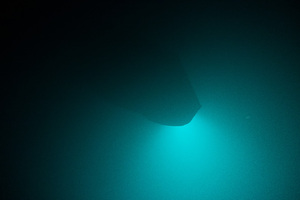
- Midnight Zone ist eine Performance über die Tiefsee, jenen Raum, in den kein Sonnenlicht mehr dringt. In dieser absolut dunklen und hohem Druck ausgesetzten Umgebung verschieben sich unsere Wahrnehmungen von Zeit, Körper und Orientierung.
In einem Raum, der das eigene Körpergefühl verschwimmen lässt, durchziehen Fischlaute, Maschinengeräusche und ferne Erdbeben die verschiedenen atmosphärischen Bedingungen des größten Lebensraums der Erde. Performerinnen bewegen sich wie fremde Wesen, zugleich Teil der Natur und Spiegel menschlicher Eingriffe. Mit jeder Bewegung beeinflussen die Besucher*innen das Netz aus Klang, Schatten und Choreografie und werden selbst Teil des Ökosystems, das sie beobachten.
Midnight Zone macht das fragile System der Tiefsee sinnlich erfahrbar: Dort, wo das Leben möglicherweise begann, wo Zeit anders fließt und Prozesse Jahrhunderte dauern können, ist der menschliche Einfluss zunehmend spürbar. Die Arbeit lässt Traum und Realität, Mensch und Natur, Oberfläche und Tiefe ineinander übergehen. Sie lädt dazu ein, lineare Zeitvorstellungen hinter sich zu lassen und alternative Rhythmen zu erspüren. Rhythmen, die im Einklang mit planetarischen Zyklen stehen und dem beschleunigten Takt des Anthropozäns etwas entgegensetzen.
- Midnight Zone ist eine Performance über die Tiefsee, jenen Raum, in den kein Sonnenlicht mehr dringt. In dieser absolut dunklen und hohem Druck ausgesetzten Umgebung verschieben sich unsere Wahrnehmungen von Zeit, Körper und Orientierung.
- Beschreibung (en)
- Midnight Zone is a performance about the deep sea, that realm into which no sunlight can penetrate. In this environment of absolute darkness and immense pressure, our perceptions of time, body, and orientation begin to shift.
In a space where one’s sense of the body starts to blur, fish sounds, mechanical noises, and distant earthquakes move through the atmospheric layers of the largest habitat on Earth. The performers move like unfamiliar beings, at once part of nature and a reflection of human impact. With every movement, the visitors influence the network of sound, shadow, and choreography, becoming part of the very ecosystem they are observing.
Midnight Zone makes the fragile system of the deep sea sensually perceptible: a place where life may have begun, where time flows differently and processes can take centuries, and where human presence is increasingly noticeable. The work allows dream and reality, human and nature, surface and depth to merge. It invites the audience to let go of linear notions of time and attune themselves to alternative rhythms, rhythms aligned with planetary cycles, offering a counterpoint to the accelerated tempo of the Anthropocene.
- Midnight Zone is a performance about the deep sea, that realm into which no sunlight can penetrate. In this environment of absolute darkness and immense pressure, our perceptions of time, body, and orientation begin to shift.
- Kategorie
- Typ des Projekts/Werks
- Schlagworte
- Datierung
- 30.10.25 und 31.10.25
- Mitwirkende
- Dank an
- Dauer
- 1 Stunde
- Ort: Institution
- Ort
- Großes Studio
- Stadt
- Land
- Beteiligte Institution(en)
- Titel
- Midnight Zone
- Projektleiter/in
- Semester
- Studiengang
- Typ der Abschlussarbeit
- Importiert am
- 03.12.2025
- Übergeordnete Sets
- 3
- Set enthält
- 0 13
Ministry for the Future
Name that can easily go onto 2 lines
Author that can easily go onto 2 lines as well
- Titel
- Ministry for the Future
- Titel (en)
- Ministry for the Future
- Autor/in
- Beschreibung (de)
- Ministry for the Future ist eine transdisziplinäre Produktion über mögliche Zukünfte im Angesicht der Klimakrise – und darüber, wie wir sie verhandeln, bevor sie eintreten. Inspiriert vom gleichnamigen Roman von Kim Stanley Robinson entwickelte sich ein groß angelegtes Kooperationsprojekt zwischen dem Theater Neumarkt, dem Collegium Helveticum Zürich und der Hochschule für Gestaltung Karlsruhe.
Ausgangspunkt ist ein spekulatives Szenario im Jahr 2034: Die Erde hat Kipppunkte erreicht, Regierungen reagieren, eine neue Institution wird gegründet – das Ministerium für die Zukunft. Innerhalb dieser Fiktion operiert die Produktion als diskursives Format, das sich fortlaufend mit der zentralen Frage auseinandersetzt: Welche Handlungsspielräume bleiben uns?
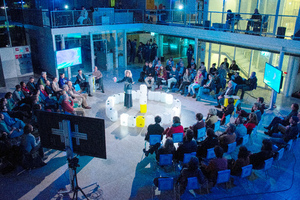
Das Projekt kombiniert künstlerische, wissenschaftliche und gestalterische Perspektiven zu einem Format zwischen Preenactment und realer Wissenschaftskommunikation. Herzstück ist ein mobiles Bühnenbild, das drängende forschungsbasierte Diskurse in eine begehbare, funktionale Infrastruktur übersetzt. Die Szenografie wurde konsequent durch Re- und Upcycling-Prozesse entwickelt. Sie folgt einer Haltung, die den Anforderungen ökologischer Krisen standhalten will – indem sie aus dem Material jener Krisen selbst hervorgeht. In vier thematisch fokussierten Episoden an vier verschiedenen Orten in Zürich wird der Raum selbst zum Instrument: eine spekulative Versammlung, eine temporäre Institution, ein Möglichkeitslabor.
Die Inszenierung bringt reale Wissenschaftler:innen, Performer:innen und Bürger:innen im Modus eines fiktionalen Ministeriums in Austausch – und mit ihnen die Fragen: Wie lässt sich Zukunft verhandeln, wenn sie längst begonnen hat? Was bedeutet Teilhabe, wenn die Katastrophe strukturell geworden ist? Und wie kann Raum für solche Aushandlungen heute aussehen?
- Ministry for the Future ist eine transdisziplinäre Produktion über mögliche Zukünfte im Angesicht der Klimakrise – und darüber, wie wir sie verhandeln, bevor sie eintreten. Inspiriert vom gleichnamigen Roman von Kim Stanley Robinson entwickelte sich ein groß angelegtes Kooperationsprojekt zwischen dem Theater Neumarkt, dem Collegium Helveticum Zürich und der Hochschule für Gestaltung Karlsruhe.
- Beschreibung (en)
- Ministry for the Future is a transdisciplinary production about possible futures in the face of the climate crisis—and about how we negotiate them before they arrive. Inspired by the novel of the same name by Kim Stanley Robinson, the project evolved into a large-scale collaboration between Theater Neumarkt, the Collegium Helveticum Zurich, and the Karlsruhe University of Arts and Design (HfG).
Its starting point is a speculative scenario set in the year 2034: the Earth has reached tipping points, governments are reacting, and a new institution is established—the Ministry for the Future. Within this fiction, the production functions as a discursive format that continuously engages with the central question: What room for action remains?
The project combines artistic, scientific, and design perspectives into a hybrid format somewhere between preenactment and real science communication. At its core is a mobile stage design that translates urgent, research-based discourses into an immersive, functional infrastructure. The scenography was developed entirely through re- and upcycling processes, guided by an attitude that seeks to meet the demands of ecological crises—by emerging from their very material. Across four thematically focused episodes in four different locations in Zurich, the space itself becomes an instrument: a speculative assembly, a temporary institution, a lab of possibilities.
The performance brings together real scientists, performers, and citizens within the framework of a fictional ministry—and with them, the questions: How can we negotiate the future when it has already begun? What does participation mean when catastrophe has become structural? And what kind of space is needed for such negotiations today?
- Ministry for the Future is a transdisciplinary production about possible futures in the face of the climate crisis—and about how we negotiate them before they arrive. Inspired by the novel of the same name by Kim Stanley Robinson, the project evolved into a large-scale collaboration between Theater Neumarkt, the Collegium Helveticum Zurich, and the Karlsruhe University of Arts and Design (HfG).
- Kategorie
- Typ des Projekts/Werks
- Schlagworte
- Sprache
- Dauer
- 4 Episoden, jeweils 2 Stunden
- Ort: Institution
- Ort
- Episode 1: ETH Zürich
Episode 2: Naturhistorisches Museum Zürich
Episode 3: Wasserkirche Zürich
Episode 4: Semper Sternwarte / Collegium Helveticum Zürich
- Episode 1: ETH Zürich
- Land
- Beteiligte Institution(en)
- Titel
- Ministry for the Future
- Projektleiter/in
- Semester
- Studiengang
- Importiert am
- 29.06.2025
- Übergeordnete Sets
- 0
- Set enthält
- 0 39
MS Guilty Pleasure

Name that can easily go onto 2 lines
Author that can easily go onto 2 lines as well
- Titel
- MS Guilty Pleasure
- Titel (en)
- MS Guilty Pleasure
- Autor/in
- Beschreibung (de)
- Meine Abschlussarbeit beschäftigt sich mit dem Kreuzfahrtschiff als einer Form von Architektur, die zwei parallel voneinander laufende Wirklichkeiten konstituiert, mit eigenen Regeln, Bewegungen und sozialen Codes.
Das Schiff organisiert diese Trennung bis ins Detail. Wege, Blickrichtungen und Abläufe lenken den Körper beinahe intuitiv durch den Raum. Bestimmte Rollen erscheinen selbstverständlich: der entspannte Gast, die serviceorientierte Crew, der verborgene Bereich hinter den Kulissen, der den reibungslosen Ablauf überhaupt erst ermöglicht.
Die Installation greift die Gleichzeitigkeit über eine räumliche und akustische Situation auf.
Während im Hintergrund versucht wird, den Betrieb aufrechtzuerhalten, dringen in den öffentlichen Bereich nur Fragmente der Störung: Durchsagen, Gesprächsfetzen, Beschwerden und das Weiterlaufen eines Unterhaltungsprogramms.
Für einen kurzen Moment wird hörbar, was normalerweise hinter der Oberfläche des scheinbar mühelosen Urlaubs verschwindet. Doch Unterhaltung und Betrieb laufen auch dort nahezu ohne Unterbrechung weiter, wo Erschöpfung, Zeitdruck oder technische Störungen Teil des Systems sind.
Dabei ist die Kreuzfahrt nur ein Luxusgut unter vielen, das sich auf technische Infrastruktur, Versorgungssysteme, Reinigung und Wartung sowie Handwerker, Fachkräfte und Hilfsarbeiter aus aller Welt stützt.
Nicht die Welt eines permanent inszenierten Erlebens steht im Mittelpunkt, sondern das Sichtbarwerden einer Infrastruktur, die sonst hinter Oberfläche, Routine und Unterhaltung verschwindet.
- Meine Abschlussarbeit beschäftigt sich mit dem Kreuzfahrtschiff als einer Form von Architektur, die zwei parallel voneinander laufende Wirklichkeiten konstituiert, mit eigenen Regeln, Bewegungen und sozialen Codes.
- Beschreibung (en)
- My diploma explores the cruise ship as an architectural structure that produces two parallel realities, each governed by its own rules, movements, and social codes.
The ship organizes this separation down to the smallest detail. Pathways, sightlines, and routines guide bodies through space almost intuitively. Certain roles appear self-evident: the relaxed guest, the service-oriented crew member, and the hidden backstage areas that make the ship’s seamless operation possible in the first place.
The installation addresses this simultaneity through a spatial and acoustic setting.
While continuous efforts are made behind the scenes to keep operations running, only fragments of disruption reach the public areas: announcements, snippets of conversation, complaints, and the ongoing entertainment programme. For a brief moment, what normally disappears beneath the surface of the seemingly effortless holiday becomes audible. Yet entertainment and operations continue almost uninterrupted, even where exhaustion, time pressure, or technical failures are built into the system.
At the same time, the cruise industry is only one example of a luxury product that depends on extensive technical infrastructure, global supply chains, cleaning and maintenance services, as well as skilled and unskilled labour from around the world.
The focus is not the world of permanently staged experiences itself, but rather the visibility of an infrastructure that usually disappears behind surfaces, routines, and entertainment.
- My diploma explores the cruise ship as an architectural structure that produces two parallel realities, each governed by its own rules, movements, and social codes.
- Kategorie
- Schlagworte
- Material
- Technik/Verfahren/Formate
- Situatives Hörspiel
- Dauer
- 25 Minuten
- Ort: Institution
- Ort
- Waldstraße
- Titel
- MS Guilty Pleasure
- Projektleiter/in
- Semester
- Studiengang
- Typ der Abschlussarbeit
- Importiert am
- 20.06.2026
- Übergeordnete Sets
- 2
- Set enthält
- 0 18
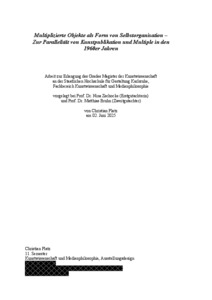
Multiplizierte Objekte als Form von Selbstorganisation
Name that can easily go onto 2 lines
Author that can easily go onto 2 lines as well
- Titel
- Multiplizierte Objekte als Form von Selbstorganisation
- Titel (en)
- Multiplied objects as a form of self-organization
- Untertitel
- Zur Parallelität von Kunstpublikation und Multiple in den 1960er Jahren
- Untertitel des Projekts/Werks (en)
- On the Parallelism Between Art Publications and Multiples in the 1960s
- Autor/in
- Beschreibung (de)
- Kunstpublikationen und Multiples (Auflagenobjekte) der 1960er Jahren weisen strukturelle und konzeptuelle Parallelen auf, die in dieser Arbeit als Ausdruck selbstorganisierter künstlerischer Praxis zu verstehen sind. Ausgehend von einer kritischen Auseinandersetzung mit dem etablierten Kunstsystem entstanden in dieser Zeit alternative Formate der Produktion und Distribution, die auf Vervielfältigung, Partizipation und Autonomie basierten. Anhand exemplarischer Fallbeispiele, darunter die intermedialen Publikationsobjekte "dokumentation b", die "Edition Et", die Zeitschriften "spirale" und "rot" sowie die Multiples der Edition "MAT" und die Serienobjekte der "Gruppe X", wird gezeigt, wie sich die entsprechenden Werkformen als kuratorische, serielle und partizipative Medien positionieren lassen. Die Arbeit kontextualisiert diese Formate sowohl medienästhetisch als auch kulturpolitisch und versteht sie als materielle Strategien der Selbstorganisation. Sie argumentiert, dass Kunstpublikationen und Multiples nicht nur als Ausdruck einer alternativen Öffentlichkeit fungierten, sondern mit ihnen auch frühe Modelle einer dezentralen künstlerischen Infrastruktur entwickelt wurden. Diese Betrachtung ermöglicht eine genealogische Neubewertung des Multiples, indem sie sich vom etablierten, auf Marcel Duchamp fixierten Diskursrahmen löst und eine weiter gefasste Perspektive eröffnet.
- Kunstpublikationen und Multiples (Auflagenobjekte) der 1960er Jahren weisen strukturelle und konzeptuelle Parallelen auf, die in dieser Arbeit als Ausdruck selbstorganisierter künstlerischer Praxis zu verstehen sind. Ausgehend von einer kritischen Auseinandersetzung mit dem etablierten Kunstsystem entstanden in dieser Zeit alternative Formate der Produktion und Distribution, die auf Vervielfältigung, Partizipation und Autonomie basierten. Anhand exemplarischer Fallbeispiele, darunter die intermedialen Publikationsobjekte "dokumentation b", die "Edition Et", die Zeitschriften "spirale" und "rot" sowie die Multiples der Edition "MAT" und die Serienobjekte der "Gruppe X", wird gezeigt, wie sich die entsprechenden Werkformen als kuratorische, serielle und partizipative Medien positionieren lassen. Die Arbeit kontextualisiert diese Formate sowohl medienästhetisch als auch kulturpolitisch und versteht sie als materielle Strategien der Selbstorganisation. Sie argumentiert, dass Kunstpublikationen und Multiples nicht nur als Ausdruck einer alternativen Öffentlichkeit fungierten, sondern mit ihnen auch frühe Modelle einer dezentralen künstlerischen Infrastruktur entwickelt wurden. Diese Betrachtung ermöglicht eine genealogische Neubewertung des Multiples, indem sie sich vom etablierten, auf Marcel Duchamp fixierten Diskursrahmen löst und eine weiter gefasste Perspektive eröffnet.
- Beschreibung (en)
- Art publications and multiples from the 1960s share structural and conceptual parallels that can be understood in this work as expressions of self-organized artistic practice. Based on a critical examination of the established art system, alternative formats of production and distribution emerged during this period that were based on reproduction, participation, and autonomy. Using exemplary case studies, including the intermedia publication objects "dokumentation b", "Edition Et", the magazines "spirale" and "rot", the multiples of Edition "MAT", and the serial objects of "Gruppe X", this work shows how the corresponding forms of work can be positioned as curatorial, serial, and participatory media. The work contextualizes these formats both in terms of media aesthetics and cultural politics and understands them as material strategies of self-organization. It argues that art publications and multiples not only functioned as expressions of an alternative public sphere, but also served to develop early models of a decentralized artistic infrastructure. This perspective enables a genealogical reassessment of the multiple by breaking away from the established discourse framework centered on Marcel Duchamp and opening up a broader perspective.
- Kategorie
- Typ des Projekts/Werks
- Schlagworte
- Datierung
- 02.06.2025
- Dank an
- Sprache
- Abmessungen
- 116 Seiten (77 Textseiten)
- Titel
- Multiplizierte Objekte als Form von Selbstorganisation
- Untertitel
- Zur Parallelität von Kunstpublikation und Multiple in den 1960er Jahren
- Projektleiter/in
- Semester
- Studiengang
- Typ der Abschlussarbeit
- Importiert am
- 16.03.2026
- Übergeordnete Sets
- 4
- Set enthält
- 0 3
MYCOSKENE
Name that can easily go onto 2 lines
Author that can easily go onto 2 lines as well
- Titel
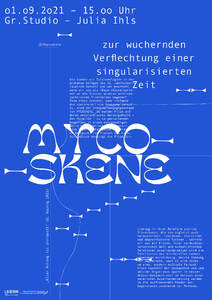
- MYCOSKENE
- Titel (en)
- Mycoskene
- Untertitel
- Zur wuchernden Verflechtung einer singularisierten Zeit
- Untertitel des Projekts/Werks (en)
- Or on the rampant interweaving of a singularized time
- Autor/in
- Beschreibung (de)
- MYCOSKENE ist eine material-theoretische Verflechtung rund um das Thema Mycelium, dem unterirdischen Hyphengeflecht der Pilze. Ob als sozio-philosophische Metapher, Bau- und Gestaltungsmaterial oder in Form einer multi-medialen Rauminstallation – in ihrer Arbeit folgte die Szenografin und Konzepterin Julia Ihls über 8 Monate den fein verwobenen Strukturen jener Organismen, die durch ihre eigene Zeitlichkeit und Qualitäten zu maßgeblichen Co-Gestaltenden wurden.
- Beschreibung (en)
- MYCOSKENE is a material-theoretical interweaving around the theme of mycelium, the subterranean network of hyphae of fungi. Whether as a socio-philosophical metaphor, building and design material or in the form of a multi-media spatial installation - in her work, scenographer and conceptual designer Julia Ihls followed the finely interwoven structures of these organisms for over 8 months, which became decisive co-creators through their own temporality and qualities.
- Kategorie
- Typ des Projekts/Werks
- Schlagworte
- Datierung
- 01.09.2021 - 03.09.2021
- Mitwirkende
- Sprache
- Ort: Institution
- Ort
- Großes Studio
- Stadt
- Land
- Internetlinks
- Walkthrough Video: https://vimeo.com/653230334
Doku Film:
Instagram: @mycoskene https://www.instagram.com/mycoskene/?hl=de
Website: https://mycoskene-.hotglue.me/
- Walkthrough Video: https://vimeo.com/653230334
- Titel
- MYCOSKENE
- Untertitel
- Zur wuchernden Verflechtung einer singularisierten Zeit
- Projektleiter/in
- Semester
- Studiengang
- Typ der Abschlussarbeit
- Importiert am
- 14.12.2023
- Übergeordnete Sets
- 2
- Set enthält
- 0 11
Mythos Großstadt
Name that can easily go onto 2 lines
Author that can easily go onto 2 lines as well
- Titel
- Mythos Großstadt
- Titel (en)
- The myth of the big city
- Untertitel
- Untersuchungen zur Stadtwahrnehmung in der Fotografie am Beispiel von Eugène Atget, Berenice Abbott und Andreas Feininger
- Autor/in
- Beschreibung (de)
- „Paris – New York, zwei Städte, deren Namen eine Flut von Begriffen, Bildern und Assoziationen in unserem Inneren auslösen. Zwei Weltstädte, die unterschiedlicher kaum sein können. Die eine, die verträumte Stadt an der Seine, gilt als das Mekka der Liebenden, ist der Inbegriff für Kunst und Kultur, war Sitz von Königen und Kaisern wir Ludwig XIV. oder Napoleon und blutiger Schauplatz zahlreicher Revolutionen. Sie ist geprägt von einer mehr als zweitausendjährigen Geschichte und verkörpert schlichtweg das, was man heute mit französischer Lebensart verbindet. Die andere, 'die wunderbare Katastrophe', wie Le Corbusier sie nennt, besticht durch ihre schier unerschöpfliche Energie und Wandlungsfähigkeit, ihre spektakuläre Hochhausarchitektur und ihre multikulturelle Gesellschaft. Ihr Name steht für Freiheit und Selbstverwirklichung. Sie ist die Hauptstadt des Kapitalismus, aber auch ein Ort extremer sozialer Gegensätze und krimineller Energien.
Das Großstadtleben beider ist legendär und es verwundert daher nicht, dass sowohl Paris als auch New York schon früh im Brennpunkt künstlerischen bzw. fotografischen Interesses standen.”
- „Paris – New York, zwei Städte, deren Namen eine Flut von Begriffen, Bildern und Assoziationen in unserem Inneren auslösen. Zwei Weltstädte, die unterschiedlicher kaum sein können. Die eine, die verträumte Stadt an der Seine, gilt als das Mekka der Liebenden, ist der Inbegriff für Kunst und Kultur, war Sitz von Königen und Kaisern wir Ludwig XIV. oder Napoleon und blutiger Schauplatz zahlreicher Revolutionen. Sie ist geprägt von einer mehr als zweitausendjährigen Geschichte und verkörpert schlichtweg das, was man heute mit französischer Lebensart verbindet. Die andere, 'die wunderbare Katastrophe', wie Le Corbusier sie nennt, besticht durch ihre schier unerschöpfliche Energie und Wandlungsfähigkeit, ihre spektakuläre Hochhausarchitektur und ihre multikulturelle Gesellschaft. Ihr Name steht für Freiheit und Selbstverwirklichung. Sie ist die Hauptstadt des Kapitalismus, aber auch ein Ort extremer sozialer Gegensätze und krimineller Energien.
- Beschreibung (en)
- "Paris - New York, two cities whose names trigger a flood of concepts, images and associations within us. Two cosmopolitan cities that could hardly be more different. One, the dreamy city on the Seine, is considered the Mecca of lovers, is the epitome of art and culture, was the seat of kings and emperors such as Louis XIV and Napoleon and the bloody scene of numerous revolutions. It is characterized by more than two thousand years of history and simply embodies what is associated with the French way of life today. The other, 'the marvelous catastrophe', as Le Corbusier called it, captivates with its sheer inexhaustible energy and adaptability, its spectacular high-rise architecture and its multicultural society. Its name stands for freedom and self-realization. It is the capital of capitalism, but also a place of extreme social contrasts and criminal energy.
The big city life of both is legendary and it is therefore not surprising that both Paris and New York were the focus of artistic and photographic interest early on."
- "Paris - New York, two cities whose names trigger a flood of concepts, images and associations within us. Two cosmopolitan cities that could hardly be more different. One, the dreamy city on the Seine, is considered the Mecca of lovers, is the epitome of art and culture, was the seat of kings and emperors such as Louis XIV and Napoleon and the bloody scene of numerous revolutions. It is characterized by more than two thousand years of history and simply embodies what is associated with the French way of life today. The other, 'the marvelous catastrophe', as Le Corbusier called it, captivates with its sheer inexhaustible energy and adaptability, its spectacular high-rise architecture and its multicultural society. Its name stands for freedom and self-realization. It is the capital of capitalism, but also a place of extreme social contrasts and criminal energy.
- Kategorie
- Typ des Projekts/Werks
- Schlagworte
- Datierung
- 2003
- Sprache
- Ort: Institution
- Stadt
- Titel
- Mythos Großstadt
- Untertitel
- Untersuchungen zur Stadtwahrnehmung in der Fotografie am Beispiel von Eugène Atget, Berenice Abbott und Andreas Feininger
- Projektleiter/in
- Semester
- Studiengang
- Typ der Abschlussarbeit
- Archiv-Signatur
- HfG HS 2003 02
- Externes Archiv
- Importiert am
- 16.06.2024
- Übergeordnete Sets
- 2
- Set enthält
- 0 2