| Titel | |
| Titel (en) | |
| Autor/in | |
| Kategorie | |
| Schlagworte | |
| Betreuer/innen | |
| Semester | |
| Studiengang | |
| Typ der Abschlussarbeit | |
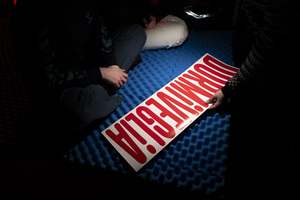
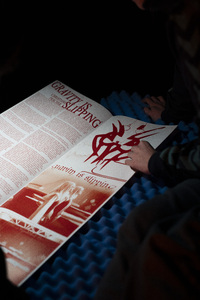
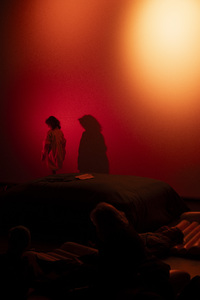
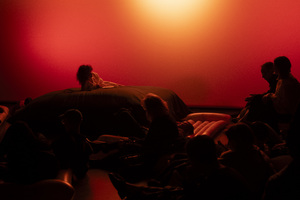
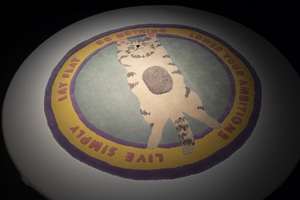
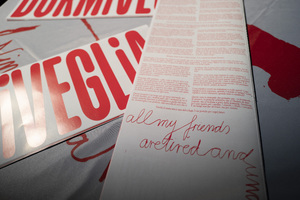
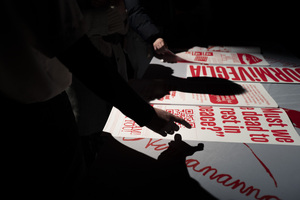
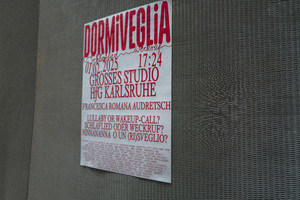
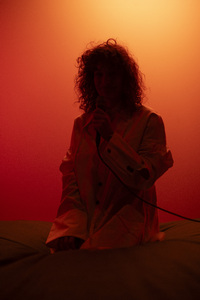
| Beschreibung | - „DORMIVEGLIA“ ist ein fortlaufendes Archiv zum Thema Schlaf, Ruhe und Regeneration, das Stimmen, Praktiken und künstlerische Beiträge sammelt. Für den Diplomtag wurde daraus eine immersive Traumlandschaft entwickelt: ein Raum mit Liegeflächen aus Audio-Schaumstoff, olfaktorischen Duftkomponenten, amber-rötlichem Licht sowie einer Soundarbeit in Kooperation mit der sri-lankischen Musiker:innengruppe Bilala. Die Arbeit versteht Schlaf als kollektive, politische Praxis und eröffnet einen Ort des Innehaltens, der gemeinsamen Erschöpfung und des Dazwischen-Seins.
|
| Beschreibung (en) | - “DORMIVEGLIA” is an ongoing archive dedicated to sleep, rest, and regeneration, gathering voices, practices, and artistic contributions. For the diploma presentation, it was transformed into an immersive dreamscape: a space with reclining surfaces made of acoustic foam, olfactory scent components, amber-red light, and a sound piece created in collaboration with the Sri Lankan music collective Bilala. The work understands sleep as a collective and political practice, offering a space for pause, shared exhaustion, and states of in-between.
|
| Ausführliche Beschreibung | - Dormiveglia. Ein Wort, das sich zwischen den Welten bewegt, das sich nicht einfangen lässt. Es steht für den Zustand, der weder ganz Schlaf noch ganz Wachsein ist – ein Schweben in der Schwebe. Es ist die diffuse Zeit, in der sich die Ränder von uns selbst auflösen, die uns erinnert, dass es etwas jenseits der geraden Linien und festen Formen gibt.
Schlaf. Ein Wort, das in unserer Sprache oft mit Stillstand verwechselt wird, mit Faulheit, mit Zeitverlust. Aber in Wirklichkeit ist Schlaf etwas Widerständiges, etwas Radikales. Es ist ein Sich-Entziehen, ein Innehalten in einer Welt, die uns ruhelos macht. In einem System, das uns zu Maschinen formt, die produzieren, konsumieren, wiederholen, fordert Schlaf uns auf, einfach zu sein.
Wir denken an die Geduld – sabr, wie sie im Türkischen und Arabischen heißt. Doch Geduld ist mehr als das Warten. Es ist ein Aushalten, ein Demut zeigen vor dem, was größer ist als wir. Es ist die Fähigkeit, still zu werden, nicht um zu resignieren, sondern um Platz zu schaffen: für das Flüstern der Träume, für das, was unter der Oberfläche ruht und nur gehört werden kann, wenn wir endlich aufhören, danach zu greifen.
Dieses Projekt ist ein Ort für die Zwischenräume: für die schlaflosen Nächte, für die trägen Morgen, für die Momente, in denen unser inneres Flimmern sich mit dem der Welt überschneidet. Dormiveglia ist ein Archiv, eine Sammlung von Stimmen, die uns daran erinnern, dass Schlaf nicht nur für Einzelne ist, sondern auch für Gemeinschaften. Dass er politisch ist. Dass er sich weigert, nützlich zu sein.
Ein Baum, dessen Wurzeln geschnitten werden, wächst weiter – aber anders, an einem neuen Ort. Vielleicht ist es der Schlaf, der uns hilft, diese Wurzeln neu zu finden. Die Geduld, die wir brauchen, um zu warten, bis sich die Äste ausstrecken. Es ist in diesem dormiveglia, in dieser Schwebe, dass wir neu denken können, neu fühlen können.
Was bedeutet es, ein:e Tagträumer:in zu sein? Was bedeutet es, Geduld zu haben, wenn die Welt uns drängt? Was bedeutet es, still zu sein, wenn alles laut ist?
Diese Fragen stellen wir hier – in Fragmenten, in Flüstern, in künstlerischen Praktiken, die sich weigern, Antworten zu geben, aber uns dazu einladen, selbst zu fragen. Dormiveglia ist ein Raum für die Verlorenen, die Müden, die Aufständischen, die Suchenden. Es ist ein Ort, um nicht anzukommen, sondern zu verweilen.
Denn der Schlaf ist keine Flucht. Er ist ein Portal.
|
| Ausführliche Beschreibung (en) | - Dormiveglia. A word that moves between worlds, that cannot be captured. It represents a state that is neither fully asleep nor fully awake – a floating in suspension. It is the diffusive time in which the edges of ourselves dissolve, reminding us that there is something beyond straight lines and solid forms.
Sleep. A word that, in our language, is often mistaken for stillness, laziness, the loss of time. But in truth, sleep is something resistant, something radical. It is a withdrawal, a pause in a world that makes us restless. In a system that shapes us into machines that produce, consume, repeat, sleep invites us to simply be.
We think of patience – sabr, as it is called in Turkish and Arabic. But patience is more than waiting. It is enduring, showing humility before what is greater than us. It is the ability to become silent, not to resign, but to create space: for the whispers of dreams, for what lies beneath the surface and can only be heard when we finally stop grasping for it.
This project is a place for in-between spaces: for sleepless nights, for lazy mornings, for the moments when our inner flickering overlaps with that of the world. Dormiveglia is an archive, a collection of voices reminding us that sleep is not only for individuals but also for communities. That it is political. That it refuses to be useful.
A tree whose roots are cut continues to grow – but differently, in a new place. Perhaps it is sleep that helps us rediscover these roots. The patience we need to wait for the branches to reach out. It is in this dormiveglia, in this suspension, that we can think anew, feel anew.
What does it mean to be a daydreamer? What does it mean to have patience when the world pushes us? What does it mean to be silent when everything is loud?
These are the questions we ask here – in fragments, in whispers, in artistic practices that refuse to give answers but invite us to ask ourselves. Dormiveglia is a space for the lost, the weary, the rebellious, the seekers. It is a place not to arrive, but to linger.
Because sleep is not an escape. It is a portal.
(additional)
Dormiveglia: On Sleep, Softness, and Structural Breaks
According to sleep research, humans spend nearly one-third of their lives asleep. In neoliberal contexts, where time is commodified and bodies are valued only through productivity, this figure is cast as troubling: the sleeping body becomes a lazy antagonist, a site of waste. Yet, sleep’s apparent uselessness allows to reframe its potentials as a site of refusal. To sleep, to rest, to linger horizontally interrupts the endless cycles of production and consumption, exposing the exhaustion of a burnt-out world.
This lecture explores how sleep, softness, and suspension can be understood as structural breaks. Drawing on my ongoing research project DORMIVEGLIA (2025), I approach the term dormiveglia— an in-between state of diffusive temporalities —as a conceptual tool to think through cracks and discontinuities. It marks a liminal threshold where the self dissolves, where silence becomes an act of endurance, and where vulnerability can be reimagined as strength.
Sleep here is not a private indulgence but a collective, political practice. By embracing sleep’s uselessness as a refuge for imaginative withdrawals, it becomes a tool to practice other rhythms of living and to renegotiate privileges around their accessibility. In doing so, sleep becomes a site of encounter: between rest and movement, absence and availability, fragility and resilience.
My research proposes resting as a horizon for critical explorations and dormiveglia as a method for sensing what lies beneath the surface. What does it mean to endure softly in moments of rupture? What kinds of futures might emerge if sleep itself is reclaimed—not as escape, but as a portal into other ways of conviviality?
|
| Mitwirkende / weitere Personen | |
| Material | |
| Dauer | |