Lisa Ertel
| Name | Lisa Ertel |
2 Inhalte
- Seite 1 von 1
PLAY DATE
Name that can easily go onto 2 lines
Author that can easily go onto 2 lines as well
- Titel
- PLAY DATE
- Untertitel
- PLAY DATE OBJECTS
- Autor/in
- Beschreibung (de)
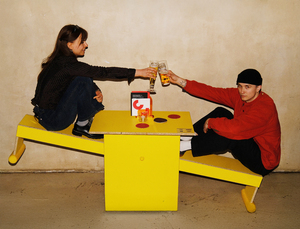
- Ausgehend von der Idee des freien Spielens in der Kindheit entfaltet sich PLAY DATE als Studienreihe, die die Entdeckung des zwecklosen Spielens im Erwachsenenalter erforscht. Oft von gesellschaftlichen Normen und sozialen Hemmungen überdeckt, bleibt der Spieltrieb doch bestehen, sobald man ihm wieder Raum gibt.
Ausgangspunkt war die Beobachtung, dass traditionelle Spielplätze fast ausschließlich Kindern vorbehalten sind, während erwachsene Personen kaum Raum finden, einfach verspielt zu sein.
In PLAY DATE 1, dem ersten experimentellen Spielplatz, wurde untersucht, welche nicht-kompetitiven Spielarten Erwachsene ansprechen. Die Ergebnisse zeigten, dass freies Spiel für Erwachsene angenommen würde, wenn der soziale Rahmen als akzeptierend wahrgenommen wird.
Darauf aufbauend fand PLAY DATE 2 in einer Bar statt, wo spielerische Bewegungsformen situativ in den Kontext des sozialen Zusammenkommens und geselligen Beisammenseins integriert wurden. Spielerische Gesten konnten so nahtlos in gewohnte Beschäftigungen eingeschrieben werden.
Mit PLAY DATE 3 wurde die Erkundung im Alltag erweitert: temporäre Spielobjekte wurden in die Stadtlandschaft gebracht, um zu beobachten, wie Passant:innen auf unerwartete Momente des Spiels reagieren, die den Alltag durchbrechen.
PLAY DATE OBJECTS zeigen, wie freies Spiel für jedes Alter wieder zugänglich gemacht werden kann und neue soziale, kulturelle und räumliche Kontexte eröffnet.
- Ausgehend von der Idee des freien Spielens in der Kindheit entfaltet sich PLAY DATE als Studienreihe, die die Entdeckung des zwecklosen Spielens im Erwachsenenalter erforscht. Oft von gesellschaftlichen Normen und sozialen Hemmungen überdeckt, bleibt der Spieltrieb doch bestehen, sobald man ihm wieder Raum gibt.
- Beschreibung (en)
- Starting from the idea of uninhibited play in childhood, PLAY DATE unfolds as a series of studies exploring the rediscovery of purposeless play in adulthood. Although often obscured by social norms and inhibitions, the impulse to play persists, emerging again once it is given space.
The project originated from the observation that traditional playgrounds are almost exclusively designed for children, while adults rarely find spaces where they can simply be playful.
PLAY DATE 1, the first experimental playground, investigated which forms of non-competitive play appeal to adults. The results suggested that adults readily embrace free play when the social environment is perceived as accepting and non-judgmental.
Building on these findings, PLAY DATE 2 took place in a bar, where playful modes of movement were introduced into the social setting of gathering and spending time together. Playful gestures became seamlessly integrated into familiar social activities.
With PLAY DATE 3, the investigation expanded into everyday urban life. Temporary play objects were placed throughout the city to observe how passersby respond to unexpected moments of play that interrupt the routines of daily life.
PLAY DATE OBJECTS demonstrate how free play can be made accessible again for people of all ages, opening up new social, cultural, and spatial contexts.
- Starting from the idea of uninhibited play in childhood, PLAY DATE unfolds as a series of studies exploring the rediscovery of purposeless play in adulthood. Although often obscured by social norms and inhibitions, the impulse to play persists, emerging again once it is given space.
- Kategorie
- Schlagworte
- Material
- Titel
- PLAY DATE
- Untertitel
- PLAY DATE OBJECTS
- Projektleiter/in
- Semester
- Studiengang
- Importiert am
- 12.06.2026
- Übergeordnete Sets
- 1
- Set enthält
- 0 25
Anything Besides a Bed
Name that can easily go onto 2 lines
Author that can easily go onto 2 lines as well
- Titel
- Anything Besides a Bed
- Autor/in
- Beschreibung (de)
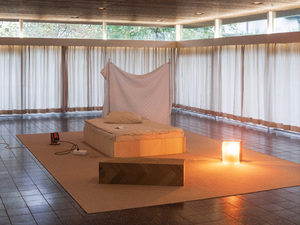
- "Anything Besides a Bed" ist eine Kollektion bestehend aus sechs Arbeiten, die sich alle mit bestimmten Aspekten des Betts befassen: Schlafgewohnheiten, Dunkelheit und künstliches Licht, Lesen in und Reden über Betten, deren technologisches und digitales Umfeld sowie Privatsphäre, Intimität und Öffentlichkeit.
Jedes einzelne Objekt entsteht durch Beobachten, Vermischen, Austauschen und Kombinieren seiner kulturhistorischen, archäologischen, philosophischen oder sozialen Kontexte, gleichzeitig aber auch die Kontexte und formalen Aspekte der tatsächlichen Gegenstände, die im Umfeld eines Betts herum zu finden sind.
Daraus ergeben sich sechs Objekte, die nicht nur einfach eine Recherche und Analyse wiedergeben, sondern durch gewisse Interventionen in ihrer Form und Funktionsweise als nutzbares Möbel bzw. technisches Gerät zum Nachdenken anregen.
- "Anything Besides a Bed" ist eine Kollektion bestehend aus sechs Arbeiten, die sich alle mit bestimmten Aspekten des Betts befassen: Schlafgewohnheiten, Dunkelheit und künstliches Licht, Lesen in und Reden über Betten, deren technologisches und digitales Umfeld sowie Privatsphäre, Intimität und Öffentlichkeit.
- Beschreibung (en)
- "Anything Besides a Bed" is a collection consisting of six objects that all deal with certain aspects of the bed: sleep patterns, darkness and artificial light, reading and talking about beds, technological and digital environment as well as privacy and publicity.
Every individual object is conceived by observing, mixing, interchanging, and combining its contexts. These being the research aspects as well as the contexts of being actual objects and pieces of furniture that are found around the bed. The objects don’t just reflect their research but have their own purpose by being thought-provoking interventions in the way they look and are used.
- "Anything Besides a Bed" is a collection consisting of six objects that all deal with certain aspects of the bed: sleep patterns, darkness and artificial light, reading and talking about beds, technological and digital environment as well as privacy and publicity.
- Kategorie
- Typ des Projekts/Werks
- Schlagworte
- Datierung
- October 2023
- Dank an
- Moritz Appich
- Francesca-Romana Audretsch
- Massimiliano Audretsch
- Tim Bartel
- Vincent Carl Becher
- Nils Bergmann
- Jonathan Blaschke
- Sibylle Bläser
- Christoph Bläser
- Vanessa Bosch
- Oliver Boualam
- Richard Brunner
- Jules Buchholtz
- Felipe Carrión
- Sam Chermayeff
- Lukas Clark
- Céline Condorelli
- Ute Deutz
- Lizzy Ellbrück
- Lisa Ertel
- Marie Faaß
- Hanna Franke
- Taavi Hallimäe
- Teresa-Louise Häußler
- Susanne Heyer
- Matthias Holznagel
- Bruno Jacoby
- Chris Kabel
- Tobias Keilbach
- Barbara Zoé Kiolbassa
- Florian Knöbl
- Mio Kojima
- Julian Kuf
- Stefan Legner
- Lukas Marstaller
- Mona Mayer
- Isabel Motz
- Anne-Sophie Oberkrome
- Vlado Petrovic
- Barbara Polakova
- Johanna Schäfer
- Susanne Schmitt
- Waldemar Schwab
- Moritz Kamil Simon
- Wieki Somers
- Lorenz Stein
- Marcel Strauß
- Saskia van der Meer
- Leia Morgana Walz
- Jannis Zell
- Phil Zumbruch
- Sprache
- Material
- Abmessungen
- Mattress Multiplug Maße: 240 × 130 × 75 mm, Street Light Lamp Maße: 330 × 330 × 350 mm, Bedspread Curtain Maße: 2300 × 1800 mm / 350 × 350 × 1800 mm, Parquet Chest Maße: 1200 × 400 × 300 mm, Bedside Readings Maße: 109 × 75 × 108 mm, Sleep Timer Maße: 220 × 220 × 240 mm
- Ort: Institution
- Ort
- ZKM Pavillon
- Stadt
- Land
- Beteiligte Institution(en)
- Titel
- Anything Besides a Bed
- Projektleiter/in
- Semester
- Studiengang
- Typ der Abschlussarbeit
- Importiert am
- 05.11.2024
- Übergeordnete Sets
- 3
- Set enthält
- 0 7