Jule Köpke
| Name | Jule Köpke |
4 Inhalte
- Seite 1 von 1
Umpolen Kollektiv
Name that can easily go onto 2 lines
Author that can easily go onto 2 lines as well
- Titel
- Umpolen Kollektiv
- Titel (en)
- Umpolen Collective
- Autor/in
- Merve Abt
- Klara Beck
- Franka Breunig
- Timothée Charon
- Athina Chrisofakis
- Edona Ibrahimi
- Alexander Johl
- Jule Köpke
- Peter Oellerich
- Anika Osbelt
- Nina Overkott
- Lasse Peters
- Elisabeth Potemkin
- Leo Schick
- Emil Schönert
- Charlot Schümann
- Asimina Sideris
- Estella Staader
- Joscha Thorn
- Laura Waterstradt
- Cédric Weber
- Max Werling
- Camilla Wondrak
- Lando
- Beschreibung (de)
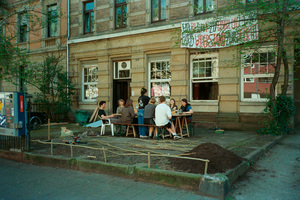
- Umpolen ist ein Kollektiv das leerstehende Räume in Karlsruhe nutzt, um temporäre, nicht-kommerzielle Orte der Begegnung und des Austauschs zu schaffen. Sie dienen als kurzfristige soziokulturelle Veranstaltungs- und Ausstellungsräume, aber auch einfache Treffpunkte. Im Januar 2026 bespielte Umpolen für eine Woche eine ehemalige Wohngemeinschaft in der Karlsruher Südstadt und widmete sich Fragen von Freund*innenschaft und Distanz. Dazu gab es Workshops, “Küche für Alle”, Filmvorführungen, Konzerte und Lesungen.
Seit Mai 2026 baut Umpolen einen temporären Nachbar*innenschaftstreff und Kulturort im ehemaligen Löwenbräukeller in der Karlsruher Weststadt auf. Ausgangspunkt ist jedes Mal der Raum selbst, von dem aus sich das Kollektiv dem Thema Nachbar*innenschaft widmen will. Die Orte stellen eine Brücke zwischen sozialem Raum, Werkstatt, Arbeitsraum, Ausstellungsraum, Garten und versuchen Menschen in Dialoge miteinander zu setzen. Dabei arbeitet Umpolen sowohl mit lokalen Initiativen als auch mit Menschen außerhalb Karlsruhes zusammen und entwickelt Formate, die gegenseitiges Lernen, Gespräche und Beisammensein ermöglichen.
Im ehemaligen Löwenbräukeller wird versucht im Alltag Strukturen zu schaffen in dem die Nachbar*innenschaft nicht nur fremde Gesichter bleiben, sondern Mitmenschen sind, mit denen man solidarisch lebt und in Kontakt tritt.
Der Raum ist zwei mal die Woche geöffnet und bespielt manchmal mit Programm manchmal als reinen Treffpunkt den Ort und beschäftigt sich auch mit den Erinnerungen, die an den Ort geknüpft sind.
Umpolen hat sich als Kollektiv im Sommer 2025 gegründet und besteht aus Studierenden der Studiengänge Ausstellungsdesign und Szenografie, Kunstwissenschaft und Medienphilosophie und Kommunikationsdesign von der HfG, Studierenden der Kunstakademie und Menschen aus Karlsruhe, die zusammengekommen sind um Gemeinschaft und Kulturarbeit in Karlsruhe zugänglich zu machen. Umpolen arbeitet zudem fest mit Radio ShbShb zusammen, die die Veranstaltungen live online übertragen.
- Umpolen ist ein Kollektiv das leerstehende Räume in Karlsruhe nutzt, um temporäre, nicht-kommerzielle Orte der Begegnung und des Austauschs zu schaffen. Sie dienen als kurzfristige soziokulturelle Veranstaltungs- und Ausstellungsräume, aber auch einfache Treffpunkte. Im Januar 2026 bespielte Umpolen für eine Woche eine ehemalige Wohngemeinschaft in der Karlsruher Südstadt und widmete sich Fragen von Freund*innenschaft und Distanz. Dazu gab es Workshops, “Küche für Alle”, Filmvorführungen, Konzerte und Lesungen.
- Beschreibung (en)
- Umpolen is a collective that uses vacant spaces in Karlsruhe to create temporary, non-commercial places for people to meet and exchange ideas. These spaces serve as short-term venues for sociocultural events and exhibitions, as well as simple gathering places. In January 2026, Umpolen took over a former shared apartment in Karlsruhe’s Südstadt neighborhood for a week and explored questions of friendship and distance. The event featured workshops, “Kitchen for All,” film screenings, concerts, and readings.
Since May 2026, the collective has been setting up a temporary neighborhood gathering place and cultural space in the former Löwenbräukeller in Karlsruhe’s Weststadt district. Each time, the starting point is the space itself, from which Umpolen aims to explore the theme of neighborliness. These spaces serve as a bridge between social space, workshop, workspace, exhibition space, and garden, and aim to bring people together in dialogue. In doing so, Umpolen collaborates with both local initiatives and people outside of Karlsruhe, developing formats that facilitate mutual learning, conversation, and socializing.
At the former Löwenbräukeller, Umpolen strives to create structures in our daily lives where neighbors aren’t just strangers, but fellow human beings with whom we live in solidarity and connect.
The space is open twice a week and serves as a venue, sometimes hosting events, sometimes simply as a gathering place, while also engaging with the memories tied to the location.
Umpolen was founded as a collective in the summer of 2025 and consists of students from the HfG and the Art Academy, as well as people from Karlsruhe who have come together to make community and cultural work accessible in Karlsruhe. Umpolen also collaborates closely with Radio ShbShb, which broadcasts the events live online.
- Umpolen is a collective that uses vacant spaces in Karlsruhe to create temporary, non-commercial places for people to meet and exchange ideas. These spaces serve as short-term venues for sociocultural events and exhibitions, as well as simple gathering places. In January 2026, Umpolen took over a former shared apartment in Karlsruhe’s Südstadt neighborhood for a week and explored questions of friendship and distance. The event featured workshops, “Kitchen for All,” film screenings, concerts, and readings.
- Kategorie
- Typ des Projekts/Werks
- Schlagworte
- Datierung
- 01.01.2026 - 01.11.2026
- Mitwirkende
- Sprache
- Ort
- Im Januar 2026 in der Rüppurerstr. 14, 76137 Karlsruhe
von Mai bis Oktober 2026 in der ehemaligen Gaststätte Löwenbräukeller in der Sophienstraße 95, 76135 Karlsruhe
- Im Januar 2026 in der Rüppurerstr. 14, 76137 Karlsruhe
- Stadt
- Land
- Internetlinks
- Titel
- Umpolen Kollektiv
- Importiert am
- 23.06.2026
- Übergeordnete Sets
- 1
- Set enthält
- 0 24
The Nature of Total Planning
Name that can easily go onto 2 lines
Author that can easily go onto 2 lines as well
- Titel
- The Nature of Total Planning
- Titel (en)
- The Nature of Total Planning
- Untertitel
- From Francoist Hydropolitics to Green Capitalism
- Untertitel des Projekts/Werks (en)
- From Francoist Hydropolitics to Green Capitalism
- Autor/in
- Beschreibung (en)
- To what extent is sustainable development truly sustainable? In which ways is it different from previous ecological regimes, such as the extractivist practices of XXth century authoritarianisms? How do plans, and models, mediate between different temporalities? What can we learn about our social metabolism by studying climate scenarios as political techniques of government?
'The Nature of Total Planning' tries to answer these question by doing a close reading of the environmental history of La Bizkaia, a godforsaken valley in northern Spain. Historicising La Bizkaia’s social metabolism is the first step for a political and epistemological critique of green capitalism. A broader investigation of Francoist hydropolitics contextualises the pine monoculture as part of a national programme to enrol nature into Franco’s political project. The last section of this thesis compares that model with how La Bizkaia is managed today, under the sustainable development paradigm. While, discursively, sustainable development distances itself from the extractivist practices of fascist autarky, 'The Nature of Total Planning' reveals striking continuities in the material practices of La Bizkaia’s forestry management.
- To what extent is sustainable development truly sustainable? In which ways is it different from previous ecological regimes, such as the extractivist practices of XXth century authoritarianisms? How do plans, and models, mediate between different temporalities? What can we learn about our social metabolism by studying climate scenarios as political techniques of government?
- Kategorie
- Typ des Projekts/Werks
- Schlagworte
- Datierung
- 06.06.2024
- Mitwirkende
- Dank an
- Boris Buden
- Nagore Chivite Lizarraga
- Ariana Dongus
- Christian Egerer
- Víctor Fancelli Capdevila
- Max Grünberg
- Sami Khatib
- Jule Köpke
- Barbara Kuon
- Livia Lazzarini
- Iñigo Mazkiaran
- Matteo Pasquinelli
- César Alonso Porras
- Juan José Recalde
- Jess Saxby
- Valentin Schwarz
- Mariana Silva
- Ionel Spanachi
- Iñigo Villafranca Apesteguía
- Lioudmila Voropai
- Sprache
- Ort: Institution
- Stadt
- Land
- Beteiligte Institution(en)
- Internetlinks
- Titel
- The Nature of Total Planning
- Untertitel
- From Francoist Hydropolitics to Green Capitalism
- Projektleiter/in
- Studiengang
- Typ der Abschlussarbeit
- Importiert am
- 22.10.2024
- Übergeordnete Sets
- 0
- Set enthält
- 0 1
UMBAU Issue 3 Celebration
Name that can easily go onto 2 lines
Author that can easily go onto 2 lines as well
- Titel
- UMBAU Issue 3 Celebration
- Autor/in
- Beschreibung (de)
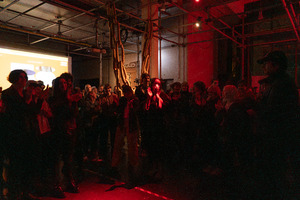
- Thursday our HfG online Journal UMBAU will celebrate it's 3rd Issue called CHAINING.
8pm / 18.01.24 / at HfG Forum
There will be a performance by the artist Elle Fierce at 20:30 They are a Trans Non-Binary, British born Jamaican-Irish artist and activist, classically trained in ballet and modern dance, and have performed on stages around the world, particularly in the UK and most recently as a Soloist at Oper Leipzig. Now a freelance artist, with a multi disciplinary approach to performance, combining their activism and life experience as a black trans body to create provocative works.
The event shows artworks by Lucia Mattes and Lars Pinkwart and hosts afterwards DJ sets by aswesome LaLa Tina and our very best Frankie Spiderweb.
Our first contributions feature Mascha Dilger, Matteo Pasquinelli and Ülkü Süngün.
With unchained hearts, your UMBAU Team // Paolo Caffoni, Charlotte Eifler, Yannick Fritz, Jule Köpke & Livia Lazzarini
- Thursday our HfG online Journal UMBAU will celebrate it's 3rd Issue called CHAINING.
- Beschreibung (en)
- Thursday our HfG online Journal UMBAU will celebrate it's 3rd Issue called CHAINING.
8pm / 18.01.24 / at HfG Forum
There will be a performance by the artist Elle Fierce at 20:30 They are a Trans Non-Binary, British born Jamaican-Irish artist and activist, classically trained in ballet and modern dance, and have performed on stages around the world, particularly in the UK and most recently as a Soloist at Oper Leipzig. Now a freelance artist, with a multi disciplinary approach to performance, combining their activism and life experience as a black trans body to create provocative works.
The event shows artworks by Lucia Mattes and Lars Pinkwart and hosts afterwards DJ sets by aswesome LaLa Tina and our very best Frankie Spiderweb.
Our first contributions feature Mascha Dilger, Matteo Pasquinelli and Ülkü Süngün.
With unchained hearts, your UMBAU Team // Paolo Caffoni, Charlotte Eifler, Yannick Fritz, Jule Köpke & Livia Lazzarini
- Thursday our HfG online Journal UMBAU will celebrate it's 3rd Issue called CHAINING.
- Schlagworte
- Datierung
- 18.01.2024
- Mitwirkende
- Ort: Institution
- Ort
- HfG Forum
- Stadt
- Land
- Internetlinks
- Titel
- UMBAU Issue 3 Celebration
- Importiert am
- 20.02.2024
- Übergeordnete Sets
- 0
- Set enthält
- 0 25
Disparate Precedents of Display
Name that can easily go onto 2 lines
Author that can easily go onto 2 lines as well
- Titel
- Disparate Precedents of Display
- Titel (en)
- Disparate Precedents of Display
- Untertitel des Projekts/Werks (en)
- A Footnote
- Autor/in
- Beschreibung (de)
- "Disparate Precedents of Display" untersucht die Art und Weise, wie der Raum auf die Besucher wirkt, und stellt Ausstellungsdesign als eine genuin politische Praxis dar, die auf der Vergangenheit aufbaut und von ihr erbt - von vergangenen Ausstellungen, einflussreichen Ausstellungsgestalter*innen und Konventionen der Präsentation, die in unterschiedlichen politischen Systemen wurzeln.
Zwei Ausstellungen, die vom deutschen Staat in Auftrag gegeben wurden, dienen als Fallstudien. "Gebt mir vier Jahre Zeit" war eine nationalsozialistische Propagandaschau, die 1937 in Berlin stattfand. Sie feierte die Umgestaltung aller Bereiche der Gesellschaft unter der nationalsozialistischen Herrschaft seit der Umsetzung von Adolf Hitlers Vierjahresplan. Einundzwanzig Jahre später beauftragte die Bundesrepublik Deutschland denselben Architekten mit der Gestaltung des deutschen Pavillons auf der Expo '58 in Brüssel. Auf der Weltausstellung hatte der junge Nachfolgestaat zum ersten Mal die Gelegenheit, die kulturellen, wirtschaftlichen und politischen Parameter des nunmehr demokratischen Deutschlands auf internationaler Ebene zu präsentieren. Beide Ausstellungen lassen sich als Repräsentationen staatlicher Macht und politischer Narrative beschreiben - die eine im Namen des Krieges, die andere im Namen der Humanität. Maßgeblich beteiligt an beiden Ausstellungen war Egon Eiermann als Ausstellungsarchitekt.
Performance: Anna K. Seidel
Outside Eye: Caroline Kapp, Manon Haase
Graphikdesign: Mona Mayer
Single line font EE_7475: Barbara Acevedo Strange, Moritz Appich
Coding: Frank Bublitz
Stimme: Liv Rahel Schwenk
Aufzeichnung: Florian Wulff
Video Dokumentation: Mustafa Emin Büyükcoşkun
Photographien: Lizzy Ellbrück
Editorial support: Joyce Moore
Copyediting: George MacBeth
Special Thanks to
Céline Condorelli, Hanne König, Sami Khatib, Lioudmila Voropai,
Julian Warner, Thomas Rustemeyer, Constanze Fischbeck,
Susanne Kriemann, Hans D. Christ und Iris Dressler, Judith Milz,
Christian Becker (Stadtarchiv Oranienburg), Mechthild Ebert (saai),
Janina Capelle, Lydia Kähny, Daniel Lythgoe, Tjark Schönfeld,
Alexander Knoppik, Lena Breitmoser, Sören Göbel, Jule Köpke, Arthur Schuman,
Jana Barthel and Danny Klein.
Gefördert von
Fonds Darstellende Künste (Rechercheförderung)
Rosa Luxemburg Stiftung Baden Württemberg
- "Disparate Precedents of Display" untersucht die Art und Weise, wie der Raum auf die Besucher wirkt, und stellt Ausstellungsdesign als eine genuin politische Praxis dar, die auf der Vergangenheit aufbaut und von ihr erbt - von vergangenen Ausstellungen, einflussreichen Ausstellungsgestalter*innen und Konventionen der Präsentation, die in unterschiedlichen politischen Systemen wurzeln.
- Beschreibung (en)
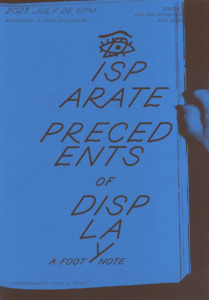
- "Disparate Precedents of Display" looks at the way space affects visitors, exposing exhibition design as a genuinely political practice, building on and inheriting from the past – from past exhibitions, influential exhibition designers and conventions of display rooted in disparate political systems.
Two exhibitions, commissioned by the German state, serve as case studies. “Gebt mir vier Jahre Zeit” was a National Socialist propaganda show staged in Berlin in 1937. It celebrated the transformation of all sectors of society under National Socialist rule since the implementation of Adolf Hitlers 4-year-plan. Twenty-one years later, the Federal Republic of Germany commissioned the same architect to design the German Pavilion at the Expo ‘58 in Brussels. At the World‘s Fair the young successor state had its first opportunity to present the cultural, economic and political parameters of a now democratic Germany on an international scale. Both shows can be described as representations of state power and political narratives – one in the name of war and one in the name of humanity. Significant contributor to both exhibitions was Egon Eiermann in his role as exhibition architect.
Performance: Anna K. Seidel
Outside Eye: Caroline Kapp, Manon Haase
Graphic Design: Mona Mayer
Single line font EE_7475: Barbara Acevedo Strange, Moritz Appich
Coding: Frank Bublitz
Voice: Liv Rahel Schwenk
Recording: Florian Wulff
Video documentation: Mustafa Emin Büyükcoşkun
Photography: Lizzy Ellbrück
Editorial support: Joyce Moore
Copyediting: George MacBeth
Special Thanks to
Céline Condorelli, Hanne König, Sami Khatib, Lioudmila Voropai,
Julian Warner, Thomas Rustemeyer, Constanze Fischbeck,
Susanne Kriemann, Hans D. Christ und Iris Dressler, Judith Milz,
Christian Becker (Stadtarchiv Oranienburg), Mechthild Ebert (saai),
Janina Capelle, Lydia Kähny, Daniel Lythgoe, Tjark Schönfeld,
Alexander Knoppik, Lena Breitmoser, Sören Göbel, Jule Köpke, Arthur Schuman,
Jana Barthel and Danny Klein.
Funded by
Fonds Darstellende Künste (Rechercheförderung)
Rosa Luxemburg Stiftung Baden Württemberg
- "Disparate Precedents of Display" looks at the way space affects visitors, exposing exhibition design as a genuinely political practice, building on and inheriting from the past – from past exhibitions, influential exhibition designers and conventions of display rooted in disparate political systems.
- Typ des Projekts/Werks
- Schlagworte
- Datierung
- 28.07.2023
- Mitwirkende
- Dank an
- Sprache
- Dauer
- Performance: ca. 30 Minuten
- Ort
- Pavillon an der Brauerstraße
- Stadt
- Land
- Titel
- Disparate Precedents of Display
- Projektleiter/in
- Semester
- Studiengang
- Typ der Abschlussarbeit
- Importiert am
- 28.09.2023
- Übergeordnete Sets
- 3
- Set enthält
- 0 17