Johannes Bauer
| Name | Johannes Bauer |
4 Inhalte
- Seite 1 von 1
Forest Souvenirs
Name that can easily go onto 2 lines
Author that can easily go onto 2 lines as well
- Titel
- Forest Souvenirs
- Autor/in
- Beschreibung (de)
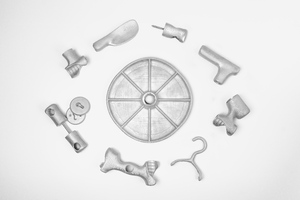
- Forest Souvenirs ist ein modulares System langlebiger Verbindungselemente, das aus ausrangierten Aluminium-Autofelgen gefertigt wird und recyceltes Metall mit von den Nutzer:innen gesammelten, ausgewählten und bearbeiteten Holzästen kombiniert. So entstehen flexible Alltagsobjekte wie Stühle, Lampen, Garderoben oder Kleiderhaken aus lokal gefundenen Materialien. Statt fertiger Produkte bietet das System eine einfache, robuste metallische Schnittstelle, die zur aktiven Aneignung einlädt. Die leimfreien, wiederverwendbaren Verbinder ermöglichen den Aufbau ohne spezielle Werkzeuge oder Vorkenntnisse und machen Materialkreisläufe im Gebrauch unmittelbar erfahrbar.
Forest Souvenirs versteht sich als offenes, zirkuläres Designsystem zwischen industrieller Logik und naturbasiertem Gestalten. Es verlängert nicht nur Materiallebenszyklen, sondern schafft eine hybride Formensprache, die den Archetyp des selbstgebauten Möbels neu interpretiert. Die entstehenden Objekte sind keine fixen Produkte, sondern wandelbare Konfigurationen – ein kontinuierlicher Dialog zwischen Material, Umwelt und Nutzer:innen, die zu Co-Designer:innen werden und eine stärkere emotionale Bindung sowie ein vertieftes Materialbewusstsein entwickeln.
- Forest Souvenirs ist ein modulares System langlebiger Verbindungselemente, das aus ausrangierten Aluminium-Autofelgen gefertigt wird und recyceltes Metall mit von den Nutzer:innen gesammelten, ausgewählten und bearbeiteten Holzästen kombiniert. So entstehen flexible Alltagsobjekte wie Stühle, Lampen, Garderoben oder Kleiderhaken aus lokal gefundenen Materialien. Statt fertiger Produkte bietet das System eine einfache, robuste metallische Schnittstelle, die zur aktiven Aneignung einlädt. Die leimfreien, wiederverwendbaren Verbinder ermöglichen den Aufbau ohne spezielle Werkzeuge oder Vorkenntnisse und machen Materialkreisläufe im Gebrauch unmittelbar erfahrbar.
- Beschreibung (en)
- Forest Souvenirs reimagines our relationship with everyday objects by bridging industrial production and nature-based making. Rooted in humanity's earliest practices of sourcing and shaping materials from the immediate environment, the project responds to the detachment created by global industrialization. Instead of offering finished products, it transforms a discarded aluminum car rim into a modular system of nine durable connectors, each made from 100% recycled material. These elements serve as a simple yet precise interface, enabling users to combine them with wooden branches they collect, select, and shape themselves.
Through this process, found materials become functional objects such as chairs, lamps, coat racks, hangers, or even a walking cane. Assembly requires no adhesives or specialized tools, making the system accessible, reusable, and fully recyclable. The mono-material aluminum ensures a closed material cycle, while the organic variability of wood introduces uniqueness and adaptability. Each object becomes a reflection of its maker and its environment.
Forest Souvenirs places the user at the center of creation. The act of gathering wood becomes an intentional journey—an invitation to slow down, step outside urban routines, and reconnect with nature. Walking replaces driving, making replaces consuming. This participatory approach fosters emotional attachment, material awareness, and a deeper appreciation for resources and processes.
By merging industrial logic with the archetype of self-crafted furniture, the project establishes a hybrid design language that is both contemporary and timeless. The aluminum connector acts as a threshold between two worlds: standardized production and organic growth. In doing so, Forest Souvenirs challenges conventional systems of consumption and proposes an alternative grounded in reuse, care, and engagement.
Ultimately, the project reframes everyday objects as evolving, personal artifacts. It empowers users as co-designers and encourages a shift from passive consumption toward active participation—offering not just objects, but meaningful experiences and a renewed connection to our surroundings.
- Forest Souvenirs reimagines our relationship with everyday objects by bridging industrial production and nature-based making. Rooted in humanity's earliest practices of sourcing and shaping materials from the immediate environment, the project responds to the detachment created by global industrialization. Instead of offering finished products, it transforms a discarded aluminum car rim into a modular system of nine durable connectors, each made from 100% recycled material. These elements serve as a simple yet precise interface, enabling users to combine them with wooden branches they collect, select, and shape themselves.
- Kategorie
- Typ des Projekts/Werks
- Schlagworte
- Datierung
- 30.10.2025
- Mitwirkende
- Material
- Technik/Verfahren/Formate
- Aluminium Sandguss
- Ort: Institution
- Ort
- Lichthof
- Stadt
- Land
- Titel
- Forest Souvenirs
- Projektleiter/in
- Semester
- Studiengang
- Typ der Abschlussarbeit
- Archiv-Signatur
- Importiert am
- 13.03.2026
- Übergeordnete Sets
- 1
- Set enthält
- 0 26
Aqua Logistik
Name that can easily go onto 2 lines
Author that can easily go onto 2 lines as well
- Titel
- Aqua Logistik
- Titel (en)
- Aqua logistics
- Autor/in
- Beschreibung (de)
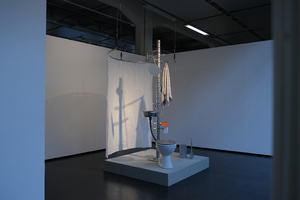
- Aqua Logistik ist ein Konzept für ein alternatives Badezimmer. Im Mittelpunkt des Entwurfs steht eine Säule, die gleichzeitig als Wasserverteilungssystem dient. Durch das Einsetzen von Komponenten in die perforierte Säule können die Nutzer das Bad nach ihren Bedürfnissen gestalten. Durch die Vereinfachung und Minimierung des Wassermanagements fördert das System einen direkteren Umgang mit der wertvollen Ressource Wasser.
Der modulare Aufbau ermutigt zu unterschiedlichen Reinigungsroutinen und lädt dazu ein, die Gewohnheiten im Bad zu überdenken - und fördert so einen intelligenteren Umgang mit Wasser im privaten Bereich. Die Grundlage für dieses Konzept bildet eine selbst durchgeführte Untersuchung und Umfrage, die in einer Publikation mit dem Titel veröffentlicht wurde: „May I ask you some Questions about your Bathroom usage“.
- Aqua Logistik ist ein Konzept für ein alternatives Badezimmer. Im Mittelpunkt des Entwurfs steht eine Säule, die gleichzeitig als Wasserverteilungssystem dient. Durch das Einsetzen von Komponenten in die perforierte Säule können die Nutzer das Bad nach ihren Bedürfnissen gestalten. Durch die Vereinfachung und Minimierung des Wassermanagements fördert das System einen direkteren Umgang mit der wertvollen Ressource Wasser.
- Beschreibung (en)
- Aqua Logistics is a concept for an alternative bathroom. The design centers around a column that also serves as the water distribution system. By inserting components into the perforated column, users can customize the bathroom according to their needs. By simplifying and minimizing water management, the system fosters a more direct relationship with the valuable resource of water.
The modular setup encourages diverse cleaning routines and invites a rethinking of bathroom habits—ultimately promoting more intelligent water usage in private spaces. The base for this concepts relies on a self conducted research and survey, published in a book called: “May I ask you some Questions about your Bathroom usage“.
- Aqua Logistics is a concept for an alternative bathroom. The design centers around a column that also serves as the water distribution system. By inserting components into the perforated column, users can customize the bathroom according to their needs. By simplifying and minimizing water management, the system fosters a more direct relationship with the valuable resource of water.
- Kategorie
- Typ des Projekts/Werks
- Schlagworte
- Datierung
- 30.04.2025
- Mitwirkende
- Dank an
- Johannes Bauer
- Patricia Capalija
- Athina Chrisofakis
- Lukas Clark
- Lukas Dechau
- Fabian Düss
- Rustam Faradzev
- Hannes Holstein
- Chris Kabel
- Tobias Keilbach
- Alexander Knoppik
- Mikail Kolbasar
- Julian Kuf
- Stefan Legner
- Anouk Merceron
- Tim Miler
- Lea Möscheid
- Francesco Perale
- Jana Renger
- Sebastian Schäfer
- Sebastian Schilbach
- Susanne Schmitt
- Marlon Schüch
- Wieki Somers
- Yannik Thamm
- Thomas Traxler
- Leonard Wille
- Levi Zimmermann
- Material
- Abmessungen
- Breite: 150cm, Länge: 150cm, Höhe 220 cm
- Ort: Institution
- Ort
- Lichtbrücke
- Stadt
- Land
- Titel
- Aqua Logistik
- Projektleiter/in
- Semester
- Studiengang
- Typ der Abschlussarbeit
- Importiert am
- 16.06.2025
- Übergeordnete Sets
- 1
- Set enthält
- 0 16
so much water, so close to home
Name that can easily go onto 2 lines
Author that can easily go onto 2 lines as well
- Titel
- so much water, so close to home
- Autor/in
- Beschreibung (de)
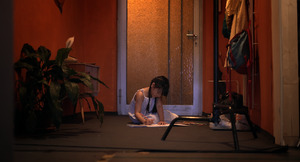
- Als Kind wurde Minh Anh Nguyễn sexuell missbraucht. Mit ihrem 47-minütigen Essayfilm versucht sie, diesen schwierigen Teil ihres Lebens in Worte zu fassen, das Unsagbare auszusprechen und durch die Reflexion und Projektion der filmischen Praxis ein Gefühl für das eigene Selbst zurückzugewinnen. Die Filmemacherin offenbart dabei intime Gespräche mit ihrer Mutter und versucht, den schmerzhaften Prozess zu bewältigen, dieses Trauma an die Öffentlichkeit zu bringen. Mit einer zerbrechlichen Intimität bewegt sich der Film zwischen Fiktion, Archivmaterial und Dokumentation, auf der Suche nach einer Sprache, um das Vergangene auszudrücken und die Zukunft anzunehmen.
- Beschreibung (en)
- As a child, Minh Anh Nguyễn was sexually abused. Her 47-minute essay film is an attempt to put words to this difficult part of her life, to speak the unspeakable and regain a sense of self through the reflection and projection that the act of filmmaking allows. Her film reveals intimate conversations with her mother and tries to overcome the difficult process of making this trauma public. It navigates through a wounded intimacy between fiction, archive footage and documentary in search of a language to articulate the past and embrace the future.
- Kategorie
- Typ des Projekts/Werks
- Schlagworte
- Datierung
- 2025
- Mitwirkende
- Dank an
- Kathrin Beckers
- Kevin Beckmann
- Liam Birtolonu
- Matthias Bruhn
- Phuong Uyen Dao
- Christian Egerer
- Charlotte Eifler
- Kurt Glockzin
- Ute Haag
- Eva Hartmann
- Marine Hugonnier
- Fred Kelemen
- Dane Komljen
- Peter Lütje
- Phuong Thao Luu
- Malik Meyer
- Laura Morcillo
- Hong Anh Nguyen
- Thanh Long Nguyen
- Hai Nguyen
- Ludger Pfanz
- Lars Valentino Pfeiffer
- Christine Reeh
- Caroline Schwarz
- Manuel Sékou
- Trinh Ngoc Tran
- Thu Thao Tran
- Serpil Turhan
- Ha Linh Vuong
- Sprache
- Untertitel (Film)
- Material
- Technik/Verfahren/Formate
- Film
- Dauer
- 46:40 Minuten
- Stadt
- Land
- Beteiligte Institution(en)
- Titel
- so much water, so close to home
- Projektleiter/in
- Semester
- Studiengang
- Typ der Abschlussarbeit
- Externes Archiv
- Importiert am
- 14.05.2025
- Übergeordnete Sets
- 0
- Set enthält
- 0 5
Reflecting Bodies
Name that can easily go onto 2 lines
Author that can easily go onto 2 lines as well
- Titel
- Reflecting Bodies
- Titel (en)
- Reflecting Bodies
- Untertitel
- A space where a physical phenomenon meets a personal fascination
- Untertitel des Projekts/Werks (en)
- A space where a physical phenomenon meets a personal fascination
- Autor/in
- Beschreibung (de)
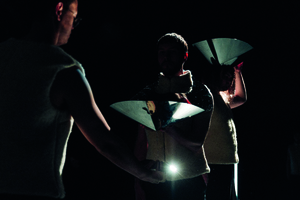
- „Reflektierende Körper“ ist eine interaktive Installation, bei der das physikalische Phänomen der Lichtreflexionen auf eine persönliche Faszination für diese trifft. Im Fokus stehen Lichtreflexionen, die vom menschlichen Körper ausgehen und in Verbindung mit dessen Bewegungsabläufen entstehen.
Hauptbestandteil der Installation ist eine Serie von vier Metallobjekten, die wie Schmuckstücke am Körper getragen werden und mit Wasser gefüllt sind. Sie dienen als Reflexionsflächen und geben auf subtile Art und Weise die Präsenz der Menschen im Raum wieder, während sich dieser in eine lebendige und dynamische Lichtinstallation verwandelt.
Ursprung der Arbeit ist die Auseinandersetzung mit dem Thema "natürliches Licht" und dessen Bedeutung für den Menschen. Die allgemeine Faszination und evolutionsbedingte Abhängigkeit der Menschheit von der Sonne findet sich in nahezu allen Kulturen wieder und bildet die Inspirationsquelle für die Formensprache der Objekte und die Gestaltung des Raums.
- „Reflektierende Körper“ ist eine interaktive Installation, bei der das physikalische Phänomen der Lichtreflexionen auf eine persönliche Faszination für diese trifft. Im Fokus stehen Lichtreflexionen, die vom menschlichen Körper ausgehen und in Verbindung mit dessen Bewegungsabläufen entstehen.
- Beschreibung (en)
- "Reflecting Bodies" is an interactive installation in which the physical phenomenon of light reflections meets a personal fascination for them. The focus is on light reflections that originate from the human body and arise in connection with its movements.
The main component of the installation is a series of four metal objects worn like jewellery pieces on the body and filled with water. They serve as reflecting surfaces and subtly mirror the presence of people in space while it transforms into a vibrant and dynamic light installation.
The origin of the work lies in the study of natural light and its importance for human beings. The general fascination and evolutionary dependence of mankind on the sun can be found in almost all cultures and forms the source of inspiration for the design language of the objects and the space.
- "Reflecting Bodies" is an interactive installation in which the physical phenomenon of light reflections meets a personal fascination for them. The focus is on light reflections that originate from the human body and arise in connection with its movements.
- Kategorie
- Typ des Projekts/Werks
- Schlagworte
- Datierung
- 27.04.2023
- Mitwirkende
- Dank an
- Material
- Technik/Verfahren/Formate
- Metallverarbeitung
- Ort: Institution
- Ort
- Großes Studio
- Stadt
- Land
- Internetlinks
- Titel
- Reflecting Bodies
- Untertitel
- A space where a physical phenomenon meets a personal fascination
- Projektleiter/in
- Semester
- Studiengang
- Typ der Abschlussarbeit
- Importiert am
- 06.10.2024
- Übergeordnete Sets
- 2
- Set enthält
- 0 9