"Bibliothek von ZKM und HfG Karlsruhe"
| Begriff | Bibliothek von ZKM und HfG Karlsruhe |
| Metakey | Externes Archiv (institution:archive) |
| Typ | Keyword |
| Vokabular | HfG |
38 Inhalte
- Seite 1 von 4
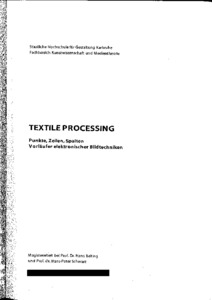
Textile Processing (geschwärzt)
Name that can easily go onto 2 lines
Author that can easily go onto 2 lines as well
- Titel
- Textile Processing (geschwärzt)
- Untertitel
- Punkte, Zeilen, Spalten Vorläufer elektronischer Bildtechniken
- Autor/in
- Beschreibung (de)
- “Die Ähnlichkeiten von Geweben, Mustervorlagen und heutigen Rasterbildern sind eklatant.
In einer Genese der technischen Bilder kann das Gewebe als Exemplarfall und Vorreiter
aller technisch-elektronischer Bilder gelten.”
“Die ersten Bilder, die von ihrem Bildkörper abgelöst wurden, bestanden aus einem Stapel
gelochter Karten für die Verwendung im Jacquardwebstuhl. Der Bildcode ist hier noch
begreifbar, das Bild, wenn es aus dem Stapel dieser Karten gewoben wird, ein textil-taktiles
Produkt. Patricia Wallers Needle-Works zeigen die Leerstelle heutiger Bildmaschinen auf,
wo Bilder auf Monitoren erscheinen, um im nächsten Moment schon wieder durch den
nächsten (Netzhaut-) Eindruck ausgetauscht zu werden.”
- “Die Ähnlichkeiten von Geweben, Mustervorlagen und heutigen Rasterbildern sind eklatant.
- Beschreibung (en)
- ‘The similarities between fabrics, patterns and today's raster images are striking. In the genesis of technical images, the fabric can be seen as the exemplary case and forerunner of all technical-electronic images.’
‘The first images that were detached from their image body consisted of a stack of perforated cards for use in the Jacquard loom. The image code is still comprehensible here, the image, when woven from the pile of these cards, is a textile-tactile product. Patricia Waller's needle works show the empty space of today's image machines, where images appear on monitors only to be replaced by the next (retinal) impression in the very next moment.’
- ‘The similarities between fabrics, patterns and today's raster images are striking. In the genesis of technical images, the fabric can be seen as the exemplary case and forerunner of all technical-electronic images.’
- Kategorie
- Schlagworte
- Datierung
- 02.11.1998
- Sprache
- Ort: Institution
- Titel
- Textile Processing (geschwärzt)
- Untertitel
- Punkte, Zeilen, Spalten Vorläufer elektronischer Bildtechniken
- Urheberrechtshinweis
- Brigit Schneider
- Rechtsschutz/Lizenz
- Freigabe Nutzung HfG
- Medienersteller/in
- Beziehung/Funktion
- Projektleiter/in
- Semester
- Studiengang
- Typ der Abschlussarbeit
- Archiv-Signatur
- HfG HS 1998 02a
- Externes Archiv
- Importiert am
- 17.03.2025
- Übergeordnete Sets
- 1
Textile Processing Deckblatt
Name that can easily go onto 2 lines
Author that can easily go onto 2 lines as well
- Titel
- Textile Processing Deckblatt
- Autor/in
- Beschreibung (de)
- „Die Ähnlichkeiten von Geweben, Mustervorlagen und heutigen Rasterbildern sind eklatant. In einer Genese der technischen Bilder kann das Gewebe als Exemplarfall und Vorreiter aller technisch-elektronischer Bilder gelten.”
„Die ersten Bilder, die von ihrem Bildkörper abgelöst wurden, bestanden aus einem Stapel gelochter Karten für die Verwendung im Jacquardwebstuhl. Der Bildcode ist hier noch begreifbar, das Bild, wenn es aus dem Stapel dieser Karten gewoben wird, ein textil-taktiles Produkt. Patricia Wallers Needle-Works zeigen die Leerstelle heutiger Bildmaschinen auf, wo Bilder auf Monitoren erscheinen, um im nächsten Moment schon wieder durch den nächsten (Netzhaut-) Eindruck ausgetauscht zu werden.”
- „Die Ähnlichkeiten von Geweben, Mustervorlagen und heutigen Rasterbildern sind eklatant. In einer Genese der technischen Bilder kann das Gewebe als Exemplarfall und Vorreiter aller technisch-elektronischer Bilder gelten.”
- Beschreibung (en)
- “The similarities between fabrics, patterns and today's raster images are striking. In the genesis of technical images, the fabric can be regarded as an exemplary case and forerunner of all technical-electronic images.”
“The first images that were detached from their image body consisted of a stack of perforated cards for use in the Jacquard loom. The image code is still comprehensible here, the image, when woven from the pile of these cards, is a textile-tactile product. Patricia Waller's needle works show the blank space of today's image machines, where images appear on monitors only to be replaced by the next (retinal) impression in the very next moment.”
- “The similarities between fabrics, patterns and today's raster images are striking. In the genesis of technical images, the fabric can be regarded as an exemplary case and forerunner of all technical-electronic images.”
- Kategorie
- Typ des Projekts/Werks
- Schlagworte
- Datierung
- 02.11.1998
- Sprache
- Ort: Institution
- Stadt
- Titel
- Textile Processing Deckblatt
- Urheberrechtshinweis
- Birgit Schneider
- Rechtsschutz/Lizenz
- Freigabe Nutzung HfG
- Medienersteller/in
- Beziehung/Funktion
- Projektleiter/in
- Semester
- Studiengang
- Typ der Abschlussarbeit
- Archiv-Signatur
- HfG HS 1998 02
- Externes Archiv
- Importiert am
- 09.01.2025
- Übergeordnete Sets
- 1
Textile Processing
Name that can easily go onto 2 lines
Author that can easily go onto 2 lines as well
- Titel
- Textile Processing
- Untertitel
- Punkte, Zeilen, Spalten; Vorläufer elektronischer Bildtechniken
- Autor/in
- Beschreibung (de)
- „Die Ähnlichkeiten von Geweben, Mustervorlagen und heutigen Rasterbildern sind eklatant. In einer Genese der technischen Bilder kann das Gewebe als Exemplarfall und Vorreiter aller technisch-elektronischer Bilder gelten.”
„Die ersten Bilder, die von ihrem Bildkörper abgelöst wurden, bestanden aus einem Stapel gelochter Karten für die Verwendung im Jacquardwebstuhl. Der Bildcode ist hier noch begreifbar, das Bild, wenn es aus dem Stapel dieser Karten gewoben wird, ein textil-taktiles Produkt. Patricia Wallers Needle-Works zeigen die Leerstelle heutiger Bildmaschinen auf, wo Bilder auf Monitoren erscheinen, um im nächsten Moment schon wieder durch den nächsten (Netzhaut-) Eindruck ausgetauscht zu werden.”
- „Die Ähnlichkeiten von Geweben, Mustervorlagen und heutigen Rasterbildern sind eklatant. In einer Genese der technischen Bilder kann das Gewebe als Exemplarfall und Vorreiter aller technisch-elektronischer Bilder gelten.”
- Beschreibung (en)
- “The similarities between fabrics, patterns and today's raster images are striking. In the genesis of technical images, the fabric can be regarded as an exemplary case and forerunner of all technical-electronic images.”
“The first images that were detached from their image body consisted of a stack of perforated cards for use in the Jacquard loom. The image code is still comprehensible here, the image, when woven from the pile of these cards, is a textile-tactile product. Patricia Waller's needle works show the blank space of today's image machines, where images appear on monitors only to be replaced by the next (retinal) impression in the very next moment.”
- “The similarities between fabrics, patterns and today's raster images are striking. In the genesis of technical images, the fabric can be regarded as an exemplary case and forerunner of all technical-electronic images.”
- Kategorie
- Typ des Projekts/Werks
- Schlagworte
- Datierung
- 02.11.1998
- Sprache
- Ort: Institution
- Stadt
- Titel
- Textile Processing
- Untertitel
- Punkte, Zeilen, Spalten; Vorläufer elektronischer Bildtechniken
- Urheberrechtshinweis
- Brigit Schneider
- Rechtsschutz/Lizenz
- Freigabe Nutzung HfG
- Medienersteller/in
- Beziehung/Funktion
- Projektleiter/in
- Semester
- Studiengang
- Typ der Abschlussarbeit
- Archiv-Signatur
- HfG HS 1998 02
- Externes Archiv
- Importiert am
- 04.08.2023
- Übergeordnete Sets
- 1
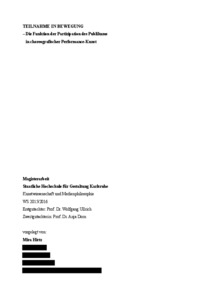
Teilnahme in Bewegung Magisterarbeit (geschw.)
Name that can easily go onto 2 lines
Author that can easily go onto 2 lines as well
- Titel
- Teilnahme in Bewegung Magisterarbeit (geschw.)
- Untertitel
- die Funktion der Partizipation des Publikums in choreografischer Performance-Kunst
- Autor/in
- Beschreibung (de)
- „Die Partizipation des Publikums in Performance-Kunst – der Titel der Magisterarbeit – ruft die Vorstellung eines klassischen ,Mitmach‘-Theaters beziehungsweise eines von ,mitmachenden‘ Performance-BesucherInnen hervor, in dem das Publikum dazu angehalten wird, sich aktiv und produktiv am Geschehen der Aufführung zu beteiligen. Auch am Beginn meiner Recherche stand diese Vorstellung und Partizipation damit als Phänomen, dem – sowohl von der Seite der RezipientInnen aus, als auch von der der PerformerInnen und der KünstlerInnen – zum einen mit großen Unbehagen, zum anderen mit großer Begeisterung begegnet wird.”
„Das Versprechen, das von der Partizipation des Publikums ausgeht, baut darauf, der konventionell passiven und kontemplativen Betrachtung des Kunstwerks, das von einer singulären Autorschaft gefertigt wurde, entgegenzuwirken. Das Unbehagen gegenüber Partizipation drückt sich zum einen in der Skepsis aus, ob Partizipation die Funktion der Aktivierung des Publikums leisten kann. Bedeutet Teilhabe nicht, dass das Publikum innerhalb eines festgelegten Rahmens und eines bestehenden Konzeptes bloß mitmachen ,darf‘? Heißt das nicht, dass es noch immer in passiver Unmündigkeit gefangen bleibt, aber nun, ja noch schlimmer, mit der Illusion der eigenen Souveränität? In der folgenden Analyse werde ich zeigen, dass die Bezeichnungen aktiv und passiv, selbstbestimmt und determiniert und die damit einhergehenden normativen Befunde allerdings genauerer Differenzierung bedürfen.”
- „Die Partizipation des Publikums in Performance-Kunst – der Titel der Magisterarbeit – ruft die Vorstellung eines klassischen ,Mitmach‘-Theaters beziehungsweise eines von ,mitmachenden‘ Performance-BesucherInnen hervor, in dem das Publikum dazu angehalten wird, sich aktiv und produktiv am Geschehen der Aufführung zu beteiligen. Auch am Beginn meiner Recherche stand diese Vorstellung und Partizipation damit als Phänomen, dem – sowohl von der Seite der RezipientInnen aus, als auch von der der PerformerInnen und der KünstlerInnen – zum einen mit großen Unbehagen, zum anderen mit großer Begeisterung begegnet wird.”
- Beschreibung (en)
- ‘The participation of the audience in performance art - the title of the master's thesis - evokes the idea of a classic ‘participatory’ theatre or one of ‘participating’ performance visitors, in which the audience is encouraged to actively and productively participate in the events of the performance. At the beginning of my research, this idea and participation was also a phenomenon that was met with great discomfort on the one hand and great enthusiasm on the other, both on the part of the recipients and the performers and artists.’
‘The promise of audience participation is based on counteracting the conventionally passive and contemplative view of the artwork produced by a singular authorship. The unease about participation is expressed on the one hand in the scepticism as to whether participation can fulfil the function of activating the audience. Doesn't participation mean that the audience is merely ‘allowed’ to take part within a fixed framework and an existing concept? Does this not mean that they are still trapped in passive immaturity, but now, even worse, with the illusion of their own sovereignty? In the following analysis, I will show that the terms active and passive, self-determined and determined and the associated normative findings require more precise differentiation.’
- ‘The participation of the audience in performance art - the title of the master's thesis - evokes the idea of a classic ‘participatory’ theatre or one of ‘participating’ performance visitors, in which the audience is encouraged to actively and productively participate in the events of the performance. At the beginning of my research, this idea and participation was also a phenomenon that was met with great discomfort on the one hand and great enthusiasm on the other, both on the part of the recipients and the performers and artists.’
- Kategorie
- Typ des Projekts/Werks
- Schlagworte
- Sprache
- Ort: Institution
- Titel
- Teilnahme in Bewegung Magisterarbeit (geschw.)
- Untertitel
- die Funktion der Partizipation des Publikums in choreografischer Performance-Kunst
- Urheberrechtshinweis
- © Mira Hirtz
- Rechtsschutz/Lizenz
- Freigabe Nutzung HfG
- Medienersteller/in
- Beziehung/Funktion
- Medien-Beschreibung (en)
- censored version
- Projektleiter/in
- Semester
- Studiengang
- Typ der Abschlussarbeit
- Archiv-Signatur
- HfG HS 2015 05
- Externes Archiv
- Importiert am
- 30.03.2025
- Übergeordnete Sets
- 1
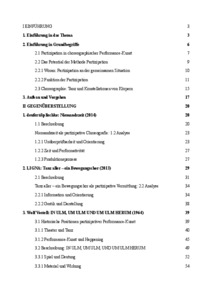
Teilnahme in Bewegung Inhaltsverzeichnis
Name that can easily go onto 2 lines
Author that can easily go onto 2 lines as well
- Titel
- Teilnahme in Bewegung Inhaltsverzeichnis
- Untertitel
- die Funktion der Partizipation des Publikums in choreografischer Performance-Kunst
- Autor/in
- Beschreibung (de)
- „Die Partizipation des Publikums in Performance-Kunst – der Titel der Magisterarbeit – ruft die Vorstellung eines klassischen ,Mitmach‘-Theaters beziehungsweise eines von ,mitmachenden‘ Performance-BesucherInnen hervor, in dem das Publikum dazu angehalten wird, sich aktiv und produktiv am Geschehen der Aufführung zu beteiligen. Auch am Beginn meiner Recherche stand diese Vorstellung und Partizipation damit als Phänomen, dem – sowohl von der Seite der RezipientInnen aus, als auch von der der PerformerInnen und der KünstlerInnen – zum einen mit großen Unbehagen, zum anderen mit großer Begeisterung begegnet wird.”
„Das Versprechen, das von der Partizipation des Publikums ausgeht, baut darauf, der konventionell passiven und kontemplativen Betrachtung des Kunstwerks, das von einer singulären Autorschaft gefertigt wurde, entgegenzuwirken. Das Unbehagen gegenüber Partizipation drückt sich zum einen in der Skepsis aus, ob Partizipation die Funktion der Aktivierung des Publikums leisten kann. Bedeutet Teilhabe nicht, dass das Publikum innerhalb eines festgelegten Rahmens und eines bestehenden Konzeptes bloß mitmachen ,darf‘? Heißt das nicht, dass es noch immer in passiver Unmündigkeit gefangen bleibt, aber nun, ja noch schlimmer, mit der Illusion der eigenen Souveränität? In der folgenden Analyse werde ich zeigen, dass die Bezeichnungen aktiv und passiv, selbstbestimmt und determiniert und die damit einhergehenden normativen Befunde allerdings genauerer Differenzierung bedürfen.”
- „Die Partizipation des Publikums in Performance-Kunst – der Titel der Magisterarbeit – ruft die Vorstellung eines klassischen ,Mitmach‘-Theaters beziehungsweise eines von ,mitmachenden‘ Performance-BesucherInnen hervor, in dem das Publikum dazu angehalten wird, sich aktiv und produktiv am Geschehen der Aufführung zu beteiligen. Auch am Beginn meiner Recherche stand diese Vorstellung und Partizipation damit als Phänomen, dem – sowohl von der Seite der RezipientInnen aus, als auch von der der PerformerInnen und der KünstlerInnen – zum einen mit großen Unbehagen, zum anderen mit großer Begeisterung begegnet wird.”
- Beschreibung (en)
- ‘The participation of the audience in performance art - the title of the master's thesis - evokes the idea of a classic ‘participatory’ theatre or one of ‘participating’ performance visitors, in which the audience is encouraged to actively and productively participate in the events of the performance. At the beginning of my research, this idea and participation was also a phenomenon that was met with great discomfort on the one hand and great enthusiasm on the other, both on the part of the recipients and the performers and artists.’
‘The promise of audience participation is based on counteracting the conventionally passive and contemplative view of the artwork produced by a singular authorship. The unease about participation is expressed on the one hand in the scepticism as to whether participation can fulfil the function of activating the audience. Doesn't participation mean that the audience is merely ‘allowed’ to take part within a fixed framework and an existing concept? Does this not mean that they are still trapped in passive immaturity, but now, even worse, with the illusion of their own sovereignty? In the following analysis, I will show that the terms active and passive, self-determined and determined and the associated normative findings require more precise differentiation.’
- ‘The participation of the audience in performance art - the title of the master's thesis - evokes the idea of a classic ‘participatory’ theatre or one of ‘participating’ performance visitors, in which the audience is encouraged to actively and productively participate in the events of the performance. At the beginning of my research, this idea and participation was also a phenomenon that was met with great discomfort on the one hand and great enthusiasm on the other, both on the part of the recipients and the performers and artists.’
- Kategorie
- Typ des Projekts/Werks
- Schlagworte
- Sprache
- Ort: Institution
- Titel
- Teilnahme in Bewegung Inhaltsverzeichnis
- Untertitel
- die Funktion der Partizipation des Publikums in choreografischer Performance-Kunst
- Urheberrechtshinweis
- © Mira Hirtz
- Rechtsschutz/Lizenz
- Freigabe Nutzung HfG
- Medienersteller/in
- Beziehung/Funktion
- Projektleiter/in
- Semester
- Studiengang
- Typ der Abschlussarbeit
- Archiv-Signatur
- HfG HS 2015 05
- Externes Archiv
- Importiert am
- 30.03.2025
- Übergeordnete Sets
- 1
Teilnahme in Bewegung Decklblatt

Name that can easily go onto 2 lines
Author that can easily go onto 2 lines as well
- Titel
- Teilnahme in Bewegung Decklblatt
- Untertitel
- die Funktion der Partizipation des Publikums in choreografischer Performance-Kunst
- Autor/in
- Beschreibung (de)
- „Die Partizipation des Publikums in Performance-Kunst – der Titel der Magisterarbeit – ruft die Vorstellung eines klassischen ,Mitmach‘-Theaters beziehungsweise eines von ,mitmachenden‘ Performance-BesucherInnen hervor, in dem das Publikum dazu angehalten wird, sich aktiv und produktiv am Geschehen der Aufführung zu beteiligen. Auch am Beginn meiner Recherche stand diese Vorstellung und Partizipation damit als Phänomen, dem – sowohl von der Seite der RezipientInnen aus, als auch von der der PerformerInnen und der KünstlerInnen – zum einen mit großen Unbehagen, zum anderen mit großer Begeisterung begegnet wird.”
„Das Versprechen, das von der Partizipation des Publikums ausgeht, baut darauf, der konventionell passiven und kontemplativen Betrachtung des Kunstwerks, das von einer singulären Autorschaft gefertigt wurde, entgegenzuwirken. Das Unbehagen gegenüber Partizipation drückt sich zum einen in der Skepsis aus, ob Partizipation die Funktion der Aktivierung des Publikums leisten kann. Bedeutet Teilhabe nicht, dass das Publikum innerhalb eines festgelegten Rahmens und eines bestehenden Konzeptes bloß mitmachen ,darf‘? Heißt das nicht, dass es noch immer in passiver Unmündigkeit gefangen bleibt, aber nun, ja noch schlimmer, mit der Illusion der eigenen Souveränität? In der folgenden Analyse werde ich zeigen, dass die Bezeichnungen aktiv und passiv, selbstbestimmt und determiniert und die damit einhergehenden normativen Befunde allerdings genauerer Differenzierung bedürfen.”
- „Die Partizipation des Publikums in Performance-Kunst – der Titel der Magisterarbeit – ruft die Vorstellung eines klassischen ,Mitmach‘-Theaters beziehungsweise eines von ,mitmachenden‘ Performance-BesucherInnen hervor, in dem das Publikum dazu angehalten wird, sich aktiv und produktiv am Geschehen der Aufführung zu beteiligen. Auch am Beginn meiner Recherche stand diese Vorstellung und Partizipation damit als Phänomen, dem – sowohl von der Seite der RezipientInnen aus, als auch von der der PerformerInnen und der KünstlerInnen – zum einen mit großen Unbehagen, zum anderen mit großer Begeisterung begegnet wird.”
- Beschreibung (en)
- ‘The participation of the audience in performance art - the title of the master's thesis - evokes the idea of a classic ‘participatory’ theatre or one of ‘participating’ performance visitors, in which the audience is encouraged to actively and productively participate in the events of the performance. At the beginning of my research, this idea and participation was also a phenomenon that was met with great discomfort on the one hand and great enthusiasm on the other, both on the part of the recipients and the performers and artists.’
‘The promise of audience participation is based on counteracting the conventionally passive and contemplative view of the artwork produced by a singular authorship. The unease about participation is expressed on the one hand in the scepticism as to whether participation can fulfil the function of activating the audience. Doesn't participation mean that the audience is merely ‘allowed’ to take part within a fixed framework and an existing concept? Does this not mean that they are still trapped in passive immaturity, but now, even worse, with the illusion of their own sovereignty? In the following analysis, I will show that the terms active and passive, self-determined and determined and the associated normative findings require more precise differentiation.’
- ‘The participation of the audience in performance art - the title of the master's thesis - evokes the idea of a classic ‘participatory’ theatre or one of ‘participating’ performance visitors, in which the audience is encouraged to actively and productively participate in the events of the performance. At the beginning of my research, this idea and participation was also a phenomenon that was met with great discomfort on the one hand and great enthusiasm on the other, both on the part of the recipients and the performers and artists.’
- Kategorie
- Typ des Projekts/Werks
- Schlagworte
- Sprache
- Ort: Institution
- Titel
- Teilnahme in Bewegung Decklblatt
- Untertitel
- die Funktion der Partizipation des Publikums in choreografischer Performance-Kunst
- Urheberrechtshinweis
- © Mira Hirtz
- Rechtsschutz/Lizenz
- Freigabe Nutzung HfG
- Medienersteller/in
- Projektleiter/in
- Semester
- Studiengang
- Typ der Abschlussarbeit
- Archiv-Signatur
- HfG HS 2015 05
- Externes Archiv
- Importiert am
- 30.03.2025
- Übergeordnete Sets
- 1
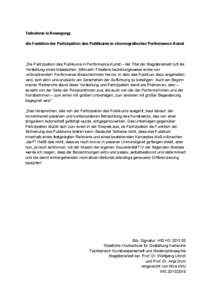
Teilnahme in Bewegung Abstract
Name that can easily go onto 2 lines
Author that can easily go onto 2 lines as well
- Titel
- Teilnahme in Bewegung Abstract
- Untertitel
- die Funktion der Partizipation des Publikums in choreografischer Performance-Kunst
- Autor/in
- Beschreibung (de)
- „Die Partizipation des Publikums in Performance-Kunst – der Titel der Magisterarbeit – ruft die Vorstellung eines klassischen ,Mitmach‘-Theaters beziehungsweise eines von ,mitmachenden‘ Performance-BesucherInnen hervor, in dem das Publikum dazu angehalten wird, sich aktiv und produktiv am Geschehen der Aufführung zu beteiligen. Auch am Beginn meiner Recherche stand diese Vorstellung und Partizipation damit als Phänomen, dem – sowohl von der Seite der RezipientInnen aus, als auch von der der PerformerInnen und der KünstlerInnen – zum einen mit großen Unbehagen, zum anderen mit großer Begeisterung begegnet wird.”
„Das Versprechen, das von der Partizipation des Publikums ausgeht, baut darauf, der konventionell passiven und kontemplativen Betrachtung des Kunstwerks, das von einer singulären Autorschaft gefertigt wurde, entgegenzuwirken. Das Unbehagen gegenüber Partizipation drückt sich zum einen in der Skepsis aus, ob Partizipation die Funktion der Aktivierung des Publikums leisten kann. Bedeutet Teilhabe nicht, dass das Publikum innerhalb eines festgelegten Rahmens und eines bestehenden Konzeptes bloß mitmachen ,darf‘? Heißt das nicht, dass es noch immer in passiver Unmündigkeit gefangen bleibt, aber nun, ja noch schlimmer, mit der Illusion der eigenen Souveränität? In der folgenden Analyse werde ich zeigen, dass die Bezeichnungen aktiv und passiv, selbstbestimmt und determiniert und die damit einhergehenden normativen Befunde allerdings genauerer Differenzierung bedürfen.”
- „Die Partizipation des Publikums in Performance-Kunst – der Titel der Magisterarbeit – ruft die Vorstellung eines klassischen ,Mitmach‘-Theaters beziehungsweise eines von ,mitmachenden‘ Performance-BesucherInnen hervor, in dem das Publikum dazu angehalten wird, sich aktiv und produktiv am Geschehen der Aufführung zu beteiligen. Auch am Beginn meiner Recherche stand diese Vorstellung und Partizipation damit als Phänomen, dem – sowohl von der Seite der RezipientInnen aus, als auch von der der PerformerInnen und der KünstlerInnen – zum einen mit großen Unbehagen, zum anderen mit großer Begeisterung begegnet wird.”
- Beschreibung (en)
- ‘The participation of the audience in performance art - the title of the master's thesis - evokes the idea of a classic ‘participatory’ theatre or one of ‘participating’ performance visitors, in which the audience is encouraged to actively and productively participate in the events of the performance. At the beginning of my research, this idea and participation was also a phenomenon that was met with great discomfort on the one hand and great enthusiasm on the other, both on the part of the recipients and the performers and artists.’
‘The promise of audience participation is based on counteracting the conventionally passive and contemplative view of the artwork produced by a singular authorship. The unease about participation is expressed on the one hand in the scepticism as to whether participation can fulfil the function of activating the audience. Doesn't participation mean that the audience is merely ‘allowed’ to take part within a fixed framework and an existing concept? Does this not mean that they are still trapped in passive immaturity, but now, even worse, with the illusion of their own sovereignty? In the following analysis, I will show that the terms active and passive, self-determined and determined and the associated normative findings require more precise differentiation.’
- ‘The participation of the audience in performance art - the title of the master's thesis - evokes the idea of a classic ‘participatory’ theatre or one of ‘participating’ performance visitors, in which the audience is encouraged to actively and productively participate in the events of the performance. At the beginning of my research, this idea and participation was also a phenomenon that was met with great discomfort on the one hand and great enthusiasm on the other, both on the part of the recipients and the performers and artists.’
- Kategorie
- Typ des Projekts/Werks
- Schlagworte
- Sprache
- Ort: Institution
- Titel
- Teilnahme in Bewegung Abstract
- Untertitel
- die Funktion der Partizipation des Publikums in choreografischer Performance-Kunst
- Urheberrechtshinweis
- © Mira Hirtz
- Rechtsschutz/Lizenz
- Freigabe Nutzung HfG
- Medienersteller/in
- Beziehung/Funktion
- Projektleiter/in
- Semester
- Studiengang
- Typ der Abschlussarbeit
- Archiv-Signatur
- HfG HS 2015 05
- Externes Archiv
- Importiert am
- 30.03.2025
- Übergeordnete Sets
- 1
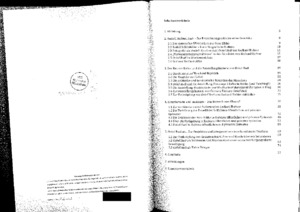
Onkel Rudi als... (Inhaltsverzeichnis)
Name that can easily go onto 2 lines
Author that can easily go onto 2 lines as well
- Titel
- Onkel Rudi als... (Inhaltsverzeichnis)
- Untertitel
- zur Werk- und Wirkungsgeschichte eines Gemäldes von Gerhard Richter im Spiegel seiner Selbstäußerungen
- Autor/in
- Beschreibung (de)
- „Das Jahr 2012 stand ganz im Zeichen Gerhard Richters. So konnte man ihm im Kino bei der Arbeit bei der Arbeit über die Schulter schauen – so der bereits erstmals im September 2011 präsentierte Kinofilm Painting von Corinna Belz .., was einherging mit dem beachtlichen Erfolg auf dem secondary market, dem Auktionsmarkt, wo seine vornehmlich abstrakten Gemälde dank Höchstpreisen zu Kunstmarktlieblingen avancierten.”
„Gerade ein Gemälde scheint anders als viele andere in den letzten Jahren immer mehr mit symbolischer Bedeutung aufgeladen worden zu sein: Onkel Rudi (Abb.1), entstanden 1965. Die fotografische Vorlage entnahm Richter dem eigenen Familienalbum. Als ‚Privates öffentlich’ machen, wurde diese Vorgehensweise in der Motivauswahl der so genannten Foto-Bilder vielfach begründet. Dies zeigt sich nicht zuletzt in den Fotografien, die Richter auf Einladung der Tageszeitung „Die Welt” für eine Sonderausgabe ausdrucken ließ – und damit ist “der große Zweifler der Gegenwartskunst” erst der dritte Künstler, nach Georg Baselitz und Ellsworth Kelly, die die „Welt-Herrschaft” für einen Tag übernommen hat.”
- „Das Jahr 2012 stand ganz im Zeichen Gerhard Richters. So konnte man ihm im Kino bei der Arbeit bei der Arbeit über die Schulter schauen – so der bereits erstmals im September 2011 präsentierte Kinofilm Painting von Corinna Belz .., was einherging mit dem beachtlichen Erfolg auf dem secondary market, dem Auktionsmarkt, wo seine vornehmlich abstrakten Gemälde dank Höchstpreisen zu Kunstmarktlieblingen avancierten.”
- Beschreibung (en)
- "The year 2012 was all about Gerhard Richter. It was possible to watch him at work in the cinema - for example, the cinema film Painting by Corinna Belz, first presented in September 2011 ... which was accompanied by considerable success on the secondary market, the auction market, where his predominantly abstract paintings became art market favourites thanks to top prices.‘
’One painting in particular, unlike many others, seems to have been increasingly charged with symbolic meaning in recent years: Uncle Rudi (fig. 1), created in 1965. Richter took the photographic model from his own family album. This approach was often justified as “publicising the private” in the choice of motifs for the so-called photo images. This can be seen not least in the photographs that Richter had printed for a special edition at the invitation of the daily newspaper ‘Die Welt’ - making ‘the great doubter of contemporary art’ only the third artist, after Georg Baselitz and Ellsworth Kelly, to take over ‘Welt/world domination’ for a day."
- "The year 2012 was all about Gerhard Richter. It was possible to watch him at work in the cinema - for example, the cinema film Painting by Corinna Belz, first presented in September 2011 ... which was accompanied by considerable success on the secondary market, the auction market, where his predominantly abstract paintings became art market favourites thanks to top prices.‘
- Kategorie
- Typ des Projekts/Werks
- Schlagworte
- Datierung
- 15.01.2013
- Sprache
- Ort: Institution
- Titel
- Onkel Rudi als... (Inhaltsverzeichnis)
- Untertitel
- zur Werk- und Wirkungsgeschichte eines Gemäldes von Gerhard Richter im Spiegel seiner Selbstäußerungen
- Urheberrechtshinweis
- Hendrik Bündge
- Rechtsschutz/Lizenz
- Freigabe Nutzung HfG
- Medienersteller/in
- Beziehung/Funktion
- Projektleiter/in
- Semester
- Studiengang
- Typ der Abschlussarbeit
- Archiv-Signatur
- HfG HS 2013 01
- Externes Archiv
- Importiert am
- 17.03.2025
- Übergeordnete Sets
- 1
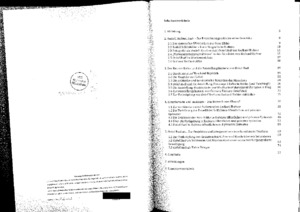
Onkel Rudi als... (edited)
Name that can easily go onto 2 lines
Author that can easily go onto 2 lines as well
- Titel
- Onkel Rudi als... (edited)
- Untertitel
- zur Werk- und Wirkungsgeschichte eines Gemäldes von Gerhard Richter im Spiegel seiner Selbstäußerungen
- Autor/in
- Beschreibung (de)
- „Das Jahr 2012 stand ganz im Zeichen Gerhard Richters. So konnte man ihm im Kino bei der Arbeit bei der Arbeit über die Schulter schauen – so der bereits erstmals im September 2011 präsentierte Kinofilm Painting von Corinna Belz .., was einherging mit dem beachtlichen Erfolg auf dem secondary market, dem Auktionsmarkt, wo seine vornehmlich abstrakten Gemälde dank Höchstpreisen zu Kunstmarktlieblingen avancierten.”
„Gerade ein Gemälde scheint anders als viele andere in den letzten Jahren immer mehr mit symbolischer Bedeutung aufgeladen worden zu sein: Onkel Rudi (Abb.1), entstanden 1965. Die fotografische Vorlage entnahm Richter dem eigenen Familienalbum. Als ‚Privates öffentlich’ machen, wurde diese Vorgehensweise in der Motivauswahl der so genannten Foto-Bilder vielfach begründet. Dies zeigt sich nicht zuletzt in den Fotografien, die Richter auf Einladung der Tageszeitung „Die Welt” für eine Sonderausgabe ausdrucken ließ – und damit ist “der große Zweifler der Gegenwartskunst” erst der dritte Künstler, nach Georg Baselitz und Ellsworth Kelly, die die „Welt-Herrschaft” für einen Tag übernommen hat.”
- „Das Jahr 2012 stand ganz im Zeichen Gerhard Richters. So konnte man ihm im Kino bei der Arbeit bei der Arbeit über die Schulter schauen – so der bereits erstmals im September 2011 präsentierte Kinofilm Painting von Corinna Belz .., was einherging mit dem beachtlichen Erfolg auf dem secondary market, dem Auktionsmarkt, wo seine vornehmlich abstrakten Gemälde dank Höchstpreisen zu Kunstmarktlieblingen avancierten.”
- Beschreibung (en)
- "The year 2012 was all about Gerhard Richter. It was possible to watch him at work in the cinema - for example, the cinema film Painting by Corinna Belz, first presented in September 2011 ... which was accompanied by considerable success on the secondary market, the auction market, where his predominantly abstract paintings became art market favourites thanks to top prices.‘
’One painting in particular, unlike many others, seems to have been increasingly charged with symbolic meaning in recent years: Uncle Rudi (fig. 1), created in 1965. Richter took the photographic model from his own family album. This approach was often justified as “publicising the private” in the choice of motifs for the so-called photo images. This can be seen not least in the photographs that Richter had printed for a special edition at the invitation of the daily newspaper ‘Die Welt’ - making ‘the great doubter of contemporary art’ only the third artist, after Georg Baselitz and Ellsworth Kelly, to take over ‘Welt/world domination’ for a day."
- "The year 2012 was all about Gerhard Richter. It was possible to watch him at work in the cinema - for example, the cinema film Painting by Corinna Belz, first presented in September 2011 ... which was accompanied by considerable success on the secondary market, the auction market, where his predominantly abstract paintings became art market favourites thanks to top prices.‘
- Kategorie
- Typ des Projekts/Werks
- Schlagworte
- Datierung
- 15.01.2013
- Sprache
- Ort: Institution
- Titel
- Onkel Rudi als... (edited)
- Untertitel
- zur Werk- und Wirkungsgeschichte eines Gemäldes von Gerhard Richter im Spiegel seiner Selbstäußerungen
- Urheberrechtshinweis
- Hendrik Bündge
- Rechtsschutz/Lizenz
- Freigabe Nutzung HfG
- Medienersteller/in
- Beziehung/Funktion
- Medien-Beschreibung
- geschwärzte / censored Version
- Projektleiter/in
- Semester
- Studiengang
- Typ der Abschlussarbeit
- Archiv-Signatur
- HfG HS 2013 01
- Externes Archiv
- Importiert am
- 17.03.2025
- Übergeordnete Sets
- 1
Onkel Rudi als... (Deckblatt)
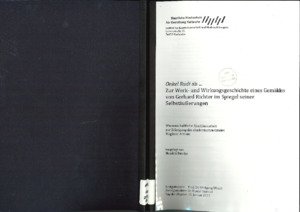
Name that can easily go onto 2 lines
Author that can easily go onto 2 lines as well
- Titel
- Onkel Rudi als... (Deckblatt)
- Untertitel
- zur Werk- und Wirkungsgeschichte eines Gemäldes von Gerhard Richter im Spiegel seiner Selbstäußerungen
- Autor/in
- Beschreibung (de)
- „Das Jahr 2012 stand ganz im Zeichen Gerhard Richters. So konnte man ihm im Kino bei der Arbeit bei der Arbeit über die Schulter schauen – so der bereits erstmals im September 2011 präsentierte Kinofilm Painting von Corinna Belz .., was einherging mit dem beachtlichen Erfolg auf dem secondary market, dem Auktionsmarkt, wo seine vornehmlich abstrakten Gemälde dank Höchstpreisen zu Kunstmarktlieblingen avancierten.”
„Gerade ein Gemälde scheint anders als viele andere in den letzten Jahren immer mehr mit symbolischer Bedeutung aufgeladen worden zu sein: Onkel Rudi (Abb.1), entstanden 1965. Die fotografische Vorlage entnahm Richter dem eigenen Familienalbum. Als ‚Privates öffentlich’ machen, wurde diese Vorgehensweise in der Motivauswahl der so genannten Foto-Bilder vielfach begründet. Dies zeigt sich nicht zuletzt in den Fotografien, die Richter auf Einladung der Tageszeitung „Die Welt” für eine Sonderausgabe ausdrucken ließ – und damit ist “der große Zweifler der Gegenwartskunst” erst der dritte Künstler, nach Georg Baselitz und Ellsworth Kelly, die die „Welt-Herrschaft” für einen Tag übernommen hat.”
- „Das Jahr 2012 stand ganz im Zeichen Gerhard Richters. So konnte man ihm im Kino bei der Arbeit bei der Arbeit über die Schulter schauen – so der bereits erstmals im September 2011 präsentierte Kinofilm Painting von Corinna Belz .., was einherging mit dem beachtlichen Erfolg auf dem secondary market, dem Auktionsmarkt, wo seine vornehmlich abstrakten Gemälde dank Höchstpreisen zu Kunstmarktlieblingen avancierten.”
- Beschreibung (en)
- "The year 2012 was all about Gerhard Richter. It was possible to watch him at work in the cinema - for example, the cinema film Painting by Corinna Belz, first presented in September 2011 ... which was accompanied by considerable success on the secondary market, the auction market, where his predominantly abstract paintings became art market favourites thanks to top prices.‘
’One painting in particular, unlike many others, seems to have been increasingly charged with symbolic meaning in recent years: Uncle Rudi (fig. 1), created in 1965. Richter took the photographic model from his own family album. This approach was often justified as “publicising the private” in the choice of motifs for the so-called photo images. This can be seen not least in the photographs that Richter had printed for a special edition at the invitation of the daily newspaper ‘Die Welt’ - making ‘the great doubter of contemporary art’ only the third artist, after Georg Baselitz and Ellsworth Kelly, to take over ‘Welt/world domination’ for a day."
- "The year 2012 was all about Gerhard Richter. It was possible to watch him at work in the cinema - for example, the cinema film Painting by Corinna Belz, first presented in September 2011 ... which was accompanied by considerable success on the secondary market, the auction market, where his predominantly abstract paintings became art market favourites thanks to top prices.‘
- Kategorie
- Typ des Projekts/Werks
- Schlagworte
- Datierung
- 15.01.2013
- Sprache
- Ort: Institution
- Titel
- Onkel Rudi als... (Deckblatt)
- Untertitel
- zur Werk- und Wirkungsgeschichte eines Gemäldes von Gerhard Richter im Spiegel seiner Selbstäußerungen
- Urheberrechtshinweis
- Hendrik Bündge
- Rechtsschutz/Lizenz
- Freigabe Nutzung HfG
- Medienersteller/in
- Beziehung/Funktion
- Projektleiter/in
- Semester
- Studiengang
- Typ der Abschlussarbeit
- Archiv-Signatur
- HfG HS 2013 01
- Externes Archiv
- Importiert am
- 20.02.2025
- Übergeordnete Sets
- 1
Onkel Rudi als... (Abstract)
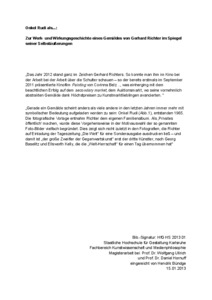
Name that can easily go onto 2 lines
Author that can easily go onto 2 lines as well
- Titel
- Onkel Rudi als... (Abstract)
- Untertitel
- zur Werk- und Wirkungsgeschichte eines Gemäldes von Gerhard Richter im Spiegel seiner Selbstäußerungen
- Autor/in
- Beschreibung (de)
- „Das Jahr 2012 stand ganz im Zeichen Gerhard Richters. So konnte man ihm im Kino bei der Arbeit bei der Arbeit über die Schulter schauen – so der bereits erstmals im September 2011 präsentierte Kinofilm Painting von Corinna Belz .., was einherging mit dem beachtlichen Erfolg auf dem secondary market, dem Auktionsmarkt, wo seine vornehmlich abstrakten Gemälde dank Höchstpreisen zu Kunstmarktlieblingen avancierten.”
„Gerade ein Gemälde scheint anders als viele andere in den letzten Jahren immer mehr mit symbolischer Bedeutung aufgeladen worden zu sein: Onkel Rudi (Abb.1), entstanden 1965. Die fotografische Vorlage entnahm Richter dem eigenen Familienalbum. Als ‚Privates öffentlich’ machen, wurde diese Vorgehensweise in der Motivauswahl der so genannten Foto-Bilder vielfach begründet. Dies zeigt sich nicht zuletzt in den Fotografien, die Richter auf Einladung der Tageszeitung „Die Welt” für eine Sonderausgabe ausdrucken ließ – und damit ist “der große Zweifler der Gegenwartskunst” erst der dritte Künstler, nach Georg Baselitz und Ellsworth Kelly, die die „Welt-Herrschaft” für einen Tag übernommen hat.”
- „Das Jahr 2012 stand ganz im Zeichen Gerhard Richters. So konnte man ihm im Kino bei der Arbeit bei der Arbeit über die Schulter schauen – so der bereits erstmals im September 2011 präsentierte Kinofilm Painting von Corinna Belz .., was einherging mit dem beachtlichen Erfolg auf dem secondary market, dem Auktionsmarkt, wo seine vornehmlich abstrakten Gemälde dank Höchstpreisen zu Kunstmarktlieblingen avancierten.”
- Beschreibung (en)
- "The year 2012 was all about Gerhard Richter. It was possible to watch him at work in the cinema - for example, the cinema film Painting by Corinna Belz, first presented in September 2011 ... which was accompanied by considerable success on the secondary market, the auction market, where his predominantly abstract paintings became art market favourites thanks to top prices.‘
’One painting in particular, unlike many others, seems to have been increasingly charged with symbolic meaning in recent years: Uncle Rudi (fig. 1), created in 1965. Richter took the photographic model from his own family album. This approach was often justified as “publicising the private” in the choice of motifs for the so-called photo images. This can be seen not least in the photographs that Richter had printed for a special edition at the invitation of the daily newspaper ‘Die Welt’ - making ‘the great doubter of contemporary art’ only the third artist, after Georg Baselitz and Ellsworth Kelly, to take over ‘Welt/world domination’ for a day."
- "The year 2012 was all about Gerhard Richter. It was possible to watch him at work in the cinema - for example, the cinema film Painting by Corinna Belz, first presented in September 2011 ... which was accompanied by considerable success on the secondary market, the auction market, where his predominantly abstract paintings became art market favourites thanks to top prices.‘
- Kategorie
- Typ des Projekts/Werks
- Schlagworte
- Datierung
- 15.01.2013
- Sprache
- Ort: Institution
- Titel
- Onkel Rudi als... (Abstract)
- Untertitel
- zur Werk- und Wirkungsgeschichte eines Gemäldes von Gerhard Richter im Spiegel seiner Selbstäußerungen
- Urheberrechtshinweis
- Hendrik Bündge
- Rechtsschutz/Lizenz
- Freigabe Nutzung HfG
- Medienersteller/in
- Beziehung/Funktion
- Medien-Beschreibung
- Kurzbescheibung / Abstract
- Projektleiter/in
- Semester
- Studiengang
- Typ der Abschlussarbeit
- Archiv-Signatur
- HfG HS 2013 01
- Externes Archiv
- Importiert am
- 24.02.2025
- Übergeordnete Sets
- 1
Mythos Großstadt
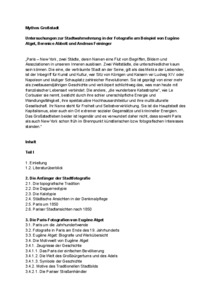
Name that can easily go onto 2 lines
Author that can easily go onto 2 lines as well
- Titel
- Mythos Großstadt
- Untertitel
- Untersuchungen zur Stadtwahrnehmung in der Fotografie am Beispiel von Eugène Atget, Berenice Abbott und Andreas Feininger
- Autor/in
- Beschreibung (de)
- „Paris – New York, zwei Städte, deren Namen eine Flut von Begriffen, Bildern und Assoziationen in unserem Inneren auslösen. Zwei Weltstädte, die unterschiedlicher kaum sein können. Die eine, die verträumte Stadt an der Seine, gilt als das Mekka der Liebenden, ist der Inbegriff für Kunst und Kultur, war Sitz von Königen und Kaisern wir Ludwig XIV. oder Napoleon und blutiger Schauplatz zahlreicher Revolutionen. Sie ist geprägt von einer mehr als zweitausendjährigen Geschichte und verkörpert schlichtweg das, was man heute mit französischer Lebensart verbindet. Die andere, 'die wunderbare Katastrophe', wie Le Corbusier sie nennt, besticht durch ihre schier unerschöpfliche Energie und Wandlungsfähigkeit, ihre spektakuläre Hochhausarchitektur und ihre multikulturelle Gesellschaft. Ihr Name steht für Freiheit und Selbstverwirklichung. Sie ist die Hauptstadt des Kapitalismus, aber auch ein Ort extremer sozialer Gegensätze und krimineller Energien.
Das Großstadtleben beider ist legendär und es verwundert daher nicht, dass sowohl Paris als auch New York schon früh im Brennpunkt künstlerischen bzw. fotografischen Interesses standen.”
- „Paris – New York, zwei Städte, deren Namen eine Flut von Begriffen, Bildern und Assoziationen in unserem Inneren auslösen. Zwei Weltstädte, die unterschiedlicher kaum sein können. Die eine, die verträumte Stadt an der Seine, gilt als das Mekka der Liebenden, ist der Inbegriff für Kunst und Kultur, war Sitz von Königen und Kaisern wir Ludwig XIV. oder Napoleon und blutiger Schauplatz zahlreicher Revolutionen. Sie ist geprägt von einer mehr als zweitausendjährigen Geschichte und verkörpert schlichtweg das, was man heute mit französischer Lebensart verbindet. Die andere, 'die wunderbare Katastrophe', wie Le Corbusier sie nennt, besticht durch ihre schier unerschöpfliche Energie und Wandlungsfähigkeit, ihre spektakuläre Hochhausarchitektur und ihre multikulturelle Gesellschaft. Ihr Name steht für Freiheit und Selbstverwirklichung. Sie ist die Hauptstadt des Kapitalismus, aber auch ein Ort extremer sozialer Gegensätze und krimineller Energien.
- Beschreibung (en)
- "Paris - New York, two cities whose names trigger a flood of concepts, images and associations within us. Two cosmopolitan cities that could hardly be more different. One, the dreamy city on the Seine, is considered the Mecca of lovers, is the epitome of art and culture, was the seat of kings and emperors such as Louis XIV and Napoleon and the bloody scene of numerous revolutions. It is characterized by more than two thousand years of history and simply embodies what is associated with the French way of life today. The other, 'the marvelous catastrophe', as Le Corbusier called it, captivates with its sheer inexhaustible energy and adaptability, its spectacular high-rise architecture and its multicultural society. Its name stands for freedom and self-realization. It is the capital of capitalism, but also a place of extreme social contrasts and criminal energy.
The big city life of both is legendary and it is therefore not surprising that both Paris and New York were the focus of artistic and photographic interest early on."
- "Paris - New York, two cities whose names trigger a flood of concepts, images and associations within us. Two cosmopolitan cities that could hardly be more different. One, the dreamy city on the Seine, is considered the Mecca of lovers, is the epitome of art and culture, was the seat of kings and emperors such as Louis XIV and Napoleon and the bloody scene of numerous revolutions. It is characterized by more than two thousand years of history and simply embodies what is associated with the French way of life today. The other, 'the marvelous catastrophe', as Le Corbusier called it, captivates with its sheer inexhaustible energy and adaptability, its spectacular high-rise architecture and its multicultural society. Its name stands for freedom and self-realization. It is the capital of capitalism, but also a place of extreme social contrasts and criminal energy.
- Kategorie
- Typ des Projekts/Werks
- Schlagworte
- Datierung
- 2003
- Sprache
- Ort: Institution
- Stadt
- Titel
- Mythos Großstadt
- Untertitel
- Untersuchungen zur Stadtwahrnehmung in der Fotografie am Beispiel von Eugène Atget, Berenice Abbott und Andreas Feininger
- Urheberrechtshinweis
- © Daphne Noee
- Rechtsschutz/Lizenz
- Freigabe Nutzung HfG
- Medienersteller/in
- Beziehung/Funktion
- Projektleiter/in
- Semester
- Studiengang
- Typ der Abschlussarbeit
- Archiv-Signatur
- HfG HS 2003 02
- Externes Archiv
- Importiert am
- 16.06.2024
- Übergeordnete Sets
- 1