Sets
444 Inhalte
- Seite 1 von 37
Anima Sola

Name that can easily go onto 2 lines
Author that can easily go onto 2 lines as well
- Titel
- Anima Sola
- Titel (en)
- Anima Sola
- Autor/in
- Beschreibung (de)
- Ein Fahrradschloss das leuchtet ist nicht nur eine naheliegende Zusammenlegung zweier Objekte die sich unter dem Sattel in die Quere kommen, sondern verhindert zur gleichen Zeit den Diebstahl akkubetriebener Rücklichter.
- Beschreibung (en)
- A bike lock that lights up is not only an obvious combination of two objects that contest the space under the saddle, but also prevents the theft of battery-powered rear lights at the same time.
- Typ des Projekts/Werks
- Schlagworte
- Datierung
- 18.07.2024
- Titel
- Anima Sola
- Projektleiter/in
- Studiengang
- Importiert am
- 18.07.2025
- Übergeordnete Sets
- 1
- Set enthält
- 0 8
PCO 1810
Name that can easily go onto 2 lines
Author that can easily go onto 2 lines as well
- Titel
- PCO 1810
- Titel (en)
- PCO 1810
- Autor/in
- Beschreibung (de)
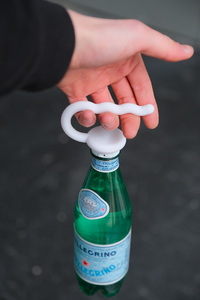
- Der neu geformte Flaschendeckel fordert auf, eine Plastikflasche zu adoptieren und sie zur persönlichen Begleiterin im Alltag zu machen.
Seine Form ermöglicht es, die Flasche auf viele Weisen körpernah zu tragen und in die Umgebung einzubinden.
So wird die Flasche zur persönlichen, was dazu einlädt sie nach dem Leeren nicht wegzuwerfen, sondern immer wieder aufzufüllen.
Die ständige Verfügbarkeit von Wasser fördert ganz nebenbei einen erhöhten Wasserkonsum.
Dank des standardisierten PCO-Gewindes ist bei Bedarf ein flexibler Wechsel zu einer neuen Flasche jederzeit möglich.
- Der neu geformte Flaschendeckel fordert auf, eine Plastikflasche zu adoptieren und sie zur persönlichen Begleiterin im Alltag zu machen.
- Beschreibung (en)
- The newly shaped bottle lid invites you to adopt a plastic bottle and make it your personal companion in everyday life.
It's shape makes it possible to carry the bottle close to the body and integrate it into your environment creatively.
In this way, the bottle becomes personal, inviting you not to throw it away after emptying it, but to refill it again and again.
The constant availability of water also encourages increased water consumption.
Thanks to the standardized PCO thread, a flexible change to a new bottle is possible at any time if required.
- The newly shaped bottle lid invites you to adopt a plastic bottle and make it your personal companion in everyday life.
- Typ des Projekts/Werks
- Schlagworte
- Datierung
- 18.02.2025
- Titel
- PCO 1810
- Projektleiter/in
- Studiengang
- Importiert am
- 17.07.2025
- Übergeordnete Sets
- 1
- Set enthält
- 0 11
FROM ENLIGHTENMENT TO ENLICHENMENT
Name that can easily go onto 2 lines
Author that can easily go onto 2 lines as well
- Titel
- FROM ENLIGHTENMENT TO ENLICHENMENT
- Titel (en)
- FROM ENLIGHTENMENT TO ENLICHENMENT
- Untertitel
- Flechten, Symbiose und posthumanistische Perspektiven in Kunst und Theorie
- Untertitel des Projekts/Werks (en)
- Lichens, symbiosis and posthumanist perspectives in art and theory
- Autor/in
- Beschreibung (de)
- Die Aufklärung („Enlightenment“) stellte den Menschen ins Zentrum des Denkens – doch Flechten („Lichen“) lehren uns eine andere Art der Weltwahrnehmung: relational, vernetzt, nicht-menschlich-zentriert. Als symbiotische Verbindungen von Pilzen und Algen oder Cyanobakterien verkörpern sie ein Denken jenseits des Individuellen: Sie sind mehr-als-menschliche Organismen, Holobionten, Netzwerke aus Kooperation und Anpassung. Sie gedeihen in extremen Umgebungen, überdauern Jahrhunderte und bilden fragile Ökologien,
die oft übersehen werden – und doch fundamentale Lektionen für unser eigenes Dasein bereithalten. Dieses transdisziplinäre Seminar bewegt sich zwischen Wissenschaft, Philosophie und Medienkunst. Eine Exkursion mit Lichenolog*innen macht uns mit der stillen, aber
hochkomplexen Existenz der Flechten vertraut. Meditative Audiowalks laden dazu ein, das Netzwerk dieser Lebensformen zu dokumentieren und sich mit ihrer Zeitlichkeit und Materialität zu verbinden. Durch das Lesen zentraler Texte von Lynn Margulis, Scott Gilbert, Donna Haraway und Anna Tsing hinterfragen wir Konzepte von Autonomie, Subjektivität und multispeziesalem Zusammenleben. Schließlich werden wir in einem Workshop das gesammelte Wissen in Medienkunstwerke überführen – als spekulative Antworten auf die ökologischen und philosophischen Herausforderungen unserer Zeit.
- Die Aufklärung („Enlightenment“) stellte den Menschen ins Zentrum des Denkens – doch Flechten („Lichen“) lehren uns eine andere Art der Weltwahrnehmung: relational, vernetzt, nicht-menschlich-zentriert. Als symbiotische Verbindungen von Pilzen und Algen oder Cyanobakterien verkörpern sie ein Denken jenseits des Individuellen: Sie sind mehr-als-menschliche Organismen, Holobionten, Netzwerke aus Kooperation und Anpassung. Sie gedeihen in extremen Umgebungen, überdauern Jahrhunderte und bilden fragile Ökologien,
- Beschreibung (en)
- The Enlightenment placed humans at the centre of thought – but
lichens teach us a different way of perceiving the world: relational, interconnected,
non-human-centred. As symbiotic combinations of fungi and algae or cyanobacteria, they embody a way of thinking beyond the individual: they are more-than-human organisms, holobionts, networks of cooperation and adaptation. They
thrive in extreme environments, survive for centuries and form fragile ecologies
that are often overlooked – yet hold fundamental lessons for our own existence
.
This transdisciplinary seminar moves between science, philosophy and
media art. An excursion with lichenologists familiarises us with the quiet but
highly complex existence of lichens. Meditative audio walks invite us to document the
network of these life forms and connect with their temporality and
materiality. By reading key texts by Lynn Margulis, Scott Gilbert,
Donna Haraway and Anna Tsing, we question concepts of autonomy, subjectivity and
multispecies coexistence. Finally, in a workshop, we will transform the
knowledge we have gathered into media artworks – as speculative responses to the
ecological and philosophical challenges of our time.
- The Enlightenment placed humans at the centre of thought – but
- Kategorie
- Typ des Projekts/Werks
- Schlagworte
- Datierung
- Juni 2025
- Mitwirkende
- Dank an
- Sprache
- Ort: Institution
- Ort
- Bio Design Lab
- Stadt
- Land
- Titel
- FROM ENLIGHTENMENT TO ENLICHENMENT
- Untertitel
- Flechten, Symbiose und posthumanistische Perspektiven in Kunst und Theorie
- Importiert am
- 17.07.2025
- Übergeordnete Sets
- 1
- Set enthält
- 0 21
Honey
Name that can easily go onto 2 lines
Author that can easily go onto 2 lines as well
- Titel
- Honey
- Titel (en)
- Honey
- Untertitel
- hotbag
- Untertitel des Projekts/Werks (en)
- hotbag
- Autor/in
- Beschreibung (de)
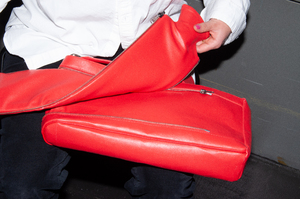
- Wie können wir Wärme mobilisieren? Diese Handtasche mit integrierter Wärmflasche ist eine Antwort auf diese Frage. Sie wurde speziell entwickelt, um Menstruationsbeschwerden zu lindern, ohne diese natürlichen Bedürfnisse zu verbergen oder zu tabuisieren. Stattdessen setzt sie ein sichtbares und selbstbewusstes Statement, das zeigt: Wohlbefinden verdient Aufmerksamkeit und Designlösungen, bei denen weibliche Designerinnen eine zentrale Rolle im heutigen gesellschaftlichen Diskurs spielen. Die Tasche ist so konzipiert, dass sie Komfort auf Reisen bietet, beispielsweise bei der Arbeit oder in öffentlichen Räumen.
Die extra lange Wärmflasche für Bauch und Rücken speichert die Wärme stundenlang und lässt sich leicht wieder auffüllen. Ein modulares Reißverschlusssystem sorgt für Vielseitigkeit in der Anwendung, und eine thermische Einlage schützt vor Überhitzung im Inneren der Tasche.
- Wie können wir Wärme mobilisieren? Diese Handtasche mit integrierter Wärmflasche ist eine Antwort auf diese Frage. Sie wurde speziell entwickelt, um Menstruationsbeschwerden zu lindern, ohne diese natürlichen Bedürfnisse zu verbergen oder zu tabuisieren. Stattdessen setzt sie ein sichtbares und selbstbewusstes Statement, das zeigt: Wohlbefinden verdient Aufmerksamkeit und Designlösungen, bei denen weibliche Designerinnen eine zentrale Rolle im heutigen gesellschaftlichen Diskurs spielen. Die Tasche ist so konzipiert, dass sie Komfort auf Reisen bietet, beispielsweise bei der Arbeit oder in öffentlichen Räumen.
- Beschreibung (en)
- How can we mobilise heat? This handbag with an integrated hot water bottle is an answer to this question. It is specially designed to relieve menstrual pain without hiding or tabooing these natural needs. Instead, it makes a visible and confident statement that shows: Well-being deserves attention and design solutions, where female designers play a central role in today's social discourse. The bag is designed to provide comfort when travelling, for example at work or in public spaces.
The extra-long hot water bottle for for stomach and back retains heat for hours and can be filled up again easily. A modular zip system ensures versatility of use, and a thermal inlay protects against overheating inside the bag.
- How can we mobilise heat? This handbag with an integrated hot water bottle is an answer to this question. It is specially designed to relieve menstrual pain without hiding or tabooing these natural needs. Instead, it makes a visible and confident statement that shows: Well-being deserves attention and design solutions, where female designers play a central role in today's social discourse. The bag is designed to provide comfort when travelling, for example at work or in public spaces.
- Kategorie
- Typ des Projekts/Werks
- Schlagworte
- Datierung
- Februar 2025
- Material
- Technik/Verfahren/Formate
- textile Handarbeit
- Ort: Institution
- Ort
- Lichtbrücke
- Stadt
- Land
- Titel
- Honey
- Untertitel
- hotbag
- Importiert am
- 17.07.2025
- Übergeordnete Sets
- 1
- Set enthält
- 0 9
ChitoTinkering
Name that can easily go onto 2 lines
Author that can easily go onto 2 lines as well
- Titel
- ChitoTinkering
- Titel (en)
- ChitoTinkering
- Untertitel
- neue perspektiven für chitosan
- Untertitel des Projekts/Werks (en)
- new perspectives for chitosan
- Autor/in
- Beschreibung (de)
- Im Rahmen ihres Materialforschungsprojekts entwickelten Benjamin Kaltenbach, Lilith Stumpf, Felix Harr und Julia Ihls innovative Anwendungen für Chitosan – ein vielseitiges Biopolymer, das aus Chitin gewonnen wird. Chitin ist nach Cellulose das zweithäufigste natürliche Polymer und bildet die strukturelle Basis für die Schalen von Krebstieren, die Exoskelette von Insekten sowie Zellwände bestimmter Pilze.
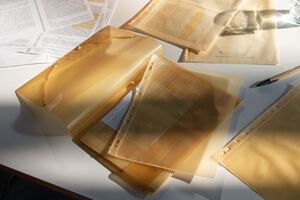
Inspiriert von der schützenden Funktion von Chitin in der Natur übertrugen die Designer*innen die Materialeigenschaften von Chitosan in einen alltagsnahen Kontext. Der Fokus lag dabei auf den Konzepten von Gehäusen und Hüllen – Anwendungen, die Schutz und Struktur vereinen. Das Ergebnis sind eine Reihe funktionaler Prototypen, darunter ein Lampenschirm, ein Stift, transparente Dokumentenhüllen sowie eine Dokumentenmappe, die aus dem Chitosan-Komposit gefertigt wurden.
Um die gestalterischen und technischen Möglichkeiten des Materials auszuloten, wurden unterschiedliche Bearbeitungstechniken erprobt: Das Chitosan-Material wurde genäht, genietet, gebügelt, gefaltet, selbstverklebt sowie mittels CNC-Laser graviert und geschnitten. Diese experimentelle Auseinandersetzung mit Verarbeitungstechniken hebt die gestalterische Vielseitigkeit von Chitosan hervor und zeigt sein Potenzial als nachhaltige Material Alternative auf.
Durch diese gestalterische und technische sowie konzeptuelle Auseinandersetzung eröffnen die Designer*innen neue Perspektiven für Chitosan und unterstreichen sein Potenzial als nachhaltige Material Alternative.
- Im Rahmen ihres Materialforschungsprojekts entwickelten Benjamin Kaltenbach, Lilith Stumpf, Felix Harr und Julia Ihls innovative Anwendungen für Chitosan – ein vielseitiges Biopolymer, das aus Chitin gewonnen wird. Chitin ist nach Cellulose das zweithäufigste natürliche Polymer und bildet die strukturelle Basis für die Schalen von Krebstieren, die Exoskelette von Insekten sowie Zellwände bestimmter Pilze.
- Beschreibung (en)
- As part of their material research project, Benjamin Kaltenbach, Lilith Stumpf, Felix Harr, and Julia Ihls developed innovative applications for chitosan – a versatile biopolymer derived from chitin. Chitin is the second most abundant natural polymer after cellulose and forms the structural basis of crustacean shells, insect exoskeletons, and the cell walls of certain fungi.
Inspired by chitin’s protective function in nature, the designers translated the material properties of chitosan into everyday applications. Their focus was on the concept of enclosures and casings – objects that combine protection and structure. The result is a series of functional prototypes, including a lampshade, a pen, transparent document sleeves, and a folder, all made from chitosan composite material.
To explore the material’s creative and technical potential, various processing techniques were tested: The chitosan material was sewn, riveted, ironed, folded, self-adhered, and engraved or cut using a CNC laser. This experimental approach highlights the versatility of chitosan and demonstrates its potential as a sustainable material alternative.
Through this design and technical exploration, the designers open up new perspectives for chitosan and emphasize its potential as an innovative, bio-based material.
- As part of their material research project, Benjamin Kaltenbach, Lilith Stumpf, Felix Harr, and Julia Ihls developed innovative applications for chitosan – a versatile biopolymer derived from chitin. Chitin is the second most abundant natural polymer after cellulose and forms the structural basis of crustacean shells, insect exoskeletons, and the cell walls of certain fungi.
- Kategorie
- Typ des Projekts/Werks
- Schlagworte
- Datierung
- Februar 2025
- Mitwirkende
- Dank an
- Material
- Ort: Institution
- Ort
- Unter dem Bio Design Lab
- Stadt
- Land
- Internetlinks
- Titel
- ChitoTinkering
- Untertitel
- neue perspektiven für chitosan
- Importiert am
- 17.07.2025
- Übergeordnete Sets
- 1
- Set enthält
- 0 9
Herkules & Karl
Name that can easily go onto 2 lines
Author that can easily go onto 2 lines as well
- Titel
- Herkules & Karl
- Titel (en)
- Herkules & Karl
- Autor/in
- Beschreibung (de)
- Die Statue „Herkules Farnese“ war sowohl in der Antike als auch während der Renaissance und des Barock eine der bekanntesten Ikonen. Der eigentlich unbesiegbare Held stützt sich erschöpft auf seine Keule und versteckt hinter seinem Rücken fast kindlich drei goldene Früchte. Laut der mythologischen Erzählung steht Herkules zu diesem Zeitpunkt kurz vor dem Ende der ihm auferlegten Aufgabenreihe, die ihm seinen rechtmäßigen Platz im Olymp verspricht. Die goldenen Früchte aus der Erzählung symbolisieren Fruchtbarkeit, Unsterblichkeit und Macht. Ursprünglich wurden sie als Äpfel interpretiert, sobald Zitrusfrüchte auf den europäischen Markt kamen, wurden aus ihnen Zitronen, Pomeranzen oder Orangen.
Mit dem stilisierten Aufleben der griechischen Antike zur Zeit der Renaissance gewann auch der „Herkules Farnese“ stärker an Bedeutung und wurde von vielen Adligen in ihren neu errichteten Gartenanlagen erst im Stil italienischer und später im Barock im Stil französischer Gärten verarbeitet sowie reproduziert. Orangerien, die zu den meisten barocken Gärten gehörten, wurden als Sammlungs- und Ausstellungsort der erworbenen Gewächse erbaut. August der Starke lies sich beispielsweise auf dem Dach seiner Orangerie als Herkules, der das Himmelsgewölbe trägt, darstellen.
Die barocken Gärten zeichnen sich besonders dadurch aus, dass die Architektur des Schloss oder Palast immer gemeinsam mit der künstlichen Landschaft entworfen wird. In Karlsruhe wurde allerdings nicht nur die Parkanlage im Gedanken des Absolutismus passend als Fortführung des Schloss gebaut, sondern auch durch die Stadtgründung 1715 die gesamte Stadtplanung dieser Ideologie folgend angelegt. Das Schloss und auch die langen Alleen, die Blickachsen auf das historische Machtzentrum erzeugen, existieren heute noch. Der Garten ist, wie fast alle anderen Anlagen im französischen Stil, relativ zügig nach der Erbauung in einen englischen Landschaftsgarten umgeplant worden.
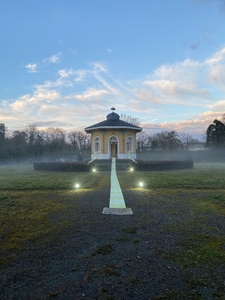
Die Spuren der ursprüngliche Anlage sind in der Linolschnittserie mit einem Motiv basierend auf einem Bepflanzungsplan des Karlsruher Barockgartens sichtbar und ziehen die Besucher:innen der Installation von einer Metallplatte, die über die historischen Zusammenhänge der Arbeit aufklärt, in das Teehaus, den letzten Überrest des Barockgartens. Im Inneren des Pavillons steht eine Gedenkstätte für Karl, Barockgärten und die vergangenen Zeit, für die diese Männer zu Symbolfiguren wurden.
- Die Statue „Herkules Farnese“ war sowohl in der Antike als auch während der Renaissance und des Barock eine der bekanntesten Ikonen. Der eigentlich unbesiegbare Held stützt sich erschöpft auf seine Keule und versteckt hinter seinem Rücken fast kindlich drei goldene Früchte. Laut der mythologischen Erzählung steht Herkules zu diesem Zeitpunkt kurz vor dem Ende der ihm auferlegten Aufgabenreihe, die ihm seinen rechtmäßigen Platz im Olymp verspricht. Die goldenen Früchte aus der Erzählung symbolisieren Fruchtbarkeit, Unsterblichkeit und Macht. Ursprünglich wurden sie als Äpfel interpretiert, sobald Zitrusfrüchte auf den europäischen Markt kamen, wurden aus ihnen Zitronen, Pomeranzen oder Orangen.
- Beschreibung (en)
-
The ‘Hercules Farnese’ statue was one of the most famous icons in antiquity as well as during the Renaissance and Baroque periods. The actually invincible hero leans exhaustedly on his club and hides three golden fruits behind his back in an almost childlike manner. According to the mythological tale, at this point Hercules is about to complete the series of tasks imposed on him, which promises him his rightful place in Olympus. The golden fruits in the story symbolise fertility, immortality and power. Originally they were interpreted as apples, but as soon as citrus fruits came onto the European market, they became lemons, bitter orange or oranges.
With the stylised revival of Greek antiquity during the Renaissance, the ‘Hercules Farnese’ also became more important and was used and reproduced by many aristocrats in their newly built gardens, first in the style of Italian gardens and later in the Baroque period in the style of French gardens. Orangeries, which were part of most Baroque gardens, were built as a place to collect and display the plants acquired. Augustus the Strong, for example, had himself depicted on the roof of his orangery as Hercules carrying the vault of heaven.
Baroque gardens are particularly characterised by the fact that the architecture of the castle or palace is always designed together with the artificial landscape. In Karlsruhe, however, not only was the park built in the spirit of absolutism as a continuation of the palace, but the entire urban planning was also designed in line with this ideology when the city was founded in 1715. The palace and the long avenues, which create lines of sight to the historic centre of power, still exist today. Like almost all other French-style gardens, the garden was converted into an English landscape garden relatively quickly after its construction.
The traces of the original layout are visible in the linocut series with a motif based on a planting plan of the Karlsruhe Baroque garden and draw visitors to the installation from a metal plate, which explains the historical context of the work, into the tea house, the last remnant of the Baroque garden. Inside the pavilion is a memorial to Karl, baroque gardens and the bygone era for which these men became symbolic figures.
-
- Kategorie
- Typ des Projekts/Werks
- Schlagworte
- Datierung
- 25.02.2025 - 27.02.2025
- Mitwirkende
- Dank an
- Sprache
- Material
- Technik/Verfahren/Formate
- Linolschnitt, Lasergravur, audio-visuelle Installation, Animation, fiktionalisierte Geschichte
- Dauer
- ca 5min (Video)
- Ort
- Teehaus im Schlosspark
- Stadt
- Land
- Titel
- Herkules & Karl
- Studiengang
- Importiert am
- 17.07.2025
- Übergeordnete Sets
- 1
- Set enthält
- 0 12
Blast or Bless 2024/2025
Name that can easily go onto 2 lines
Author that can easily go onto 2 lines as well
- Titel
- Blast or Bless 2024/2025
- Titel (en)
- Blast or Bless 2024/2025
- Untertitel
- Eine Einführung in den Siebdruck
- Untertitel des Projekts/Werks (en)
- An introduction into screen printing
- Beschreibung (de)
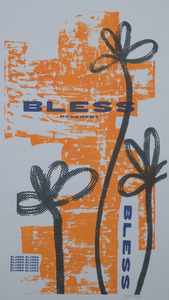
- Inspiriert vom Manifest des Vortizismus "Blast!" kreieren Studierende ein experimentelles, grafisches Poster als Teil des Siebdruck-Grundlagenkurses an der HfG. Während des viertägigen Kurses, der die praktischen und theoretischen Grundlagen der Druckvorstufe und des Siebdruckes an die Studierenden vermittelt, lernen Studierende über die historische und kunstgeschichtliche Entwicklung des Druckverfahrens und wie sie mit Ölkreide und Papierschablonen erste, experimentelle Siebe mit kleinem Budget herstellen können. Des Weiteren erfahren Studierende, wie sie ihre Motive und die Siebe vorbereiten, um sie fotografisch zu entwickeln, wie sie mit wasserbasierten Farben umgehen, die Drucktische einrichten, um die unterschiedlichen Ebenen ihres mehrfarbigen Posters zu registrieren und wie sie die Siebdruckrahmen im Anschluss entschichten.
- Beschreibung (en)
- Inspired by the "Blast!" Manifestos of Vorticism, students create an experimental, graphic poster as part of the screen printing foundation course at the HfG. During the four-day course, which teaches students the practical and theoretical basics of prepress and screen printing, students learn about the historical and art-historical development of the printing process and how they can use oil pastels and paper stencils to produce their first experimental screens on a small budget. Furthermore, students learn how to prepare their motifs and the screens in order to develop them photographically, how to deal with water-based inks, how to set up the printing tables to register the different levels of their multicoloured poster and how to decoat the screen printing frame.
- Kategorie
- Typ des Projekts/Werks
- Schlagworte
- Datierung
- 01.10.2024 - 01.08.2025
- Mitwirkende
- Titel
- Blast or Bless 2024/2025
- Untertitel
- Eine Einführung in den Siebdruck
- Projektleiter/in
- Semester
- Studiengang
- Importiert am
- 15.07.2025
- Übergeordnete Sets
- 1
- Set enthält
- 0 31
„Meine Zuständigkeit hört auf, da wo der Strom kommt“
Name that can easily go onto 2 lines
Author that can easily go onto 2 lines as well
- Titel
- „Meine Zuständigkeit hört auf, da wo der Strom kommt“
- Autor/in
- Beschreibung (de)
- „Meine Zuständigkeit hört auf, da wo der Strom kommt“ ist eine Installation über Straßenbahnoberleitungen. Sie setzt sich mit Infrastrukturen im öffentlichen Raum auseinander, die für uns im Alltag essenziell sind, die wir aber gelernt haben auszublenden. Sie soll diesen scheinbar banalen, anonymen Zweckbauten einen Wert verleihen und auf sie aufmerksam machen.
Oberleitungen sind in einer Stadt mit vielen Straßenbahnen, wie Karlsruhe, wenn man sich auf der Straße bewegt, immer da. Alles, was man im öffentlichen Raum sieht, sieht man durch das Netz der Oberleitungen. Sie sind allgegenwärtig und ein wichtiger Bestandteil der täglichen Fortbewegung, doch die meisten Leute blenden das im alltäglichen Leben aus. Und das ist kein Zufall: die Stadt schreibt vor, Oberleitungen so zu planen, dass sie möglichst unauffällig sind und in ihrer Umgebung untergehen. Es gibt keine Wertschätzung dafür, wie viel Technik und Material dahinter steckt, dass man sich mit der Straßenbahn durch die Stadt bewegen kann.
Auf diese Themen soll die Installation aufmerksam machen. Ich habe durch diese Arbeit einen intensiven Blick auf Oberleitungen bekommen und wollte diesen durch meine Installation teilen.
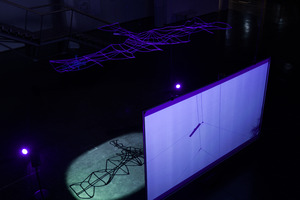
In der Installation „Meine Zuständigkeit hört auf, da wo der Strom kommt“ steht man, unter dem im Maßstab 1:26, aus blauen Seilen nachgebildeten, freischwebenden Muster, einer großen Kreuzung in Karlsruhe. Auf der Leinwand läuft ein Stop Motion Video, das alltägliche Momentaufnahmen und Blicke in Bewegung auf die Oberleitungen zeigt.
Aus drei verschiedenen Richtungen kommen Sounds. Einmal die Klänge der Bahnen, denen man auch auf einer Kreuzung zuhören könnte, und dann von rechts und links, zwei verschiedene Blickwinkel, von verschiedenen Personen auf das Thema Oberleitungen. Eins ist der technische Blick von einer Person, die mit Oberleitungen arbeitet, und der andere ist meiner, ein eher poetischer Blick den ich auf die bildliche Ebene der Oberleitungen gewonnen habe. Die eine Seite sagt, dass die Oberleitungen möglichst unauffällig sein sollen, um nicht aufzufallen, und die andere sagt, schaut nach oben, schaut was da alles hängt.
Die Installation soll den Blick der Leute, die sie anschauen, in Zukunft etwas öfter nach oben auf die Oberleitungen lenken
- „Meine Zuständigkeit hört auf, da wo der Strom kommt“ ist eine Installation über Straßenbahnoberleitungen. Sie setzt sich mit Infrastrukturen im öffentlichen Raum auseinander, die für uns im Alltag essenziell sind, die wir aber gelernt haben auszublenden. Sie soll diesen scheinbar banalen, anonymen Zweckbauten einen Wert verleihen und auf sie aufmerksam machen.
- Beschreibung (en)
- “Meine Zuständigkeit hört auf, da wo der Strom kommt” is an installation about tram overhead lines. It explores infrastructures in public spaces that are essential to our everyday lives but which we have learnt to ignore. It is intended to give these seemingly banal, anonymous functional structures a value and draw attention to them.
In a city with a lot of trams, like Karlsruhe, overhead lines are always present when you move along the street. Everything you see in public space is seen through the web of overhead lines. They are omnipresent and essential to everyday transport, however most people ignore them in their day to day lives. And this is no coincidence: the city requires overhead lines to be planned in such a way that they are as discreet as possible and blend into their surroundings. There is no appreciation of how much technology and material goes into getting a tram through the city.
The installation is intended to draw attention to this topic. This work and research has allowed me an immersive view of overhead lines, which I wanted to share and visualise through my installation.
In the installation “Meine Zuständigkeit hört auf, da wo der Strom kommt”, one stands and moves under the free-floating pattern of a large intersection in Karlsruhe, modelled on a scale of 1:26 using blue ropes. A stop motion video runs on the projection screen, showing everyday snapshots and views of the overhead lines in motion.
Sounds come from three different directions. Firstly, the sounds of the trains, which you could also listen to at a crossing, and then from the right and left, two different perspectives, from different people on the subject of overhead lines. One is the technical view of a person who works with overhead lines, and the other is mine, a more poetic view that I have gained of the visual level of the overhead lines. One side says that the overhead lines should be as subtle as possible in order not to attract attention, and the other says, look up, see what's hanging there.
With my installation I hope to draw people’s attention to the overhead lines that play such an important yet invisible role in our daily lives.
- “Meine Zuständigkeit hört auf, da wo der Strom kommt” is an installation about tram overhead lines. It explores infrastructures in public spaces that are essential to our everyday lives but which we have learnt to ignore. It is intended to give these seemingly banal, anonymous functional structures a value and draw attention to them.
- Kategorie
- Typ des Projekts/Werks
- Datierung
- 24.04.2025
- Ort
- Lichthof drei
- Titel
- „Meine Zuständigkeit hört auf, da wo der Strom kommt“
- Projektleiter/in
- Semester
- Studiengang
- Typ der Abschlussarbeit
- Importiert am
- 15.07.2025
- Übergeordnete Sets
- 1
- Set enthält
- 0 7
Folded Sheets
Name that can easily go onto 2 lines
Author that can easily go onto 2 lines as well
- Titel
- Folded Sheets
- Autor/in
- Beschreibung (de)
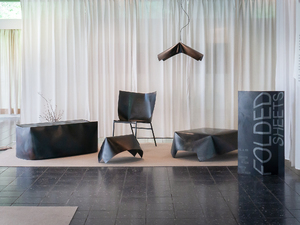
- Folded Sheets untersucht, wie sich Papier-Falttechniken auf Stahlbleche übertragen lassen. Rechteckige Tafeln werden durch gezielte Einschnitte und Faltungen in stabile dreidimensionale Formen gebracht, ohne dass Material verloren geht. Der Prozess des Schwarzbrennens, bei dem Leinöl in die Oberfläche eingebrannt wird, verleiht den Objekten ihre charakteristische schwarze Färbung, schützt sie vor Korrosion und unterstützt die strukturelle Festigkeit.
- Beschreibung (en)
- Folded Sheets explores the possiblities of transferring paper folds into steel sheet furniture. By using cuts and folds on rectangular steel sheets, tensioned rigid shapes without offcuts are created. The objects are further strengthend by blackening the surface with burnt linseed oil.
- Kategorie
- Typ des Projekts/Werks
- Schlagworte
- Datierung
- 2025
- Dank an
- Material
- Technik/Verfahren/Formate
- Falttechnik, Schwarzbrennen mit Leinöl
- Stadt
- Land
- Internetlinks
- Titel
- Folded Sheets
- Projektleiter/in
- Semester
- Studiengang
- Typ der Abschlussarbeit
- Importiert am
- 15.07.2025
- Übergeordnete Sets
- 3
- Set enthält
- 0 18
Catalogue
Name that can easily go onto 2 lines
Author that can easily go onto 2 lines as well
- Titel
- Catalogue
- Titel (en)
- Catalogue
- Autor/in
- Beschreibung (de)
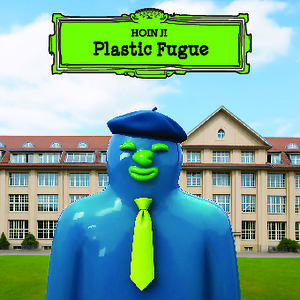
- Plastic Fugue als Diplomprojekt besteht aus vier Teilen:
0. Introducing ipcl, ein Einführungsvideo, das eine Produktpräsentation imitiert. CEO Framey von „Moberm“, einer fiktiven Firma, spricht darüber, wie Moberm aufgrund der Kindheitserinnerungen des CEOs beschloss, sein Geschäft auf Musikinstrumente auszuweiten. Das Video behauptet selbstbewusst die Multifunktionalität der air&dust-Instrumente, bleibt dabei jedoch letztlich inhaltsleer. Framey, die sprechende Figur, artikuliert indirekt die Erzählung der Person hinter dem Werk und stellt gleichzeitig eine von Stereotypen und Neoliberalismus durchzogene Kunststruktur nach.
1. Plastic Fugue, eine interaktive Klanginstallation, bestehend aus sechs Flöten (air 5-10, air Pp 1), die jeweils nur einen Ton erzeugen und über codierte Dirigierknöpfe ferngesteuert aktiviert werden. Die Reihenfolge der Töne ist jedes Mal zufällig. Die Fuge wird auf ihre Struktur reduziert und in ein Spiel mit Sequenz und Zeit überführt. Anstelle der idealisierten Ordnung stelle ich mir eine offenere Art der Klangmontage vor, eine Art demokratischer Kontrapunkt.
2. Sax Recital, ein Video, gespielt von Arno Arial mit der DIY-Saxophone-Serie, deren Mundstücke auf Open-Source-3D-Modellen basieren und handgefertigt aus PCL und PLA bestehen. Das Stück wurde aufgenommen, während Arial Kopfhörer trug, um klassische Musik zu hören, sowie lärmunterdrückende Ausrüstung darüber, um sowohl äußere als auch selbst erzeugte Klänge auszublenden. Das Video läuft im Ausstellungsraum in Dauerschleife und bildet gemeinsam mit Plastic Fugue eine gebrochene fugenhafte Gegenstimme.
3. Pp 1-8, air 1-4 und dust 1-2, frühe Instrumente und Polymer-Gemälde, bei denen ich keinen überzeugenden Grund fand, weiterhin traditionelle Materialien zu verwenden. Also entschied ich mich, sie stattdessen mit PCL und PLA zu schaffen.
Die oben genannten Arbeiten sind das Ergebnis eines Instrumentenbaus durch DIY-Praxis und Open-Source-Dateien aus dem Internet, indem die Illusion der klassistischen Form geschmolzen, vermischt und in biologisch abbaubare Polymere gegossen wurde, nicht nur mit der Hand, sondern auch mit dem 3D-Drucker. Eine besondere Qualifikation ist für die Herstellung nicht nötig. Die Bauanleitungen für diese DIY-Instrumente werden während der Ausstellung und auf der Website zur Verfügung gestellt.
Wenn das Publikum die Knöpfe drückt, spielt dieses neutrale Orchester eine fugenhafte Struktur, bei der sich alle paar Sekunden Klänge überlagern. Die Kontrolle über das Orchester liegt beim Publikum. Die Arbeit hinterfragt geerbte Hierarchien, sowohl durch Material als auch durch Methode.
Für Kinder, die früh gelernt haben, nichts zu verlangen, und für Erwachsene, die mit dieser Erinnerung aufgewachsen sind.
- Plastic Fugue als Diplomprojekt besteht aus vier Teilen:
- Beschreibung (en)
- Plastic Fugue as Diplom project features four parts.
0. Introducing air&dust, a (introduction) video that appropriates a product unveiling conference. CEO Framey from Moberm, a pseudo corporation, speaks about how Moberm decided to expand its business into musical instruments based on the CEO's childhood memory. It boldly claims air&dust’s multifunctionality in musical instruments but remains ultimately hollow.
Framey, the speaking character, serves as a device that indirectly voices the artist's narrative within the work, while also reenacting the structure of art polluted by stereotypes and neoliberalism. The character is made with the virtual youtuber avatar technique.
1. Plastic Fugue, an interactive sound installation which consists of six flutes (air 5-10, air Pp 1) with air pumps, each producing a single tone and activated remotely through coded conducting buttons. The order of play is random every time as the buttons signal remotely.
The fugue has long stood as a symbol of musical authority and elitism, a form that represents technical mastery and the traditional hierarchy of composition. In my work, I try to break apart that formal authority, stripping the fugue down to its bare structure and shifting it toward an exploration of sequence and time. Instead of upholding its idealized order, I imagine a more open, accessible way of assembling sound, a kind of democratic counterpoint. You could call it a process of unmaking the fugue, of abstracting it.
2. Sax Recital, a recital video piece played by Arno Arial featuring DIY-Saxophone series, which is a quite decent structure of mouthpiece built using open-source 3D models and handcrafted with PCL and PLA. Filmed while Arial was wearing earphones for listening to classical music and soundproof gear on top to block out both external and self-produced instrumental sound. This piece is loop-playing all the time in the exhibition, making broken fugal counterpoint together with Plastic Fugue.
3. Pp 1-9, air 1-4, and dust 1-2, early-made instruments and polymer paintings which I found no compelling reason to continue using traditional materials, and so I ended up creating them with PCL and PLA.
The above instruments and paintings are the result of instrument-making through DIY-ness and open-source files from the internet by melting, merging, and mixing the illusion of classism's shape into biodegradable polymers, not only with a hand, but also with a 3D printer. However, any sacred qualification to make is not needed. DIY instructions for these DIY instruments are distributed at the exhibition and website.
When audiences press the buttons, this neutral orchestra plays a Fugue-like style, which overlaps sounds every few seconds. Placing control of the orchestra in the hands of the audience, the work democratizes a position of authority and questions inherited hierarchies through both material and method.
- Plastic Fugue as Diplom project features four parts.
- Mitwirkende
- Titel
- Catalogue
- Projektleiter/in
- Semester
- Studiengang
- Typ der Abschlussarbeit
- Importiert am
- 12.07.2025
- Übergeordnete Sets
- 1
- Set enthält
- 0 1
Video Work
Name that can easily go onto 2 lines
Author that can easily go onto 2 lines as well
- Titel
- Video Work
- Titel (en)
- Video Work
- Autor/in
- Beschreibung (de)
- Plastic Fugue als Diplomprojekt besteht aus vier Teilen:
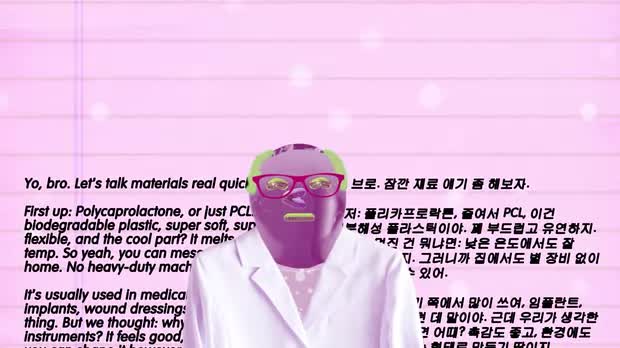
0. Introducing ipcl, ein Einführungsvideo, das eine Produktpräsentation imitiert. CEO Framey von „Moberm“, einer fiktiven Firma, spricht darüber, wie Moberm aufgrund der Kindheitserinnerungen des CEOs beschloss, sein Geschäft auf Musikinstrumente auszuweiten. Das Video behauptet selbstbewusst die Multifunktionalität der air&dust-Instrumente, bleibt dabei jedoch letztlich inhaltsleer. Framey, die sprechende Figur, artikuliert indirekt die Erzählung der Person hinter dem Werk und stellt gleichzeitig eine von Stereotypen und Neoliberalismus durchzogene Kunststruktur nach.
1. Plastic Fugue, eine interaktive Klanginstallation, bestehend aus sechs Flöten (air 5-10, air Pp 1), die jeweils nur einen Ton erzeugen und über codierte Dirigierknöpfe ferngesteuert aktiviert werden. Die Reihenfolge der Töne ist jedes Mal zufällig. Die Fuge wird auf ihre Struktur reduziert und in ein Spiel mit Sequenz und Zeit überführt. Anstelle der idealisierten Ordnung stelle ich mir eine offenere Art der Klangmontage vor, eine Art demokratischer Kontrapunkt.
2. Sax Recital, ein Video, gespielt von Arno Arial mit der DIY-Saxophone-Serie, deren Mundstücke auf Open-Source-3D-Modellen basieren und handgefertigt aus PCL und PLA bestehen. Das Stück wurde aufgenommen, während Arial Kopfhörer trug, um klassische Musik zu hören, sowie lärmunterdrückende Ausrüstung darüber, um sowohl äußere als auch selbst erzeugte Klänge auszublenden. Das Video läuft im Ausstellungsraum in Dauerschleife und bildet gemeinsam mit Plastic Fugue eine gebrochene fugenhafte Gegenstimme.
3. Pp 1-8, air 1-4 und dust 1-2, frühe Instrumente und Polymer-Gemälde, bei denen ich keinen überzeugenden Grund fand, weiterhin traditionelle Materialien zu verwenden. Also entschied ich mich, sie stattdessen mit PCL und PLA zu schaffen.
Die oben genannten Arbeiten sind das Ergebnis eines Instrumentenbaus durch DIY-Praxis und Open-Source-Dateien aus dem Internet, indem die Illusion der klassistischen Form geschmolzen, vermischt und in biologisch abbaubare Polymere gegossen wurde, nicht nur mit der Hand, sondern auch mit dem 3D-Drucker. Eine besondere Qualifikation ist für die Herstellung nicht nötig. Die Bauanleitungen für diese DIY-Instrumente werden während der Ausstellung und auf der Website zur Verfügung gestellt.
Wenn das Publikum die Knöpfe drückt, spielt dieses neutrale Orchester eine fugenhafte Struktur, bei der sich alle paar Sekunden Klänge überlagern. Die Kontrolle über das Orchester liegt beim Publikum. Die Arbeit hinterfragt geerbte Hierarchien, sowohl durch Material als auch durch Methode.
Für Kinder, die früh gelernt haben, nichts zu verlangen, und für Erwachsene, die mit dieser Erinnerung aufgewachsen sind.
- Plastic Fugue als Diplomprojekt besteht aus vier Teilen:
- Beschreibung (en)
- Plastic Fugue as Diplom project features four parts.
0. Introducing air&dust, a (introduction) video that appropriates a product unveiling conference. CEO Framey from Moberm, a pseudo corporation, speaks about how Moberm decided to expand its business into musical instruments based on the CEO's childhood memory. It boldly claims air&dust’s multifunctionality in musical instruments but remains ultimately hollow.
Framey, the speaking character, serves as a device that indirectly voices the artist's narrative within the work, while also reenacting the structure of art polluted by stereotypes and neoliberalism. The character is made with the virtual youtuber avatar technique.
1. Plastic Fugue, an interactive sound installation which consists of six flutes (air 5-10, air Pp 1) with air pumps, each producing a single tone and activated remotely through coded conducting buttons. The order of play is random every time as the buttons signal remotely.
The fugue has long stood as a symbol of musical authority and elitism, a form that represents technical mastery and the traditional hierarchy of composition. In my work, I try to break apart that formal authority, stripping the fugue down to its bare structure and shifting it toward an exploration of sequence and time. Instead of upholding its idealized order, I imagine a more open, accessible way of assembling sound, a kind of democratic counterpoint. You could call it a process of unmaking the fugue, of abstracting it.
2. Sax Recital, a recital video piece played by Arno Arial featuring DIY-Saxophone series, which is a quite decent structure of mouthpiece built using open-source 3D models and handcrafted with PCL and PLA. Filmed while Arial was wearing earphones for listening to classical music and soundproof gear on top to block out both external and self-produced instrumental sound. This piece is loop-playing all the time in the exhibition, making broken fugal counterpoint together with Plastic Fugue.
3. Pp 1-9, air 1-4, and dust 1-2, early-made instruments and polymer paintings which I found no compelling reason to continue using traditional materials, and so I ended up creating them with PCL and PLA.
The above instruments and paintings are the result of instrument-making through DIY-ness and open-source files from the internet by melting, merging, and mixing the illusion of classism's shape into biodegradable polymers, not only with a hand, but also with a 3D printer. However, any sacred qualification to make is not needed. DIY instructions for these DIY instruments are distributed at the exhibition and website.
When audiences press the buttons, this neutral orchestra plays a Fugue-like style, which overlaps sounds every few seconds. Placing control of the orchestra in the hands of the audience, the work democratizes a position of authority and questions inherited hierarchies through both material and method.
- Plastic Fugue as Diplom project features four parts.
- Mitwirkende
- Titel
- Video Work
- Projektleiter/in
- Semester
- Studiengang
- Typ der Abschlussarbeit
- Importiert am
- 12.07.2025
- Übergeordnete Sets
- 1
- Set enthält
- 0 2
Work Detail
Name that can easily go onto 2 lines
Author that can easily go onto 2 lines as well
- Titel
- Work Detail
- Titel (en)
- Work Detail
- Autor/in
- Beschreibung (de)
- Plastic Fugue als Diplomprojekt besteht aus vier Teilen:
0. Introducing ipcl, ein Einführungsvideo, das eine Produktpräsentation imitiert. CEO Framey von „Moberm“, einer fiktiven Firma, spricht darüber, wie Moberm aufgrund der Kindheitserinnerungen des CEOs beschloss, sein Geschäft auf Musikinstrumente auszuweiten. Das Video behauptet selbstbewusst die Multifunktionalität der air&dust-Instrumente, bleibt dabei jedoch letztlich inhaltsleer. Framey, die sprechende Figur, artikuliert indirekt die Erzählung der Person hinter dem Werk und stellt gleichzeitig eine von Stereotypen und Neoliberalismus durchzogene Kunststruktur nach.
1. Plastic Fugue, eine interaktive Klanginstallation, bestehend aus sechs Flöten (air 5-10, air Pp 1), die jeweils nur einen Ton erzeugen und über codierte Dirigierknöpfe ferngesteuert aktiviert werden. Die Reihenfolge der Töne ist jedes Mal zufällig. Die Fuge wird auf ihre Struktur reduziert und in ein Spiel mit Sequenz und Zeit überführt. Anstelle der idealisierten Ordnung stelle ich mir eine offenere Art der Klangmontage vor, eine Art demokratischer Kontrapunkt.
2. Sax Recital, ein Video, gespielt von Arno Arial mit der DIY-Saxophone-Serie, deren Mundstücke auf Open-Source-3D-Modellen basieren und handgefertigt aus PCL und PLA bestehen. Das Stück wurde aufgenommen, während Arial Kopfhörer trug, um klassische Musik zu hören, sowie lärmunterdrückende Ausrüstung darüber, um sowohl äußere als auch selbst erzeugte Klänge auszublenden. Das Video läuft im Ausstellungsraum in Dauerschleife und bildet gemeinsam mit Plastic Fugue eine gebrochene fugenhafte Gegenstimme.
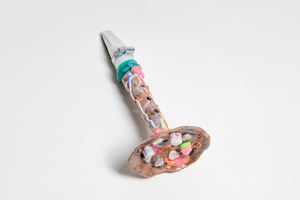
3. Pp 1-8, air 1-4 und dust 1-2, frühe Instrumente und Polymer-Gemälde, bei denen ich keinen überzeugenden Grund fand, weiterhin traditionelle Materialien zu verwenden. Also entschied ich mich, sie stattdessen mit PCL und PLA zu schaffen.
Die oben genannten Arbeiten sind das Ergebnis eines Instrumentenbaus durch DIY-Praxis und Open-Source-Dateien aus dem Internet, indem die Illusion der klassistischen Form geschmolzen, vermischt und in biologisch abbaubare Polymere gegossen wurde, nicht nur mit der Hand, sondern auch mit dem 3D-Drucker. Eine besondere Qualifikation ist für die Herstellung nicht nötig. Die Bauanleitungen für diese DIY-Instrumente werden während der Ausstellung und auf der Website zur Verfügung gestellt.
Wenn das Publikum die Knöpfe drückt, spielt dieses neutrale Orchester eine fugenhafte Struktur, bei der sich alle paar Sekunden Klänge überlagern. Die Kontrolle über das Orchester liegt beim Publikum. Die Arbeit hinterfragt geerbte Hierarchien, sowohl durch Material als auch durch Methode.
Für Kinder, die früh gelernt haben, nichts zu verlangen, und für Erwachsene, die mit dieser Erinnerung aufgewachsen sind.
- Plastic Fugue als Diplomprojekt besteht aus vier Teilen:
- Beschreibung (en)
- Plastic Fugue as Diplom project features four parts.
0. Introducing air&dust, a (introduction) video that appropriates a product unveiling conference. CEO Framey from Moberm, a pseudo corporation, speaks about how Moberm decided to expand its business into musical instruments based on the CEO's childhood memory. It boldly claims air&dust’s multifunctionality in musical instruments but remains ultimately hollow.
Framey, the speaking character, serves as a device that indirectly voices the artist's narrative within the work, while also reenacting the structure of art polluted by stereotypes and neoliberalism. The character is made with the virtual youtuber avatar technique.
1. Plastic Fugue, an interactive sound installation which consists of six flutes (air 5-10, air Pp 1) with air pumps, each producing a single tone and activated remotely through coded conducting buttons. The order of play is random every time as the buttons signal remotely.
The fugue has long stood as a symbol of musical authority and elitism, a form that represents technical mastery and the traditional hierarchy of composition. In my work, I try to break apart that formal authority, stripping the fugue down to its bare structure and shifting it toward an exploration of sequence and time. Instead of upholding its idealized order, I imagine a more open, accessible way of assembling sound, a kind of democratic counterpoint. You could call it a process of unmaking the fugue, of abstracting it.
2. Sax Recital, a recital video piece played by Arno Arial featuring DIY-Saxophone series, which is a quite decent structure of mouthpiece built using open-source 3D models and handcrafted with PCL and PLA. Filmed while Arial was wearing earphones for listening to classical music and soundproof gear on top to block out both external and self-produced instrumental sound. This piece is loop-playing all the time in the exhibition, making broken fugal counterpoint together with Plastic Fugue.
3. Pp 1-9, air 1-4, and dust 1-2, early-made instruments and polymer paintings which I found no compelling reason to continue using traditional materials, and so I ended up creating them with PCL and PLA.
The above instruments and paintings are the result of instrument-making through DIY-ness and open-source files from the internet by melting, merging, and mixing the illusion of classism's shape into biodegradable polymers, not only with a hand, but also with a 3D printer. However, any sacred qualification to make is not needed. DIY instructions for these DIY instruments are distributed at the exhibition and website.
When audiences press the buttons, this neutral orchestra plays a Fugue-like style, which overlaps sounds every few seconds. Placing control of the orchestra in the hands of the audience, the work democratizes a position of authority and questions inherited hierarchies through both material and method.
- Plastic Fugue as Diplom project features four parts.
- Mitwirkende
- Titel
- Work Detail
- Projektleiter/in
- Semester
- Studiengang
- Typ der Abschlussarbeit
- Importiert am
- 12.07.2025
- Übergeordnete Sets
- 1
- Set enthält
- 0 36