Die Kehrseite der Erinnerungskultur
Benachbarte Sets (153)Alle Zusammenhänge anzeigen
Diese Sets wurden den gleichen Sets hinzugefügt wie das ausgewählte Set.
153 Inhalte
- Seite 1 von 13
Erikas Töchter

Name that can easily go onto 2 lines
Author that can easily go onto 2 lines as well
- Titel
- Erikas Töchter
- Autor/in
- Beschreibung (de)
- "Erikas Töchter" untersucht anhand der fiktiven Figur Erika Mustermann Perspektiven auf die weibliche* Identitätsbildung in Deutschland. Seit 1987 existiert Erika als Musteridentität in amtlichen Dokumenten - weiß, blond, blau- oder grünäugig. Als ein lächelnder Anachronismus geistert sie, erschreckend unkommentiert, durch die Bürokratielandschaft Deutschlands. Ihre durchdringende Augen blicken uns alle aufmerksam an, die Mundwinkel deuten ein neutrales Lächeln an. Doch je länger man sie betrachtet, desto schwerer wiegt ihr Blick: normierend, klassifizierend und ausschließend.
Die Arbeit übersetzt diese fiktive Identität in ein irritierendes Szenario, das zwischen Gartenfest, Ausstellung, Performance und Büroalltag changiert. Im Zentrum stehen zwei Ebenen: Zum einen die Präsentation der IDOLLs, einer Serie neuer weiblicher Musteridentitäten, die im Format einer Teleshopping-Show als innovative Lösung zeitgenössischer Identitätsprobleme vermarktet werden. Zum anderen der Blick in Erikas Büroalltag. Umgeben von Plastik-Buchsbaumbüschen, Teppichboden und generischen Büromöbeln ist sie gefangen im Moment des Fotos und der Reproduktion ihres Gesichtes.
- "Erikas Töchter" untersucht anhand der fiktiven Figur Erika Mustermann Perspektiven auf die weibliche* Identitätsbildung in Deutschland. Seit 1987 existiert Erika als Musteridentität in amtlichen Dokumenten - weiß, blond, blau- oder grünäugig. Als ein lächelnder Anachronismus geistert sie, erschreckend unkommentiert, durch die Bürokratielandschaft Deutschlands. Ihre durchdringende Augen blicken uns alle aufmerksam an, die Mundwinkel deuten ein neutrales Lächeln an. Doch je länger man sie betrachtet, desto schwerer wiegt ihr Blick: normierend, klassifizierend und ausschließend.
- Beschreibung (en)
- “Erikas Töchter” explores perspectives on female* identity formation in Germany through the fictional figure of Erika Mustermann. Since 1987, Erika has served as the standard identity in official documents – white, blonde, blue- or green-eyed. As a smiling anachronism, she continues to haunt Germany’s bureaucratic landscape. Erika’s eyes look directly at the viewer, the corners of her mouth suggesting a neutral smile. Yet the longer she gazes at you, the more insistent her expression becomes: classifying and excluding
The work translates this fictional identity into a scenario that shifts between garden party, exhibition, performance, and office routine. At its center are two layers: on the one hand, the presentation of the IDOLLs – a series of new female standard identities, presented in the style of a teleshopping show, offering an innovative approach to contemporary issues of identity; on the other hand, a glimpse into Erika’s everyday office life. Surrounded by plastic boxwood shrubs, carpeting, and generic office furniture, she remains trapped in the moment of the photograph and the endless reproduction of her own face.
- “Erikas Töchter” explores perspectives on female* identity formation in Germany through the fictional figure of Erika Mustermann. Since 1987, Erika has served as the standard identity in official documents – white, blonde, blue- or green-eyed. As a smiling anachronism, she continues to haunt Germany’s bureaucratic landscape. Erika’s eyes look directly at the viewer, the corners of her mouth suggesting a neutral smile. Yet the longer she gazes at you, the more insistent her expression becomes: classifying and excluding
- Kategorie
- Typ des Projekts/Werks
- Schlagworte
- Datierung
- 22.07.2025
- Mitwirkende
- Sprache
- Material
- Abmessungen
- Ein kleines Haus mit Garten
- Dauer
- 4 Stunden
- Ort: Institution
- Stadt
- Land
- Titel
- Erikas Töchter
- Projektleiter/in
- Semester
- Studiengang
- Typ der Abschlussarbeit
- Importiert am
- 29.09.2025
- Übergeordnete Sets
- 3
- Set enthält
- 2 23
Ambassadors
Name that can easily go onto 2 lines
Author that can easily go onto 2 lines as well
- Titel
- Ambassadors
- Titel (en)
- Ambassadors
- Untertitel
- 12 stories of artificial survival
- Untertitel des Projekts/Werks (en)
- 12 stories of artificial survival
- Autor/in
- Beschreibung (de)
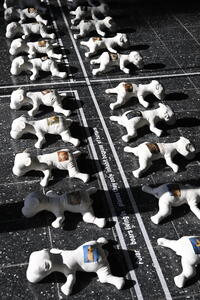
- AMBASSADORS ist eine installative Sammlung, bestehend aus 120 Stofftieren, die das Verhältnis der Konzepte vom Natürlichen und Künstlichen anhand des Eisbären in menschlicher Gefangenschaft beleuchtet. Im Kampf um die Klimakrise ist der Eisbär zum Symbolbild der zu schützenden Natur geworden und hat sich als solches zum Repräsentanten in das kollektive Gedächtnis eingebrannt. KI-generierte Bilder, von denen jeweils 10 eine der 12 Geschichten in der Installation visualisieren, wurden einzeln auf die Rücken der 120 Stofftiere übertragen und gemeinsam in ein immersives Wimmelbild verwoben. So werden die Stofftiere in der Installation zu Botschaftern einer künstlichen Population und verlängern damit, ohne Lebewesen Leid zuzufügen, die Ketten an Abbildungen von Abbildungen von etwas, das mal natürlich war.
- Beschreibung (en)
- Ambassadors is an installation consisting of 120 stuffed animals that explores the relation between the natural and the artificial through the lens of the polar bear in human captivity. In the fight against the climate crisis, polar bears haves become a symbolic image of nature in need of protection—an image that has etched itself into the collective memory. Each set of ten AI-generated images represents one of the twelve stories depicted in the installation. These images were transferred individually onto the backs of the 120 stuffed animals and collectively woven into an immersive Wimmelbild. In this way, the stuffed animals once again become ambassadors of an artificial population—extending the chain of representations of representations of something that once was natural, without causing harm to living beings.
- Kategorie
- Schlagworte
- Mitwirkende
- Material
- Titel
- Ambassadors
- Untertitel
- 12 stories of artificial survival
- Projektleiter/in
- Semester
- Studiengang
- Typ der Abschlussarbeit
- Importiert am
- 29.09.2025
- Übergeordnete Sets
- 3
- Set enthält
- 0 8
Imaginary Gardens with Real Toads in Them
Name that can easily go onto 2 lines
Author that can easily go onto 2 lines as well
- Titel
- Imaginary Gardens with Real Toads in Them
- Titel (en)
- Imaginary Gardens with Real Toads in Them
- Autor/in
- Beschreibung (de)
- „Imaginary Gardens with Real Toads in Them“ ist eine bekannte Zeile aus dem Gedicht „Poetry“ der amerikanischen Dichterin Marianne Moore. Es beschreibt ihre Einstellung zu Poesie und Kunst. „Imaginary gardens“ symbolisieren den idealisierten, fantastischen Teil von Kunst und Literatur – eine Vorstellung oder Wunschvorstellung, die die Fantasie anregt. Auf der anderen Seite stehen „real toads“ für die realen, greifbaren, oft unromantischen oder nicht idealisierten Aspekte der Welt – Dinge, die konkret und wahr sind, aber vielleicht nicht so schön wie die imaginären Visionen.
In meiner Ausstellung nahm ich mit drei Objekten Bezug auf diese Vorstellung:
– Eine Bank, die den Besucher zum Sitzen und Verweilen, zum Innehalten und Beobachten einlädt. Sie steht für Besinnung und die Erkenntnis der eigenen Position im Garten.
– Eine Kräuterkiste, die für das alte Wissen der Natur steht. Sie symbolisieren die verborgenen Schätze und Geheimnisse, die entdeckt und genutzt werden können. Hier ist der Besucher eingeladen, sich selbst einen Tee zusammenzustellen und aufzubrühen.
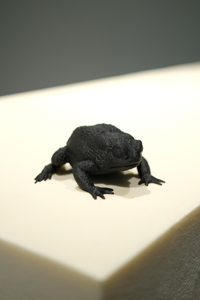
– Der Wächter des Gartens – die Kröte – und ihr Rückzugsort, der Brunnen, dienen als Quelle für alle Lebewesen. Der Brunnen steht für Tiefe und Erkenntnis, ein Ort, der durch Achtsamkeit zugänglich ist.
Begleitend zur Ausstellung lag am Eingang der Ausstellung ein kleines Leaflet für jeden Besucher mit einer von mir illustrierten Pflanze. Dazu habe ich eine kleine Geschichte zu meinem „Imaginary Garden“ abgedruckt, daneben ein Plan der Ausstellung mit Hinweisen zu den verschiedenen Objekten. Auf der Rückseite findet sich ein Impressum meiner ganzen Recherche.
- „Imaginary Gardens with Real Toads in Them“ ist eine bekannte Zeile aus dem Gedicht „Poetry“ der amerikanischen Dichterin Marianne Moore. Es beschreibt ihre Einstellung zu Poesie und Kunst. „Imaginary gardens“ symbolisieren den idealisierten, fantastischen Teil von Kunst und Literatur – eine Vorstellung oder Wunschvorstellung, die die Fantasie anregt. Auf der anderen Seite stehen „real toads“ für die realen, greifbaren, oft unromantischen oder nicht idealisierten Aspekte der Welt – Dinge, die konkret und wahr sind, aber vielleicht nicht so schön wie die imaginären Visionen.
- Beschreibung (en)
- „Imaginary Gardens with Real Toads in Them“ is a well-known line from the poem „Poetry“ by American poet Marianne Moore. It describes her attitude towards poetry and art.
„Imaginary gardens“ symbolises the idealised, fantastical part of art and literature – an idea or wishful thinking that stimulates the imagination. On the other hand, „real toads“ represents the real, tangible, often unromantic or non-idealised aspects of the world – things that are concrete and true, but perhaps not as beautiful as imaginary visions.
In my exhibition, I referenced this idea with three objects:
– A bench that invites visitors to sit and linger, to pause and observe. It stands for reflection and awareness of one's own position in the garden.
– A herb box, which represents the ancient knowledge of nature. They symbolise the hidden treasures and secrets that can be discovered and used. Here, visitors are invited to mix and brew their own tea.
– The guardian of the garden – the toad – and its retreat, the well, serve as a source for all living creatures. The well represents depth and insight, a place that can be accessed through mindfulness.
Accompanying the exhibition, a small leaflet was available for each visitor at the entrance, featuring a plant illustrated by me. I also printed a short story about my „Imaginary Garden“. Next to it was a map of the exhibition with information about the various objects. On the back is an imprint of my entire research.
- „Imaginary Gardens with Real Toads in Them“ is a well-known line from the poem „Poetry“ by American poet Marianne Moore. It describes her attitude towards poetry and art.
- Kategorie
- Typ des Projekts/Werks
- Schlagworte
- Datierung
- 22.01.2025 - 27.01.2025
- Dank an
- Sprache
- Material
- Abmessungen
- 5,8m x 8m
- Ort: Institution
- Ort
- Lichthof
- Stadt
- Land
- Titel
- Imaginary Gardens with Real Toads in Them
- Projektleiter/in
- Semester
- Studiengang
- Typ der Abschlussarbeit
- Importiert am
- 01.10.2025
- Übergeordnete Sets
- 3
- Set enthält
- 0 11
Elusive Unrealities
Name that can easily go onto 2 lines
Author that can easily go onto 2 lines as well
- Titel
- Elusive Unrealities
- Titel (en)
- Elusive Unrealities
- Untertitel
- On Calling, Grasping & Awakening Dreams
- Untertitel des Projekts/Werks (en)
- On Calling, Grasping & Awakening Dreams
- Autor/in
- Beschreibung (de)
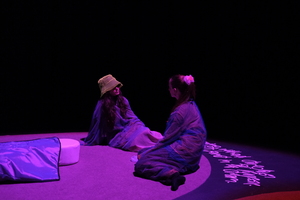
- Jeder Mensch träumt, manche Träume sind lebendig und bildhaft, andere abstrakt und symbolisch. In meiner Abschlussarbeitrbeit habe ich Traumerfahrungen in interaktive Objekte übersetzt und im Rahmen einer interaktive Ausstellung präsentiert. Darin werden sieben Traumthemen reflektiert: zwei der häufigsten Traumarten, Alptraum und Lusttraum; zwei wissenschaftliche Erkenntnisse, die Schwierigkeit des Gehirns, im Schlaf Gesichter und Figuren zu erkennen sowie die Unfähigkeit, Muster in geschriebener Schrift zu lesen; drei persönliche Faszinationen, das Ritual des Einschlafens, des Aufwachens sowie das Träumen als Reise in fantastische Welten.
- Beschreibung (en)
- Everyone dreams, some dreams are vivid and lifelike, others abstract and symbolic. In my diploma project I translated dream experiences into interactive objects and presented them in an interactive exhibition, reflecting seven dream themes: two addressing the most common dream types, nightmare and pleasure dreaming; two drawing on scientific research, the brain's difficulty recognising faces and figures during sleep, and its inability to read patterns in written text; three rooted in personal fascination, the rituals of falling asleep and waking, and dreaming as a passage to fantastical worlds.
- Kategorie
- Typ des Projekts/Werks
- Schlagworte
- Datierung
- 22.4.2025
- Dank an
- Sprache
- Material
- Abmessungen
- 90sqm
- Ort: Institution
- Stadt
- Land
- Internetlinks
- Titel
- Elusive Unrealities
- Untertitel
- On Calling, Grasping & Awakening Dreams
- Projektleiter/in
- Semester
- Studiengang
- Typ der Abschlussarbeit
- Importiert am
- 08.10.2025
- Übergeordnete Sets
- 3
- Set enthält
- 0 13
DORMIVEGLIA
Name that can easily go onto 2 lines
Author that can easily go onto 2 lines as well
- Titel
- DORMIVEGLIA
- Titel (en)
- DORMIVEGLIA
- Autor/in
- Beschreibung (de)
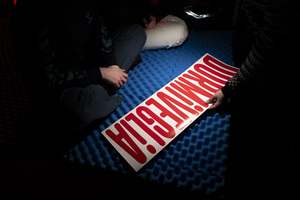
- „DORMIVEGLIA“ ist ein fortlaufendes Archiv zum Thema Schlaf, Ruhe und Regeneration, das Stimmen, Praktiken und künstlerische Beiträge sammelt. Für den Diplomtag wurde daraus eine immersive Traumlandschaft entwickelt: ein Raum mit Liegeflächen aus Audio-Schaumstoff, olfaktorischen Duftkomponenten, amber-rötlichem Licht sowie einer Soundarbeit in Kooperation mit der sri-lankischen Musiker:innengruppe Bilala. Die Arbeit versteht Schlaf als kollektive, politische Praxis und eröffnet einen Ort des Innehaltens, der gemeinsamen Erschöpfung und des Dazwischen-Seins.
- Beschreibung (en)
- “DORMIVEGLIA” is an ongoing archive dedicated to sleep, rest, and regeneration, gathering voices, practices, and artistic contributions. For the diploma presentation, it was transformed into an immersive dreamscape: a space with reclining surfaces made of acoustic foam, olfactory scent components, amber-red light, and a sound piece created in collaboration with the Sri Lankan music collective Bilala. The work understands sleep as a collective and political practice, offering a space for pause, shared exhaustion, and states of in-between.
- Kategorie
- Typ des Projekts/Werks
- Schlagworte
- Datierung
- 2025
- Mitwirkende
- Dank an
- Sprache
- Material
- Dauer
- 45 min
- Ort: Institution
- Ort
- Großes Studio
- Stadt
- Land
- Beteiligte Institution(en)
- Internetlinks
- Titel
- DORMIVEGLIA
- Projektleiter/in
- Semester
- Studiengang
- Typ der Abschlussarbeit
- Importiert am
- 13.10.2025
- Übergeordnete Sets
- 2
- Set enthält
- 0 9
Kunst in der Praxis
Name that can easily go onto 2 lines
Author that can easily go onto 2 lines as well
- Titel
- Kunst in der Praxis
- Untertitel
- Methoden des Ausstellens im Vergleich zwischen ärztlicher Praxis und Kunstmuseum
- Autor/in
- Beschreibung (de)
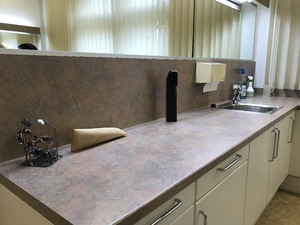
- In ärztlichen Praxen sind häufig künstlerische Objekte ausgestellt. Anders als im Museum ist die Begegnung mit diesen Objekten jedoch eher selten der Anlass für den Besuch der medizinischen Einrichtung. Die beiläufige Betrachtung der Kunstwerke ist vielmehr ein ästhetisches Nebenprodukt des eigentlichen Anliegens der Besucher*innen. Wie und warum werden überhaupt Kunstobjekte in ärztlichen Einrichtungen präsentiert? Lässt sich diese Präsentation mit musealen Ausstellungen vergleichen? Diesen Fragen wird in dieser Magisterarbeit nachgegangen und mittels Feldforschung und museumskritischer Einordnung begegnet.
- Kategorie
- Typ des Projekts/Werks
- Schlagworte
- Datierung
- 21.10.2021
- Dank an
- Sprache
- Abmessungen
- 123 Seiten (85 Seiten Text)
- Stadt
- Land
- Titel
- Kunst in der Praxis
- Untertitel
- Methoden des Ausstellens im Vergleich zwischen ärztlicher Praxis und Kunstmuseum
- Projektleiter/in
- Semester
- Studiengang
- Typ der Abschlussarbeit
- Importiert am
- 13.10.2025
- Übergeordnete Sets
- 2
- Set enthält
- 0 6
(Un)Stopped Motion
Name that can easily go onto 2 lines
Author that can easily go onto 2 lines as well
- Titel
- (Un)Stopped Motion
- Titel (en)
- (Un)Stopped Motion
- Autor/in
- Beschreibung (de)
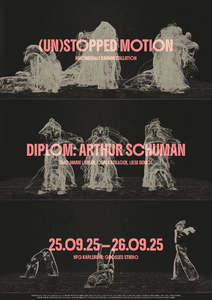
- In dieser interdisziplinären Arbeit wird der schleichende Prozess der Selbstkontrolle als Reaktion auf äußere Störungen untersucht. Ausgangspunkt ist die Angst, einen Fehler zu begehen, die nicht mit einem sichtbaren Eingriff beginnt, sondern sich langsam in das Bewegungsrepertoire des Körpers einschreibt, bis sie schließlich zum Stillstand führt.
Die Performance wird aus mehreren Perspektiven gefilmt. Diese Aufnahmen aus verschiedenen Blickachsen eines überwachenden Apparats, werden in der Installation projiziert.
- In dieser interdisziplinären Arbeit wird der schleichende Prozess der Selbstkontrolle als Reaktion auf äußere Störungen untersucht. Ausgangspunkt ist die Angst, einen Fehler zu begehen, die nicht mit einem sichtbaren Eingriff beginnt, sondern sich langsam in das Bewegungsrepertoire des Körpers einschreibt, bis sie schließlich zum Stillstand führt.
- Beschreibung (en)
- This interdisciplinary work examines the creeping process of self-control as a response to external disturbances. The starting point is the fear of making a mistake, which does not begin with a visible intervention, but slowly inscribes itself into the body's repertoire of movements until it finally leads to a standstill.
The performance is filmed from several perspectives. These recordings from different viewing angles of a surveillance device are projected in the installation.
- This interdisciplinary work examines the creeping process of self-control as a response to external disturbances. The starting point is the fear of making a mistake, which does not begin with a visible intervention, but slowly inscribes itself into the body's repertoire of movements until it finally leads to a standstill.
- Kategorie
- Typ des Projekts/Werks
- Schlagworte
- Datierung
- 24.09.2025 - 29.09.2025
- Mitwirkende
- Dank an
- Material
- Abmessungen
- 4x Screens 1,8x2,8 m
- Dauer
- 08:30
- Ort: Institution
- Ort
- Großes Studio, HfG Karlsruhe
Screen, HfG Karlsruhe
- Großes Studio, HfG Karlsruhe
- Stadt
- Land
- Titel
- (Un)Stopped Motion
- Projektleiter/in
- Semester
- Studiengang
- Typ der Abschlussarbeit
- Importiert am
- 21.10.2025
- Übergeordnete Sets
- 3
- Set enthält
- 2 4
Midnight Zone
Name that can easily go onto 2 lines
Author that can easily go onto 2 lines as well
- Titel
- Midnight Zone
- Titel (en)
- Midnight Zone
- Autor/in
- Beschreibung (de)
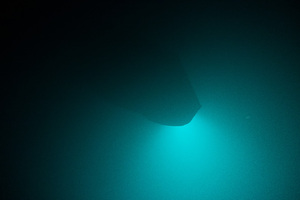
- Midnight Zone ist eine Performance über die Tiefsee, jenen Raum, in den kein Sonnenlicht mehr dringt. In dieser absolut dunklen und hohem Druck ausgesetzten Umgebung verschieben sich unsere Wahrnehmungen von Zeit, Körper und Orientierung.
In einem Raum, der das eigene Körpergefühl verschwimmen lässt, durchziehen Fischlaute, Maschinengeräusche und ferne Erdbeben die verschiedenen atmosphärischen Bedingungen des größten Lebensraums der Erde. Performerinnen bewegen sich wie fremde Wesen, zugleich Teil der Natur und Spiegel menschlicher Eingriffe. Mit jeder Bewegung beeinflussen die Besucher*innen das Netz aus Klang, Schatten und Choreografie und werden selbst Teil des Ökosystems, das sie beobachten.
Midnight Zone macht das fragile System der Tiefsee sinnlich erfahrbar: Dort, wo das Leben möglicherweise begann, wo Zeit anders fließt und Prozesse Jahrhunderte dauern können, ist der menschliche Einfluss zunehmend spürbar. Die Arbeit lässt Traum und Realität, Mensch und Natur, Oberfläche und Tiefe ineinander übergehen. Sie lädt dazu ein, lineare Zeitvorstellungen hinter sich zu lassen und alternative Rhythmen zu erspüren. Rhythmen, die im Einklang mit planetarischen Zyklen stehen und dem beschleunigten Takt des Anthropozäns etwas entgegensetzen.
- Midnight Zone ist eine Performance über die Tiefsee, jenen Raum, in den kein Sonnenlicht mehr dringt. In dieser absolut dunklen und hohem Druck ausgesetzten Umgebung verschieben sich unsere Wahrnehmungen von Zeit, Körper und Orientierung.
- Beschreibung (en)
- Midnight Zone is a performance about the deep sea, that realm into which no sunlight can penetrate. In this environment of absolute darkness and immense pressure, our perceptions of time, body, and orientation begin to shift.
In a space where one’s sense of the body starts to blur, fish sounds, mechanical noises, and distant earthquakes move through the atmospheric layers of the largest habitat on Earth. The performers move like unfamiliar beings, at once part of nature and a reflection of human impact. With every movement, the visitors influence the network of sound, shadow, and choreography, becoming part of the very ecosystem they are observing.
Midnight Zone makes the fragile system of the deep sea sensually perceptible: a place where life may have begun, where time flows differently and processes can take centuries, and where human presence is increasingly noticeable. The work allows dream and reality, human and nature, surface and depth to merge. It invites the audience to let go of linear notions of time and attune themselves to alternative rhythms, rhythms aligned with planetary cycles, offering a counterpoint to the accelerated tempo of the Anthropocene.
- Midnight Zone is a performance about the deep sea, that realm into which no sunlight can penetrate. In this environment of absolute darkness and immense pressure, our perceptions of time, body, and orientation begin to shift.
- Kategorie
- Typ des Projekts/Werks
- Schlagworte
- Datierung
- 30.10.25 und 31.10.25
- Mitwirkende
- Dank an
- Dauer
- 1 Stunde
- Ort: Institution
- Ort
- Großes Studio
- Stadt
- Land
- Beteiligte Institution(en)
- Titel
- Midnight Zone
- Projektleiter/in
- Semester
- Studiengang
- Typ der Abschlussarbeit
- Importiert am
- 03.12.2025
- Übergeordnete Sets
- 3
- Set enthält
- 0 13
Fake it till you make it
Name that can easily go onto 2 lines
Author that can easily go onto 2 lines as well
- Titel
- Fake it till you make it
- Titel (en)
- Fake it till you make it
- Autor/in
- Beschreibung (de)
- Stuckmarmor ist eine historische Stucktechnik des 16. und 17. Jahrhunderts aus Italien, die für ihre Marmorimitation bekannt ist. Dabei wurden Gips, Wasser, Pigmente und tierischer Leim gemischt, um marmorähnliche Oberflächen zu schaffen.
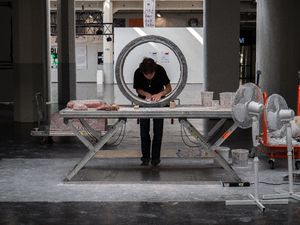
"Fake it till you make it" ist eine Erkundung dieses traditionellen Handwerks. Ziel ist es, die alte Kunst der Marmorimitation wiederzubeleben und ihre ästhetischen Werte in der heutigen Welt zu präsentieren. Darüber hinaus befasst sich das Projekt mit der Frage, was "echt" und was "unecht" ist, und untersucht die Rolle der Inszenierung. Inspiriert von den drei Teilen einer Säule (Basis, Schaft, Kapitell) habe ich drei Objekte entwickelt, die als Einzelstücke im Raum zu finden sind. Alle drei Objekte sind aus Holz gefertigt, zwei davon durch ein Stahlgerüst stabilisiert. Die Unterkonstruktion wurde dann mit Streckmetall verkleidet, verputzt und diente schließlich als Untergrund für den Stuckmarmor. Ein Making-of-Video zeigt die Herstellung des Stuckmarmors. Jedes der Objekte ist auf eine andere Art und Weise verkleidet, um die Konstruktion nicht immer zu verbergen, sondern sie vielmehr zu enthüllen, ganz nach dem Motto "fake it till you make it".
- Stuckmarmor ist eine historische Stucktechnik des 16. und 17. Jahrhunderts aus Italien, die für ihre Marmorimitation bekannt ist. Dabei wurden Gips, Wasser, Pigmente und tierischer Leim gemischt, um marmorähnliche Oberflächen zu schaffen.
- Beschreibung (en)
- Stucco marble is a historic plasterwork technique originating from 16th and 17th-century Italy, celebrated for its imitation of marble. This involved blending gypsum plaster, water, pigments, and animal glue to create marble-like surfaces.
„fake it till you make it“ is an exploration of this traditional craft of stucco marble. The aim is to revive the ancient art of imitating marble and to present its aesthetic values in today‘s world. In addition, the project will address the question of what is „real“ and what is „fake“ and examine the role of staging. Inspired by the three parts of a column (base, shaft, capital) I have developed three objects that can be found as individual pieces in the room. All three objects are made of wood, two of them stabilized by a steel framework. Ribbed expanded metal lath was then stapled onto the wood and plastered, serving as the base for the stucco marble. A making of video shows the production of the stucco marble. Each of the objects is covered in a different way, intended not to always conceal the construction but rather to reveal it, embodying the spirit of „fake it till you make it.“
- Stucco marble is a historic plasterwork technique originating from 16th and 17th-century Italy, celebrated for its imitation of marble. This involved blending gypsum plaster, water, pigments, and animal glue to create marble-like surfaces.
- Kategorie
- Typ des Projekts/Werks
- Schlagworte
- Datierung
- 25.06.2024
- Dank an
- Material
- Ort: Institution
- Ort
- Unter der Lichtbrücke
- Stadt
- Land
- Titel
- Fake it till you make it
- Projektleiter/in
- Semester
- Studiengang
- Typ der Abschlussarbeit
- Importiert am
- 20.12.2025
- Übergeordnete Sets
- 1
- Set enthält
- 0 16
Leaving on a High Note
Name that can easily go onto 2 lines
Author that can easily go onto 2 lines as well
- Titel
- Leaving on a High Note
- Autor/in
- Beschreibung (de)
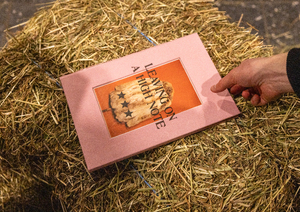
- "Leaving on a High Note" ist eine Reflexion über Schönheit und das Medium Buch. Die Arbeit bringt vielfältiges visuelles Material, von gescannten Fotografien und Kunstwerken über handgezeichnete Textilmuster bis hin zu in Auftrag gegebenen künstlerischen Beiträgen, zusammen. Als eine Art poetisches Moodboard geht das Projekt der Frage nach, wie sich Atmosphäre, Schönheit und visuelle Intuition durch Kuration im Zusammenspiel mit materiellen Entscheidungen formen lassen. Das Papier wurde akribisch gewählt, um die Betrachtung um eine haptische Ebene zu erweitern. Die Bindung durch den Rücken des Hardcovers verweist auf den konzeptuellen, redaktionellen und praktischen Prozess, der zum finalen Objekt geführt hat. Das Buch enthält künstlerische Beiträge von Alva Bücking sowie Zeichnungen von Charlotte Singer.
"Leaving on a High Note" wurde im Rahmen einer Ausstellung gezeigt, die die Stimmung des Buches in den Raum übertrug. Die Soirée fand am 17. Dezember 2025 im ZKM Pavillon in Karlsruhe statt und umfasste eine Installation und eine Chorperformance. Der Chor wurde von Leonie Inga Klopstock geleitet und mit von Anton Schüler designten Krägen ausgestattet.
- "Leaving on a High Note" ist eine Reflexion über Schönheit und das Medium Buch. Die Arbeit bringt vielfältiges visuelles Material, von gescannten Fotografien und Kunstwerken über handgezeichnete Textilmuster bis hin zu in Auftrag gegebenen künstlerischen Beiträgen, zusammen. Als eine Art poetisches Moodboard geht das Projekt der Frage nach, wie sich Atmosphäre, Schönheit und visuelle Intuition durch Kuration im Zusammenspiel mit materiellen Entscheidungen formen lassen. Das Papier wurde akribisch gewählt, um die Betrachtung um eine haptische Ebene zu erweitern. Die Bindung durch den Rücken des Hardcovers verweist auf den konzeptuellen, redaktionellen und praktischen Prozess, der zum finalen Objekt geführt hat. Das Buch enthält künstlerische Beiträge von Alva Bücking sowie Zeichnungen von Charlotte Singer.
- Beschreibung (en)
- "Leaving on a High Note" is a reflection on beauty as well as on bookmaking. It is a collection of diverse visual material ranging from scanned photography and artworks to hand-drawn textile patterns and commissioned artistic contributions. It functions as a poetic moodboard, exploring how atmosphere, beauty and visual intuition can be shaped through curation and material decisions. The paper was chosen meticulously in order to introduce a refined tactile experience to the act of viewing. The work is bound with thread punched through the hardcover spine, referencing the conceptual, editorial and practical process that led to the final object. The book includes commissioned work by Alva Bücking as well as drawings by Charlotte Singer.
"Leaving on a High Note" was shown in an exhibition that translated the book’s mood into the space. The soirée took place at the ZKM Pavillon in Karlsruhe on December 17, 2025 and featured an installation alongside a choir performance. The choir was conducted by Leonie Inga Klopstock and outfitted with collars by Anton Schüler.
- "Leaving on a High Note" is a reflection on beauty as well as on bookmaking. It is a collection of diverse visual material ranging from scanned photography and artworks to hand-drawn textile patterns and commissioned artistic contributions. It functions as a poetic moodboard, exploring how atmosphere, beauty and visual intuition can be shaped through curation and material decisions. The paper was chosen meticulously in order to introduce a refined tactile experience to the act of viewing. The work is bound with thread punched through the hardcover spine, referencing the conceptual, editorial and practical process that led to the final object. The book includes commissioned work by Alva Bücking as well as drawings by Charlotte Singer.
- Kategorie
- Typ des Projekts/Werks
- Schlagworte
- Datierung
- 17.12.2025
- Mitwirkende
- Dank an
- Paul Bailey
- Vincent Carl Becher
- Alva Bücking
- Rahel Diederich
- Till Engelhardt
- Marie Faaß
- Line-Gry Hørup
- Dans Jirgensons
- Tobias Keilbach
- Leonie Inga Klopstock
- Susanne Kriemann
- Ida Kuczewski
- Barbara Kuon
- Isabel Motz
- Tereza Ruller
- Luis Rüttiger
- Jana Schmeckenbecher
- Anton Schüler
- Isabel Seiffert
- Moritz Kamil Simon
- Charlotte Singer
- Lilith Stumpf
- Pierre Zimmer
- Petra Zimmermann
- HfG Chor
- Sprache
- Ort: Institution
- Stadt
- Land
- Titel
- Leaving on a High Note
- Projektleiter/in
- Semester
- Studiengang
- Typ der Abschlussarbeit
- Importiert am
- 05.01.2026
- Übergeordnete Sets
- 2
- Set enthält
- 0 10
No Feeding
Name that can easily go onto 2 lines
Author that can easily go onto 2 lines as well
- Titel
- No Feeding
- Titel (en)
- No Feeding
- Autor/in
- Beschreibung (de)
- Tauben gehören zu den alltäglichsten Tieren unseres urbanen Lebens. In allen Städten Deutschlands sieht man sie täglich in Gassen, auf Plätzen, Dächern und Geländern. Während meiner Recherche stieß ich sogar im Stadtarchiv Karlsruhe auf zahlreiche taubenbezogene Bilder, Texte und Dokumente.
Obwohl sie wie wir in der Stadt leben, werden Tauben oft übersehen, verachtet oder gar misshandelt. Man nennt sie manchmal „fliegende Staubsauger“, weil sie Essensreste vom Boden aufpicken, oder „fliegende Ratten“, da sie als Krankheitsüberträger gelten.
Doch als ich begann, mich intensiver mit der Geschichte der Tauben zu beschäftigen, entdeckte ich eine ganz andere Seite: Früher waren sie verlässliche Boten in der Kommunikation. Auf Reisen und in kolonialen Unternehmungen nahm man Tauben mit, als Begleiter und Nachrichtenübermittler. Mit der Ausbreitung globaler Mobilität verbreiteten sich auch Tauben weltweit. Heute benötigen wir sie durch den Fortschritt der Technik nicht mehr und begegnen ihnen mit Ablehnung, wie die allgegenwärtigen Taubenabwehrspitzen an Gebäuden zeigen.
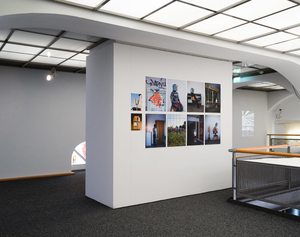
In meinen Fotografien verwende ich die Taube auf humorvolle und absurde Weise als Symbol, um ihre komplexe Beziehung zum Menschen zu thematisieren und zugleich meine eigene Identitätsfrage zu reflektieren. Mal trägt sie Anzug, mal wirkt sie einsam und verloren. Ist es ein Mensch mit Taubenmaske oder eine Taube, die versucht, ein Mensch zu sein?
- Tauben gehören zu den alltäglichsten Tieren unseres urbanen Lebens. In allen Städten Deutschlands sieht man sie täglich in Gassen, auf Plätzen, Dächern und Geländern. Während meiner Recherche stieß ich sogar im Stadtarchiv Karlsruhe auf zahlreiche taubenbezogene Bilder, Texte und Dokumente.
- Beschreibung (en)
- Pigeons are perhaps the most familiar animals in our everyday urban life. In every city across Germany, you can spot them in alleys, on rooftops, in squares, always present, always overlooked. During my research, I even found numerous images, texts, and records related to pigeons in the city archive of Karlsruhe.
Despite being fellow residents of our cities, pigeons are often ignored, despised, or mistreated. They’re sometimes called “flying vacuum cleaners” for picking up crumbs from the ground, or “flying rats” due to their association with disease.
But when I started to explore their history more deeply, I discovered another side of them: pigeons were once trusted messengers. People used them for communication, especially during travel or colonial expansion, and they became companions on long journeys. As globalization advanced, pigeons spread across the world. Today, we no longer rely on them, yet we go to great lengths to drive them away, visible in the anti-pigeon spikes found on buildings everywhere.
In my photographs, I use the pigeon’s form as a symbol in a playful and absurd way, capturing its complex identity through staged, theatrical compositions. At times it wears a suit; at others, it seems lonely or melancholic. Is it a person in a pigeon mask or a pigeon pretending to be human?
- Pigeons are perhaps the most familiar animals in our everyday urban life. In every city across Germany, you can spot them in alleys, on rooftops, in squares, always present, always overlooked. During my research, I even found numerous images, texts, and records related to pigeons in the city archive of Karlsruhe.
- Kategorie
- Typ des Projekts/Werks
- Schlagworte
- Mitwirkende
- Dank an
- Material
- Abmessungen
- 420 x 594 mm x 8, 210 x 297 mm x 2
- Ort
- Art Karlsruhe, Halle 3 / H3/S08
- Stadt
- Land
- Beteiligte Institution(en)
- Titel
- No Feeding
- Projektleiter/in
- Semester
- Studiengang
- Importiert am
- 24.01.2026
- Übergeordnete Sets
- 1
- Set enthält
- 0 13
PINK ELEPHANT
Name that can easily go onto 2 lines
Author that can easily go onto 2 lines as well
- Titel
- PINK ELEPHANT
- Titel (en)
- PINK ELEPHANT
- Autor/in
- Beschreibung (de)
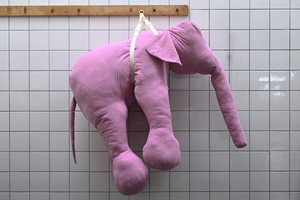
- Pink Elephant ist eine textile Skulptur, die im Rahmen der Sprint Residency im Studio Hö der Hoepfner Stiftung entstanden ist. Das Werk übersetzt das Sprichwort „Seeing Pink Elephants“ in den Raum – eine Redewendung für Halluzinationen, die normalerweise durch schweren Alkoholentzug oder alkoholische Halluzinose verursacht werden und einen Zustand des Deliriums darstellen, in dem der Geist bizarre Bilder wie leuchtend rosa Elefanten erzeugt. Damit spielt die Arbeit auf den Kontext an, in dem sie präsentiert wird, nämlich die Kunststiftung einer Brauerei.
- Pink Elephant ist eine textile Skulptur, die im Rahmen der Sprint Residency im Studio Hö der Hoepfner Stiftung entstanden ist. Das Werk übersetzt das Sprichwort „Seeing Pink Elephants“ in den Raum – eine Redewendung für Halluzinationen, die normalerweise durch schweren Alkoholentzug oder alkoholische Halluzinose verursacht werden und einen Zustand des Deliriums darstellen, in dem der Geist bizarre Bilder wie leuchtend rosa Elefanten erzeugt. Damit spielt die Arbeit auf den Kontext an, in dem sie präsentiert wird, nämlich die Kunststiftung einer Brauerei.
- Beschreibung (en)
- Pink Elephant is a textile sculpture created as part of the Sprint Residency at Studio Hö of the Hoepfner Foundation. The work translates the saying “seeing pink elephants” into space, an idiom for hallucinations, usually caused by severe alcohol withdrawal or alcoholic hallucinosis, representing a state of delirium where the mind fabricates bizarre sights like bright pink elephants. The work thus alludes to the context for which it was originally made and presented, the art foundation of a brewery.
- Kategorie
- Datierung
- 2025
- Technik/Verfahren/Formate
- Textilobjekt
- Abmessungen
- Höhe: 120cm Breite: 150cm Tiefe: 50cm
- Stadt
- Land
- Auftrag durch
- Hoepfner Stiftung
- Internetlinks
- Titel
- PINK ELEPHANT
- Semester
- Studiengang
- Importiert am
- 26.01.2026
- Übergeordnete Sets
- 1
- Set enthält
- 0 6