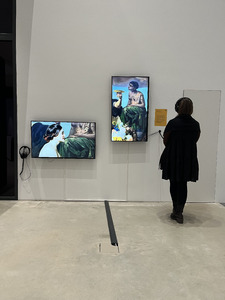
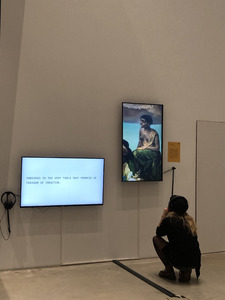
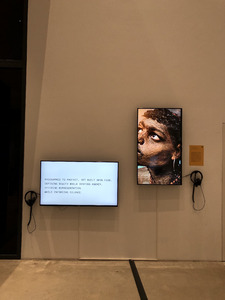
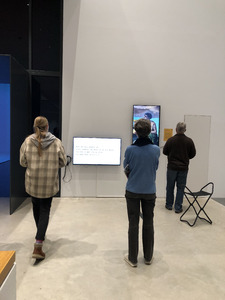
| Description (de) | - In this project, I examine how the male gaze is built within AI systems content moderation , where censorship and sexualization coexist. Drawing from Anselm Feuerbach’s 1852 painting Hafis vor der Schenke, depicting the poet Hafez and two silent women, the work poses the question: if freed from spectatorship, what voices might they reveal? This two-channel video installation reimagines the scene through AI video generation and live narration. Referencing Valerie Solanas’s S.C.U.M. Manifesto, it reflects on how Gen-AI, governed by moral bias, mirrors a patriarchal worldview - still defining what is visible and what must remain unseen.
|
| Description (en) | - THE (A)RB(I)TER
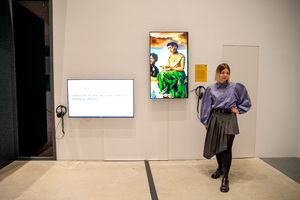
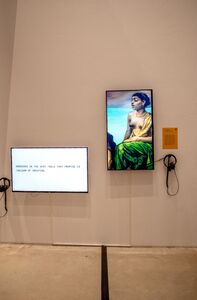
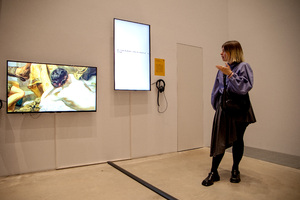
In this project, I examine how the male gaze is built within AI systems content moderation , where censorship and sexualization coexist. Drawing from Anselm Feuerbach’s 1852 painting Hafis vor der Schenke, depicting the poet Hafez and two silent women, the work poses the question: if freed from spectatorship, what voices might they reveal? This two-channel video installation reimagines the scene through AI video generation and live narration. Referencing Valerie Solanas’s S.C.U.M. Manifesto, it reflects on how Gen-AI, governed by moral bias, mirrors a patriarchal worldview - still defining what is visible and what must remain unseen.
|
| Extensive Description (en) | - THE (A)RB(I)TER
"...that she is the shaped rather than the shaper; the
apprentice rather than the master; the atmosphere,
the background, the set, the surrounding against which the focused male figure vividly plays out the substantial action of civilization and its discontents."
Vivian Gornick, referencing Valerie Solanas' S.C.U.M. Manifesto
In this project, I'm exploring why the male gaze is represented through AI software, how censorship and sexualization coexist in this system, as well as tracing the notion of "The Great Artist" within both historical and contemporary frameworks.
In the course of researching the extensive collection of historical paintings at Kunsthalle Mannheim, I focused on the work "Hafis vor der Schenke" ( Hafez in Front of the Tavern ) , made by Anselm Feuerbach in 1852.
This painting depicts a Persian poet, Hafez, while reading his poetry, and the two women figures around , completely silent and still.
Yet their stillness raises a question: if freed from enforced spectatorship, what voices would these women reveal?
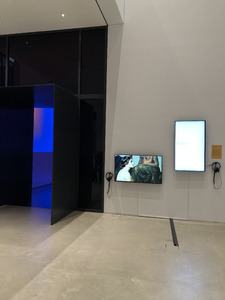
This project consists of a two-channel video installation drawn from the painting and animated through AI-video generation. Combined with the live audio narration, the piece constructs an imagined lens onto women’s subjective experiences.
The theoretical base of this project references the S.C.U.M. Manifesto, written by Valerie Solanas in 1967 . What began as a text voiced by untamed rage evolved into a transformative force within the radical feminist movement.
During the development of the work , I encountered a set of guardrails and censorship enforced by Gen-AI, which led me to question:
Can widely used Gen-AI still tell the difference between a historical painting and sexually explicit content ?
Only in theory, because in practice, when AI-video generators are fed with a painting revealing a subtle hint of nudity, they interpret the output in a realistically sexualized way . As a result, Gen-AI labels it as "harmful content" , blocks the video output, and censors its own interpretation of the image.
The algorithm is not only inconsistent but also designed in the dystopian paradigm, enforcing conformity and a patriarchal worldview.
It draws a parallel between Gen-Ai guided by the questionable morals of large tech companies, and the male artists of the 19th century , who envisioned the Great Art by depicting female nudes , but strictly limiting the roles played out in the image.
Ultimately, the "Frameworks of Fiction" are still imposed in the common tools and systems that we use daily, defining what is allowed in cultural production and what should be cut out.
|