PLAY DATE
Benachbarte Sets (14)Alle Zusammenhänge anzeigen
Diese Sets wurden den gleichen Sets hinzugefügt wie das ausgewählte Set.
14 Inhalte
- Seite 1 von 2
Raumintervention Paradies
- Titel
- Raumintervention Paradies
- Autor/in
- Beschreibung (de)
- Der Hermann-Levi-Platz, „Vorplatz“ des Badischen Staatstheaters Karlsruhe, bleibt zwischen mehreren Großbaustellen voraussichtlich bis 2036 ein Ort des Übergangs. Vor diesem Hintergrund nimmt die temporäre „Raumintervention Paradies“ einen Dialog mit der urbanen Brache auf. Die Umbenennung des Platzes in ein „Paradies“ erprobt das Potenzial dieser Fläche als lebendigen, ökologischen und sozialen Raum, der zur Auseinandersetzung mit Natur, Nachhaltigkeit und Gemeinschaft einlädt. Die Intervention gliedert sich in drei miteinander verbundene Orte des Verweilens, des Lernens und des Aus-Tauschens:
A) Biotopos – Paradies als Lernort
Die Installation inszeniert ein unbemerkt entstandenes Biotop am Rande des Platzes. Im Sinne Gilles Cléments Begriff der „dritten Landschaft“ bricht dieser wilde Ort mit geordneter Landschaftsarchitektur im urbanen Raum. Das großformatige Banner zeigt rund 200 ineinanderfließende Fotografien der Pflanzenvielfalt des Biotops, die als Brücke zwischen Realität und Imagination zu verstehen ist. Integrierte Gucklöcher rufen zur bewussten Betrachtung des Biotops auf. Ein QR-Code, der zu einem botanischen Archiv führt, ergänzt die Interaktion als digitalen Lernort.
B) Ein Steg zum Verweilen führt zu einer Insel: Paradies als Aufenthaltsraum
Inmitten von Beton und Baustellenlärm führt der inklusiv gestaltete Steg zu einer Plattform am Wasserbecken des Vorplatzes. Sitzelemente und schattenspendende Wimpel laden zum Verweilen ein. Der Steg ergründet so den Paradiesbegriff als Sehnsuchtsort, dem man sich zwar annähern kann, aber zu dem man stets auf Distanz bleibt. Die orangefarbene Leuchtschrift „Paradies“ vervollständigt als konkrete und abstrakte Größe das Bild eines sichtbaren, aber unerreichbaren Inselparadieses.
C) Feld und Pflanzentauschbörse am K-Punkt: Paradies als sozialer Raum
Bepflanzte Refarmkästen, bunte Sitzelemente und Schattenwimpel ergänzen die bereits vorhandenen entsiegelten Betonflächen und machen das Paradies als sozialen Raum und Ort der Interaktion erfahrbar. Im Mittelpunkt steht eine Pflanzentauschbörse, die neben dem Tausch auch die Pflege von Kräuterbeeten beinhaltet und die Idee des Paradieses als gemeinschaftlichen Prozess transportiert. Vergleichbar mit einem Ausstellungsraum laden die Sitzgelegenheiten zum Betrachten der Pflanzen ein.
Der szenografischen Intervention ging eine intensive Recherchearbeit voraus – bestehend aus Raumanalysen des Vorplatzes sowie der vorhandenen Vegetation, einer Besichtigung der Theaterbaustelle, Recherche zur Baugeschichte des Ortes und den städtischen Zukunftsplänen. Der Anspruch an eine möglichst nachhaltige Produktion hat den Prozess begleitet. Materialien wie die Wimpel und Elemente wie die Paletten und Sitzgelegenheiten wurden wiederverwendet und umfunktioniert.
Raumintervention Paradies wurde durch Studierende aller Studiengänge der HfG Karlsruhe entworfen und realisiert.
- Der Hermann-Levi-Platz, „Vorplatz“ des Badischen Staatstheaters Karlsruhe, bleibt zwischen mehreren Großbaustellen voraussichtlich bis 2036 ein Ort des Übergangs. Vor diesem Hintergrund nimmt die temporäre „Raumintervention Paradies“ einen Dialog mit der urbanen Brache auf. Die Umbenennung des Platzes in ein „Paradies“ erprobt das Potenzial dieser Fläche als lebendigen, ökologischen und sozialen Raum, der zur Auseinandersetzung mit Natur, Nachhaltigkeit und Gemeinschaft einlädt. Die Intervention gliedert sich in drei miteinander verbundene Orte des Verweilens, des Lernens und des Aus-Tauschens:
- Kategorie
- Typ des Projekts/Werks
- Schlagworte
- Datierung
- 23.05.2026 - 19.07.2026
- Mitwirkende
- Dank an
- Sprache
- Material
- Ort: Institution
- Ort
- Herman-Levi-Platz (Vorplatz des Staatstheaters)
- Stadt
- Beteiligte Institution(en)
- Internetlinks
- Titel
- Raumintervention Paradies
- Projektleiter/in
- Semester
- Studiengang
- Importiert am
- 30.06.2026
- Übergeordnete Sets
- 1
- Set enthält
- 0 0
Umpolen Kollektiv
Name that can easily go onto 2 lines
Author that can easily go onto 2 lines as well
- Titel
- Umpolen Kollektiv
- Titel (en)
- Umpolen Collective
- Autor/in
- Merve Abt
- Klara Beck
- Franka Breunig
- Timothée Charon
- Athina Chrisofakis
- Edona Ibrahimi
- Alexander Johl
- Jule Köpke
- Peter Oellerich
- Anika Osbelt
- Nina Overkott
- Lasse Peters
- Elisabeth Potemkin
- Leo Schick
- Emil Schönert
- Charlot Schümann
- Asimina Sideris
- Estella Staader
- Joscha Thorn
- Laura Waterstradt
- Cédric Weber
- Max Werling
- Camilla Wondrak
- Lando
- Beschreibung (de)
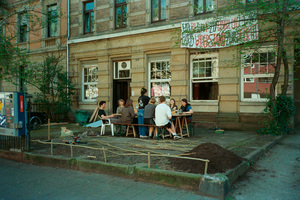
- Umpolen ist ein Kollektiv das leerstehende Räume in Karlsruhe nutzt, um temporäre, nicht-kommerzielle Orte der Begegnung und des Austauschs zu schaffen. Sie dienen als kurzfristige soziokulturelle Veranstaltungs- und Ausstellungsräume, aber auch einfache Treffpunkte. Im Januar 2026 bespielte Umpolen für eine Woche eine ehemalige Wohngemeinschaft in der Karlsruher Südstadt und widmete sich Fragen von Freund*innenschaft und Distanz. Dazu gab es Workshops, “Küche für Alle”, Filmvorführungen, Konzerte und Lesungen.
Seit Mai 2026 baut Umpolen einen temporären Nachbar*innenschaftstreff und Kulturort im ehemaligen Löwenbräukeller in der Karlsruher Weststadt auf. Ausgangspunkt ist jedes Mal der Raum selbst, von dem aus sich das Kollektiv dem Thema Nachbar*innenschaft widmen will. Die Orte stellen eine Brücke zwischen sozialem Raum, Werkstatt, Arbeitsraum, Ausstellungsraum, Garten und versuchen Menschen in Dialoge miteinander zu setzen. Dabei arbeitet Umpolen sowohl mit lokalen Initiativen als auch mit Menschen außerhalb Karlsruhes zusammen und entwickelt Formate, die gegenseitiges Lernen, Gespräche und Beisammensein ermöglichen.
Im ehemaligen Löwenbräukeller wird versucht im Alltag Strukturen zu schaffen in dem die Nachbar*innenschaft nicht nur fremde Gesichter bleiben, sondern Mitmenschen sind, mit denen man solidarisch lebt und in Kontakt tritt.
Der Raum ist zwei mal die Woche geöffnet und bespielt manchmal mit Programm manchmal als reinen Treffpunkt den Ort und beschäftigt sich auch mit den Erinnerungen, die an den Ort geknüpft sind.
Umpolen hat sich als Kollektiv im Sommer 2025 gegründet und besteht aus Studierenden der Studiengänge Ausstellungsdesign und Szenografie, Kunstwissenschaft und Medienphilosophie und Kommunikationsdesign von der HfG, Studierenden der Kunstakademie und Menschen aus Karlsruhe, die zusammengekommen sind um Gemeinschaft und Kulturarbeit in Karlsruhe zugänglich zu machen. Umpolen arbeitet zudem fest mit Radio ShbShb zusammen, die die Veranstaltungen live online übertragen.
- Umpolen ist ein Kollektiv das leerstehende Räume in Karlsruhe nutzt, um temporäre, nicht-kommerzielle Orte der Begegnung und des Austauschs zu schaffen. Sie dienen als kurzfristige soziokulturelle Veranstaltungs- und Ausstellungsräume, aber auch einfache Treffpunkte. Im Januar 2026 bespielte Umpolen für eine Woche eine ehemalige Wohngemeinschaft in der Karlsruher Südstadt und widmete sich Fragen von Freund*innenschaft und Distanz. Dazu gab es Workshops, “Küche für Alle”, Filmvorführungen, Konzerte und Lesungen.
- Beschreibung (en)
- Umpolen is a collective that uses vacant spaces in Karlsruhe to create temporary, non-commercial places for people to meet and exchange ideas. These spaces serve as short-term venues for sociocultural events and exhibitions, as well as simple gathering places. In January 2026, Umpolen took over a former shared apartment in Karlsruhe’s Südstadt neighborhood for a week and explored questions of friendship and distance. The event featured workshops, “Kitchen for All,” film screenings, concerts, and readings.
Since May 2026, the collective has been setting up a temporary neighborhood gathering place and cultural space in the former Löwenbräukeller in Karlsruhe’s Weststadt district. Each time, the starting point is the space itself, from which Umpolen aims to explore the theme of neighborliness. These spaces serve as a bridge between social space, workshop, workspace, exhibition space, and garden, and aim to bring people together in dialogue. In doing so, Umpolen collaborates with both local initiatives and people outside of Karlsruhe, developing formats that facilitate mutual learning, conversation, and socializing.
At the former Löwenbräukeller, Umpolen strives to create structures in our daily lives where neighbors aren’t just strangers, but fellow human beings with whom we live in solidarity and connect.
The space is open twice a week and serves as a venue, sometimes hosting events, sometimes simply as a gathering place, while also engaging with the memories tied to the location.
Umpolen was founded as a collective in the summer of 2025 and consists of students from the HfG and the Art Academy, as well as people from Karlsruhe who have come together to make community and cultural work accessible in Karlsruhe. Umpolen also collaborates closely with Radio ShbShb, which broadcasts the events live online.
- Umpolen is a collective that uses vacant spaces in Karlsruhe to create temporary, non-commercial places for people to meet and exchange ideas. These spaces serve as short-term venues for sociocultural events and exhibitions, as well as simple gathering places. In January 2026, Umpolen took over a former shared apartment in Karlsruhe’s Südstadt neighborhood for a week and explored questions of friendship and distance. The event featured workshops, “Kitchen for All,” film screenings, concerts, and readings.
- Kategorie
- Typ des Projekts/Werks
- Schlagworte
- Datierung
- 01.01.2026 - 01.11.2026
- Mitwirkende
- Sprache
- Ort
- Im Januar 2026 in der Rüppurerstr. 14, 76137 Karlsruhe
von Mai bis Oktober 2026 in der ehemaligen Gaststätte Löwenbräukeller in der Sophienstraße 95, 76135 Karlsruhe
- Im Januar 2026 in der Rüppurerstr. 14, 76137 Karlsruhe
- Stadt
- Land
- Internetlinks
- Titel
- Umpolen Kollektiv
- Importiert am
- 23.06.2026
- Übergeordnete Sets
- 1
- Set enthält
- 0 24