Ewa Wasilewska
| Name | Ewa Wasilewska |
3 Inhalte
- Seite 1 von 1
Ministry for the Future
Name that can easily go onto 2 lines
Author that can easily go onto 2 lines as well
- Titel
- Ministry for the Future
- Titel (en)
- Ministry for the Future
- Autor/in
- Beschreibung (de)
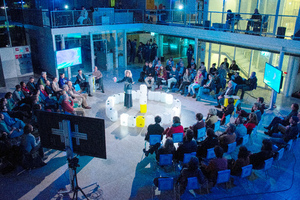
- Ministry for the Future ist eine transdisziplinäre Produktion über mögliche Zukünfte im Angesicht der Klimakrise – und darüber, wie wir sie verhandeln, bevor sie eintreten. Inspiriert vom gleichnamigen Roman von Kim Stanley Robinson entwickelte sich ein groß angelegtes Kooperationsprojekt zwischen dem Theater Neumarkt, dem Collegium Helveticum Zürich und der Hochschule für Gestaltung Karlsruhe.
Ausgangspunkt ist ein spekulatives Szenario im Jahr 2034: Die Erde hat Kipppunkte erreicht, Regierungen reagieren, eine neue Institution wird gegründet – das Ministerium für die Zukunft. Innerhalb dieser Fiktion operiert die Produktion als diskursives Format, das sich fortlaufend mit der zentralen Frage auseinandersetzt: Welche Handlungsspielräume bleiben uns?
Das Projekt kombiniert künstlerische, wissenschaftliche und gestalterische Perspektiven zu einem Format zwischen Preenactment und realer Wissenschaftskommunikation. Herzstück ist ein mobiles Bühnenbild, das drängende forschungsbasierte Diskurse in eine begehbare, funktionale Infrastruktur übersetzt. Die Szenografie wurde konsequent durch Re- und Upcycling-Prozesse entwickelt. Sie folgt einer Haltung, die den Anforderungen ökologischer Krisen standhalten will – indem sie aus dem Material jener Krisen selbst hervorgeht. In vier thematisch fokussierten Episoden an vier verschiedenen Orten in Zürich wird der Raum selbst zum Instrument: eine spekulative Versammlung, eine temporäre Institution, ein Möglichkeitslabor.
Die Inszenierung bringt reale Wissenschaftler:innen, Performer:innen und Bürger:innen im Modus eines fiktionalen Ministeriums in Austausch – und mit ihnen die Fragen: Wie lässt sich Zukunft verhandeln, wenn sie längst begonnen hat? Was bedeutet Teilhabe, wenn die Katastrophe strukturell geworden ist? Und wie kann Raum für solche Aushandlungen heute aussehen?
- Ministry for the Future ist eine transdisziplinäre Produktion über mögliche Zukünfte im Angesicht der Klimakrise – und darüber, wie wir sie verhandeln, bevor sie eintreten. Inspiriert vom gleichnamigen Roman von Kim Stanley Robinson entwickelte sich ein groß angelegtes Kooperationsprojekt zwischen dem Theater Neumarkt, dem Collegium Helveticum Zürich und der Hochschule für Gestaltung Karlsruhe.
- Beschreibung (en)
- Ministry for the Future is a transdisciplinary production about possible futures in the face of the climate crisis—and about how we negotiate them before they arrive. Inspired by the novel of the same name by Kim Stanley Robinson, the project evolved into a large-scale collaboration between Theater Neumarkt, the Collegium Helveticum Zurich, and the Karlsruhe University of Arts and Design (HfG).
Its starting point is a speculative scenario set in the year 2034: the Earth has reached tipping points, governments are reacting, and a new institution is established—the Ministry for the Future. Within this fiction, the production functions as a discursive format that continuously engages with the central question: What room for action remains?
The project combines artistic, scientific, and design perspectives into a hybrid format somewhere between preenactment and real science communication. At its core is a mobile stage design that translates urgent, research-based discourses into an immersive, functional infrastructure. The scenography was developed entirely through re- and upcycling processes, guided by an attitude that seeks to meet the demands of ecological crises—by emerging from their very material. Across four thematically focused episodes in four different locations in Zurich, the space itself becomes an instrument: a speculative assembly, a temporary institution, a lab of possibilities.
The performance brings together real scientists, performers, and citizens within the framework of a fictional ministry—and with them, the questions: How can we negotiate the future when it has already begun? What does participation mean when catastrophe has become structural? And what kind of space is needed for such negotiations today?
- Ministry for the Future is a transdisciplinary production about possible futures in the face of the climate crisis—and about how we negotiate them before they arrive. Inspired by the novel of the same name by Kim Stanley Robinson, the project evolved into a large-scale collaboration between Theater Neumarkt, the Collegium Helveticum Zurich, and the Karlsruhe University of Arts and Design (HfG).
- Kategorie
- Typ des Projekts/Werks
- Schlagworte
- Sprache
- Dauer
- 4 Episoden, jeweils 2 Stunden
- Ort: Institution
- Ort
- Episode 1: ETH Zürich
Episode 2: Naturhistorisches Museum Zürich
Episode 3: Wasserkirche Zürich
Episode 4: Semper Sternwarte / Collegium Helveticum Zürich
- Episode 1: ETH Zürich
- Land
- Beteiligte Institution(en)
- Titel
- Ministry for the Future
- Projektleiter/in
- Semester
- Studiengang
- Importiert am
- 29.06.2025
- Übergeordnete Sets
- 0
- Set enthält
- 0 39
>Raving Realities<
Name that can easily go onto 2 lines
Author that can easily go onto 2 lines as well
- Titel
- >Raving Realities<
- Titel (en)
- >Raving Realities<
- Untertitel
- Raving Realities oder eine Vorstellung
- Autor/in
- Beschreibung (de)
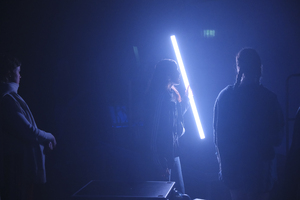
- Regie: Alize Heiser
Es spielten: Anna Tarasenko, Marix Turskiy
Dramaturgie: Bella Enderlein, Gabriel Kowak
Raumkonzept: Ewa Wasilewska
Kostüm: Klara Beck, Julia Freisinger
Live Sound: Tina Jander
Visual Arts: Victoria Mikhaylova
Text: Alize Heiser, Lydia Henkel, Anna Tarasenko, Marix Turskiy
- Regie: Alize Heiser
- Kategorie
- Typ des Projekts/Werks
- Schlagworte
- Datierung
- 23.05.2024
- Dank an
- Sprache
- Technik/Verfahren/Formate
- live performance
- Dauer
- 1h
- Ort: Institution
- Stadt
- Beteiligte Institution(en)
- Titel
- >Raving Realities<
- Untertitel
- Raving Realities oder eine Vorstellung
- Semester
- Studiengang
- Importiert am
- 16.12.2024
- Übergeordnete Sets
- 0
- Set enthält
- 0 5
It's okay now

Name that can easily go onto 2 lines
Author that can easily go onto 2 lines as well
- Titel
- It's okay now
- Titel (en)
- It's okay now
- Autor/in
- Beschreibung (de)
- "It’s okay now" ist ein autobiografisches Werk, das durch die Praxis des Erinnerns die Herkunft und Identität der beiden Protagonistinnen hinterfragt, analysiert und miteinander vergleicht. Das Erinnern dient dabei nicht nur als Mittel der Reflexion, sondern auch als eine Form des Träumens und Verarbeitens von Vergangenem. Fiktionale Szenen und Archivmaterial verweben sich zu einer Erzählung, die persönliche und kollektive Erinnerungen miteinander verschmelzen lässt.
- Beschreibung (en)
- "It’s okay now" is an autobiographical work that, through the practice of remembering, questions, analyzes, and compares the origins and identities of the two protagonists. In this process, remembering serves not only as a tool for reflection but also as a form of dreaming and processing the past. Fictional scenes and archival material intertwine to create a narrative that fuses personal and collective memories.
- Kategorie
- Typ des Projekts/Werks
- Schlagworte
- Datierung
- 01.10.2024 - 04.10.2024
- Mitwirkende
- Dank an
- Sprache
- Untertitel (Film)
- Material
- Technik/Verfahren/Formate
- 3-Kanal-Video-Audio Rauminstallation
- Abmessungen
- Breite: 10m; Tiefe: 10m; Höhe 4,5m
- Dauer
- 45 min
- Ort: Institution
- Ort
- Großes Studio
- Stadt
- Land
- Beteiligte Institution(en)
- Titel
- It's okay now
- Projektleiter/in
- Semester
- Studiengang
- Typ der Abschlussarbeit
- Archiv-Signatur
- its okay now
- Importiert am
- 10.10.2024
- Übergeordnete Sets
- 3
- Set enthält
- 0 11