"CC BY-NC: Namensnennung, nicht kommerziell"
| Term | CC BY-NC: Namensnennung, nicht kommerziell |
| Metakey | Legal protection / Licence (rights:licence) |
| Type | Keyword |
| Vocabulary | Rights |
38 Items
- Page 1 of 4
07 Invasive Pflanzen
Name that can easily go onto 2 lines
Author that can easily go onto 2 lines as well
- Title
- 07 Invasive Pflanzen
- Author
- Keywords
- Contributors
- Thanks to
- Internetlinks
- Title
- 07 Invasive Pflanzen
- Title (en)
- 07 Invasive plants
- Copyright Notice
- © Bio Design Lab / Living Library
- Legal protection / Licence
- Media creator
- Description of media
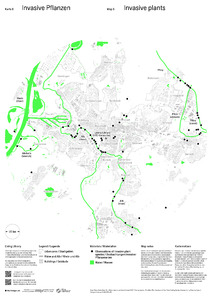
- Beobachtungen invasiver Pflanzenarten (ausgefüllte Punkte) in und um Karlsruhe, zusammengetragen aus iNaturalist, einer globalen Citizen-Science-Datenbank. Invasive Pflanzen, auch Neophyten genannt, sind Arten, die in ein neues Gebiet eingeführt wurden und sich dort aggressiv ausbreiten, oft die einheimische Vegetation verdrängen und lokale Ökosysteme stören. Die spezifischen Arten wurden während des Workshops »Über Verdrängung und Anpassung« identifiziert. Aus den Daten ergibt sich ein auffälliges Muster: Viele dieser invasiven Pflanzen treten gehäuft entlang der Flüsse Alb und Pfinz in Karlsruhe auf. Das liegt daran, dass Wasserwege oft als natürliche Korridore fungieren, die die Verbreitung von Samen und Pflanzenfragmenten erleichtern.
- Beobachtungen invasiver Pflanzenarten (ausgefüllte Punkte) in und um Karlsruhe, zusammengetragen aus iNaturalist, einer globalen Citizen-Science-Datenbank. Invasive Pflanzen, auch Neophyten genannt, sind Arten, die in ein neues Gebiet eingeführt wurden und sich dort aggressiv ausbreiten, oft die einheimische Vegetation verdrängen und lokale Ökosysteme stören. Die spezifischen Arten wurden während des Workshops »Über Verdrängung und Anpassung« identifiziert. Aus den Daten ergibt sich ein auffälliges Muster: Viele dieser invasiven Pflanzen treten gehäuft entlang der Flüsse Alb und Pfinz in Karlsruhe auf. Das liegt daran, dass Wasserwege oft als natürliche Korridore fungieren, die die Verbreitung von Samen und Pflanzenfragmenten erleichtern.
- Description of media (en)
- Observations of invasive plant species (solid dots) in and around Karlsruhe, crowdsourced from iNaturalist, a global citizen-science database. Invasive plants, also known as neophytes, are species that have been introduced to a new area and spread aggressively, often outcompeting native vegetation and disrupting local ecosystems. The specific species were identified during the workshop ‘On displacement and adaptation’. A noticeable pattern emerges from the data: many of these invasive plants are concentrated along Karlsruhe's rivers, the Alb and Pfinz. This is because waterways often act as natural corridors that facilitate the spread of seeds and plant fragments.
- Imported on
- 10.03.2026
- Parent sets
- 1
08 Industriehanf
Name that can easily go onto 2 lines
Author that can easily go onto 2 lines as well
- Title
- 08 Industriehanf
- Author
- Keywords
- Contributors
- Thanks to
- Internetlinks
- Title
- 08 Industriehanf
- Title (en)
- 08 Industrial hemp
- Copyright Notice
- © Bio Design Lab / Living Library
- Legal protection / Licence
- Media creator
- Description of media
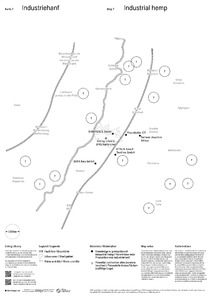
- Orte, die sich auf das Wissen oder die Produktion von Industriehanf spezialisiert haben (gefüllte Punkte), und potenzielle, zufällig gelegene Gebiete für den Anbau von Industriehanf innerhalb der Bioregion Karlsruhe (gepunktete Kreise mit Fragezeichen). Im Rahmen des Lehrprogramms »Über Tradition und Wandel« wurden zwei Standorte besucht: der Produzent BAFA Neu und der Seilmacher Joachim Dittus. Da der Hanfanbau strengen Vorschriften unterliegt, werden die genauen Standorte der Felder nicht öffentlich bekannt gegeben und konnten daher nicht besucht werden. Obwohl die ungefähre Anzahl der Anbauflächen innerhalb der Bioregion aus landwirtschaftlichen Statistiken geschätzt werden kann, bleiben ihre genauen Positionen unbekannt und werden hier als zufällige Standorte dargestellt.
- Description of media (en)
- Places specialising in the knowledge or production of industrial hemp (solid dots) and potential, randomly located areas of industrial hemp cultivation within the Karlsruhe bioregion (dotted circles with question marks). During the ‘On tradition and transition’ education programme, students visited two locations: producer BAFA Neu and ropemaker Joachim Dittus. Because hemp cultivation is subject to strict confidentiality regulations, exact field locations are not publicly disclosed and could therefore not be visited. Although the approximate number of cultivation sites within the bioregion can be estimated from agricultural statistics, their precise positions remain unknown and are represented here as randomised locations.
- Places specialising in the knowledge or production of industrial hemp (solid dots) and potential, randomly located areas of industrial hemp cultivation within the Karlsruhe bioregion (dotted circles with question marks). During the ‘On tradition and transition’ education programme, students visited two locations: producer BAFA Neu and ropemaker Joachim Dittus. Because hemp cultivation is subject to strict confidentiality regulations, exact field locations are not publicly disclosed and could therefore not be visited. Although the approximate number of cultivation sites within the bioregion can be estimated from agricultural statistics, their precise positions remain unknown and are represented here as randomised locations.
- Imported on
- 10.03.2026
- Parent sets
- 1
05 Pilze
Name that can easily go onto 2 lines
Author that can easily go onto 2 lines as well
- Title
- 05 Pilze
- Author
- Keywords
- Contributors
- Thanks to
- Internetlinks
- Title
- 05 Pilze
- Title (en)
- 05 Mushrooms
- Copyright Notice
- © Bio Design Lab / Living Library
- Legal protection / Licence
- Media creator
- Description of media
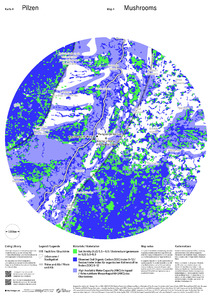
- Im Rahmen des Lehrprogramms »Über Erneuerung und Schnittstellen« besuchte die Gruppe das Pilzherbarium des Staatlichen Naturkundemuseums Karlsruhe und suchte im Rappenwörther Wald nach Pilzen. Obwohl es unmöglich ist, die genauen Standorte des Pilzwachstums zu kartieren, lassen sich Gebiete mit hoher Wahrscheinlichkeit für das Vorkommen identifizieren. Diese Karte kombiniert drei solche Indikatoren: beobachtete organische Kohlenstoffgehalte in der Erde zwischen 9 und 12, Bodenazidität (gemessen in H₂O) zwischen pH 5,5 und 6,5 und hohe verfügbare Wasserkapazität im Oberboden. Dunklere Schattierungen weisen auf günstigere Bedingungen hin.
- Description of media (en)
- During the ‘On remediation and interfacing’ education programme, students visited the Fungus Herbarium of the State Museum of Natural History Karlsruhe and searched for mushrooms in the Rappenwörth forest. Although it is impossible to map the exact locations of mushroom growth, it is possible to identify areas with a high likelihood of occurrence. This map combines three such indicators: observed soil organic carbon levels between 9 and 12, soil acidity (measured in H₂O) between pH 5.5 and 6.5, and high available water capacity in the topsoil. Darker shading indicates more favourable conditions.
- Imported on
- 10.03.2026
- Parent sets
- 1
06 Bäume
Name that can easily go onto 2 lines
Author that can easily go onto 2 lines as well
- Title
- 06 Bäume
- Author
- Keywords
- Contributors
- Thanks to
- Internetlinks
- Title
- 06 Bäume
- Title (en)
- 06 Trees
- Copyright Notice
- © Bio Design Lab / Living Library
- Legal protection / Licence
- Media creator
- Description of media
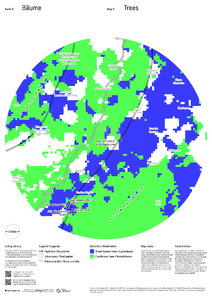
- Das pixelige Muster unterscheidet zwei Arten von Wald: Gebiete, in denen Laubbäume die dominierende Baumart sind (dunkle Schattierung), und Gebiete, in denen Nadelbäume vorherrschen (helle Schattierung). Diese Unterteilung ist zwar nicht absolut, liefert aber nützliche Informationen über das in den einzelnen Gebieten verfügbare Holz: Laubbaumarten produzieren in der Regel Hartholz, während Nadelbaumarten Weichholz liefern. Die im Rahmen des Lehrprogramms »Über Extraktion und Resilienz« rund um die Stadt Bühl besuchten Orte sind auf der Karte als ausgefüllte Punkte dargestellt.
- Description of media (en)
- The pixelated pattern distinguishes two types of forest: areas in which broad-leaved trees are the dominant species (dark shading) and areas dominated by coniferous trees (light shading). Although this division is not absolute, it provides useful information about the wood available in each area: broad-leaved species generally produce hardwoods, whereas coniferous species yield softwoods. Places visited during the education programme ‘On extraction and resilience’ around the city of Bühl are shown on the map as solid dots.
- Imported on
- 10.03.2026
- Parent sets
- 1
01 Bioregion Karlsruhe
Name that can easily go onto 2 lines
Author that can easily go onto 2 lines as well
- Title
- 01 Bioregion Karlsruhe
- Author
- Keywords
- Contributors
- Thanks to
- Internetlinks
- Title
- 01 Bioregion Karlsruhe
- Title (en)
- 01 Karlsruhe bioregion
- Copyright Notice
- © Bio Design Lab / Living Library
- Legal protection / Licence
- Media creator
- Description of media
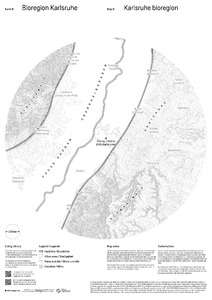
- Diese Grundkarte zeigt den 50-Kilometer-Radius, der die Bioregion Karlsruhe definiert, mit der Living Library im Zentrum. Die Region lässt sich grob in drei Bereiche unterteilen: den Oberrheingraben (umrahmt von zwei durch gestrichelte Linien gekennzeichneten Verwerfungslinien), ein großes Grabenbruchgebiet, das vor etwa 50 Millionen Jahren entstanden ist und durch dessen Mitte der Rhein nach Norden fließt (doppelte Linie); den Pfälzerwald im Westen und den Schwarzwald im Süden. Das Linienmuster zeigt die Höhe an und verdeutlicht, dass es sich um einen fast flachen Graben zwischen zwei großen Gebirgszügen handelt. Um die sprachliche Vielfalt der Region widerzuspiegeln, sind alle Städte auf der Karte sowohl mit ihrem lokalen als auch mit ihrem nationalen Namen angegeben.
- Description of media (en)
- This base map shows the 50-kilometre radius that defines the Karlsruhe bioregion, with the Living Library at its centre. The region can be broadly divided into three areas: the Oberrheingraben/Upper Rhine Graben (framed by two fault lines indicated by dashed lines), a large rift valley formed about 50 million years ago with the river Rhine flowing northwards through its centre (double line); the Pfälzerwald/Palatinate Forest to the west; and the Schwarzwald/Black Forest to the east. The line pattern indicates elevation, revealing an almost flat Graben between two large mountain ranges. To reflect the region’s linguistic diversity, all cities on the map are written in both their local and national names.
- Imported on
- 10.03.2026
- Parent sets
- 1
04 Lebensmittelabfälle
Name that can easily go onto 2 lines
Author that can easily go onto 2 lines as well
- Title
- 04 Lebensmittelabfälle
- Author
- Keywords
- Contributors
- Thanks to
- Internetlinks
- Title
- 04 Lebensmittelabfälle
- Title (en)
- 04 Food waste
- Copyright Notice
- © Bio Design Lab / Living Library
- Legal protection / Licence
- Media creator
- Description of media
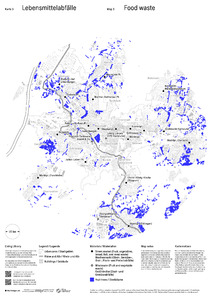
- Hier sind Straßenmärkte, auf denen Obst, Gemüse, Brot, Fisch und Fleisch verkauft werden (gefüllte Punkte), sowie Großhändler (umrandete Punkte) eingezeichnet, bei denen Lebensmittelabfälle in und um die Stadt gesammelt werden können. Die kleineren Punkte im Hintergrund kennzeichnen Bäume mit essbaren Früchten, ein Thema des Lehrprogramms »Über Stoffwechsel und Kreislauf«. Sofern einige Grundregeln beachtet werden, wie z. B. die Achtung von Eigentumsrechten und der sorgfältige Umgang mit Bäumen und Natur, können die Früchte auch gesammelt werden.
- Description of media (en)
- Street markets selling fruit, vegetables, bread, fish, and meat (solid dots) are mapped here, as well as larger food wholesalers (outlined dots) where food waste can be collected in and around the city. The smaller dots in the background indicate trees bearing edible fruit, a topic during the ‘On metabolisms and circulation’ education programme. Provided a few basic rules are kept in mind, such as respecting property rights and treating trees and nature with care, the fruit can also be collected.
- Imported on
- 10.03.2026
- Parent sets
- 1
02 Kompostierplätze und Kleingärten
Name that can easily go onto 2 lines
Author that can easily go onto 2 lines as well
- Title
- 02 Kompostierplätze und Kleingärten
- Author
- Keywords
- Contributors
- Thanks to
- Internetlinks
- Title
- 02 Kompostierplätze und Kleingärten
- Title (en)
- 02 Compost sites and allotment gardens
- Copyright Notice
- © Bio Design Lab / Living Library
- Legal protection / Licence
- Media creator
- Description of media
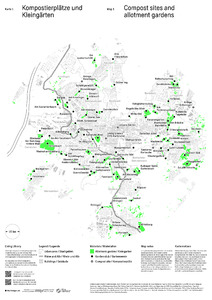
- Während des Lehrprogramms »Über Transformationen und Metamorphosen«, bei dem Studierende Kleingärten in den Stadtteilen Neureut und Daxlanden besuchten, wurde deutlich, dass Kleingartenvereine (durchgezogene Punkte auf der Karte) und ihre Mitglieder eine unschätzbare Quelle für praktisches Wissen über Kompostierung sind. Parallel dazu bieten kommunale Kompostierungsanlagen (umrandete Punkte) die großtechnische Infrastruktur, die erforderlich ist, um die biologisch abbaubaren Abfälle der Stadt zu nutzbarem Kompost zu verarbeiten.
- Description of media (en)
- During the education programme ‘On transformations and metamorphoses’, where students visited allotment gardens in the city boroughs of Neureut and Daxlanden, it became evident that allotment garden clubs / Kleingartenvereine (solid dots on the map) and their members are invaluable sources of practical knowledge about composting. In parallel, municipal composting facilities / Kompostierungsanlagen (outlined dots) provide the large-scale infrastructure required to process the city’s biodegradable waste into usable compost.
- Imported on
- 10.03.2026
- Parent sets
- 1
03 Schafe
Name that can easily go onto 2 lines
Author that can easily go onto 2 lines as well
- Title
- 03 Schafe
- Author
- Keywords
- Contributors
- Thanks to
- Internetlinks
- Title
- 03 Schafe
- Title (en)
- 03 Sheep
- Copyright Notice
- © Bio Design Lab / Living Library
- Legal protection / Licence
- Media creator
- Description of media
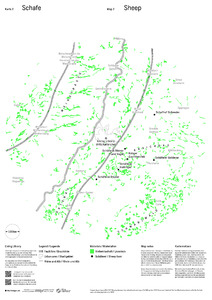
- Die Wollproduktion in der Region um Karlsruhe ist eng mit der süddeutschen Tradition der nomadischen Schafhaltung verbunden. Diese Praxis ist von der UNESCO als Teil des immateriellen Kulturerbes der Nation anerkannt. Laut Statistiken aus dem Jahr 2019 gab es in Baden-Württemberg (dem Bundesland, in dem Karlsruhe liegt) rund 215.500 Schafe und etwa 1.300 Schafhaltende mit 20 oder mehr Schafen. Mehrere Schafzuchtbetriebe (Punkte), die mit dem Workshop »Über Verflechtungen und Filzen« in Verbindung stehen, sind hier im Verhältnis zu allen Gebieten dargestellt, in denen Vieh gezüchtet wird (gefüllte Punkte) innerhalb der Bioregion Karlsruhe.
- Description of media (en)
- The production of wool in the region around Karlsruhe is closely connected to the South German tradition of nomadic sheep farming. This practice is recognised by UNESCO as part of the nation's Intangible Cultural Heritage. According to statistics from 2019, there were around 215,500 sheep and about 1,300 sheep farmers with 20 or more sheep in Baden-Württemberg (the state in which Karlsruhe is located). Several sheep farms (dots) connected to the workshop ‘On Entanglements and Felting’ are shown here in relation to all areas where livestock is raised (solid dots) within the Karlsruhe bioregion.
- Imported on
- 10.03.2026
- Parent sets
- 1
Die Living Library (Deutsch)
Name that can easily go onto 2 lines
Author that can easily go onto 2 lines as well
- Title
- Die Living Library (Deutsch)
- Author
- Type of project / creative work
- Keywords
- Contributors
- Thanks to
- Title
- Die Living Library (Deutsch)
- Copyright Notice
- (CC BY-NC 4.0) Karlsruhe University of Arts and Design and the authors
- Legal protection / Licence
- Media creator
- Description of media
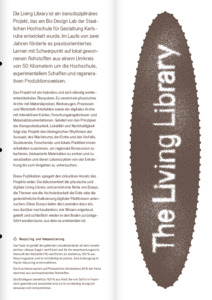
- Die Living Library ist ein transdisziplinäres Projekt, das am Bio Design Lab der Staatlichen Hochschule für Gestaltung Karlsruhe entwickelt wurde. Im Laufe von zwei Jahren förderte es praxisorientiertes Lernen mit Schwerpunkt auf lokal gewonnenen Rohstoffen aus einem Umkreis von 50 Kilometern um die Hochschule, experimentellem Schaffen und regenerativen Produktionsweisen.
Das Projekt ist ein hybrides und sich ständig weiterentwickelndes Ökosystem. Es vereint ein physisches Archiv mit Materialproben, Werkzeugen, Prozessen und Werkstatt-Artefakten sowie ein digitales Archiv mit interaktiven Karten, Forschungsergebnissen und Materialdokumentationen. Geleitet von den Prinzipien der Kompostierbarkeit, Lokalität und Nachhaltigkeit folgt das Projekt den ökologischen Rhythmen der Aussaat, des Wachstums, der Ernte und des Verfalls. Studierende, Forschende und lokale Praktiker:innen arbeiteten zusammen, um regionale Ressourcen zu kartieren, biobasierte Materialien zu ernten und zu verarbeiten und deren Lebenszyklen von der Entstehung bis zum Vergehen zu untersuchen.
Diese Publikation spiegelt den zirkulären Ansatz des Projekts wider. Sie dokumentiert die physische und digitale Living Library und vereint eine Reihe von Essays, die Themen wie die Archivierbarkeit der Erde oder die gartenähnliche Kultivierung digitaler Plattformen untersuchen. Diese Essays laden die Lesenden dazu ein, neu darüber nachzudenken, wie Wissen angebaut, geteilt und schließlich wieder in den Boden zurückgeführt werden kann, aus dem es entstanden ist.
- Die Living Library ist ein transdisziplinäres Projekt, das am Bio Design Lab der Staatlichen Hochschule für Gestaltung Karlsruhe entwickelt wurde. Im Laufe von zwei Jahren förderte es praxisorientiertes Lernen mit Schwerpunkt auf lokal gewonnenen Rohstoffen aus einem Umkreis von 50 Kilometern um die Hochschule, experimentellem Schaffen und regenerativen Produktionsweisen.
- Imported on
- 04.03.2026
- Parent sets
- 1
The Living Library (English)
Name that can easily go onto 2 lines
Author that can easily go onto 2 lines as well
- Title
- The Living Library (English)
- Author
- Type of project / creative work
- Keywords
- Contributors
- Thanks to
- Title
- The Living Library (English)
- Copyright Notice
- (CC BY-NC 4.0) Karlsruhe University of Arts and Design and the authors
- Legal protection / Licence
- Media creator
- Description of media
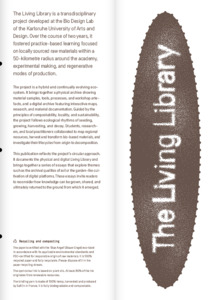
- The Living Library is a transdisciplinary project developed at the Bio Design Lab of the Karlsruhe University of Arts and Design. Over the course of two years, it fostered practice-based learning focused on locally sourced raw materials within a 50-kilometre radius around the academy, experimental making, and regenerative modes of production.
The project is a hybrid and continually evolving ecosystem. It brings together a physical archive showing material samples, tools, processes, and workshop artefacts, and a digital archive featuring interactive maps, research, and material documentation. Guided by the principles of compostability, locality, and sustainability, the project follows ecological rhythms of seeding, growing, harvesting, and decay. Students, researchers, and local practitioners collaborated to map regional resources, harvest and transform bio-based materials, and investigate their lifecycles from origin to decomposition.
This publication reflects the project’s circular approach. It documents the physical and digital Living Library and brings together a series of essays that explore themes such as the archival qualities of soil or the garden-like cultivation of digital platforms. These essays invite readers to reconsider how knowledge can be grown, shared, and ultimately returned to the ground from which it emerged.
- The Living Library is a transdisciplinary project developed at the Bio Design Lab of the Karlsruhe University of Arts and Design. Over the course of two years, it fostered practice-based learning focused on locally sourced raw materials within a 50-kilometre radius around the academy, experimental making, and regenerative modes of production.
- Imported on
- 04.03.2026
- Parent sets
- 1
Videowelt und fraktale Entspannung - Rückseite der Installation
Name that can easily go onto 2 lines
Author that can easily go onto 2 lines as well
- Title
- Videowelt und fraktale Entspannung - Rückseite der Installation
- Author
- Category
- Type of project / creative work
- Date
- 07.2023
- Duration
- 15:30
- Title
- Videowelt und fraktale Entspannung - Rückseite der Installation
- Copyright Notice
- © ewa wasilewska
- Legal protection / Licence
- Permission usage HfG
- Media creator
- Relationship/function
- Description of media
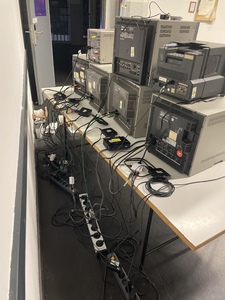
- Rückseite der Installation; mehrere Elementen angeschlossen an die „Maschine“ der Selbstreferenz: HDMI-Analog Konvertern, Android Media Players, DC 5V Stromversorgungsgeräte
- Program of Study
- Imported on
- 16.12.2024
- Parent sets
- 0
The Nature of Total Planning, From Francoist Hydropolitics to Green Capitalism
Name that can easily go onto 2 lines
Author that can easily go onto 2 lines as well
- Title
- The Nature of Total Planning, From Francoist Hydropolitics to Green Capitalism
- Author
- Description (de)
- Magisterarbeit in Medienphilosophie
- Description (en)
- Thesis for the degree of Magister in Media Philosophy
- Category
- Keywords
- Date
- 06.06.2024
- Language
- Location: institution
- Country
- Title
- The Nature of Total Planning, From Francoist Hydropolitics to Green Capitalism
- Title (en)
- The Nature of Total Planning, From Francoist Hydropolitics to Green Capitalism
- Copyright Notice
- © Guillermo Collado Wilkins
- Legal protection / Licence
- Permission usage HfG
- Media creator
- Description of media (en)
- This paper provides a critical examination of ecological planning based on the continuities that it displays across seemingly disparate political projects and historical periods. In order to do so, it draws on the small rural valley of La Bizkaia in Navarre, Spain. It produces an environmental history of the valley through a detailed study of its hydro-forestry resources, periodising such history according to a materialist reading of its ‘metabolic regimes’. That is to say, through the particular configurations between the natural and social orders that dictate life in La Bizkaia.
Initially, the study introduces the valley’s natural characteristics and its property structure, laying the foundations upon which the rest of this paper sits. Subsequently, it undertakes a detailed investigation of Francoist interventions in the 1940s-60s; a massive monoculture of pine trees was planted by the Francoist Forestry Council, which radically undermined La Bizkaia’s natural systems and depopulated it. This paper thus analyses the planning logic behind this natural intervention which, borrowing a term from one of its draftsmen, is named ‘total planning’.
The thesis then explores contemporary management of the valley by the Government of Navarre, which has maintained ownership until this day, aligning its plans with the international protocols and standards characteristic of green capitalism. By looking at projects undertaken in the valley for nature conservation and climate change adaptation, which receive funding from the European Union, this research reveals the continuities between Francoist policies and green capitalism, and how both operate under the logic of Total Planning. Under this planning logic, they both fail to accommodate the unpredictability of political conflict and natural systems.
Planning thus serves as a lens to explore the political and epistemological dimensions of ecological thought, placing a materialist reading of a small case study into the broader context of contemporary ecological intervention.
- This paper provides a critical examination of ecological planning based on the continuities that it displays across seemingly disparate political projects and historical periods. In order to do so, it draws on the small rural valley of La Bizkaia in Navarre, Spain. It produces an environmental history of the valley through a detailed study of its hydro-forestry resources, periodising such history according to a materialist reading of its ‘metabolic regimes’. That is to say, through the particular configurations between the natural and social orders that dictate life in La Bizkaia.
- Alternative text (de)
- Vollständiger Text der Magisterarbeit
- Alternative text (en)
- Complete text of the Magisterarbeit
- Projektleiter/in
- Semester
- Program of Study
- Type of graduation project
- Imported on
- 22.10.2024
- Parent sets
- 1