"Theorie"
| Term | Theorie |
| Metakey | Category (institution:project_category) |
| Type | Keyword |
| Vocabulary | HfG |
93 Items
- Page 1 of 8
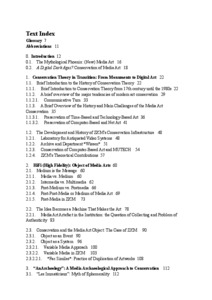
Writing the History of the Future. Inhaltsverzeichnis
Name that can easily go onto 2 lines
Author that can easily go onto 2 lines as well
- Title
- Writing the History of the Future. Inhaltsverzeichnis
- Author
- Category
- Type of project / creative work
- Title
- Writing the History of the Future. Inhaltsverzeichnis
- Title (en)
- Writing the History of the Future. Table of Content
- Copyright Notice
- © Anastasiia Bergalevich
- Legal protection / Licence
- Permission usage HfG
- Media creator
- Relationship/function
- Projektleiter/in
- Semester
- Program of Study
- Type of graduation project
- Imported on
- 19.03.2026
- Parent sets
- 1
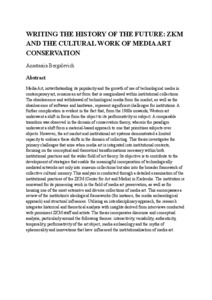
Writing the History of the Future. Abstract
Name that can easily go onto 2 lines
Author that can easily go onto 2 lines as well
- Title
- Writing the History of the Future. Abstract
- Author
- Category
- Type of project / creative work
- Title
- Writing the History of the Future. Abstract
- Title (en)
- Writing the History of the Future. Abstract
- Copyright Notice
- © Anastasiia Bergalevich
- Legal protection / Licence
- Permission usage HfG
- Media creator
- Relationship/function
- Projektleiter/in
- Semester
- Program of Study
- Type of graduation project
- Imported on
- 19.03.2026
- Parent sets
- 1
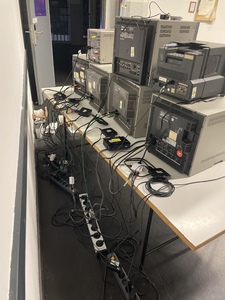
Videowelt und fraktale Entspannung - Rückseite der Installation
Name that can easily go onto 2 lines
Author that can easily go onto 2 lines as well
- Title
- Videowelt und fraktale Entspannung - Rückseite der Installation
- Author
- Category
- Type of project / creative work
- Date
- 07.2023
- Duration
- 15:30
- Title
- Videowelt und fraktale Entspannung - Rückseite der Installation
- Copyright Notice
- © ewa wasilewska
- Legal protection / Licence
- Permission usage HfG
- Media creator
- Relationship/function
- Description of media
- Rückseite der Installation; mehrere Elementen angeschlossen an die „Maschine“ der Selbstreferenz: HDMI-Analog Konvertern, Android Media Players, DC 5V Stromversorgungsgeräte
- Program of Study
- Imported on
- 16.12.2024
- Parent sets
- 0
Videowelt und fraktale Entspannung
Name that can easily go onto 2 lines
Author that can easily go onto 2 lines as well
- Title
- Videowelt und fraktale Entspannung
- Author
- Description (de)
- In seinem Text „Videowelt und fraktales Subjekt,“ beschreibt Baudrillard ein Subjekt der digitalen Ära, das danach trachtet, „sich selber in seinen Bruchstücken anzugleichen“ und anstatt nach seinem vollkommenen Idealbild, sehnt es sich nach der „Formel einer endlosen genetischen Reproduktion“ (Baudrillard 1989). Technologische Reduplikationen und Erscheinungsweisen des Körpers formen das Konzept des neuen Selbst. „Es geht heute nicht einmal mehr darum, einen Körper zu haben, sondern an seinen Körper angeschlossen (connected) zu sein.“
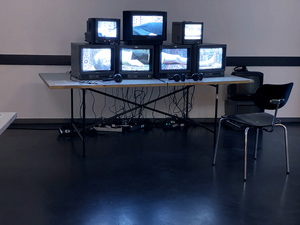
"Videowelt und fraktale Entspannung" ist als eine Mehrkanal-Installation, die sich auf das Konzept des fraktalen Körpers nach Baudrillard und der Interpassivität nach Pfaller stützt. Sieben Bildschirme zeigen die Verlängerung des menschlichen Körpers, während ein beauftragter Bot ein ungezwungenes Entspannungsprogramm durchführt. Basierend auf der progressiven Muskelentspannung nach Edmund Jacobson ermöglicht die Installation den Betrachter:innen, an der angeleiteten Choreografie teilzuhaben und so die Verbundenheit des Selbst mit der Technik zu erfahren. So ist sie ironisch als eine interpassive ‘Oase der Entspannung‘ konzipiert.
- In seinem Text „Videowelt und fraktales Subjekt,“ beschreibt Baudrillard ein Subjekt der digitalen Ära, das danach trachtet, „sich selber in seinen Bruchstücken anzugleichen“ und anstatt nach seinem vollkommenen Idealbild, sehnt es sich nach der „Formel einer endlosen genetischen Reproduktion“ (Baudrillard 1989). Technologische Reduplikationen und Erscheinungsweisen des Körpers formen das Konzept des neuen Selbst. „Es geht heute nicht einmal mehr darum, einen Körper zu haben, sondern an seinen Körper angeschlossen (connected) zu sein.“
- Description (en)
- In his text "Video World and Fractal Subject," Baudrillard describes a subject of the digital era that strives to "align itself with its own fragments." Rather than aspiring to its perfect ideal image, it yearns for the "formula of an endless genetic reproduction" (Baudrillard 1989). Technological reduplications and manifestations of the body shape the concept of the new self. "Today, it is no longer even about having a body, but about being connected to one's body."
"Video World and Fractal Relaxation" is a multi-channel installation that draws on Baudrillard's concept of the fractal body and Pfaller's theory of interpassivity. Seven screens depict the extension of the human body while a programmed bot conducts a casual relaxation routine. Based on Edmund Jacobson's progressive muscle relaxation, the installation allows viewers to participate in the guided choreography, offering them an experience of the self's connection with technology. It is ironically designed as an interpassive "oasis of relaxation."
- In his text "Video World and Fractal Subject," Baudrillard describes a subject of the digital era that strives to "align itself with its own fragments." Rather than aspiring to its perfect ideal image, it yearns for the "formula of an endless genetic reproduction" (Baudrillard 1989). Technological reduplications and manifestations of the body shape the concept of the new self. "Today, it is no longer even about having a body, but about being connected to one's body."
- Category
- Type of project / creative work
- Keywords
- Date
- 07.2023
- Contributors
- Language
- Material
- Duration
- 15:30
- Location: institution
- Location
- R. 112
- City
- Title
- Videowelt und fraktale Entspannung
- Copyright Notice
- © ewa wasilewska
- Permission usage HfG
- Media creator
- Description of media
- Mehrkanal-Installation 15’30’’
- Description of media (en)
- Multi-channel installation, 15'30''
- Program of Study
- Imported on
- 16.12.2024
- Parent sets
- 0
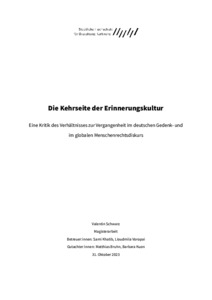
Titelblatt zu "Die Kehrseite der Erinnerungskultur"
Name that can easily go onto 2 lines
Author that can easily go onto 2 lines as well
- Title
- Titelblatt zu "Die Kehrseite der Erinnerungskultur"
- Author
- Category
- Type of project / creative work
- Keywords
- Date
- 31.10.2023
- Remarks
- Eine kondensierte Fassung des Textes wurde von "Umbau" veröffentlicht: https://umbau.hfg-karlsruhe.de/posts/die-kehrseite…
- Title
- Titelblatt zu "Die Kehrseite der Erinnerungskultur"
- Title (en)
- Cover sheet "The Other Side of Erinnerungskultur"
- Copyright Notice
- © Valentin Schwarz
- Permission usage HfG
- Media creator
- Relationship/function
- Description of media
- In dieser Arbeit setze ich mich mit unterschiedlichen Geschichtsbegriffen auseinander. Dafür dienen mir die Diskussionen um die deutsche Erinnerungskultur als Einstiegspunkt. Das Ziel ist es allerdings nicht, unmittelbar in die polarisierte Debatte einzugreifen. Stattdessen richtet sich der Fokus auf das ideologische Fundament, das verschiedenen Formen, mit der eigenen Geschichte umzugehen, zugrunde liegt. Den theoretischen roten Faden bildet das Werk "After Evil" des Philosophen Robert Meister. Darin kritisiert er die Haltung, die Vergangenheit zwar als schlimm zu verurteilen, aber gleichzeitig auch als abgetrennt von der Gegenwart zu betrachten. Herausgearbeitet werden die Argumente unter anderem anhand von Filmen von Alexander Kluge und Harun Farocki
- Description of media (en)
- In this work, I examine different concepts of history. The discussions surrounding the German culture of remembrance serve as my starting point. However, the aim is not to intervene directly in the polarized debate. Instead, the focus is on the ideological foundations that underlie different ways of dealing with one's own history. The work “After Evil” by philosopher Robert Meister forms the theoretical leitmotif. In it, he criticizes the position of condemning the past as evil, but treating it at the same as something that is separated from the present. The arguments are elaborated on the basis of films by Alexander Kluge and Harun Farocki, among others.
- Projektleiter/in
- Semester
- Program of Study
- Type of graduation project
- Imported on
- 15.06.2024
- Parent sets
- 1
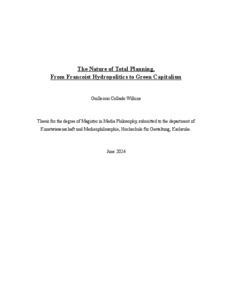
The Nature of Total Planning, From Francoist Hydropolitics to Green Capitalism
Name that can easily go onto 2 lines
Author that can easily go onto 2 lines as well
- Title
- The Nature of Total Planning, From Francoist Hydropolitics to Green Capitalism
- Author
- Description (de)
- Magisterarbeit in Medienphilosophie
- Description (en)
- Thesis for the degree of Magister in Media Philosophy
- Category
- Keywords
- Date
- 06.06.2024
- Language
- Location: institution
- Country
- Title
- The Nature of Total Planning, From Francoist Hydropolitics to Green Capitalism
- Title (en)
- The Nature of Total Planning, From Francoist Hydropolitics to Green Capitalism
- Copyright Notice
- © Guillermo Collado Wilkins
- Legal protection / Licence
- Permission usage HfG
- Media creator
- Description of media (en)
- This paper provides a critical examination of ecological planning based on the continuities that it displays across seemingly disparate political projects and historical periods. In order to do so, it draws on the small rural valley of La Bizkaia in Navarre, Spain. It produces an environmental history of the valley through a detailed study of its hydro-forestry resources, periodising such history according to a materialist reading of its ‘metabolic regimes’. That is to say, through the particular configurations between the natural and social orders that dictate life in La Bizkaia.
Initially, the study introduces the valley’s natural characteristics and its property structure, laying the foundations upon which the rest of this paper sits. Subsequently, it undertakes a detailed investigation of Francoist interventions in the 1940s-60s; a massive monoculture of pine trees was planted by the Francoist Forestry Council, which radically undermined La Bizkaia’s natural systems and depopulated it. This paper thus analyses the planning logic behind this natural intervention which, borrowing a term from one of its draftsmen, is named ‘total planning’.
The thesis then explores contemporary management of the valley by the Government of Navarre, which has maintained ownership until this day, aligning its plans with the international protocols and standards characteristic of green capitalism. By looking at projects undertaken in the valley for nature conservation and climate change adaptation, which receive funding from the European Union, this research reveals the continuities between Francoist policies and green capitalism, and how both operate under the logic of Total Planning. Under this planning logic, they both fail to accommodate the unpredictability of political conflict and natural systems.
Planning thus serves as a lens to explore the political and epistemological dimensions of ecological thought, placing a materialist reading of a small case study into the broader context of contemporary ecological intervention.
- This paper provides a critical examination of ecological planning based on the continuities that it displays across seemingly disparate political projects and historical periods. In order to do so, it draws on the small rural valley of La Bizkaia in Navarre, Spain. It produces an environmental history of the valley through a detailed study of its hydro-forestry resources, periodising such history according to a materialist reading of its ‘metabolic regimes’. That is to say, through the particular configurations between the natural and social orders that dictate life in La Bizkaia.
- Alternative text (de)
- Vollständiger Text der Magisterarbeit
- Alternative text (en)
- Complete text of the Magisterarbeit
- Projektleiter/in
- Semester
- Program of Study
- Type of graduation project
- Imported on
- 22.10.2024
- Parent sets
- 1
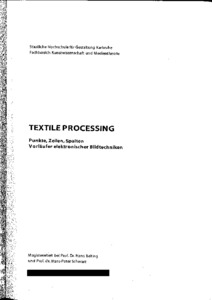
Textile Processing (geschwärzt)
Name that can easily go onto 2 lines
Author that can easily go onto 2 lines as well
- Title
- Textile Processing (geschwärzt)
- Subtitle
- Punkte, Zeilen, Spalten Vorläufer elektronischer Bildtechniken
- Author
- Description (de)
- “Die Ähnlichkeiten von Geweben, Mustervorlagen und heutigen Rasterbildern sind eklatant.
In einer Genese der technischen Bilder kann das Gewebe als Exemplarfall und Vorreiter
aller technisch-elektronischer Bilder gelten.”
“Die ersten Bilder, die von ihrem Bildkörper abgelöst wurden, bestanden aus einem Stapel
gelochter Karten für die Verwendung im Jacquardwebstuhl. Der Bildcode ist hier noch
begreifbar, das Bild, wenn es aus dem Stapel dieser Karten gewoben wird, ein textil-taktiles
Produkt. Patricia Wallers Needle-Works zeigen die Leerstelle heutiger Bildmaschinen auf,
wo Bilder auf Monitoren erscheinen, um im nächsten Moment schon wieder durch den
nächsten (Netzhaut-) Eindruck ausgetauscht zu werden.”
- “Die Ähnlichkeiten von Geweben, Mustervorlagen und heutigen Rasterbildern sind eklatant.
- Description (en)
- ‘The similarities between fabrics, patterns and today's raster images are striking. In the genesis of technical images, the fabric can be seen as the exemplary case and forerunner of all technical-electronic images.’
‘The first images that were detached from their image body consisted of a stack of perforated cards for use in the Jacquard loom. The image code is still comprehensible here, the image, when woven from the pile of these cards, is a textile-tactile product. Patricia Waller's needle works show the empty space of today's image machines, where images appear on monitors only to be replaced by the next (retinal) impression in the very next moment.’
- ‘The similarities between fabrics, patterns and today's raster images are striking. In the genesis of technical images, the fabric can be seen as the exemplary case and forerunner of all technical-electronic images.’
- Category
- Keywords
- Date
- 02.11.1998
- Language
- Location: institution
- Title
- Textile Processing (geschwärzt)
- Subtitle
- Punkte, Zeilen, Spalten Vorläufer elektronischer Bildtechniken
- Copyright Notice
- Brigit Schneider
- Legal protection / Licence
- Permission usage HfG
- Media creator
- Relationship/function
- Projektleiter/in
- Semester
- Program of Study
- Type of graduation project
- Archive signature
- HfG HS 1998 02a
- External archive
- Imported on
- 17.03.2025
- Parent sets
- 1
Textile Processing Deckblatt
Name that can easily go onto 2 lines
Author that can easily go onto 2 lines as well
- Title
- Textile Processing Deckblatt
- Author
- Description (de)
- „Die Ähnlichkeiten von Geweben, Mustervorlagen und heutigen Rasterbildern sind eklatant. In einer Genese der technischen Bilder kann das Gewebe als Exemplarfall und Vorreiter aller technisch-elektronischer Bilder gelten.”
„Die ersten Bilder, die von ihrem Bildkörper abgelöst wurden, bestanden aus einem Stapel gelochter Karten für die Verwendung im Jacquardwebstuhl. Der Bildcode ist hier noch begreifbar, das Bild, wenn es aus dem Stapel dieser Karten gewoben wird, ein textil-taktiles Produkt. Patricia Wallers Needle-Works zeigen die Leerstelle heutiger Bildmaschinen auf, wo Bilder auf Monitoren erscheinen, um im nächsten Moment schon wieder durch den nächsten (Netzhaut-) Eindruck ausgetauscht zu werden.”
- „Die Ähnlichkeiten von Geweben, Mustervorlagen und heutigen Rasterbildern sind eklatant. In einer Genese der technischen Bilder kann das Gewebe als Exemplarfall und Vorreiter aller technisch-elektronischer Bilder gelten.”
- Description (en)
- “The similarities between fabrics, patterns and today's raster images are striking. In the genesis of technical images, the fabric can be regarded as an exemplary case and forerunner of all technical-electronic images.”
“The first images that were detached from their image body consisted of a stack of perforated cards for use in the Jacquard loom. The image code is still comprehensible here, the image, when woven from the pile of these cards, is a textile-tactile product. Patricia Waller's needle works show the blank space of today's image machines, where images appear on monitors only to be replaced by the next (retinal) impression in the very next moment.”
- “The similarities between fabrics, patterns and today's raster images are striking. In the genesis of technical images, the fabric can be regarded as an exemplary case and forerunner of all technical-electronic images.”
- Category
- Type of project / creative work
- Keywords
- Date
- 02.11.1998
- Language
- Location: institution
- City
- Title
- Textile Processing Deckblatt
- Copyright Notice
- Birgit Schneider
- Legal protection / Licence
- Permission usage HfG
- Media creator
- Relationship/function
- Projektleiter/in
- Semester
- Program of Study
- Type of graduation project
- Archive signature
- HfG HS 1998 02
- External archive
- Imported on
- 09.01.2025
- Parent sets
- 1
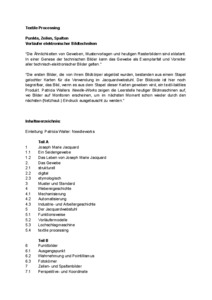
Textile Processing
Name that can easily go onto 2 lines
Author that can easily go onto 2 lines as well
- Title
- Textile Processing
- Subtitle
- Punkte, Zeilen, Spalten; Vorläufer elektronischer Bildtechniken
- Author
- Description (de)
- „Die Ähnlichkeiten von Geweben, Mustervorlagen und heutigen Rasterbildern sind eklatant. In einer Genese der technischen Bilder kann das Gewebe als Exemplarfall und Vorreiter aller technisch-elektronischer Bilder gelten.”
„Die ersten Bilder, die von ihrem Bildkörper abgelöst wurden, bestanden aus einem Stapel gelochter Karten für die Verwendung im Jacquardwebstuhl. Der Bildcode ist hier noch begreifbar, das Bild, wenn es aus dem Stapel dieser Karten gewoben wird, ein textil-taktiles Produkt. Patricia Wallers Needle-Works zeigen die Leerstelle heutiger Bildmaschinen auf, wo Bilder auf Monitoren erscheinen, um im nächsten Moment schon wieder durch den nächsten (Netzhaut-) Eindruck ausgetauscht zu werden.”
- „Die Ähnlichkeiten von Geweben, Mustervorlagen und heutigen Rasterbildern sind eklatant. In einer Genese der technischen Bilder kann das Gewebe als Exemplarfall und Vorreiter aller technisch-elektronischer Bilder gelten.”
- Description (en)
- “The similarities between fabrics, patterns and today's raster images are striking. In the genesis of technical images, the fabric can be regarded as an exemplary case and forerunner of all technical-electronic images.”
“The first images that were detached from their image body consisted of a stack of perforated cards for use in the Jacquard loom. The image code is still comprehensible here, the image, when woven from the pile of these cards, is a textile-tactile product. Patricia Waller's needle works show the blank space of today's image machines, where images appear on monitors only to be replaced by the next (retinal) impression in the very next moment.”
- “The similarities between fabrics, patterns and today's raster images are striking. In the genesis of technical images, the fabric can be regarded as an exemplary case and forerunner of all technical-electronic images.”
- Category
- Type of project / creative work
- Keywords
- Date
- 02.11.1998
- Language
- Location: institution
- City
- Title
- Textile Processing
- Subtitle
- Punkte, Zeilen, Spalten; Vorläufer elektronischer Bildtechniken
- Copyright Notice
- Brigit Schneider
- Legal protection / Licence
- Permission usage HfG
- Media creator
- Relationship/function
- Projektleiter/in
- Semester
- Program of Study
- Type of graduation project
- Archive signature
- HfG HS 1998 02
- External archive
- Imported on
- 04.08.2023
- Parent sets
- 1
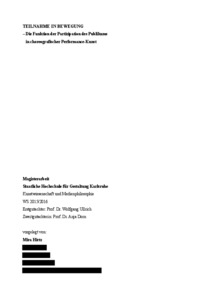
Teilnahme in Bewegung Magisterarbeit (geschw.)
Name that can easily go onto 2 lines
Author that can easily go onto 2 lines as well
- Title
- Teilnahme in Bewegung Magisterarbeit (geschw.)
- Subtitle
- die Funktion der Partizipation des Publikums in choreografischer Performance-Kunst
- Author
- Description (de)
- „Die Partizipation des Publikums in Performance-Kunst – der Titel der Magisterarbeit – ruft die Vorstellung eines klassischen ,Mitmach‘-Theaters beziehungsweise eines von ,mitmachenden‘ Performance-BesucherInnen hervor, in dem das Publikum dazu angehalten wird, sich aktiv und produktiv am Geschehen der Aufführung zu beteiligen. Auch am Beginn meiner Recherche stand diese Vorstellung und Partizipation damit als Phänomen, dem – sowohl von der Seite der RezipientInnen aus, als auch von der der PerformerInnen und der KünstlerInnen – zum einen mit großen Unbehagen, zum anderen mit großer Begeisterung begegnet wird.”
„Das Versprechen, das von der Partizipation des Publikums ausgeht, baut darauf, der konventionell passiven und kontemplativen Betrachtung des Kunstwerks, das von einer singulären Autorschaft gefertigt wurde, entgegenzuwirken. Das Unbehagen gegenüber Partizipation drückt sich zum einen in der Skepsis aus, ob Partizipation die Funktion der Aktivierung des Publikums leisten kann. Bedeutet Teilhabe nicht, dass das Publikum innerhalb eines festgelegten Rahmens und eines bestehenden Konzeptes bloß mitmachen ,darf‘? Heißt das nicht, dass es noch immer in passiver Unmündigkeit gefangen bleibt, aber nun, ja noch schlimmer, mit der Illusion der eigenen Souveränität? In der folgenden Analyse werde ich zeigen, dass die Bezeichnungen aktiv und passiv, selbstbestimmt und determiniert und die damit einhergehenden normativen Befunde allerdings genauerer Differenzierung bedürfen.”
- „Die Partizipation des Publikums in Performance-Kunst – der Titel der Magisterarbeit – ruft die Vorstellung eines klassischen ,Mitmach‘-Theaters beziehungsweise eines von ,mitmachenden‘ Performance-BesucherInnen hervor, in dem das Publikum dazu angehalten wird, sich aktiv und produktiv am Geschehen der Aufführung zu beteiligen. Auch am Beginn meiner Recherche stand diese Vorstellung und Partizipation damit als Phänomen, dem – sowohl von der Seite der RezipientInnen aus, als auch von der der PerformerInnen und der KünstlerInnen – zum einen mit großen Unbehagen, zum anderen mit großer Begeisterung begegnet wird.”
- Description (en)
- ‘The participation of the audience in performance art - the title of the master's thesis - evokes the idea of a classic ‘participatory’ theatre or one of ‘participating’ performance visitors, in which the audience is encouraged to actively and productively participate in the events of the performance. At the beginning of my research, this idea and participation was also a phenomenon that was met with great discomfort on the one hand and great enthusiasm on the other, both on the part of the recipients and the performers and artists.’
‘The promise of audience participation is based on counteracting the conventionally passive and contemplative view of the artwork produced by a singular authorship. The unease about participation is expressed on the one hand in the scepticism as to whether participation can fulfil the function of activating the audience. Doesn't participation mean that the audience is merely ‘allowed’ to take part within a fixed framework and an existing concept? Does this not mean that they are still trapped in passive immaturity, but now, even worse, with the illusion of their own sovereignty? In the following analysis, I will show that the terms active and passive, self-determined and determined and the associated normative findings require more precise differentiation.’
- ‘The participation of the audience in performance art - the title of the master's thesis - evokes the idea of a classic ‘participatory’ theatre or one of ‘participating’ performance visitors, in which the audience is encouraged to actively and productively participate in the events of the performance. At the beginning of my research, this idea and participation was also a phenomenon that was met with great discomfort on the one hand and great enthusiasm on the other, both on the part of the recipients and the performers and artists.’
- Category
- Type of project / creative work
- Keywords
- Language
- Location: institution
- Title
- Teilnahme in Bewegung Magisterarbeit (geschw.)
- Subtitle
- die Funktion der Partizipation des Publikums in choreografischer Performance-Kunst
- Copyright Notice
- © Mira Hirtz
- Legal protection / Licence
- Permission usage HfG
- Media creator
- Relationship/function
- Description of media (en)
- censored version
- Projektleiter/in
- Semester
- Program of Study
- Type of graduation project
- Archive signature
- HfG HS 2015 05
- External archive
- Imported on
- 30.03.2025
- Parent sets
- 1
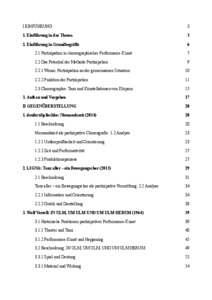
Teilnahme in Bewegung Inhaltsverzeichnis
Name that can easily go onto 2 lines
Author that can easily go onto 2 lines as well
- Title
- Teilnahme in Bewegung Inhaltsverzeichnis
- Subtitle
- die Funktion der Partizipation des Publikums in choreografischer Performance-Kunst
- Author
- Description (de)
- „Die Partizipation des Publikums in Performance-Kunst – der Titel der Magisterarbeit – ruft die Vorstellung eines klassischen ,Mitmach‘-Theaters beziehungsweise eines von ,mitmachenden‘ Performance-BesucherInnen hervor, in dem das Publikum dazu angehalten wird, sich aktiv und produktiv am Geschehen der Aufführung zu beteiligen. Auch am Beginn meiner Recherche stand diese Vorstellung und Partizipation damit als Phänomen, dem – sowohl von der Seite der RezipientInnen aus, als auch von der der PerformerInnen und der KünstlerInnen – zum einen mit großen Unbehagen, zum anderen mit großer Begeisterung begegnet wird.”
„Das Versprechen, das von der Partizipation des Publikums ausgeht, baut darauf, der konventionell passiven und kontemplativen Betrachtung des Kunstwerks, das von einer singulären Autorschaft gefertigt wurde, entgegenzuwirken. Das Unbehagen gegenüber Partizipation drückt sich zum einen in der Skepsis aus, ob Partizipation die Funktion der Aktivierung des Publikums leisten kann. Bedeutet Teilhabe nicht, dass das Publikum innerhalb eines festgelegten Rahmens und eines bestehenden Konzeptes bloß mitmachen ,darf‘? Heißt das nicht, dass es noch immer in passiver Unmündigkeit gefangen bleibt, aber nun, ja noch schlimmer, mit der Illusion der eigenen Souveränität? In der folgenden Analyse werde ich zeigen, dass die Bezeichnungen aktiv und passiv, selbstbestimmt und determiniert und die damit einhergehenden normativen Befunde allerdings genauerer Differenzierung bedürfen.”
- „Die Partizipation des Publikums in Performance-Kunst – der Titel der Magisterarbeit – ruft die Vorstellung eines klassischen ,Mitmach‘-Theaters beziehungsweise eines von ,mitmachenden‘ Performance-BesucherInnen hervor, in dem das Publikum dazu angehalten wird, sich aktiv und produktiv am Geschehen der Aufführung zu beteiligen. Auch am Beginn meiner Recherche stand diese Vorstellung und Partizipation damit als Phänomen, dem – sowohl von der Seite der RezipientInnen aus, als auch von der der PerformerInnen und der KünstlerInnen – zum einen mit großen Unbehagen, zum anderen mit großer Begeisterung begegnet wird.”
- Description (en)
- ‘The participation of the audience in performance art - the title of the master's thesis - evokes the idea of a classic ‘participatory’ theatre or one of ‘participating’ performance visitors, in which the audience is encouraged to actively and productively participate in the events of the performance. At the beginning of my research, this idea and participation was also a phenomenon that was met with great discomfort on the one hand and great enthusiasm on the other, both on the part of the recipients and the performers and artists.’
‘The promise of audience participation is based on counteracting the conventionally passive and contemplative view of the artwork produced by a singular authorship. The unease about participation is expressed on the one hand in the scepticism as to whether participation can fulfil the function of activating the audience. Doesn't participation mean that the audience is merely ‘allowed’ to take part within a fixed framework and an existing concept? Does this not mean that they are still trapped in passive immaturity, but now, even worse, with the illusion of their own sovereignty? In the following analysis, I will show that the terms active and passive, self-determined and determined and the associated normative findings require more precise differentiation.’
- ‘The participation of the audience in performance art - the title of the master's thesis - evokes the idea of a classic ‘participatory’ theatre or one of ‘participating’ performance visitors, in which the audience is encouraged to actively and productively participate in the events of the performance. At the beginning of my research, this idea and participation was also a phenomenon that was met with great discomfort on the one hand and great enthusiasm on the other, both on the part of the recipients and the performers and artists.’
- Category
- Type of project / creative work
- Keywords
- Language
- Location: institution
- Title
- Teilnahme in Bewegung Inhaltsverzeichnis
- Subtitle
- die Funktion der Partizipation des Publikums in choreografischer Performance-Kunst
- Copyright Notice
- © Mira Hirtz
- Legal protection / Licence
- Permission usage HfG
- Media creator
- Relationship/function
- Projektleiter/in
- Semester
- Program of Study
- Type of graduation project
- Archive signature
- HfG HS 2015 05
- External archive
- Imported on
- 30.03.2025
- Parent sets
- 1
Teilnahme in Bewegung Decklblatt

Name that can easily go onto 2 lines
Author that can easily go onto 2 lines as well
- Title
- Teilnahme in Bewegung Decklblatt
- Subtitle
- die Funktion der Partizipation des Publikums in choreografischer Performance-Kunst
- Author
- Description (de)
- „Die Partizipation des Publikums in Performance-Kunst – der Titel der Magisterarbeit – ruft die Vorstellung eines klassischen ,Mitmach‘-Theaters beziehungsweise eines von ,mitmachenden‘ Performance-BesucherInnen hervor, in dem das Publikum dazu angehalten wird, sich aktiv und produktiv am Geschehen der Aufführung zu beteiligen. Auch am Beginn meiner Recherche stand diese Vorstellung und Partizipation damit als Phänomen, dem – sowohl von der Seite der RezipientInnen aus, als auch von der der PerformerInnen und der KünstlerInnen – zum einen mit großen Unbehagen, zum anderen mit großer Begeisterung begegnet wird.”
„Das Versprechen, das von der Partizipation des Publikums ausgeht, baut darauf, der konventionell passiven und kontemplativen Betrachtung des Kunstwerks, das von einer singulären Autorschaft gefertigt wurde, entgegenzuwirken. Das Unbehagen gegenüber Partizipation drückt sich zum einen in der Skepsis aus, ob Partizipation die Funktion der Aktivierung des Publikums leisten kann. Bedeutet Teilhabe nicht, dass das Publikum innerhalb eines festgelegten Rahmens und eines bestehenden Konzeptes bloß mitmachen ,darf‘? Heißt das nicht, dass es noch immer in passiver Unmündigkeit gefangen bleibt, aber nun, ja noch schlimmer, mit der Illusion der eigenen Souveränität? In der folgenden Analyse werde ich zeigen, dass die Bezeichnungen aktiv und passiv, selbstbestimmt und determiniert und die damit einhergehenden normativen Befunde allerdings genauerer Differenzierung bedürfen.”
- „Die Partizipation des Publikums in Performance-Kunst – der Titel der Magisterarbeit – ruft die Vorstellung eines klassischen ,Mitmach‘-Theaters beziehungsweise eines von ,mitmachenden‘ Performance-BesucherInnen hervor, in dem das Publikum dazu angehalten wird, sich aktiv und produktiv am Geschehen der Aufführung zu beteiligen. Auch am Beginn meiner Recherche stand diese Vorstellung und Partizipation damit als Phänomen, dem – sowohl von der Seite der RezipientInnen aus, als auch von der der PerformerInnen und der KünstlerInnen – zum einen mit großen Unbehagen, zum anderen mit großer Begeisterung begegnet wird.”
- Description (en)
- ‘The participation of the audience in performance art - the title of the master's thesis - evokes the idea of a classic ‘participatory’ theatre or one of ‘participating’ performance visitors, in which the audience is encouraged to actively and productively participate in the events of the performance. At the beginning of my research, this idea and participation was also a phenomenon that was met with great discomfort on the one hand and great enthusiasm on the other, both on the part of the recipients and the performers and artists.’
‘The promise of audience participation is based on counteracting the conventionally passive and contemplative view of the artwork produced by a singular authorship. The unease about participation is expressed on the one hand in the scepticism as to whether participation can fulfil the function of activating the audience. Doesn't participation mean that the audience is merely ‘allowed’ to take part within a fixed framework and an existing concept? Does this not mean that they are still trapped in passive immaturity, but now, even worse, with the illusion of their own sovereignty? In the following analysis, I will show that the terms active and passive, self-determined and determined and the associated normative findings require more precise differentiation.’
- ‘The participation of the audience in performance art - the title of the master's thesis - evokes the idea of a classic ‘participatory’ theatre or one of ‘participating’ performance visitors, in which the audience is encouraged to actively and productively participate in the events of the performance. At the beginning of my research, this idea and participation was also a phenomenon that was met with great discomfort on the one hand and great enthusiasm on the other, both on the part of the recipients and the performers and artists.’
- Category
- Type of project / creative work
- Keywords
- Language
- Location: institution
- Title
- Teilnahme in Bewegung Decklblatt
- Subtitle
- die Funktion der Partizipation des Publikums in choreografischer Performance-Kunst
- Copyright Notice
- © Mira Hirtz
- Legal protection / Licence
- Permission usage HfG
- Media creator
- Projektleiter/in
- Semester
- Program of Study
- Type of graduation project
- Archive signature
- HfG HS 2015 05
- External archive
- Imported on
- 30.03.2025
- Parent sets
- 1