Werk
Alle Inhalte mit Metadaten des Vokabulars "Werk". Sie sehen nur Inhalte, für die Sie berechtigt sind.
2154 Inhalte
- Seite 1 von 180
SUB_TRAKT
Name that can easily go onto 2 lines
Author that can easily go onto 2 lines as well
- Titel
- SUB_TRAKT
- Autor/in
- Beschreibung (de)
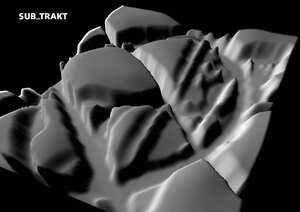
- Die Lichthöfe liegen im Zentrum der Staatlichen Hochschule für Gestaltung Karlsruhe, umgeben von Gängen und Räumen wie z.B. Studios, Büros und Cafeteria. Innerhalb des Gebäudekomplexes liegt die Hochschule zwischen dem Museum für Neue Kunst an nördlicher Seite und dem Zentrum für Kunst und Medientechnologie (ZKM) an südlicher Seite. Nicht nur die an der Hochschule tätigen Menschen durchqueren täglich die Lichthöfe, auch die Besucher der Museen werden zu Passanten des Lichthofs auf ihrem Weg von einem Ort zum anderen. Besonders hoch frequentiert wird der Lichthof 3, da er sich zwischen zwei Außentüren an westlicher und östlicher Seite befindet, und an die im Erdgeschoß befindliche Cafeteria grenzt. Manche Menschen verweilen lange im Lichthof, andere nehmen den kürzesten und somit schnellsten Weg hindurch. Die Bewegung in diesem Lichthof ist Grundlage für SUB_TRAKT.
Im Lichthof 3 wird mit einer Kamera das Geschehen im Raum von oben erfaßt. Personen innerhalb des so beobachteten Bereichs erfahren eine direkte akustische Rückkopplung ihrer Bewegungen über ein an Traversen aufgehängtes 4-Kanal-Lautsprechersystem. Jedes sich bewegende Objekt im Kamerabild generiert eine Klangstruktur im Raum, die sich – abhängig von Größe, Geschwindigkeit und Distanz der Objekte untereinander– verändert. Der Klang verstummt, wenn im Lichthof 3 keine Bewegungen mehr registriert werden.
- Die Lichthöfe liegen im Zentrum der Staatlichen Hochschule für Gestaltung Karlsruhe, umgeben von Gängen und Räumen wie z.B. Studios, Büros und Cafeteria. Innerhalb des Gebäudekomplexes liegt die Hochschule zwischen dem Museum für Neue Kunst an nördlicher Seite und dem Zentrum für Kunst und Medientechnologie (ZKM) an südlicher Seite. Nicht nur die an der Hochschule tätigen Menschen durchqueren täglich die Lichthöfe, auch die Besucher der Museen werden zu Passanten des Lichthofs auf ihrem Weg von einem Ort zum anderen. Besonders hoch frequentiert wird der Lichthof 3, da er sich zwischen zwei Außentüren an westlicher und östlicher Seite befindet, und an die im Erdgeschoß befindliche Cafeteria grenzt. Manche Menschen verweilen lange im Lichthof, andere nehmen den kürzesten und somit schnellsten Weg hindurch. Die Bewegung in diesem Lichthof ist Grundlage für SUB_TRAKT.
- Typ des Projekts/Werks
- Schlagworte
- Dank an
- Sprache
- Material
- Ort: Institution
- Ort
- Lichthof Hfg Karlsruhe
- Stadt
- Land
- Internetlinks
- Titel
- SUB_TRAKT
- Urheberrechtshinweis
- © Anne Niemetz
- Rechtsschutz/Lizenz
- Freigabe Nutzung HfG
- Medienersteller/in
- Projektleiter/in
- Semester
- Studiengang
- Typ der Abschlussarbeit
- Importiert am
- 28.08.2025
- Übergeordnete Sets
- 1
Die Übung eines gesellschaftlichen Imaginären Deckblatt
Name that can easily go onto 2 lines
Author that can easily go onto 2 lines as well
- Titel
- Die Übung eines gesellschaftlichen Imaginären Deckblatt
- Untertitel
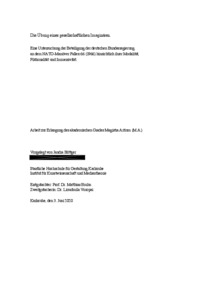
- Eine Untersuchung der Beteiligung der deutschen Bundesregierung an dem NATO-Manöver Fallex 66 (1966) hinsichtlich ihrer Modalität, Fiktionalität und Immersivität.
- Autor/in
- Beschreibung (de)
- „Fallex 66 war die dritte von zwölf biennalen Stabsrahmenübungen, die zwischen 1962 und 1982 durch die NATO organisiert wurden. Während des Kalten Krieges fanden Übungsmanöver regelmäßig statt, um mit bedingter Truppenbewegung Prozesse der Mobilisierung zu simulieren, Alarm- und Evakuierungspläne zu testen, aber auch um
Souveränität zu demonstrieren. Als solche waren sie wichtiger Teil der damaligen Abschreckungsstrategie. Die deutsche Bundesregierung beteiligte sich an diesen durch
Zivilverteidigungsübungen, um Möglichkeiten der „politischen Mitwirkung an Konsultationen und Entscheidungsfindungen der NATO auszuloten und Erfahrungen im Bereich Krisenmanagement und -kommunikation zu sammeln. Im Jahre 1966 fand diese Übung erstmals im jüngst fertiggestellten offiziellen Ausweichsitz der Bundesregierung etwa 30 Kilometer südlich von Bonn, dem Regierungsbunker Ahrweiler, statt.Neu an dieser Übung war jedoch nicht nur die Verlegung in den Regierungsbunker Ahrweiler, sondern auch der Wunsch, im Rahmen der nationalen Übung den jüngsten Entwurf für die Notstandsgesetze zu testen [...] Um den Einsatz der Notstandsgesetze im Kriegsfalle zu erproben, schritt man zu einer ungewöhnlichen Methode: 33 Mitglieder des Deutschen Bundestags und des Deutschen Bundesrates simulierten als Gemeinsamer Ausschuss – das in jenem Gesetz vorgesehene legislative Gremium – für vier Tage im Regierungsbunker Ahrweiler den „gedachten Verlauf“ eines dritten Weltkrieges.”
„Die Sorge, dass durch die Implementierung der Notstandsgesetze ein Hebel zur Totalisierung des Staates juristischen Niederschlag im Grundgesetz finden könnte, wurde dabei durch das ungewöhnliche Verfahren der Übung in dem sich durch Abschottung auszeichnenden Bunker noch verstärkt. Der Aufenthalt der PolitikerInnen wurde so nicht nur Übung der Notstandsgesetze, sondern auch Symbol einer intransparent agierenden Politik. [...] Wie ich zeigen werde, werden auch der Raum der Übung und die TeilnehmerInnen selbst zu einem fiktionstragenden Medium. Deswegen stellt die Übung eine nicht-rationale, sondern affektiv und ästhetisch wirkende Form der Wissensvermittlung dar.”
- „Fallex 66 war die dritte von zwölf biennalen Stabsrahmenübungen, die zwischen 1962 und 1982 durch die NATO organisiert wurden. Während des Kalten Krieges fanden Übungsmanöver regelmäßig statt, um mit bedingter Truppenbewegung Prozesse der Mobilisierung zu simulieren, Alarm- und Evakuierungspläne zu testen, aber auch um
- Beschreibung (en)
- „How do imaginaries claim normativity? A society can only function if enough people envision the same imaginary, says Castoriadis. I claim, that new imaginaries need to be exercised, if they are to claim normative power. This paper investigates a homogenization process of a social imaginary: In the 1966 German civil defense exercise Fallex 66, 33 members of the West German parliament simulated the at this point intensely disputed Emergency Laws. This paper argues that the fusion of fictional and real elements in the exercised scenario, combined with a bodily and affective immersion in a bunker setting had the power to shift a social imaginary. By presenting the Emergency Laws in a conservative patriarchal imaginary landscape, the exercise induces a normative shift in the social perception of the Laws. This paper sheds a leftist light on the struggle, highlighting the political bias of the exercise, as well as giving a new vocabulary to the left critique of that time. With a unique conceptual set-up, this paper investigates the imaginaries transported by and the means of their production in the civil defense exercise. Hereby, I suggest a methodical set for the analysis of social imaginaries at the cutting surface of aesthetics, affect theory, contemporary history, and social philosophy.”
- Kategorie
- Schlagworte
- Datierung
- 03.06.2020
- Sprache
- Ort: Institution
- Titel
- Die Übung eines gesellschaftlichen Imaginären Deckblatt
- Untertitel
- Eine Untersuchung der Beteiligung der deutschen Bundesregierung an dem NATO-Manöver Fallex 66 (1966) hinsichtlich ihrer Modalität, Fiktionalität und Immersivität.
- Urheberrechtshinweis
- © Jandra Böttger
- Rechtsschutz/Lizenz
- Freigabe Nutzung HfG
- Medienersteller/in
- Beziehung/Funktion
- Projektleiter/in
- Semester
- Studiengang
- Typ der Abschlussarbeit
- Archiv-Signatur
- HfG HS 2020 03
- Externes Archiv
- Importiert am
- 03.11.2025
- Übergeordnete Sets
- 1
The Living Library (English)
Name that can easily go onto 2 lines
Author that can easily go onto 2 lines as well
- Titel
- The Living Library (English)
- Autor/in
- Typ des Projekts/Werks
- Schlagworte
- Mitwirkende
- Dank an
- Titel
- The Living Library (English)
- Urheberrechtshinweis
- (CC BY-NC 4.0) Karlsruhe University of Arts and Design and the authors
- Rechtsschutz/Lizenz
- Medienersteller/in
- Medien-Beschreibung
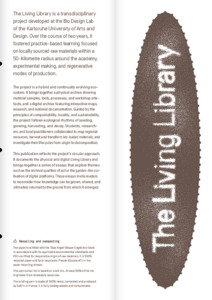
- The Living Library is a transdisciplinary project developed at the Bio Design Lab of the Karlsruhe University of Arts and Design. Over the course of two years, it fostered practice-based learning focused on locally sourced raw materials within a 50-kilometre radius around the academy, experimental making, and regenerative modes of production.
The project is a hybrid and continually evolving ecosystem. It brings together a physical archive showing material samples, tools, processes, and workshop artefacts, and a digital archive featuring interactive maps, research, and material documentation. Guided by the principles of compostability, locality, and sustainability, the project follows ecological rhythms of seeding, growing, harvesting, and decay. Students, researchers, and local practitioners collaborated to map regional resources, harvest and transform bio-based materials, and investigate their lifecycles from origin to decomposition.
This publication reflects the project’s circular approach. It documents the physical and digital Living Library and brings together a series of essays that explore themes such as the archival qualities of soil or the garden-like cultivation of digital platforms. These essays invite readers to reconsider how knowledge can be grown, shared, and ultimately returned to the ground from which it emerged.
- The Living Library is a transdisciplinary project developed at the Bio Design Lab of the Karlsruhe University of Arts and Design. Over the course of two years, it fostered practice-based learning focused on locally sourced raw materials within a 50-kilometre radius around the academy, experimental making, and regenerative modes of production.
- Importiert am
- 04.03.2026
- Übergeordnete Sets
- 1
Die Living Library (Deutsch)
Name that can easily go onto 2 lines
Author that can easily go onto 2 lines as well
- Titel
- Die Living Library (Deutsch)
- Autor/in
- Typ des Projekts/Werks
- Schlagworte
- Mitwirkende
- Dank an
- Titel
- Die Living Library (Deutsch)
- Urheberrechtshinweis
- (CC BY-NC 4.0) Karlsruhe University of Arts and Design and the authors
- Rechtsschutz/Lizenz
- Medienersteller/in
- Medien-Beschreibung
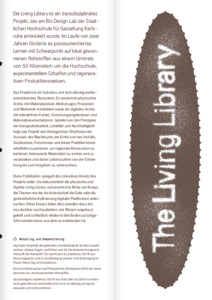
- Die Living Library ist ein transdisziplinäres Projekt, das am Bio Design Lab der Staatlichen Hochschule für Gestaltung Karlsruhe entwickelt wurde. Im Laufe von zwei Jahren förderte es praxisorientiertes Lernen mit Schwerpunkt auf lokal gewonnenen Rohstoffen aus einem Umkreis von 50 Kilometern um die Hochschule, experimentellem Schaffen und regenerativen Produktionsweisen.
Das Projekt ist ein hybrides und sich ständig weiterentwickelndes Ökosystem. Es vereint ein physisches Archiv mit Materialproben, Werkzeugen, Prozessen und Werkstatt-Artefakten sowie ein digitales Archiv mit interaktiven Karten, Forschungsergebnissen und Materialdokumentationen. Geleitet von den Prinzipien der Kompostierbarkeit, Lokalität und Nachhaltigkeit folgt das Projekt den ökologischen Rhythmen der Aussaat, des Wachstums, der Ernte und des Verfalls. Studierende, Forschende und lokale Praktiker:innen arbeiteten zusammen, um regionale Ressourcen zu kartieren, biobasierte Materialien zu ernten und zu verarbeiten und deren Lebenszyklen von der Entstehung bis zum Vergehen zu untersuchen.
Diese Publikation spiegelt den zirkulären Ansatz des Projekts wider. Sie dokumentiert die physische und digitale Living Library und vereint eine Reihe von Essays, die Themen wie die Archivierbarkeit der Erde oder die gartenähnliche Kultivierung digitaler Plattformen untersuchen. Diese Essays laden die Lesenden dazu ein, neu darüber nachzudenken, wie Wissen angebaut, geteilt und schließlich wieder in den Boden zurückgeführt werden kann, aus dem es entstanden ist.
- Die Living Library ist ein transdisziplinäres Projekt, das am Bio Design Lab der Staatlichen Hochschule für Gestaltung Karlsruhe entwickelt wurde. Im Laufe von zwei Jahren förderte es praxisorientiertes Lernen mit Schwerpunkt auf lokal gewonnenen Rohstoffen aus einem Umkreis von 50 Kilometern um die Hochschule, experimentellem Schaffen und regenerativen Produktionsweisen.
- Importiert am
- 04.03.2026
- Übergeordnete Sets
- 1
Bio Design Lab at the HfG Karlsruhe
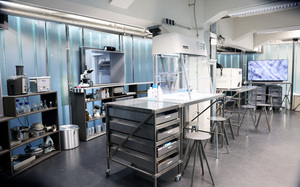
Name that can easily go onto 2 lines
Author that can easily go onto 2 lines as well
- Titel
- Bio Design Lab at the HfG Karlsruhe
- Autor/in
- Schlagworte
- Mitwirkende
- Internetlinks
- Titel
- Bio Design Lab at the HfG Karlsruhe
- Urheberrechtshinweis
- © Bio Design Lab / Living Library
- Rechtsschutz/Lizenz
- Medienersteller/in
- Importiert am
- 10.03.2026
- Übergeordnete Sets
- 1
Bio Design Lab at the HfG Karlsruhe
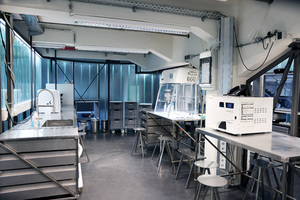
Name that can easily go onto 2 lines
Author that can easily go onto 2 lines as well
- Titel
- Bio Design Lab at the HfG Karlsruhe
- Autor/in
- Schlagworte
- Mitwirkende
- Internetlinks
- Titel
- Bio Design Lab at the HfG Karlsruhe
- Urheberrechtshinweis
- © Bio Design Lab / Living Library
- Rechtsschutz/Lizenz
- Medienersteller/in
- Importiert am
- 10.03.2026
- Übergeordnete Sets
- 1
Bio Design Lab at the HfG Karlsruhe
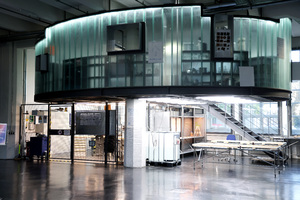
Name that can easily go onto 2 lines
Author that can easily go onto 2 lines as well
- Titel
- Bio Design Lab at the HfG Karlsruhe
- Autor/in
- Schlagworte
- Mitwirkende
- Internetlinks
- Titel
- Bio Design Lab at the HfG Karlsruhe
- Urheberrechtshinweis
- © Bio Design Lab / Living Library
- Rechtsschutz/Lizenz
- Medienersteller/in
- Importiert am
- 10.03.2026
- Übergeordnete Sets
- 1
Bio Design Lab at the HfG Karlsruhe
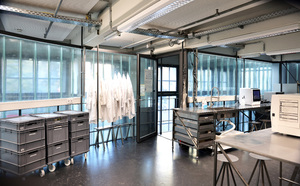
Name that can easily go onto 2 lines
Author that can easily go onto 2 lines as well
- Titel
- Bio Design Lab at the HfG Karlsruhe
- Autor/in
- Schlagworte
- Mitwirkende
- Internetlinks
- Titel
- Bio Design Lab at the HfG Karlsruhe
- Urheberrechtshinweis
- © Bio Design Lab / Living Library
- Rechtsschutz/Lizenz
- Medienersteller/in
- Importiert am
- 10.03.2026
- Übergeordnete Sets
- 1
Bio Design Lab at the HfG Karlsruhe
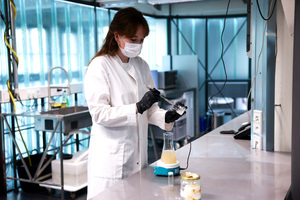
Name that can easily go onto 2 lines
Author that can easily go onto 2 lines as well
- Titel
- Bio Design Lab at the HfG Karlsruhe
- Autor/in
- Schlagworte
- Mitwirkende
- Internetlinks
- Titel
- Bio Design Lab at the HfG Karlsruhe
- Urheberrechtshinweis
- © Bio Design Lab / Living Library
- Rechtsschutz/Lizenz
- Medienersteller/in
- Abgebildete Personen
- Importiert am
- 10.03.2026
- Übergeordnete Sets
- 1
Bio Design Lab at the HfG Karlsruhe
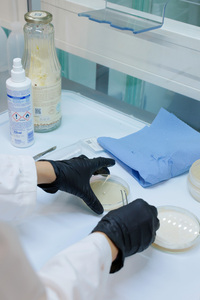
Name that can easily go onto 2 lines
Author that can easily go onto 2 lines as well
- Titel
- Bio Design Lab at the HfG Karlsruhe
- Autor/in
- Schlagworte
- Mitwirkende
- Internetlinks
- Titel
- Bio Design Lab at the HfG Karlsruhe
- Urheberrechtshinweis
- © Bio Design Lab / Living Library
- Rechtsschutz/Lizenz
- Medienersteller/in
- Importiert am
- 10.03.2026
- Übergeordnete Sets
- 1
Bio Design Lab at the HfG Karlsruhe
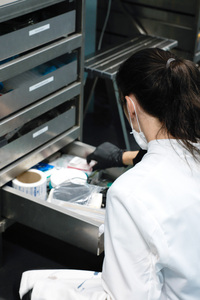
Name that can easily go onto 2 lines
Author that can easily go onto 2 lines as well
- Titel
- Bio Design Lab at the HfG Karlsruhe
- Autor/in
- Schlagworte
- Mitwirkende
- Internetlinks
- Titel
- Bio Design Lab at the HfG Karlsruhe
- Urheberrechtshinweis
- © Bio Design Lab / Living Library
- Rechtsschutz/Lizenz
- Medienersteller/in
- Abgebildete Personen
- Importiert am
- 10.03.2026
- Übergeordnete Sets
- 1
Bio Design Lab at the HfG Karlsruhe

Name that can easily go onto 2 lines
Author that can easily go onto 2 lines as well
- Titel
- Bio Design Lab at the HfG Karlsruhe
- Autor/in
- Schlagworte
- Mitwirkende
- Internetlinks
- Titel
- Bio Design Lab at the HfG Karlsruhe
- Urheberrechtshinweis
- © Bio Design Lab / Living Library
- Rechtsschutz/Lizenz
- Medienersteller/in
- Abgebildete Personen
- Importiert am
- 10.03.2026
- Übergeordnete Sets
- 1