Rote Saat
Benachbarte Sets (14)Alle Zusammenhänge anzeigen
Diese Sets wurden den gleichen Sets hinzugefügt wie das ausgewählte Set.
14 Inhalte
- Seite 1 von 2
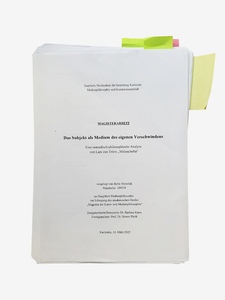
Das Subjekt als Medium des eigenen Verschwindens
Name that can easily go onto 2 lines
Author that can easily go onto 2 lines as well
- Titel
- Das Subjekt als Medium des eigenen Verschwindens
- Titel (en)
- The Subject as the Medium of Its Own Disappearance
- Untertitel
- Eine nomadisch-philosophische Analyse von Lars von Triers "Melancholia"
- Untertitel des Projekts/Werks (en)
- A Nomadic-Philosophical Reading of Lars von Trier’s Melancholia
- Autor/in
- Beschreibung (de)
- Die vorliegende Magisterarbeit untersucht Lars von Triers Film Melancholia als filmischen Denk-
und Wahrnehmungsraum, in dem sich Subjektivität unter Bedingungen einer als „absolute
Gegenwart“ beschriebenen Gegenwartsanalyse konstituiert. Der Begriff geht auf den von Marcus
Quent herausgegebenen Sammelband Absolute Gegenwart (2016) zurück. Dieser beschreibt
gegenwärtige Erfahrungs- und Zeitstrukturen als Spannungsfeld von Beschleunigung,
Bewegungsstarre und der Erosion von Differenz, verbunden mit einem Zustand der Ohnmacht, in
dem Handlung und Denken zunehmend eingeschränkt werden. Diese Analyse bildet den
Ausgangspunkt einer Perspektive, die den Film nicht als Illustration theoretischer Modelle versteht,
sondern ihn aus seiner eigenen Wahrnehmungslogik heraus erschließen möchte.
Im Zentrum steht die Melancholie als Wahrnehmungsmodus, der nicht als klinisch-pathologische
Depression verstanden wird, sondern als Transformation eines Weltbezugs, in dem sich die
Erfahrung des Anderen in eine verschobene und intensivierte Form der Zugänglichkeit ausbildet.
Der Planet Melancholia fungiert dabei nicht als äußeres Symbol, sondern als Schwellenfigur eines
paradoxen Außen, das zugleich Welt-Außen und inneres Außen des Subjekts ist. In dieser Struktur
erscheint das Andere nicht als stabile Gegeninstanz, sondern als entziehende Bewegung, die
Wahrnehmung affiziert, entsichert und verschiebt. Die melancholische Intention steht zu diesem
Außen in einer paradoxen Relation der Annäherung durch Nicht-Aneignung bzw. der Aneignung
im Modus des Nicht-Besitzes, in der sich ein virtuelles Gefüge des Sinnlich-Unsinnlichen eröffnet,
das den Raum der Erfahrung selbst reorganisiert.
Die Arbeit verbindet psychoanalytische Perspektiven (Sigmund Freud, Jacques Lacan) und
kulturphilosophische Ansätze der Melancholie (Giorgio Agamben) mit dem Denken Gilles
Deleuzes, das die zentrale theoretische Perspektive der Arbeit bildet. Im Zentrum stehen seine
Konzeption eines Begehrens jenseits von Subjekt und Objekt sowie seine Differenzphilosophie.
Ergänzend werden zeitdiagnostische Positionen von Byung-Chul Han und Alain Badiou sowie
weitere theoretische Perspektiven, unter anderem von Mark Fisher und Judith Butler, herangezogen.
Die Analyse des Films folgt einer Struktur aus Prolog und apokalyptischem Ereignis, zwischen
denen sich ein Erfahrungs- und Psychologieraum zwischen einem ersten und einem zweiten
Untergang eröffnet. Melancholia erscheint dabei als Versuchsanordnung, in der das Ende der Welt
als prekäre Schwelle erscheint, in der Wahrnehmung, Begehren und Weltverhältnis neu konfiguriert
werden. Ziel ist eine Lesart, in der Subjektivität gerade im Entwurf ihres Verschwindens ein
Vermögen der Öffnung gegenüber Alterität gewinnt.
- Die vorliegende Magisterarbeit untersucht Lars von Triers Film Melancholia als filmischen Denk-
- Beschreibung (en)
- This master's thesis examines Lars von Trier’s Melancholia as a cinematic space of thought and
perception in which subjectivity is constituted under the conditions of a temporal diagnosis
described in contemporary German theory as the “absolute Gegenwart” (literally: “absolute
present“). The term originates in Absolute Gegenwart (2016), an edited volume by Marcus Quent.
This volume describes contemporary structures of experience and temporality as a field of tension
between acceleration, stasis, and the erosion of difference, accompanied by a state of impotence in
which action and thought are increasingly constrained. This analysis serves as the point of departure
for an approach that does not treat the film as an illustration of theoretical models, but instead seeks
to engage it on the basis of its own logic of perception.
At the center of the analysis lies melancholy as a mode of perception, not understood as a clinical
pathology, but as a transformation of one’s relation to the world, in which the experience of the
Other is transformed into a shifted and intensified form of accessibility. The planet Melancholia
does not function as a symbolic object, but as a threshold figure of a paradoxical outside that is
simultaneously external to the world and internal to the subject. Within this structure, the Other no
longer appears as a stable counterpart, but as a movement of withdrawal that affects, destabilizes,
and displaces perception. The melancholic intention stands in a paradoxical relation to this outside,
characterized by an approach through non-appropriation, or appropriation in the mode of non-
possession, within which a virtual field of the sensible and the non-sensible emerges, reorganizing
the very space of experience.
The thesis combines psychoanalytic perspectives (Sigmund Freud, Jacques Lacan) and
philosophical approaches to melancholy (Giorgio Agamben) with the thought of Gilles Deleuze,
which constitutes the central theoretical framework of the study. Particular emphasis is placed on
his conception of desire beyond subject and object and on his philosophy of difference. In addition,
contemporary diagnoses of the present by Byung-Chul Han and Alain Badiou, as well as further
theoretical contributions by authors such as Mark Fisher and Judith Butler, are incorporated.
The analysis of the film follows a structure of prologue and apocalyptic event, within which an
experiential and psychological space unfolds between a first and a second downfall. Melancholia is
thus read as an experimental arrangement in which the end of the world appears as a precarious
threshold, in which perception, desire, and world relation are reconfigured. The thesis argues that
subjectivity gains its capacity for openness toward alterity precisely in the projection of its own
disappearance.
- This master's thesis examines Lars von Trier’s Melancholia as a cinematic space of thought and
- Kategorie
- Typ des Projekts/Werks
- Schlagworte
- Datierung
- 10.03.2025
- Sprache
- Titel
- Das Subjekt als Medium des eigenen Verschwindens
- Untertitel
- Eine nomadisch-philosophische Analyse von Lars von Triers "Melancholia"
- Projektleiter/in
- Semester
- Studiengang
- Typ der Abschlussarbeit
- Importiert am
- 27.06.2026
- Übergeordnete Sets
- 1
- Set enthält
- 0 3
2.5
Name that can easily go onto 2 lines
Author that can easily go onto 2 lines as well
- Titel
- 2.5
- Titel (en)
- 2.5
- Untertitel
- applied material study on 2.5mm peeled Veneer
- Untertitel des Projekts/Werks (en)
- Eine angewandte Materialstudie zu 2.5mm Schälfunier
- Autor/in
- Beschreibung (de)
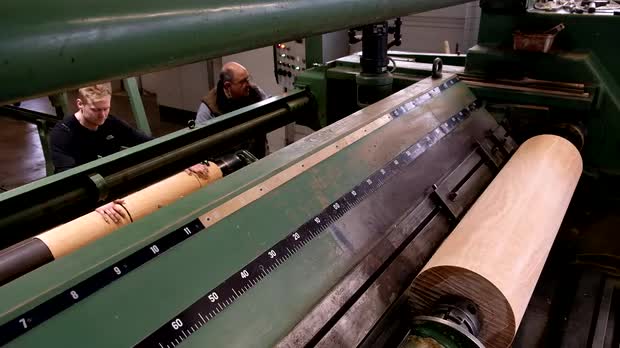
- Schälfurnier ist eine der wenigen Holzgewinnungsmethoden,
die sich an der natürlichen, runden Form des
Baumes orientiert. Ein zuvor entasteter und gedämpfter
Stamm rotiert horizontal gegen eine lange Klinge
ähnlich einem Spitzer für Stifte.
Dabei entsteht eine kontinuierliche Bahn aus Holz.
Da keine klassische Sägemechanik zum Einsatz
kommt, fällt kaum Staub an und es entsteht nahezu
kein Materialverlust durch Sägeschnitte. Durch das rota torische
Arbeiten am runden Stamm ist der Materialertrag
besonders effizient. Im Vergleich zum Aufsä gen
eines Stammes im Sägewerk bei dem ein runder
Stamm in eckige Massivholzteile zerlegt wird
liegt der Ertrag etwa 30–40 % höher.
Furnier wird meist dekorativ eingesetzt, um Oberflächen
aufzuwerten. Eine tragende Rolle erhält es vor
allem in sperrverleimten Schichtwerkstoffen, in de nen
es im Verbund überraschende Stabilität und gestalterische
Flexibilität entwickelt.
Durch kleine Interventionen im Produktionsprozess
lässt sich das Furnier nicht nur als einzelne Blätter,
sondern als kontinuierliche Rolle mit definiertem Maß
entnehmen. Diese Rolle bildet den Ausgangspunkt
und Rohstoff für eine Möbel-Kleinserie.
Die Serie „2.5“ untersucht die strukturellen Möglichkeiten
dieses Materials durch eine Neuinterpretation
klassischer Verarbeitungsmethoden.
2.5.H1
Ein Hocker mit zweifach gekrümmter Sitzschale aus
form verleimtem Furnier. Ein extrudierter Kantenanleimer
setzt sich spiralförmig im Inneren fort und bildet
eine tragende Struktur. Die durch die Geometrie der
Sitzschale entstehende Schattenfuge zum Boden legt
zugleich die textile Erscheinung der natürlichen Verwerfungen
offen, die im Furnier während des Trocknungsprozesses
entstehen.
2.5.R1
Ein Wandregalsystem, das die Kontinuität der Furnierrolle
nutzt, die durch ihr frühzeitiges Entnehmen im
Produktionsprozess möglich wird. Eine dünne Sperrschicht stabiisiert
die Faserstruktur und nimmt Zugkräfte
auf die sie zu den frei Plazierbaren Klemmträgern leitett. So bleibt eine
minimale Materialstärke bei maximaler Flexibilität
erhalten. Frei platzierbare Regalträger ermöglichen eine
spielerische Gestaltungsfreiheit und erzeugen ein
leichtes, dennoch tragfähiges Regalsystem mit geringem
Materialeinsatz.
2.5.R2
Ein Wandregal, das die Querfasern des Furniers entlang
der kurzen Seite nutzt. Was zunächst wie eine Schwäche
erscheint, ermöglicht durch die Sicherung der Kanten
eine hohe Stabilität bei sehr geringer Materialstärke.
Die Fixierung erfolgt ausschließlich entlang der Wandseite.
Natürliche Verwerfungen im Material erzeugen
dabei eine spannungsreiche Interaktion zwischen den
Furnierschichten und eine ausdrucksstarke Stirnseite.
2.5.S1
Der Sessel verbindet Formverleimung mit Prinzipien des
Kassettenbaus. Querfaseriges Furnier leitet Kräfte
direkt zu zwei tragenden Längsfriesen. An besonders
belasteten Stellen verdoppelt sich das Material, ohne
zwingend verklebt zu werden. Windungen unter der Sitzfläche
legen die Konstruktion offen. Starre Verbindungen
entstehen nur dort, wo sie notwendig sind, sodass
die Flexibilität des Materials vollständig genutzt wird
und Komfort sowie eine natürliche Dämpfung entstehen.
- Schälfurnier ist eine der wenigen Holzgewinnungsmethoden,
- Beschreibung (en)
- Rotary-cut veneer is one of the few methods of wood processing that follows the tree’s natural, cylindrical form. A debarked and steamed log rotates horizontally against a long blade, much like a pencil being sharpened. This process produces a continuous sheet of wood.
Because no conventional sawing is involved, very little dust is generated and material loss through saw kerfs is virtually eliminated. By working directly with the round log, the process achieves a particularly high material yield. Compared to sawing a log into rectangular timber sections in a sawmill—where a cylindrical trunk is converted into square lumber—the yield is approximately 30–40% higher.
Veneer is most commonly used as a decorative surface material. Its structural potential is typically realized in engineered wood products such as plywood and laminated composites, where thin layers of veneer combine to create remarkable strength and design flexibility.
With minor interventions in the production process, veneer can be extracted not only as individual sheets but also as a continuous roll of defined dimensions. This roll becomes both the starting point and the raw material for a small furniture collection.
The 2.5 series explores the structural possibilities of rotary-cut veneer through a reinterpretation of traditional manufacturing techniques.
2.5.H1
A stool featuring a doubly curved seat shell made from molded veneer. An extruded edge band continues in a spiral within the interior, forming the load-bearing structure. The shadow gap created between the seat shell and the floor reveals the textile-like appearance of the natural distortions that develop in the veneer during the drying process.
2.5.R1
A wall-mounted shelving system that takes advantage of the continuity of the veneer roll, made possible by removing the material early in the production process. A thin backing layer stabilizes the fibre structure and absorbs tensile forces, transferring them to freely positionable clamping supports. This allows for minimal material thickness while maintaining maximum flexibility.
The movable supports enable playful customization and create a lightweight yet load-bearing shelving system with a minimal use of material.
2.5.R2
A wall shelf that exploits the cross-grain properties of veneer along its shorter dimension. What initially appears to be a weakness becomes a source of strength: by reinforcing the edges, high stability can be achieved despite the extremely thin material.
The shelf is fixed exclusively along the wall side. Natural deformations within the material create a dynamic interaction between the veneer layers and result in a distinctive and expressive edge profile.
2.5.S1
This lounge chair combines molded veneer construction with principles derived from box-beam structures. Cross-grain veneer transfers loads directly to two longitudinal structural rails. In highly stressed areas, the material doubles in thickness without necessarily being bonded, allowing the construction to remain efficient and adaptable.
The layered folds beneath the seat expose the structural logic of the piece. Rigid connections are used only where structurally required, allowing the material’s inherent flexibility to be fully utilized. The result is a chair that offers comfort, natural damping, and an honest expression of its construction.
- Rotary-cut veneer is one of the few methods of wood processing that follows the tree’s natural, cylindrical form. A debarked and steamed log rotates horizontally against a long blade, much like a pencil being sharpened. This process produces a continuous sheet of wood.
- Kategorie
- Typ des Projekts/Werks
- Schlagworte
- Datierung
- 16.04.2026
- Dank an
- Sprache
- Material
- Technik/Verfahren/Formate
- Holzarbeiten
- Abmessungen
- Hocker: 50x30x45 Tisch 100x50x50 Lounge Chair 60x80x80 Regal 180x20x3.1
- Stadt
- Land
- Beteiligte Institution(en)
- Titel
- 2.5
- Untertitel
- applied material study on 2.5mm peeled Veneer
- Studiengang
- Typ der Abschlussarbeit
- Importiert am
- 09.06.2026
- Übergeordnete Sets
- 1
- Set enthält
- 0 32