Franziska Müller-Reissmann
| Name | Franziska Müller-Reissmann |
2 Inhalte
Examples:
Filter werden geladen
- Seite 1 von 1
Die Living Library (Deutsch)
Name that can easily go onto 2 lines
Author that can easily go onto 2 lines as well
- Titel
- Die Living Library (Deutsch)
- Autor/in
- Typ des Projekts/Werks
- Schlagworte
- Mitwirkende
- Dank an
- Titel
- Die Living Library (Deutsch)
- Urheberrechtshinweis
- (CC BY-NC 4.0) Karlsruhe University of Arts and Design and the authors
- Rechtsschutz/Lizenz
- Medienersteller/in
- Medien-Beschreibung
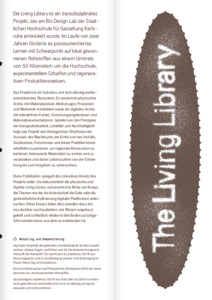
- Die Living Library ist ein transdisziplinäres Projekt, das am Bio Design Lab der Staatlichen Hochschule für Gestaltung Karlsruhe entwickelt wurde. Im Laufe von zwei Jahren förderte es praxisorientiertes Lernen mit Schwerpunkt auf lokal gewonnenen Rohstoffen aus einem Umkreis von 50 Kilometern um die Hochschule, experimentellem Schaffen und regenerativen Produktionsweisen.
Das Projekt ist ein hybrides und sich ständig weiterentwickelndes Ökosystem. Es vereint ein physisches Archiv mit Materialproben, Werkzeugen, Prozessen und Werkstatt-Artefakten sowie ein digitales Archiv mit interaktiven Karten, Forschungsergebnissen und Materialdokumentationen. Geleitet von den Prinzipien der Kompostierbarkeit, Lokalität und Nachhaltigkeit folgt das Projekt den ökologischen Rhythmen der Aussaat, des Wachstums, der Ernte und des Verfalls. Studierende, Forschende und lokale Praktiker:innen arbeiteten zusammen, um regionale Ressourcen zu kartieren, biobasierte Materialien zu ernten und zu verarbeiten und deren Lebenszyklen von der Entstehung bis zum Vergehen zu untersuchen.
Diese Publikation spiegelt den zirkulären Ansatz des Projekts wider. Sie dokumentiert die physische und digitale Living Library und vereint eine Reihe von Essays, die Themen wie die Archivierbarkeit der Erde oder die gartenähnliche Kultivierung digitaler Plattformen untersuchen. Diese Essays laden die Lesenden dazu ein, neu darüber nachzudenken, wie Wissen angebaut, geteilt und schließlich wieder in den Boden zurückgeführt werden kann, aus dem es entstanden ist.
- Die Living Library ist ein transdisziplinäres Projekt, das am Bio Design Lab der Staatlichen Hochschule für Gestaltung Karlsruhe entwickelt wurde. Im Laufe von zwei Jahren förderte es praxisorientiertes Lernen mit Schwerpunkt auf lokal gewonnenen Rohstoffen aus einem Umkreis von 50 Kilometern um die Hochschule, experimentellem Schaffen und regenerativen Produktionsweisen.
- Importiert am
- 04.03.2026
- Übergeordnete Sets
- 1
The Living Library (English)
Name that can easily go onto 2 lines
Author that can easily go onto 2 lines as well
- Titel
- The Living Library (English)
- Autor/in
- Typ des Projekts/Werks
- Schlagworte
- Mitwirkende
- Dank an
- Titel
- The Living Library (English)
- Urheberrechtshinweis
- (CC BY-NC 4.0) Karlsruhe University of Arts and Design and the authors
- Rechtsschutz/Lizenz
- Medienersteller/in
- Medien-Beschreibung
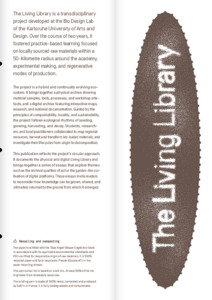
- The Living Library is a transdisciplinary project developed at the Bio Design Lab of the Karlsruhe University of Arts and Design. Over the course of two years, it fostered practice-based learning focused on locally sourced raw materials within a 50-kilometre radius around the academy, experimental making, and regenerative modes of production.
The project is a hybrid and continually evolving ecosystem. It brings together a physical archive showing material samples, tools, processes, and workshop artefacts, and a digital archive featuring interactive maps, research, and material documentation. Guided by the principles of compostability, locality, and sustainability, the project follows ecological rhythms of seeding, growing, harvesting, and decay. Students, researchers, and local practitioners collaborated to map regional resources, harvest and transform bio-based materials, and investigate their lifecycles from origin to decomposition.
This publication reflects the project’s circular approach. It documents the physical and digital Living Library and brings together a series of essays that explore themes such as the archival qualities of soil or the garden-like cultivation of digital platforms. These essays invite readers to reconsider how knowledge can be grown, shared, and ultimately returned to the ground from which it emerged.
- The Living Library is a transdisciplinary project developed at the Bio Design Lab of the Karlsruhe University of Arts and Design. Over the course of two years, it fostered practice-based learning focused on locally sourced raw materials within a 50-kilometre radius around the academy, experimental making, and regenerative modes of production.
- Importiert am
- 04.03.2026
- Übergeordnete Sets
- 1