Wolfgang Ullrich
| Name | Wolfgang Ullrich |
11 Inhalte
- Seite 1 von 1
Konstruktive Unterbrechungen Deckblatt
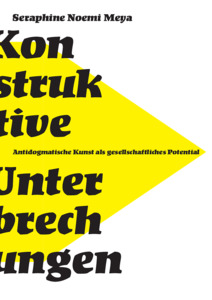
Name that can easily go onto 2 lines
Author that can easily go onto 2 lines as well
- Titel
- Konstruktive Unterbrechungen Deckblatt
- Untertitel
- antidogmatische Kunst als gesellschaftliches Potenzial
- Autor/in
- Beschreibung (de)
- „Immer wieder beschäftigten sich in den letzten Jahren Ausstellungen mit explizit politischer Kunst. Kunst, politische Kunst, künstlerischer Aktivismus und politischer Aktivismus entwickelten sich in der Warnehmung der BetrachterInnen zu einem Knoten, dessen künstlerische Wirkmacht im formalen institutionellen Rahmen auf der Strecke blieb.”
„Dort, wo Altes durch Neues herausgefordert wird. Dort, wo Kunst und Theater auf das alltägliche und das politische Leben treffen. Nicht umsonst forderten Künstler wiederholt die Annäherung von Kunst und Leben. Denn dort, wo beides aufeinander prallt, findet Auseinandersetzung statt. Dabei ist es nicht wichtig, was Kunst genau ist und wo sie anfängt oder aufhört. Relevant ist, dass Brüche geschaffen werden im reibungslosen Ablauf eines problematischen Systems. Es geht um eine Fraktur der Erwartung, um eine Unterbrechung des Gewohnten. Diese Strategie der Unterbrechung ist interessant für die vorliegende Arbeit.”
- „Immer wieder beschäftigten sich in den letzten Jahren Ausstellungen mit explizit politischer Kunst. Kunst, politische Kunst, künstlerischer Aktivismus und politischer Aktivismus entwickelten sich in der Warnehmung der BetrachterInnen zu einem Knoten, dessen künstlerische Wirkmacht im formalen institutionellen Rahmen auf der Strecke blieb.”
- Beschreibung (en)
- ‘In recent years, exhibitions have repeatedly focussed on explicitly political art. In the perception of viewers, art, political art, artistic activism and political activism have developed into a knot whose artistic impact has fallen by the wayside within the formal institutional framework.’
‘Where the old is challenged by the new. Where art and theatre meet everyday and political life. It is not for nothing that artists have repeatedly called for the convergence of art and life. Because where the two collide, confrontation takes place. It is not important what exactly art is and where it begins or ends. What is relevant is that breaks are created in the smooth running of a problematic system. It is about a fracture of expectation, an interruption of the familiar. This strategy of interruption is interesting for the present work.’
- ‘In recent years, exhibitions have repeatedly focussed on explicitly political art. In the perception of viewers, art, political art, artistic activism and political activism have developed into a knot whose artistic impact has fallen by the wayside within the formal institutional framework.’
- Kategorie
- Typ des Projekts/Werks
- Schlagworte
- Datierung
- 10.07.2014
- Sprache
- Ort: Institution
- Titel
- Konstruktive Unterbrechungen Deckblatt
- Untertitel
- antidogmatische Kunst als gesellschaftliches Potenzial
- Urheberrechtshinweis
- © Seraphine Meya
- Rechtsschutz/Lizenz
- Freigabe Nutzung HfG
- Medienersteller/in
- Beziehung/Funktion
- Projektleiter/in
- Semester
- Studiengang
- Typ der Abschlussarbeit
- Archiv-Signatur
- HfG HS 2014 01
- Externes Archiv
- Importiert am
- 30.03.2025
- Übergeordnete Sets
- 1
Konstruktive Unterbrechungen Inhaltsverzeichnis
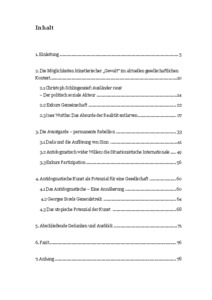
Name that can easily go onto 2 lines
Author that can easily go onto 2 lines as well
- Titel
- Konstruktive Unterbrechungen Inhaltsverzeichnis
- Untertitel
- antidogmatische Kunst als gesellschaftliches Potenzial
- Autor/in
- Beschreibung (de)
- „Immer wieder beschäftigten sich in den letzten Jahren Ausstellungen mit explizit politischer Kunst. Kunst, politische Kunst, künstlerischer Aktivismus und politischer Aktivismus entwickelten sich in der Warnehmung der BetrachterInnen zu einem Knoten, dessen künstlerische Wirkmacht im formalen institutionellen Rahmen auf der Strecke blieb.”
„Dort, wo Altes durch Neues herausgefordert wird. Dort, wo Kunst und Theater auf das alltägliche und das politische Leben treffen. Nicht umsonst forderten Künstler wiederholt die Annäherung von Kunst und Leben. Denn dort, wo beides aufeinander prallt, findet Auseinandersetzung statt. Dabei ist es nicht wichtig, was Kunst genau ist und wo sie anfängt oder aufhört. Relevant ist, dass Brüche geschaffen werden im reibungslosen Ablauf eines problematischen Systems. Es geht um eine Fraktur der Erwartung, um eine Unterbrechung des Gewohnten. Diese Strategie der Unterbrechung ist interessant für die vorliegende Arbeit.”
- „Immer wieder beschäftigten sich in den letzten Jahren Ausstellungen mit explizit politischer Kunst. Kunst, politische Kunst, künstlerischer Aktivismus und politischer Aktivismus entwickelten sich in der Warnehmung der BetrachterInnen zu einem Knoten, dessen künstlerische Wirkmacht im formalen institutionellen Rahmen auf der Strecke blieb.”
- Beschreibung (en)
- ‘In recent years, exhibitions have repeatedly focussed on explicitly political art. In the perception of viewers, art, political art, artistic activism and political activism have developed into a knot whose artistic impact has fallen by the wayside within the formal institutional framework.’
‘Where the old is challenged by the new. Where art and theatre meet everyday and political life. It is not for nothing that artists have repeatedly called for the convergence of art and life. Because where the two collide, confrontation takes place. It is not important what exactly art is and where it begins or ends. What is relevant is that breaks are created in the smooth running of a problematic system. It is about a fracture of expectation, an interruption of the familiar. This strategy of interruption is interesting for the present work.’
- ‘In recent years, exhibitions have repeatedly focussed on explicitly political art. In the perception of viewers, art, political art, artistic activism and political activism have developed into a knot whose artistic impact has fallen by the wayside within the formal institutional framework.’
- Kategorie
- Typ des Projekts/Werks
- Schlagworte
- Datierung
- 10.07.2014
- Sprache
- Ort: Institution
- Titel
- Konstruktive Unterbrechungen Inhaltsverzeichnis
- Untertitel
- antidogmatische Kunst als gesellschaftliches Potenzial
- Urheberrechtshinweis
- © Seraphine Meya
- Rechtsschutz/Lizenz
- Freigabe Nutzung HfG
- Medienersteller/in
- Beziehung/Funktion
- Projektleiter/in
- Semester
- Studiengang
- Typ der Abschlussarbeit
- Archiv-Signatur
- HfG HS 2014 01
- Externes Archiv
- Importiert am
- 30.03.2025
- Übergeordnete Sets
- 1
Konstruktive Unterbrechungen Abstract
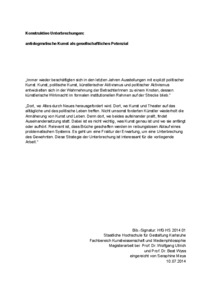
Name that can easily go onto 2 lines
Author that can easily go onto 2 lines as well
- Titel
- Konstruktive Unterbrechungen Abstract
- Untertitel
- antidogmatische Kunst als gesellschaftliches Potenzial
- Autor/in
- Beschreibung (de)
- „Immer wieder beschäftigten sich in den letzten Jahren Ausstellungen mit explizit politischer Kunst. Kunst, politische Kunst, künstlerischer Aktivismus und politischer Aktivismus entwickelten sich in der Warnehmung der BetrachterInnen zu einem Knoten, dessen künstlerische Wirkmacht im formalen institutionellen Rahmen auf der Strecke blieb.”
„Dort, wo Altes durch Neues herausgefordert wird. Dort, wo Kunst und Theater auf das alltägliche und das politische Leben treffen. Nicht umsonst forderten Künstler wiederholt die Annäherung von Kunst und Leben. Denn dort, wo beides aufeinander prallt, findet Auseinandersetzung statt. Dabei ist es nicht wichtig, was Kunst genau ist und wo sie anfängt oder aufhört. Relevant ist, dass Brüche geschaffen werden im reibungslosen Ablauf eines problematischen Systems. Es geht um eine Fraktur der Erwartung, um eine Unterbrechung des Gewohnten. Diese Strategie der Unterbrechung ist interessant für die vorliegende Arbeit.”
- „Immer wieder beschäftigten sich in den letzten Jahren Ausstellungen mit explizit politischer Kunst. Kunst, politische Kunst, künstlerischer Aktivismus und politischer Aktivismus entwickelten sich in der Warnehmung der BetrachterInnen zu einem Knoten, dessen künstlerische Wirkmacht im formalen institutionellen Rahmen auf der Strecke blieb.”
- Beschreibung (en)
- ‘In recent years, exhibitions have repeatedly focussed on explicitly political art. In the perception of viewers, art, political art, artistic activism and political activism have developed into a knot whose artistic impact has fallen by the wayside within the formal institutional framework.’
‘Where the old is challenged by the new. Where art and theatre meet everyday and political life. It is not for nothing that artists have repeatedly called for the convergence of art and life. Because where the two collide, confrontation takes place. It is not important what exactly art is and where it begins or ends. What is relevant is that breaks are created in the smooth running of a problematic system. It is about a fracture of expectation, an interruption of the familiar. This strategy of interruption is interesting for the present work.’
- ‘In recent years, exhibitions have repeatedly focussed on explicitly political art. In the perception of viewers, art, political art, artistic activism and political activism have developed into a knot whose artistic impact has fallen by the wayside within the formal institutional framework.’
- Kategorie
- Typ des Projekts/Werks
- Schlagworte
- Datierung
- 10.07.2014
- Sprache
- Ort: Institution
- Titel
- Konstruktive Unterbrechungen Abstract
- Untertitel
- antidogmatische Kunst als gesellschaftliches Potenzial
- Urheberrechtshinweis
- © Seraphine Meya
- Rechtsschutz/Lizenz
- Freigabe Nutzung HfG
- Medienersteller/in
- Beziehung/Funktion
- Projektleiter/in
- Semester
- Studiengang
- Typ der Abschlussarbeit
- Archiv-Signatur
- HfG HS 2014 01
- Externes Archiv
- Importiert am
- 30.03.2025
- Übergeordnete Sets
- 1
Konstruktive Unterbrechungen (geschw.)
Name that can easily go onto 2 lines
Author that can easily go onto 2 lines as well
- Titel
- Konstruktive Unterbrechungen (geschw.)
- Untertitel
- antidogmatische Kunst als gesellschaftliches Potenzial
- Autor/in
- Beschreibung (de)
- „Immer wieder beschäftigten sich in den letzten Jahren Ausstellungen mit explizit politischer Kunst. Kunst, politische Kunst, künstlerischer Aktivismus und politischer Aktivismus entwickelten sich in der Warnehmung der BetrachterInnen zu einem Knoten, dessen künstlerische Wirkmacht im formalen institutionellen Rahmen auf der Strecke blieb.”
„Dort, wo Altes durch Neues herausgefordert wird. Dort, wo Kunst und Theater auf das alltägliche und das politische Leben treffen. Nicht umsonst forderten Künstler wiederholt die Annäherung von Kunst und Leben. Denn dort, wo beides aufeinander prallt, findet Auseinandersetzung statt. Dabei ist es nicht wichtig, was Kunst genau ist und wo sie anfängt oder aufhört. Relevant ist, dass Brüche geschaffen werden im reibungslosen Ablauf eines problematischen Systems. Es geht um eine Fraktur der Erwartung, um eine Unterbrechung des Gewohnten. Diese Strategie der Unterbrechung ist interessant für die vorliegende Arbeit.”
- „Immer wieder beschäftigten sich in den letzten Jahren Ausstellungen mit explizit politischer Kunst. Kunst, politische Kunst, künstlerischer Aktivismus und politischer Aktivismus entwickelten sich in der Warnehmung der BetrachterInnen zu einem Knoten, dessen künstlerische Wirkmacht im formalen institutionellen Rahmen auf der Strecke blieb.”
- Beschreibung (en)
- ‘In recent years, exhibitions have repeatedly focussed on explicitly political art. In the perception of viewers, art, political art, artistic activism and political activism have developed into a knot whose artistic impact has fallen by the wayside within the formal institutional framework.’
‘Where the old is challenged by the new. Where art and theatre meet everyday and political life. It is not for nothing that artists have repeatedly called for the convergence of art and life. Because where the two collide, confrontation takes place. It is not important what exactly art is and where it begins or ends. What is relevant is that breaks are created in the smooth running of a problematic system. It is about a fracture of expectation, an interruption of the familiar. This strategy of interruption is interesting for the present work.’
- ‘In recent years, exhibitions have repeatedly focussed on explicitly political art. In the perception of viewers, art, political art, artistic activism and political activism have developed into a knot whose artistic impact has fallen by the wayside within the formal institutional framework.’
- Kategorie
- Typ des Projekts/Werks
- Schlagworte
- Datierung
- 10.07.2014
- Sprache
- Ort: Institution
- Titel
- Konstruktive Unterbrechungen (geschw.)
- Untertitel
- antidogmatische Kunst als gesellschaftliches Potenzial
- Urheberrechtshinweis
- © Seraphine Meya
- Rechtsschutz/Lizenz
- Freigabe Nutzung HfG
- Medienersteller/in
- Beziehung/Funktion
- Medien-Beschreibung
- censored version / zensierte Version
- Projektleiter/in
- Semester
- Studiengang
- Typ der Abschlussarbeit
- Archiv-Signatur
- HfG HS 2014 01
- Externes Archiv
- Importiert am
- 30.03.2025
- Übergeordnete Sets
- 1
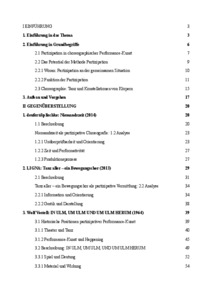
Teilnahme in Bewegung Inhaltsverzeichnis
Name that can easily go onto 2 lines
Author that can easily go onto 2 lines as well
- Titel
- Teilnahme in Bewegung Inhaltsverzeichnis
- Untertitel
- die Funktion der Partizipation des Publikums in choreografischer Performance-Kunst
- Autor/in
- Beschreibung (de)
- „Die Partizipation des Publikums in Performance-Kunst – der Titel der Magisterarbeit – ruft die Vorstellung eines klassischen ,Mitmach‘-Theaters beziehungsweise eines von ,mitmachenden‘ Performance-BesucherInnen hervor, in dem das Publikum dazu angehalten wird, sich aktiv und produktiv am Geschehen der Aufführung zu beteiligen. Auch am Beginn meiner Recherche stand diese Vorstellung und Partizipation damit als Phänomen, dem – sowohl von der Seite der RezipientInnen aus, als auch von der der PerformerInnen und der KünstlerInnen – zum einen mit großen Unbehagen, zum anderen mit großer Begeisterung begegnet wird.”
„Das Versprechen, das von der Partizipation des Publikums ausgeht, baut darauf, der konventionell passiven und kontemplativen Betrachtung des Kunstwerks, das von einer singulären Autorschaft gefertigt wurde, entgegenzuwirken. Das Unbehagen gegenüber Partizipation drückt sich zum einen in der Skepsis aus, ob Partizipation die Funktion der Aktivierung des Publikums leisten kann. Bedeutet Teilhabe nicht, dass das Publikum innerhalb eines festgelegten Rahmens und eines bestehenden Konzeptes bloß mitmachen ,darf‘? Heißt das nicht, dass es noch immer in passiver Unmündigkeit gefangen bleibt, aber nun, ja noch schlimmer, mit der Illusion der eigenen Souveränität? In der folgenden Analyse werde ich zeigen, dass die Bezeichnungen aktiv und passiv, selbstbestimmt und determiniert und die damit einhergehenden normativen Befunde allerdings genauerer Differenzierung bedürfen.”
- „Die Partizipation des Publikums in Performance-Kunst – der Titel der Magisterarbeit – ruft die Vorstellung eines klassischen ,Mitmach‘-Theaters beziehungsweise eines von ,mitmachenden‘ Performance-BesucherInnen hervor, in dem das Publikum dazu angehalten wird, sich aktiv und produktiv am Geschehen der Aufführung zu beteiligen. Auch am Beginn meiner Recherche stand diese Vorstellung und Partizipation damit als Phänomen, dem – sowohl von der Seite der RezipientInnen aus, als auch von der der PerformerInnen und der KünstlerInnen – zum einen mit großen Unbehagen, zum anderen mit großer Begeisterung begegnet wird.”
- Beschreibung (en)
- ‘The participation of the audience in performance art - the title of the master's thesis - evokes the idea of a classic ‘participatory’ theatre or one of ‘participating’ performance visitors, in which the audience is encouraged to actively and productively participate in the events of the performance. At the beginning of my research, this idea and participation was also a phenomenon that was met with great discomfort on the one hand and great enthusiasm on the other, both on the part of the recipients and the performers and artists.’
‘The promise of audience participation is based on counteracting the conventionally passive and contemplative view of the artwork produced by a singular authorship. The unease about participation is expressed on the one hand in the scepticism as to whether participation can fulfil the function of activating the audience. Doesn't participation mean that the audience is merely ‘allowed’ to take part within a fixed framework and an existing concept? Does this not mean that they are still trapped in passive immaturity, but now, even worse, with the illusion of their own sovereignty? In the following analysis, I will show that the terms active and passive, self-determined and determined and the associated normative findings require more precise differentiation.’
- ‘The participation of the audience in performance art - the title of the master's thesis - evokes the idea of a classic ‘participatory’ theatre or one of ‘participating’ performance visitors, in which the audience is encouraged to actively and productively participate in the events of the performance. At the beginning of my research, this idea and participation was also a phenomenon that was met with great discomfort on the one hand and great enthusiasm on the other, both on the part of the recipients and the performers and artists.’
- Kategorie
- Typ des Projekts/Werks
- Schlagworte
- Sprache
- Ort: Institution
- Titel
- Teilnahme in Bewegung Inhaltsverzeichnis
- Untertitel
- die Funktion der Partizipation des Publikums in choreografischer Performance-Kunst
- Urheberrechtshinweis
- © Mira Hirtz
- Rechtsschutz/Lizenz
- Freigabe Nutzung HfG
- Medienersteller/in
- Beziehung/Funktion
- Projektleiter/in
- Semester
- Studiengang
- Typ der Abschlussarbeit
- Archiv-Signatur
- HfG HS 2015 05
- Externes Archiv
- Importiert am
- 30.03.2025
- Übergeordnete Sets
- 1
Teilnahme in Bewegung Decklblatt

Name that can easily go onto 2 lines
Author that can easily go onto 2 lines as well
- Titel
- Teilnahme in Bewegung Decklblatt
- Untertitel
- die Funktion der Partizipation des Publikums in choreografischer Performance-Kunst
- Autor/in
- Beschreibung (de)
- „Die Partizipation des Publikums in Performance-Kunst – der Titel der Magisterarbeit – ruft die Vorstellung eines klassischen ,Mitmach‘-Theaters beziehungsweise eines von ,mitmachenden‘ Performance-BesucherInnen hervor, in dem das Publikum dazu angehalten wird, sich aktiv und produktiv am Geschehen der Aufführung zu beteiligen. Auch am Beginn meiner Recherche stand diese Vorstellung und Partizipation damit als Phänomen, dem – sowohl von der Seite der RezipientInnen aus, als auch von der der PerformerInnen und der KünstlerInnen – zum einen mit großen Unbehagen, zum anderen mit großer Begeisterung begegnet wird.”
„Das Versprechen, das von der Partizipation des Publikums ausgeht, baut darauf, der konventionell passiven und kontemplativen Betrachtung des Kunstwerks, das von einer singulären Autorschaft gefertigt wurde, entgegenzuwirken. Das Unbehagen gegenüber Partizipation drückt sich zum einen in der Skepsis aus, ob Partizipation die Funktion der Aktivierung des Publikums leisten kann. Bedeutet Teilhabe nicht, dass das Publikum innerhalb eines festgelegten Rahmens und eines bestehenden Konzeptes bloß mitmachen ,darf‘? Heißt das nicht, dass es noch immer in passiver Unmündigkeit gefangen bleibt, aber nun, ja noch schlimmer, mit der Illusion der eigenen Souveränität? In der folgenden Analyse werde ich zeigen, dass die Bezeichnungen aktiv und passiv, selbstbestimmt und determiniert und die damit einhergehenden normativen Befunde allerdings genauerer Differenzierung bedürfen.”
- „Die Partizipation des Publikums in Performance-Kunst – der Titel der Magisterarbeit – ruft die Vorstellung eines klassischen ,Mitmach‘-Theaters beziehungsweise eines von ,mitmachenden‘ Performance-BesucherInnen hervor, in dem das Publikum dazu angehalten wird, sich aktiv und produktiv am Geschehen der Aufführung zu beteiligen. Auch am Beginn meiner Recherche stand diese Vorstellung und Partizipation damit als Phänomen, dem – sowohl von der Seite der RezipientInnen aus, als auch von der der PerformerInnen und der KünstlerInnen – zum einen mit großen Unbehagen, zum anderen mit großer Begeisterung begegnet wird.”
- Beschreibung (en)
- ‘The participation of the audience in performance art - the title of the master's thesis - evokes the idea of a classic ‘participatory’ theatre or one of ‘participating’ performance visitors, in which the audience is encouraged to actively and productively participate in the events of the performance. At the beginning of my research, this idea and participation was also a phenomenon that was met with great discomfort on the one hand and great enthusiasm on the other, both on the part of the recipients and the performers and artists.’
‘The promise of audience participation is based on counteracting the conventionally passive and contemplative view of the artwork produced by a singular authorship. The unease about participation is expressed on the one hand in the scepticism as to whether participation can fulfil the function of activating the audience. Doesn't participation mean that the audience is merely ‘allowed’ to take part within a fixed framework and an existing concept? Does this not mean that they are still trapped in passive immaturity, but now, even worse, with the illusion of their own sovereignty? In the following analysis, I will show that the terms active and passive, self-determined and determined and the associated normative findings require more precise differentiation.’
- ‘The participation of the audience in performance art - the title of the master's thesis - evokes the idea of a classic ‘participatory’ theatre or one of ‘participating’ performance visitors, in which the audience is encouraged to actively and productively participate in the events of the performance. At the beginning of my research, this idea and participation was also a phenomenon that was met with great discomfort on the one hand and great enthusiasm on the other, both on the part of the recipients and the performers and artists.’
- Kategorie
- Typ des Projekts/Werks
- Schlagworte
- Sprache
- Ort: Institution
- Titel
- Teilnahme in Bewegung Decklblatt
- Untertitel
- die Funktion der Partizipation des Publikums in choreografischer Performance-Kunst
- Urheberrechtshinweis
- © Mira Hirtz
- Rechtsschutz/Lizenz
- Freigabe Nutzung HfG
- Medienersteller/in
- Projektleiter/in
- Semester
- Studiengang
- Typ der Abschlussarbeit
- Archiv-Signatur
- HfG HS 2015 05
- Externes Archiv
- Importiert am
- 30.03.2025
- Übergeordnete Sets
- 1
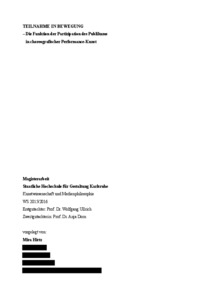
Teilnahme in Bewegung Magisterarbeit (geschw.)
Name that can easily go onto 2 lines
Author that can easily go onto 2 lines as well
- Titel
- Teilnahme in Bewegung Magisterarbeit (geschw.)
- Untertitel
- die Funktion der Partizipation des Publikums in choreografischer Performance-Kunst
- Autor/in
- Beschreibung (de)
- „Die Partizipation des Publikums in Performance-Kunst – der Titel der Magisterarbeit – ruft die Vorstellung eines klassischen ,Mitmach‘-Theaters beziehungsweise eines von ,mitmachenden‘ Performance-BesucherInnen hervor, in dem das Publikum dazu angehalten wird, sich aktiv und produktiv am Geschehen der Aufführung zu beteiligen. Auch am Beginn meiner Recherche stand diese Vorstellung und Partizipation damit als Phänomen, dem – sowohl von der Seite der RezipientInnen aus, als auch von der der PerformerInnen und der KünstlerInnen – zum einen mit großen Unbehagen, zum anderen mit großer Begeisterung begegnet wird.”
„Das Versprechen, das von der Partizipation des Publikums ausgeht, baut darauf, der konventionell passiven und kontemplativen Betrachtung des Kunstwerks, das von einer singulären Autorschaft gefertigt wurde, entgegenzuwirken. Das Unbehagen gegenüber Partizipation drückt sich zum einen in der Skepsis aus, ob Partizipation die Funktion der Aktivierung des Publikums leisten kann. Bedeutet Teilhabe nicht, dass das Publikum innerhalb eines festgelegten Rahmens und eines bestehenden Konzeptes bloß mitmachen ,darf‘? Heißt das nicht, dass es noch immer in passiver Unmündigkeit gefangen bleibt, aber nun, ja noch schlimmer, mit der Illusion der eigenen Souveränität? In der folgenden Analyse werde ich zeigen, dass die Bezeichnungen aktiv und passiv, selbstbestimmt und determiniert und die damit einhergehenden normativen Befunde allerdings genauerer Differenzierung bedürfen.”
- „Die Partizipation des Publikums in Performance-Kunst – der Titel der Magisterarbeit – ruft die Vorstellung eines klassischen ,Mitmach‘-Theaters beziehungsweise eines von ,mitmachenden‘ Performance-BesucherInnen hervor, in dem das Publikum dazu angehalten wird, sich aktiv und produktiv am Geschehen der Aufführung zu beteiligen. Auch am Beginn meiner Recherche stand diese Vorstellung und Partizipation damit als Phänomen, dem – sowohl von der Seite der RezipientInnen aus, als auch von der der PerformerInnen und der KünstlerInnen – zum einen mit großen Unbehagen, zum anderen mit großer Begeisterung begegnet wird.”
- Beschreibung (en)
- ‘The participation of the audience in performance art - the title of the master's thesis - evokes the idea of a classic ‘participatory’ theatre or one of ‘participating’ performance visitors, in which the audience is encouraged to actively and productively participate in the events of the performance. At the beginning of my research, this idea and participation was also a phenomenon that was met with great discomfort on the one hand and great enthusiasm on the other, both on the part of the recipients and the performers and artists.’
‘The promise of audience participation is based on counteracting the conventionally passive and contemplative view of the artwork produced by a singular authorship. The unease about participation is expressed on the one hand in the scepticism as to whether participation can fulfil the function of activating the audience. Doesn't participation mean that the audience is merely ‘allowed’ to take part within a fixed framework and an existing concept? Does this not mean that they are still trapped in passive immaturity, but now, even worse, with the illusion of their own sovereignty? In the following analysis, I will show that the terms active and passive, self-determined and determined and the associated normative findings require more precise differentiation.’
- ‘The participation of the audience in performance art - the title of the master's thesis - evokes the idea of a classic ‘participatory’ theatre or one of ‘participating’ performance visitors, in which the audience is encouraged to actively and productively participate in the events of the performance. At the beginning of my research, this idea and participation was also a phenomenon that was met with great discomfort on the one hand and great enthusiasm on the other, both on the part of the recipients and the performers and artists.’
- Kategorie
- Typ des Projekts/Werks
- Schlagworte
- Sprache
- Ort: Institution
- Titel
- Teilnahme in Bewegung Magisterarbeit (geschw.)
- Untertitel
- die Funktion der Partizipation des Publikums in choreografischer Performance-Kunst
- Urheberrechtshinweis
- © Mira Hirtz
- Rechtsschutz/Lizenz
- Freigabe Nutzung HfG
- Medienersteller/in
- Beziehung/Funktion
- Medien-Beschreibung (en)
- censored version
- Projektleiter/in
- Semester
- Studiengang
- Typ der Abschlussarbeit
- Archiv-Signatur
- HfG HS 2015 05
- Externes Archiv
- Importiert am
- 30.03.2025
- Übergeordnete Sets
- 1
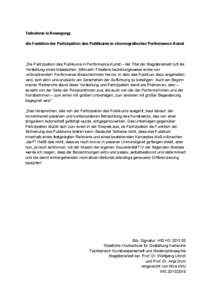
Teilnahme in Bewegung Abstract
Name that can easily go onto 2 lines
Author that can easily go onto 2 lines as well
- Titel
- Teilnahme in Bewegung Abstract
- Untertitel
- die Funktion der Partizipation des Publikums in choreografischer Performance-Kunst
- Autor/in
- Beschreibung (de)
- „Die Partizipation des Publikums in Performance-Kunst – der Titel der Magisterarbeit – ruft die Vorstellung eines klassischen ,Mitmach‘-Theaters beziehungsweise eines von ,mitmachenden‘ Performance-BesucherInnen hervor, in dem das Publikum dazu angehalten wird, sich aktiv und produktiv am Geschehen der Aufführung zu beteiligen. Auch am Beginn meiner Recherche stand diese Vorstellung und Partizipation damit als Phänomen, dem – sowohl von der Seite der RezipientInnen aus, als auch von der der PerformerInnen und der KünstlerInnen – zum einen mit großen Unbehagen, zum anderen mit großer Begeisterung begegnet wird.”
„Das Versprechen, das von der Partizipation des Publikums ausgeht, baut darauf, der konventionell passiven und kontemplativen Betrachtung des Kunstwerks, das von einer singulären Autorschaft gefertigt wurde, entgegenzuwirken. Das Unbehagen gegenüber Partizipation drückt sich zum einen in der Skepsis aus, ob Partizipation die Funktion der Aktivierung des Publikums leisten kann. Bedeutet Teilhabe nicht, dass das Publikum innerhalb eines festgelegten Rahmens und eines bestehenden Konzeptes bloß mitmachen ,darf‘? Heißt das nicht, dass es noch immer in passiver Unmündigkeit gefangen bleibt, aber nun, ja noch schlimmer, mit der Illusion der eigenen Souveränität? In der folgenden Analyse werde ich zeigen, dass die Bezeichnungen aktiv und passiv, selbstbestimmt und determiniert und die damit einhergehenden normativen Befunde allerdings genauerer Differenzierung bedürfen.”
- „Die Partizipation des Publikums in Performance-Kunst – der Titel der Magisterarbeit – ruft die Vorstellung eines klassischen ,Mitmach‘-Theaters beziehungsweise eines von ,mitmachenden‘ Performance-BesucherInnen hervor, in dem das Publikum dazu angehalten wird, sich aktiv und produktiv am Geschehen der Aufführung zu beteiligen. Auch am Beginn meiner Recherche stand diese Vorstellung und Partizipation damit als Phänomen, dem – sowohl von der Seite der RezipientInnen aus, als auch von der der PerformerInnen und der KünstlerInnen – zum einen mit großen Unbehagen, zum anderen mit großer Begeisterung begegnet wird.”
- Beschreibung (en)
- ‘The participation of the audience in performance art - the title of the master's thesis - evokes the idea of a classic ‘participatory’ theatre or one of ‘participating’ performance visitors, in which the audience is encouraged to actively and productively participate in the events of the performance. At the beginning of my research, this idea and participation was also a phenomenon that was met with great discomfort on the one hand and great enthusiasm on the other, both on the part of the recipients and the performers and artists.’
‘The promise of audience participation is based on counteracting the conventionally passive and contemplative view of the artwork produced by a singular authorship. The unease about participation is expressed on the one hand in the scepticism as to whether participation can fulfil the function of activating the audience. Doesn't participation mean that the audience is merely ‘allowed’ to take part within a fixed framework and an existing concept? Does this not mean that they are still trapped in passive immaturity, but now, even worse, with the illusion of their own sovereignty? In the following analysis, I will show that the terms active and passive, self-determined and determined and the associated normative findings require more precise differentiation.’
- ‘The participation of the audience in performance art - the title of the master's thesis - evokes the idea of a classic ‘participatory’ theatre or one of ‘participating’ performance visitors, in which the audience is encouraged to actively and productively participate in the events of the performance. At the beginning of my research, this idea and participation was also a phenomenon that was met with great discomfort on the one hand and great enthusiasm on the other, both on the part of the recipients and the performers and artists.’
- Kategorie
- Typ des Projekts/Werks
- Schlagworte
- Sprache
- Ort: Institution
- Titel
- Teilnahme in Bewegung Abstract
- Untertitel
- die Funktion der Partizipation des Publikums in choreografischer Performance-Kunst
- Urheberrechtshinweis
- © Mira Hirtz
- Rechtsschutz/Lizenz
- Freigabe Nutzung HfG
- Medienersteller/in
- Beziehung/Funktion
- Projektleiter/in
- Semester
- Studiengang
- Typ der Abschlussarbeit
- Archiv-Signatur
- HfG HS 2015 05
- Externes Archiv
- Importiert am
- 30.03.2025
- Übergeordnete Sets
- 1
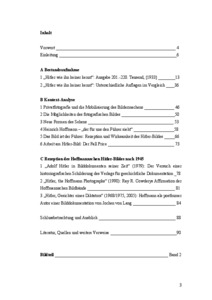
Bildstrategien: Inhaltsverzeichnis
Name that can easily go onto 2 lines
Author that can easily go onto 2 lines as well
- Titel
- Bildstrategien: Inhaltsverzeichnis
- Autor/in
- Beschreibung (de)
- „Rudolf Herz hat mit seiner Ausstellung im Fotomuseum im Münchner Stadtmuseum und der gleichnamigen Publikation „Hoffmann und Hitler – Fotografie als Medium des Führer-Mythos“ 1994 einen wichtigen Grundstein für die Forschung um Heinrich Hoffmann, Adolf Hitler und die fotografische Führerpropaganda gelegt. Herz führt in seiner Darlegung in gewisser Weise eine Genealogie des „Hitlerbildes“ aus, das durch die Fotografie Hoffmanns seinen Ausdruck fand: Beginnend mit frühen fotografischen Portraitstudien, die von Heinrich Hoffmann als Postkarten vertrieben wurden, eröffnet der Medienforscher Herz in seinem Buch ein Panorama, das nicht nur die Herausformung der Figur Hitler zeigt, sondern auch die darauf folgenden Bildgattungen, in denen Hitler als Mensch vermarktet wurde.”
„Dieser Band ist nicht der erste Versuch, Adolf Hitler als Bildkonstante in die Gesellschaft einzuführen. Allerdings ist es der erste erfolgreiche Bildband, der es schafft, nicht nur von Hitler zu erzählen, sondern ihn mittels geschickt arrangierter Bildfolge zugleich als Führer und als natürlichen Menschen erscheinen zu lassen. In welchem Zeitraum des Jahres 1932 genau der Bildband „Hitler wie ihn keiner kennt“ erschienen ist, kann mittels der heute noch vorliegenden Bände nicht mehr rekonstruiert werden. Es ist vor allem der Rückgriff auf den Kontext, der in der analytischen Betrachtung und Einordnung des Bandes helfen muss. Das Medium Fotografie wird hier ein zweites Mal wirksam, jedoch nicht immanent (narrativ), sondern aus historischer Perspektive: eine Perspektive, die an dieser Stelle trotz propagandistischer Bildkonzeption auch dokumentarisch Auskunft geben kann.”
- „Rudolf Herz hat mit seiner Ausstellung im Fotomuseum im Münchner Stadtmuseum und der gleichnamigen Publikation „Hoffmann und Hitler – Fotografie als Medium des Führer-Mythos“ 1994 einen wichtigen Grundstein für die Forschung um Heinrich Hoffmann, Adolf Hitler und die fotografische Führerpropaganda gelegt. Herz führt in seiner Darlegung in gewisser Weise eine Genealogie des „Hitlerbildes“ aus, das durch die Fotografie Hoffmanns seinen Ausdruck fand: Beginnend mit frühen fotografischen Portraitstudien, die von Heinrich Hoffmann als Postkarten vertrieben wurden, eröffnet der Medienforscher Herz in seinem Buch ein Panorama, das nicht nur die Herausformung der Figur Hitler zeigt, sondern auch die darauf folgenden Bildgattungen, in denen Hitler als Mensch vermarktet wurde.”
- Beschreibung (en)
- ‘With his exhibition at the Fotomuseum in Munich's Stadtmuseum and the publication of the same name ‘Hoffmann and Hitler - Photography as a Medium of the Führer Myth’ in 1994, Rudolf Herz laid an important foundation stone for research into Heinrich Hoffmann, Adolf Hitler and photographic Führer propaganda. In his account, Herz sets out a kind of genealogy of the ‘Hitler image’, which found its expression through Hoffmann's photography: Beginning with early photographic portrait studies that were distributed by Heinrich Hoffmann as postcards, media researcher Herz opens up a panorama in his book that shows not only the moulding of the figure of Hitler, but also the subsequent image genres in which Hitler was marketed as a human being.’
‘This volume is not the first attempt to introduce Adolf Hitler into society as an image constant. However, it is the first successful illustrated book that manages not only to tell the story of Hitler, but also to make him appear both as a leader and as a natural human being by means of a skilfully arranged sequence of images. It is no longer possible to reconstruct exactly when the illustrated book ‘Hitler wie ihn keiner kennt’ was published in 1932 using the volumes still available today. It is above all the recourse to the context that must help in the analytical consideration and categorisation of the volume. The medium of photography becomes effective a second time here, but not immanently (narratively), but from a historical perspective: a perspective that can also provide documentary information at this point, despite the propagandistic image concept.’
- ‘With his exhibition at the Fotomuseum in Munich's Stadtmuseum and the publication of the same name ‘Hoffmann and Hitler - Photography as a Medium of the Führer Myth’ in 1994, Rudolf Herz laid an important foundation stone for research into Heinrich Hoffmann, Adolf Hitler and photographic Führer propaganda. In his account, Herz sets out a kind of genealogy of the ‘Hitler image’, which found its expression through Hoffmann's photography: Beginning with early photographic portrait studies that were distributed by Heinrich Hoffmann as postcards, media researcher Herz opens up a panorama in his book that shows not only the moulding of the figure of Hitler, but also the subsequent image genres in which Hitler was marketed as a human being.’
- Kategorie
- Schlagworte
- Datierung
- 01.03.2011
- Sprache
- Ort: Institution
- Titel
- Bildstrategien: Inhaltsverzeichnis
- Urheberrechtshinweis
- © Christina Irrgang
- Rechtsschutz/Lizenz
- Freigabe Nutzung HfG
- Medienersteller/in
- Beziehung/Funktion
- Projektleiter/in
- Semester
- Studiengang
- Typ der Abschlussarbeit
- Archiv-Signatur
- HfG HS 2011 04
- Externes Archiv
- Importiert am
- 31.03.2025
- Übergeordnete Sets
- 1
Bildstrategien: Deckblatt
Name that can easily go onto 2 lines
Author that can easily go onto 2 lines as well
- Titel
- Bildstrategien: Deckblatt
- Autor/in
- Beschreibung (de)
- „Rudolf Herz hat mit seiner Ausstellung im Fotomuseum im Münchner Stadtmuseum und der gleichnamigen Publikation „Hoffmann und Hitler – Fotografie als Medium des Führer-Mythos“ 1994 einen wichtigen Grundstein für die Forschung um Heinrich Hoffmann, Adolf Hitler und die fotografische Führerpropaganda gelegt. Herz führt in seiner Darlegung in gewisser Weise eine Genealogie des „Hitlerbildes“ aus, das durch die Fotografie Hoffmanns seinen Ausdruck fand: Beginnend mit frühen fotografischen Portraitstudien, die von Heinrich Hoffmann als Postkarten vertrieben wurden, eröffnet der Medienforscher Herz in seinem Buch ein Panorama, das nicht nur die Herausformung der Figur Hitler zeigt, sondern auch die darauf folgenden Bildgattungen, in denen Hitler als Mensch vermarktet wurde.”
„Dieser Band ist nicht der erste Versuch, Adolf Hitler als Bildkonstante in die Gesellschaft einzuführen. Allerdings ist es der erste erfolgreiche Bildband, der es schafft, nicht nur von Hitler zu erzählen, sondern ihn mittels geschickt arrangierter Bildfolge zugleich als Führer und als natürlichen Menschen erscheinen zu lassen. In welchem Zeitraum des Jahres 1932 genau der Bildband „Hitler wie ihn keiner kennt“ erschienen ist, kann mittels der heute noch vorliegenden Bände nicht mehr rekonstruiert werden. Es ist vor allem der Rückgriff auf den Kontext, der in der analytischen Betrachtung und Einordnung des Bandes helfen muss. Das Medium Fotografie wird hier ein zweites Mal wirksam, jedoch nicht immanent (narrativ), sondern aus historischer Perspektive: eine Perspektive, die an dieser Stelle trotz propagandistischer Bildkonzeption auch dokumentarisch Auskunft geben kann.”
- „Rudolf Herz hat mit seiner Ausstellung im Fotomuseum im Münchner Stadtmuseum und der gleichnamigen Publikation „Hoffmann und Hitler – Fotografie als Medium des Führer-Mythos“ 1994 einen wichtigen Grundstein für die Forschung um Heinrich Hoffmann, Adolf Hitler und die fotografische Führerpropaganda gelegt. Herz führt in seiner Darlegung in gewisser Weise eine Genealogie des „Hitlerbildes“ aus, das durch die Fotografie Hoffmanns seinen Ausdruck fand: Beginnend mit frühen fotografischen Portraitstudien, die von Heinrich Hoffmann als Postkarten vertrieben wurden, eröffnet der Medienforscher Herz in seinem Buch ein Panorama, das nicht nur die Herausformung der Figur Hitler zeigt, sondern auch die darauf folgenden Bildgattungen, in denen Hitler als Mensch vermarktet wurde.”
- Beschreibung (en)
- ‘With his exhibition at the Fotomuseum in Munich's Stadtmuseum and the publication of the same name ‘Hoffmann and Hitler - Photography as a Medium of the Führer Myth’ in 1994, Rudolf Herz laid an important foundation stone for research into Heinrich Hoffmann, Adolf Hitler and photographic Führer propaganda. In his account, Herz sets out a kind of genealogy of the ‘Hitler image’, which found its expression through Hoffmann's photography: Beginning with early photographic portrait studies that were distributed by Heinrich Hoffmann as postcards, media researcher Herz opens up a panorama in his book that shows not only the moulding of the figure of Hitler, but also the subsequent image genres in which Hitler was marketed as a human being.’
‘This volume is not the first attempt to introduce Adolf Hitler into society as an image constant. However, it is the first successful illustrated book that manages not only to tell the story of Hitler, but also to make him appear both as a leader and as a natural human being by means of a skilfully arranged sequence of images. It is no longer possible to reconstruct exactly when the illustrated book ‘Hitler wie ihn keiner kennt’ was published in 1932 using the volumes still available today. It is above all the recourse to the context that must help in the analytical consideration and categorisation of the volume. The medium of photography becomes effective a second time here, but not immanently (narratively), but from a historical perspective: a perspective that can also provide documentary information at this point, despite the propagandistic image concept.’
- ‘With his exhibition at the Fotomuseum in Munich's Stadtmuseum and the publication of the same name ‘Hoffmann and Hitler - Photography as a Medium of the Führer Myth’ in 1994, Rudolf Herz laid an important foundation stone for research into Heinrich Hoffmann, Adolf Hitler and photographic Führer propaganda. In his account, Herz sets out a kind of genealogy of the ‘Hitler image’, which found its expression through Hoffmann's photography: Beginning with early photographic portrait studies that were distributed by Heinrich Hoffmann as postcards, media researcher Herz opens up a panorama in his book that shows not only the moulding of the figure of Hitler, but also the subsequent image genres in which Hitler was marketed as a human being.’
- Kategorie
- Schlagworte
- Datierung
- 01.03.2011
- Sprache
- Ort: Institution
- Titel
- Bildstrategien: Deckblatt
- Urheberrechtshinweis
- © Christina Irrgang
- Rechtsschutz/Lizenz
- Freigabe Nutzung HfG
- Medienersteller/in
- Beziehung/Funktion
- Projektleiter/in
- Semester
- Studiengang
- Typ der Abschlussarbeit
- Archiv-Signatur
- HfG HS 2011 04
- Externes Archiv
- Importiert am
- 31.03.2025
- Übergeordnete Sets
- 1
Bildstrategien: Abstract
Name that can easily go onto 2 lines
Author that can easily go onto 2 lines as well
- Titel
- Bildstrategien: Abstract
- Autor/in
- Beschreibung (de)
- „Rudolf Herz hat mit seiner Ausstellung im Fotomuseum im Münchner Stadtmuseum und der gleichnamigen Publikation „Hoffmann und Hitler – Fotografie als Medium des Führer-Mythos“ 1994 einen wichtigen Grundstein für die Forschung um Heinrich Hoffmann, Adolf Hitler und die fotografische Führerpropaganda gelegt. Herz führt in seiner Darlegung in gewisser Weise eine Genealogie des „Hitlerbildes“ aus, das durch die Fotografie Hoffmanns seinen Ausdruck fand: Beginnend mit frühen fotografischen Portraitstudien, die von Heinrich Hoffmann als Postkarten vertrieben wurden, eröffnet der Medienforscher Herz in seinem Buch ein Panorama, das nicht nur die Herausformung der Figur Hitler zeigt, sondern auch die darauf folgenden Bildgattungen, in denen Hitler als Mensch vermarktet wurde.”
„Dieser Band ist nicht der erste Versuch, Adolf Hitler als Bildkonstante in die Gesellschaft einzuführen. Allerdings ist es der erste erfolgreiche Bildband, der es schafft, nicht nur von Hitler zu erzählen, sondern ihn mittels geschickt arrangierter Bildfolge zugleich als Führer und als natürlichen Menschen erscheinen zu lassen. In welchem Zeitraum des Jahres 1932 genau der Bildband „Hitler wie ihn keiner kennt“ erschienen ist, kann mittels der heute noch vorliegenden Bände nicht mehr rekonstruiert werden. Es ist vor allem der Rückgriff auf den Kontext, der in der analytischen Betrachtung und Einordnung des Bandes helfen muss. Das Medium Fotografie wird hier ein zweites Mal wirksam, jedoch nicht immanent (narrativ), sondern aus historischer Perspektive: eine Perspektive, die an dieser Stelle trotz propagandistischer Bildkonzeption auch dokumentarisch Auskunft geben kann.”
- „Rudolf Herz hat mit seiner Ausstellung im Fotomuseum im Münchner Stadtmuseum und der gleichnamigen Publikation „Hoffmann und Hitler – Fotografie als Medium des Führer-Mythos“ 1994 einen wichtigen Grundstein für die Forschung um Heinrich Hoffmann, Adolf Hitler und die fotografische Führerpropaganda gelegt. Herz führt in seiner Darlegung in gewisser Weise eine Genealogie des „Hitlerbildes“ aus, das durch die Fotografie Hoffmanns seinen Ausdruck fand: Beginnend mit frühen fotografischen Portraitstudien, die von Heinrich Hoffmann als Postkarten vertrieben wurden, eröffnet der Medienforscher Herz in seinem Buch ein Panorama, das nicht nur die Herausformung der Figur Hitler zeigt, sondern auch die darauf folgenden Bildgattungen, in denen Hitler als Mensch vermarktet wurde.”
- Beschreibung (en)
- ‘With his exhibition at the Fotomuseum in Munich's Stadtmuseum and the publication of the same name ‘Hoffmann and Hitler - Photography as a Medium of the Führer Myth’ in 1994, Rudolf Herz laid an important foundation stone for research into Heinrich Hoffmann, Adolf Hitler and photographic Führer propaganda. In his account, Herz sets out a kind of genealogy of the ‘Hitler image’, which found its expression through Hoffmann's photography: Beginning with early photographic portrait studies that were distributed by Heinrich Hoffmann as postcards, media researcher Herz opens up a panorama in his book that shows not only the moulding of the figure of Hitler, but also the subsequent image genres in which Hitler was marketed as a human being.’
‘This volume is not the first attempt to introduce Adolf Hitler into society as an image constant. However, it is the first successful illustrated book that manages not only to tell the story of Hitler, but also to make him appear both as a leader and as a natural human being by means of a skilfully arranged sequence of images. It is no longer possible to reconstruct exactly when the illustrated book ‘Hitler wie ihn keiner kennt’ was published in 1932 using the volumes still available today. It is above all the recourse to the context that must help in the analytical consideration and categorisation of the volume. The medium of photography becomes effective a second time here, but not immanently (narratively), but from a historical perspective: a perspective that can also provide documentary information at this point, despite the propagandistic image concept.’
- ‘With his exhibition at the Fotomuseum in Munich's Stadtmuseum and the publication of the same name ‘Hoffmann and Hitler - Photography as a Medium of the Führer Myth’ in 1994, Rudolf Herz laid an important foundation stone for research into Heinrich Hoffmann, Adolf Hitler and photographic Führer propaganda. In his account, Herz sets out a kind of genealogy of the ‘Hitler image’, which found its expression through Hoffmann's photography: Beginning with early photographic portrait studies that were distributed by Heinrich Hoffmann as postcards, media researcher Herz opens up a panorama in his book that shows not only the moulding of the figure of Hitler, but also the subsequent image genres in which Hitler was marketed as a human being.’
- Kategorie
- Schlagworte
- Datierung
- 01.03.2011
- Sprache
- Ort: Institution
- Titel
- Bildstrategien: Abstract
- Urheberrechtshinweis
- © Christina Irrgang
- Rechtsschutz/Lizenz
- Freigabe Nutzung HfG
- Medienersteller/in
- Beziehung/Funktion
- Projektleiter/in
- Semester
- Studiengang
- Typ der Abschlussarbeit
- Archiv-Signatur
- HfG HS 2011 04
- Externes Archiv
- Importiert am
- 31.03.2025
- Übergeordnete Sets
- 1