Beat Wyss
| Name | Beat Wyss |
6 Items
- Page 1 of 1
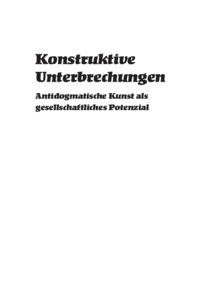
Konstruktive Unterbrechungen (geschw.)
Name that can easily go onto 2 lines
Author that can easily go onto 2 lines as well
- Title
- Konstruktive Unterbrechungen (geschw.)
- Subtitle
- antidogmatische Kunst als gesellschaftliches Potenzial
- Author
- Description (de)
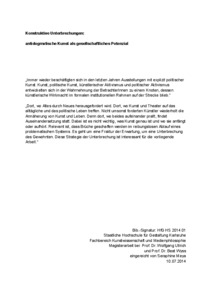
- „Immer wieder beschäftigten sich in den letzten Jahren Ausstellungen mit explizit politischer Kunst. Kunst, politische Kunst, künstlerischer Aktivismus und politischer Aktivismus entwickelten sich in der Warnehmung der BetrachterInnen zu einem Knoten, dessen künstlerische Wirkmacht im formalen institutionellen Rahmen auf der Strecke blieb.”
„Dort, wo Altes durch Neues herausgefordert wird. Dort, wo Kunst und Theater auf das alltägliche und das politische Leben treffen. Nicht umsonst forderten Künstler wiederholt die Annäherung von Kunst und Leben. Denn dort, wo beides aufeinander prallt, findet Auseinandersetzung statt. Dabei ist es nicht wichtig, was Kunst genau ist und wo sie anfängt oder aufhört. Relevant ist, dass Brüche geschaffen werden im reibungslosen Ablauf eines problematischen Systems. Es geht um eine Fraktur der Erwartung, um eine Unterbrechung des Gewohnten. Diese Strategie der Unterbrechung ist interessant für die vorliegende Arbeit.”
- „Immer wieder beschäftigten sich in den letzten Jahren Ausstellungen mit explizit politischer Kunst. Kunst, politische Kunst, künstlerischer Aktivismus und politischer Aktivismus entwickelten sich in der Warnehmung der BetrachterInnen zu einem Knoten, dessen künstlerische Wirkmacht im formalen institutionellen Rahmen auf der Strecke blieb.”
- Description (en)
- ‘In recent years, exhibitions have repeatedly focussed on explicitly political art. In the perception of viewers, art, political art, artistic activism and political activism have developed into a knot whose artistic impact has fallen by the wayside within the formal institutional framework.’
‘Where the old is challenged by the new. Where art and theatre meet everyday and political life. It is not for nothing that artists have repeatedly called for the convergence of art and life. Because where the two collide, confrontation takes place. It is not important what exactly art is and where it begins or ends. What is relevant is that breaks are created in the smooth running of a problematic system. It is about a fracture of expectation, an interruption of the familiar. This strategy of interruption is interesting for the present work.’
- ‘In recent years, exhibitions have repeatedly focussed on explicitly political art. In the perception of viewers, art, political art, artistic activism and political activism have developed into a knot whose artistic impact has fallen by the wayside within the formal institutional framework.’
- Category
- Type of project / creative work
- Keywords
- Date
- 10.07.2014
- Language
- Location: institution
- Title
- Konstruktive Unterbrechungen (geschw.)
- Subtitle
- antidogmatische Kunst als gesellschaftliches Potenzial
- Copyright Notice
- © Seraphine Meya
- Legal protection / Licence
- Permission usage HfG
- Media creator
- Relationship/function
- Description of media
- censored version / zensierte Version
- Projektleiter/in
- Semester
- Program of Study
- Type of graduation project
- Archive signature
- HfG HS 2014 01
- External archive
- Imported on
- 30.03.2025
- Parent sets
- 1
Konstruktive Unterbrechungen Abstract
Name that can easily go onto 2 lines
Author that can easily go onto 2 lines as well
- Title
- Konstruktive Unterbrechungen Abstract
- Subtitle
- antidogmatische Kunst als gesellschaftliches Potenzial
- Author
- Description (de)
- „Immer wieder beschäftigten sich in den letzten Jahren Ausstellungen mit explizit politischer Kunst. Kunst, politische Kunst, künstlerischer Aktivismus und politischer Aktivismus entwickelten sich in der Warnehmung der BetrachterInnen zu einem Knoten, dessen künstlerische Wirkmacht im formalen institutionellen Rahmen auf der Strecke blieb.”
„Dort, wo Altes durch Neues herausgefordert wird. Dort, wo Kunst und Theater auf das alltägliche und das politische Leben treffen. Nicht umsonst forderten Künstler wiederholt die Annäherung von Kunst und Leben. Denn dort, wo beides aufeinander prallt, findet Auseinandersetzung statt. Dabei ist es nicht wichtig, was Kunst genau ist und wo sie anfängt oder aufhört. Relevant ist, dass Brüche geschaffen werden im reibungslosen Ablauf eines problematischen Systems. Es geht um eine Fraktur der Erwartung, um eine Unterbrechung des Gewohnten. Diese Strategie der Unterbrechung ist interessant für die vorliegende Arbeit.”
- „Immer wieder beschäftigten sich in den letzten Jahren Ausstellungen mit explizit politischer Kunst. Kunst, politische Kunst, künstlerischer Aktivismus und politischer Aktivismus entwickelten sich in der Warnehmung der BetrachterInnen zu einem Knoten, dessen künstlerische Wirkmacht im formalen institutionellen Rahmen auf der Strecke blieb.”
- Description (en)
- ‘In recent years, exhibitions have repeatedly focussed on explicitly political art. In the perception of viewers, art, political art, artistic activism and political activism have developed into a knot whose artistic impact has fallen by the wayside within the formal institutional framework.’
‘Where the old is challenged by the new. Where art and theatre meet everyday and political life. It is not for nothing that artists have repeatedly called for the convergence of art and life. Because where the two collide, confrontation takes place. It is not important what exactly art is and where it begins or ends. What is relevant is that breaks are created in the smooth running of a problematic system. It is about a fracture of expectation, an interruption of the familiar. This strategy of interruption is interesting for the present work.’
- ‘In recent years, exhibitions have repeatedly focussed on explicitly political art. In the perception of viewers, art, political art, artistic activism and political activism have developed into a knot whose artistic impact has fallen by the wayside within the formal institutional framework.’
- Category
- Type of project / creative work
- Keywords
- Date
- 10.07.2014
- Language
- Location: institution
- Title
- Konstruktive Unterbrechungen Abstract
- Subtitle
- antidogmatische Kunst als gesellschaftliches Potenzial
- Copyright Notice
- © Seraphine Meya
- Legal protection / Licence
- Permission usage HfG
- Media creator
- Relationship/function
- Projektleiter/in
- Semester
- Program of Study
- Type of graduation project
- Archive signature
- HfG HS 2014 01
- External archive
- Imported on
- 30.03.2025
- Parent sets
- 1
Konstruktive Unterbrechungen Inhaltsverzeichnis
Name that can easily go onto 2 lines
Author that can easily go onto 2 lines as well
- Title
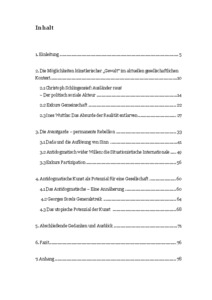
- Konstruktive Unterbrechungen Inhaltsverzeichnis
- Subtitle
- antidogmatische Kunst als gesellschaftliches Potenzial
- Author
- Description (de)
- „Immer wieder beschäftigten sich in den letzten Jahren Ausstellungen mit explizit politischer Kunst. Kunst, politische Kunst, künstlerischer Aktivismus und politischer Aktivismus entwickelten sich in der Warnehmung der BetrachterInnen zu einem Knoten, dessen künstlerische Wirkmacht im formalen institutionellen Rahmen auf der Strecke blieb.”
„Dort, wo Altes durch Neues herausgefordert wird. Dort, wo Kunst und Theater auf das alltägliche und das politische Leben treffen. Nicht umsonst forderten Künstler wiederholt die Annäherung von Kunst und Leben. Denn dort, wo beides aufeinander prallt, findet Auseinandersetzung statt. Dabei ist es nicht wichtig, was Kunst genau ist und wo sie anfängt oder aufhört. Relevant ist, dass Brüche geschaffen werden im reibungslosen Ablauf eines problematischen Systems. Es geht um eine Fraktur der Erwartung, um eine Unterbrechung des Gewohnten. Diese Strategie der Unterbrechung ist interessant für die vorliegende Arbeit.”
- „Immer wieder beschäftigten sich in den letzten Jahren Ausstellungen mit explizit politischer Kunst. Kunst, politische Kunst, künstlerischer Aktivismus und politischer Aktivismus entwickelten sich in der Warnehmung der BetrachterInnen zu einem Knoten, dessen künstlerische Wirkmacht im formalen institutionellen Rahmen auf der Strecke blieb.”
- Description (en)
- ‘In recent years, exhibitions have repeatedly focussed on explicitly political art. In the perception of viewers, art, political art, artistic activism and political activism have developed into a knot whose artistic impact has fallen by the wayside within the formal institutional framework.’
‘Where the old is challenged by the new. Where art and theatre meet everyday and political life. It is not for nothing that artists have repeatedly called for the convergence of art and life. Because where the two collide, confrontation takes place. It is not important what exactly art is and where it begins or ends. What is relevant is that breaks are created in the smooth running of a problematic system. It is about a fracture of expectation, an interruption of the familiar. This strategy of interruption is interesting for the present work.’
- ‘In recent years, exhibitions have repeatedly focussed on explicitly political art. In the perception of viewers, art, political art, artistic activism and political activism have developed into a knot whose artistic impact has fallen by the wayside within the formal institutional framework.’
- Category
- Type of project / creative work
- Keywords
- Date
- 10.07.2014
- Language
- Location: institution
- Title
- Konstruktive Unterbrechungen Inhaltsverzeichnis
- Subtitle
- antidogmatische Kunst als gesellschaftliches Potenzial
- Copyright Notice
- © Seraphine Meya
- Legal protection / Licence
- Permission usage HfG
- Media creator
- Relationship/function
- Projektleiter/in
- Semester
- Program of Study
- Type of graduation project
- Archive signature
- HfG HS 2014 01
- External archive
- Imported on
- 30.03.2025
- Parent sets
- 1
Konstruktive Unterbrechungen Deckblatt
Name that can easily go onto 2 lines
Author that can easily go onto 2 lines as well
- Title
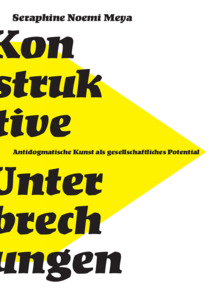
- Konstruktive Unterbrechungen Deckblatt
- Subtitle
- antidogmatische Kunst als gesellschaftliches Potenzial
- Author
- Description (de)
- „Immer wieder beschäftigten sich in den letzten Jahren Ausstellungen mit explizit politischer Kunst. Kunst, politische Kunst, künstlerischer Aktivismus und politischer Aktivismus entwickelten sich in der Warnehmung der BetrachterInnen zu einem Knoten, dessen künstlerische Wirkmacht im formalen institutionellen Rahmen auf der Strecke blieb.”
„Dort, wo Altes durch Neues herausgefordert wird. Dort, wo Kunst und Theater auf das alltägliche und das politische Leben treffen. Nicht umsonst forderten Künstler wiederholt die Annäherung von Kunst und Leben. Denn dort, wo beides aufeinander prallt, findet Auseinandersetzung statt. Dabei ist es nicht wichtig, was Kunst genau ist und wo sie anfängt oder aufhört. Relevant ist, dass Brüche geschaffen werden im reibungslosen Ablauf eines problematischen Systems. Es geht um eine Fraktur der Erwartung, um eine Unterbrechung des Gewohnten. Diese Strategie der Unterbrechung ist interessant für die vorliegende Arbeit.”
- „Immer wieder beschäftigten sich in den letzten Jahren Ausstellungen mit explizit politischer Kunst. Kunst, politische Kunst, künstlerischer Aktivismus und politischer Aktivismus entwickelten sich in der Warnehmung der BetrachterInnen zu einem Knoten, dessen künstlerische Wirkmacht im formalen institutionellen Rahmen auf der Strecke blieb.”
- Description (en)
- ‘In recent years, exhibitions have repeatedly focussed on explicitly political art. In the perception of viewers, art, political art, artistic activism and political activism have developed into a knot whose artistic impact has fallen by the wayside within the formal institutional framework.’
‘Where the old is challenged by the new. Where art and theatre meet everyday and political life. It is not for nothing that artists have repeatedly called for the convergence of art and life. Because where the two collide, confrontation takes place. It is not important what exactly art is and where it begins or ends. What is relevant is that breaks are created in the smooth running of a problematic system. It is about a fracture of expectation, an interruption of the familiar. This strategy of interruption is interesting for the present work.’
- ‘In recent years, exhibitions have repeatedly focussed on explicitly political art. In the perception of viewers, art, political art, artistic activism and political activism have developed into a knot whose artistic impact has fallen by the wayside within the formal institutional framework.’
- Category
- Type of project / creative work
- Keywords
- Date
- 10.07.2014
- Language
- Location: institution
- Title
- Konstruktive Unterbrechungen Deckblatt
- Subtitle
- antidogmatische Kunst als gesellschaftliches Potenzial
- Copyright Notice
- © Seraphine Meya
- Legal protection / Licence
- Permission usage HfG
- Media creator
- Relationship/function
- Projektleiter/in
- Semester
- Program of Study
- Type of graduation project
- Archive signature
- HfG HS 2014 01
- External archive
- Imported on
- 30.03.2025
- Parent sets
- 1
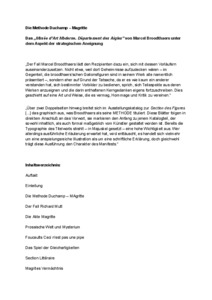
Die Methode Duchamp – Magritte Abstract / Inhaltsv.
Name that can easily go onto 2 lines
Author that can easily go onto 2 lines as well
- Title
- Die Methode Duchamp – Magritte Abstract / Inhaltsv.
- Subtitle
- Das „Musée d’Art Moderne. Département des Aigles” von Marcel Broodthaers unter dem Aspekt der strategischen Aneignung
- Author
- Description (de)
- „Der Fall Marcel Broodthaers lädt den Rezipienten dazu ein, sich mit dessen Vorläufern auseinanderzusetzen. Nicht etwa, weil dort Geheimnisse aufzudecken wären – im Gegenteil, die broodthaers’schen Galionsfiguren sind in seinem Werk alle namentlich präsentiert –, sondern eher auf Grund der Tatsache, da er es wie kaum ein anderer verstanden hat, sich bestimmter Vorbilder zu bedienen, sprich, sich Teilaspekte aus deren Werken anzueignen und die darin enthaltenen Kerngedanken eigens fortzuschreiben. Dies geschieht auf eine Art und Weise, die es vermag, Hommage und Kritik zu vereinen.”
„Über zwei Doppelseiten hinweg breitet sich im Ausstellungskatalog zur Section des Figures [...] das graphisch aus, was Broodthaers als seine METHODE tituliert. Diese Blätter folgen in direktem Anschluß an das Vorwort, sie markieren den Anfang zu jenem Katalogteil, der sowohl inhaltlich, als auch formal maßgeblich vom Künstler gestaltet worden ist. Bereits die Typographie des Titelworts strahlt – in Majuskel gesetzt – eine hohe Wichtigkeit aus. Wer allerdings ausführliche Erläuterung erwartet hat, wird enttäuscht, es handelt sich vielmehr um eine anspielungsreiche Illustration als um eine schriftliche Erklärung, doch gleichwohl trägt diese Ausführung den Charakter des Manifests.”
- „Der Fall Marcel Broodthaers lädt den Rezipienten dazu ein, sich mit dessen Vorläufern auseinanderzusetzen. Nicht etwa, weil dort Geheimnisse aufzudecken wären – im Gegenteil, die broodthaers’schen Galionsfiguren sind in seinem Werk alle namentlich präsentiert –, sondern eher auf Grund der Tatsache, da er es wie kaum ein anderer verstanden hat, sich bestimmter Vorbilder zu bedienen, sprich, sich Teilaspekte aus deren Werken anzueignen und die darin enthaltenen Kerngedanken eigens fortzuschreiben. Dies geschieht auf eine Art und Weise, die es vermag, Hommage und Kritik zu vereinen.”
- Description (en)
- "The case of Marcel Broodthaers invites the recipient to engage with his precursors. Not because there are secrets to be uncovered there - on the contrary, Broodthaers' figureheads are all presented by name in his work - but rather due to the fact that he understood better than almost anyone else how to make use of certain role models, i.e. to appropriate partial aspects from their works and to continue the core ideas contained therein in his own way. This is done in a way that manages to combine homage and criticism."
"Over two double-page spreads in the exhibition catalogue for Section des Figures [...] Broodthaers' METHOD is presented graphically. These pages follow directly after the preface and mark the beginning of the section of the catalogue that was designed by the artist both in terms of content and form. Even the typography of the title word - set in majuscule - radiates great importance. However, anyone expecting a detailed explanation will be disappointed; it is more of an allusive illustration than a written explanation, but this version nevertheless has the character of a manifesto."
- "The case of Marcel Broodthaers invites the recipient to engage with his precursors. Not because there are secrets to be uncovered there - on the contrary, Broodthaers' figureheads are all presented by name in his work - but rather due to the fact that he understood better than almost anyone else how to make use of certain role models, i.e. to appropriate partial aspects from their works and to continue the core ideas contained therein in his own way. This is done in a way that manages to combine homage and criticism."
- Category
- Date
- November 2010
- Language
- Location: institution
- Title
- Die Methode Duchamp – Magritte Abstract / Inhaltsv.
- Subtitle
- Das „Musée d’Art Moderne. Département des Aigles” von Marcel Broodthaers unter dem Aspekt der strategischen Aneignung
- Copyright Notice
- Alice Wilke
- Legal protection / Licence
- Permission usage HfG
- Media creator
- Relationship/function
- Projektleiter/in
- Semester
- Program of Study
- Type of graduation project
- Archive signature
- HfG HS 2010 09
- External archive
- Imported on
- 10.01.2025
- Parent sets
- 1
Die Methode Duchamp - Magritte Deckblatt
Name that can easily go onto 2 lines
Author that can easily go onto 2 lines as well
- Title
- Die Methode Duchamp - Magritte Deckblatt
- Subtitle
- Das „Musée d’Art Moderne. Département des Aigles” von Marcel Broodthaers unter dem Aspekt der strategischen Aneignung
- Author
- Description (de)
- „Der Fall Marcel Broodthaers lädt den Rezipienten dazu ein, sich mit dessen Vorläufern auseinanderzusetzen. Nicht etwa, weil dort Geheimnisse aufzudecken wären – im Gegenteil, die broodthaers’schen Galionsfiguren sind in seinem Werk alle namentlich präsentiert –, sondern eher auf Grund der Tatsache, da er es wie kaum ein anderer verstanden hat, sich bestimmter Vorbilder zu bedienen, sprich, sich Teilaspekte aus deren Werken anzueignen und die darin enthaltenen Kerngedanken eigens fortzuschreiben. Dies geschieht auf eine Art und Weise, die es vermag, Hommage und Kritik zu vereinen.”
„Über zwei Doppelseiten hinweg breitet sich im Ausstellungskatalog zur Section des Figures [...] das graphisch aus, was Broodthaers als seine METHODE tituliert. Diese Blätter folgen in direktem Anschluß an das Vorwort, sie markieren den Anfang zu jenem Katalogteil, der sowohl inhaltlich, als auch formal maßgeblich vom Künstler gestaltet worden ist. Bereits die Typographie des Titelworts strahlt – in Majuskel gesetzt – eine hohe Wichtigkeit aus. Wer allerdings ausführliche Erläuterung erwartet hat, wird enttäuscht, es handelt sich vielmehr um eine anspielungsreiche Illustration als um eine schriftliche Erklärung, doch gleichwohl trägt diese Ausführung den Charakter des Manifests.”
- „Der Fall Marcel Broodthaers lädt den Rezipienten dazu ein, sich mit dessen Vorläufern auseinanderzusetzen. Nicht etwa, weil dort Geheimnisse aufzudecken wären – im Gegenteil, die broodthaers’schen Galionsfiguren sind in seinem Werk alle namentlich präsentiert –, sondern eher auf Grund der Tatsache, da er es wie kaum ein anderer verstanden hat, sich bestimmter Vorbilder zu bedienen, sprich, sich Teilaspekte aus deren Werken anzueignen und die darin enthaltenen Kerngedanken eigens fortzuschreiben. Dies geschieht auf eine Art und Weise, die es vermag, Hommage und Kritik zu vereinen.”
- Description (en)
- "The case of Marcel Broodthaers invites the recipient to engage with his precursors. Not because there are secrets to be uncovered there - on the contrary, Broodthaers' figureheads are all presented by name in his work - but rather due to the fact that he understood better than almost anyone else how to make use of certain role models, i.e. to appropriate partial aspects from their works and to continue the core ideas contained therein in his own way. This is done in a way that manages to combine homage and criticism."
"Over two double-page spreads in the exhibition catalogue for Section des Figures [...] Broodthaers' METHOD is presented graphically. These pages follow directly after the preface and mark the beginning of the section of the catalogue that was designed by the artist both in terms of content and form. Even the typography of the title word - set in majuscule - radiates great importance. However, anyone expecting a detailed explanation will be disappointed; it is more of an allusive illustration than a written explanation, but this version nevertheless has the character of a manifesto."
- "The case of Marcel Broodthaers invites the recipient to engage with his precursors. Not because there are secrets to be uncovered there - on the contrary, Broodthaers' figureheads are all presented by name in his work - but rather due to the fact that he understood better than almost anyone else how to make use of certain role models, i.e. to appropriate partial aspects from their works and to continue the core ideas contained therein in his own way. This is done in a way that manages to combine homage and criticism."
- Category
- Date
- November 2010
- Language
- Location: institution
- Title
- Die Methode Duchamp - Magritte Deckblatt
- Subtitle
- Das „Musée d’Art Moderne. Département des Aigles” von Marcel Broodthaers unter dem Aspekt der strategischen Aneignung
- Copyright Notice
- Alice Wilke
- Legal protection / Licence
- Permission usage HfG
- Media creator
- Projektleiter/in
- Semester
- Program of Study
- Type of graduation project
- Archive signature
- HfG HS 2010 09
- External archive
- Imported on
- 10.01.2025
- Parent sets
- 1